


Best Cement Stocks in India 2026: Top Picks Compared
October 8, 2026


TABLE OF CONTENTS
Get AI Summary


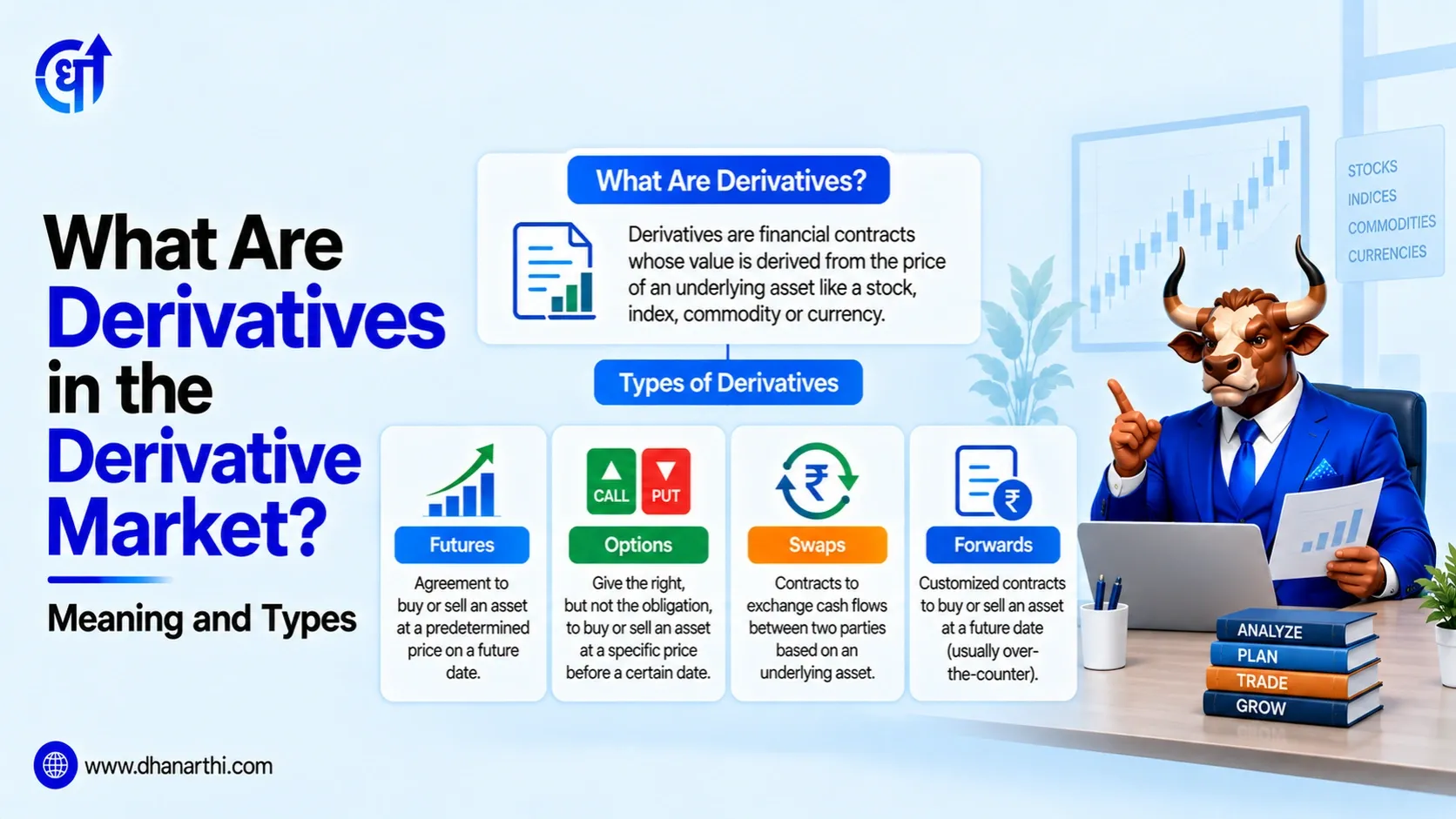
A derivative is a financial contract whose value is derived from an underlying asset, such as a stock, index, commodity, or currency, rather than having independent value of its own. The derivative market is where these contracts, mainly forwards, futures, options, and swaps, are bought and sold, allowing participants to hedge risk, speculate on price movements, or gain exposure to an asset without owning it directly.
Research Stocks Smarter with Dhanarthi AI Screener
Analyze 5,000+ NSE & BSE stocks with 150+ custom filters, real-time volume breakout scans, and transparent fundamental data.
Use Dhanarthi Screener
Derivatives in stock market terms refer to financial contracts that do not have independent value, instead, their price moves in response to the price of an underlying asset. This underlying asset can be a stock, a market index like the Nifty 50, a commodity such as gold or crude oil, a currency, or even an interest rate.
Financial derivatives exist for a simple reason: they let market participants gain exposure to an asset's price movement without needing to buy or sell that asset directly. If someone expects a stock to rise, they can enter a derivative contract to profit from that expected rise, or, on the other side, use a derivative to protect an existing position from a potential price decline. Derivative meaning in stock market discussions almost always centers on this core idea, value derived from something else, rather than value held independently.
Derivatives trading in India is not a recent phenomenon. Organized derivatives trading traces back to 1875, when the Bombay Cotton Trade Association began facilitating futures trading in cotton, making India one of the earlier markets globally to formalize this kind of contract trading. The market's path since then has not been straightforward, the government banned options trading and cash settlement in 1952, pushing much of derivatives activity into informal forward contracts for decades.
The regulatory framework has consolidated significantly over time. Today, the Securities and Exchange Board of India (SEBI) regulates the exchange-traded equity and commodity derivatives market, while the Reserve Bank of India (RBI) jointly regulates currency and interest rate derivatives alongside SEBI. A significant regulatory shift occurred in 2015, when the erstwhile Forward Markets Commission, which had separately overseen commodity derivatives, was merged into SEBI, bringing commodity and securities derivatives regulation under a single regulator for the first time. This same regulatory structure now governs the margin and lot-size rules covered in our guide to F&O margin requirements.
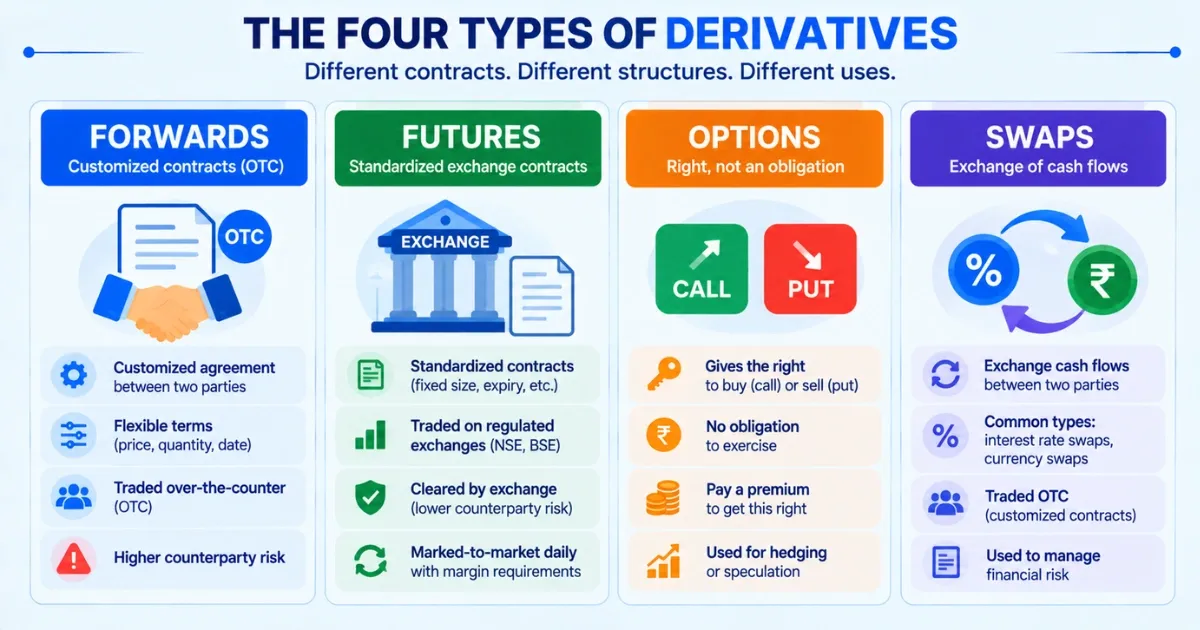 Types of derivatives in the market generally fall into four categories, each with a distinct structure and typical use case.
Forwards are customized agreements between two parties to buy or sell an asset at a fixed price on a specific future date. Forwards are traded over-the-counter (OTC) rather than on an exchange, which makes them flexible but also exposes both parties to counterparty risk, the possibility that the other party fails to honor the contract, since no clearing house guarantees the trade.
Futures work similarly to forwards but are standardized and traded on regulated exchanges like NSE and BSE. Because futures are exchange-traded, they carry lower counterparty risk than forwards, since the exchange's clearing corporation guarantees the trade, and positions are marked-to-market daily. A full breakdown of how futures contracts work, including margin and settlement mechanics, is covered in our dedicated guide to futures trading.
Options give the buyer the right, but not the obligation, to buy (call option) or sell (put option) the underlying asset at a predetermined strike price before or at expiry. This right-without-obligation structure is what separates options from futures and forwards, both of which involve a binding obligation for both parties.
Swaps involve two parties exchanging cash flows based on a predetermined formula, most commonly used to manage interest rate or currency exposure. An interest rate swap, for example, might let one party convert a variable-interest obligation into a fixed-interest one, or vice versa. Swaps are typically traded over-the-counter rather than on public exchanges.
| Derivative Type | Traded On | Obligation | Common Use |
|---|---|---|---|
| Forwards | OTC (private) | Both parties obligated | Customized hedging |
| Futures | Exchange (NSE, BSE) | Both parties obligated | Standardized hedging/speculation |
| Options | Exchange | Buyer has right, seller has obligation if exercised | Defined-risk hedging/speculation |
| Swaps | OTC (private) | Both parties obligated to exchange cash flows | Interest rate/currency risk management |
This distinction affects transparency, counterparty risk, and how easily a position can be exited. Exchange-traded derivatives, such as futures and options on NSE and BSE, follow standardized terms, quantity, expiry, and contract specifications are set by the exchange, and a central clearing corporation guarantees every trade, virtually eliminating counterparty risk for individual participants.
Over-the-counter (OTC) derivatives, such as most forwards and swaps, are privately negotiated between two parties without going through a centralized exchange. This allows the contract to be tailored precisely to both parties' needs, but it removes the safety net an exchange's clearing corporation provides, meaning each party bears direct counterparty risk if the other side is unable to fulfill its obligation.
Three broad categories of participants drive activity in the derivative market, each with a different objective.
India's derivatives market has grown into a genuinely large and active market by contract volume, though the exact global ranking has shifted more than most static descriptions suggest. NSE held the title of world's largest derivatives exchange by number of contracts traded, based on Futures Industry Association (FIA) data, for five consecutive years through 2023. In 2025, NSE's leadership confirmed it had lost this title to Brazil's B3 exchange, which saw a sharper increase in trading volumes during the first seven months of that year. By the first four months of 2026, however, data compiled by Statista showed NSE had reclaimed its position as the world's largest derivatives exchange by contract volume.
This back-and-forth is a useful reminder that market rankings shift over time rather than staying fixed forever, and it reflects genuinely massive underlying activity either way, whether NSE or B3 holds the top spot in a given period, both exchanges are processing billions of derivative contracts annually, dwarfing many developed-market exchanges in sheer volume terms.
Beyond individual trading strategies, derivatives serve genuine economic functions. They allow businesses and investors to manage risk that would otherwise be unavoidable, a farmer can lock in a selling price for a future harvest, an importer can hedge against currency fluctuations, and an investor can protect a portfolio against a market downturn, all using derivative contracts rather than restructuring their underlying business or holdings.
Derivatives also contribute to price discovery, the process by which markets arrive at a fair current price for an asset based on expectations about its future value. Because futures and options prices reflect collective market expectations about where an asset is headed, they often provide an early signal of sentiment that feeds back into how the underlying asset itself is priced.
Derivatives carry risks that differ meaningfully from simply owning the underlying asset outright.
Given these risks, most financial educators recommend building a solid understanding of the underlying asset and basic risk management before trading derivatives with meaningful capital, an approach covered further in our guide comparing options and futures trading.

Confused about chart patterns & stock analysis?
Use
Dhanarthi Stock Guru
to chat, analyze price patterns, and ask questions directly.
What are derivatives in the derivative market, at their core, comes down to one idea: contracts whose value is derived from something else, an underlying stock, index, commodity, or currency, rather than having independent value of their own. Forwards, futures, options, and swaps each serve this purpose differently, with exchange-traded contracts offering standardization and reduced counterparty risk compared to privately negotiated OTC agreements. India's derivative market, one of the largest in the world by contract volume, continues to evolve both in regulatory structure and global standing, making it worth understanding at this foundational level before exploring specific instruments like futures and options in greater depth.
Disclaimer: This article is for educational purposes only. It does not constitute investment advice. Please consult a SEBI-registered financial advisor before making investment decisions.
1. What is a derivative in simple terms?
A derivative is a financial contract whose value is derived from an underlying asset, such as a stock, index, commodity, or currency, rather than having independent value of its own.
2. What are the types of derivatives?
The four main types of derivatives are forwards, futures, options, and swaps, each differing in whether they are exchange-traded or OTC, and whether both parties are obligated or only one side has a right.
3. What is derivatives in stock market terms?
Derivatives in stock market terms refer to contracts like futures and options that derive their value from an underlying stock or index, used for hedging risk or speculating on price movements without owning the asset directly.
4. What is the difference between exchange-traded and OTC derivatives?
Exchange-traded derivatives are standardized and guaranteed by a central clearing corporation, reducing counterparty risk, while OTC derivatives are privately negotiated and customized, carrying direct counterparty risk between the two parties.
5. Who participates in the derivative market?
Three main types of participants drive the derivative market: hedgers who use derivatives to manage risk, speculators who bet on price direction for profit, and arbitrageurs who exploit price differences across markets.
6. Is NSE the world's largest derivatives exchange?
NSE held this title for five consecutive years through 2023, briefly lost it to Brazil's B3 exchange in 2025, and reclaimed the position by contract volume in the first four months of 2026 according to Statista data.
7. What is the difference between a forward and a futures contract?
A forward is a customized, privately negotiated OTC contract with counterparty risk, while a futures contract is standardized, exchange-traded, and guaranteed by a clearing corporation, reducing that counterparty risk.
8. What is a swap in derivatives?
A swap is a derivative contract where two parties exchange cash flows based on a predetermined formula, commonly used to manage interest rate or currency exposure, and typically traded over-the-counter.
9. Who regulates the derivative market in India?
SEBI regulates exchange-traded equity and commodity derivatives in India, while RBI jointly regulates currency and interest rate derivatives with SEBI, following the 2015 merger of the erstwhile Forward Markets Commission into SEBI.
10. Why do investors use derivatives?
Investors use derivatives mainly for hedging existing risk, speculating on future price movements, gaining market exposure without owning the underlying asset, and in some cases, arbitrage between related markets.
11. Are derivatives riskier than stocks?
Derivatives can carry higher risk than simply owning stocks due to leverage, which magnifies both gains and losses, and additional factors like counterparty risk in OTC contracts and sensitivity to volatility changes.
12. When did derivatives trading start in India?
Organized derivatives trading in India traces back to 1875, when the Bombay Cotton Trade Association began facilitating futures trading in cotton, making it one of the earlier formal derivatives markets globally.
Share Market
IPO
Artificial Intelligence
Semi Conductor