ICICI Bank Q2 FY27 Outperforms, Government Boosts EV Component PLI; L&T Secures Major Order
TABLE OF CONTENTS
- Reading Overview

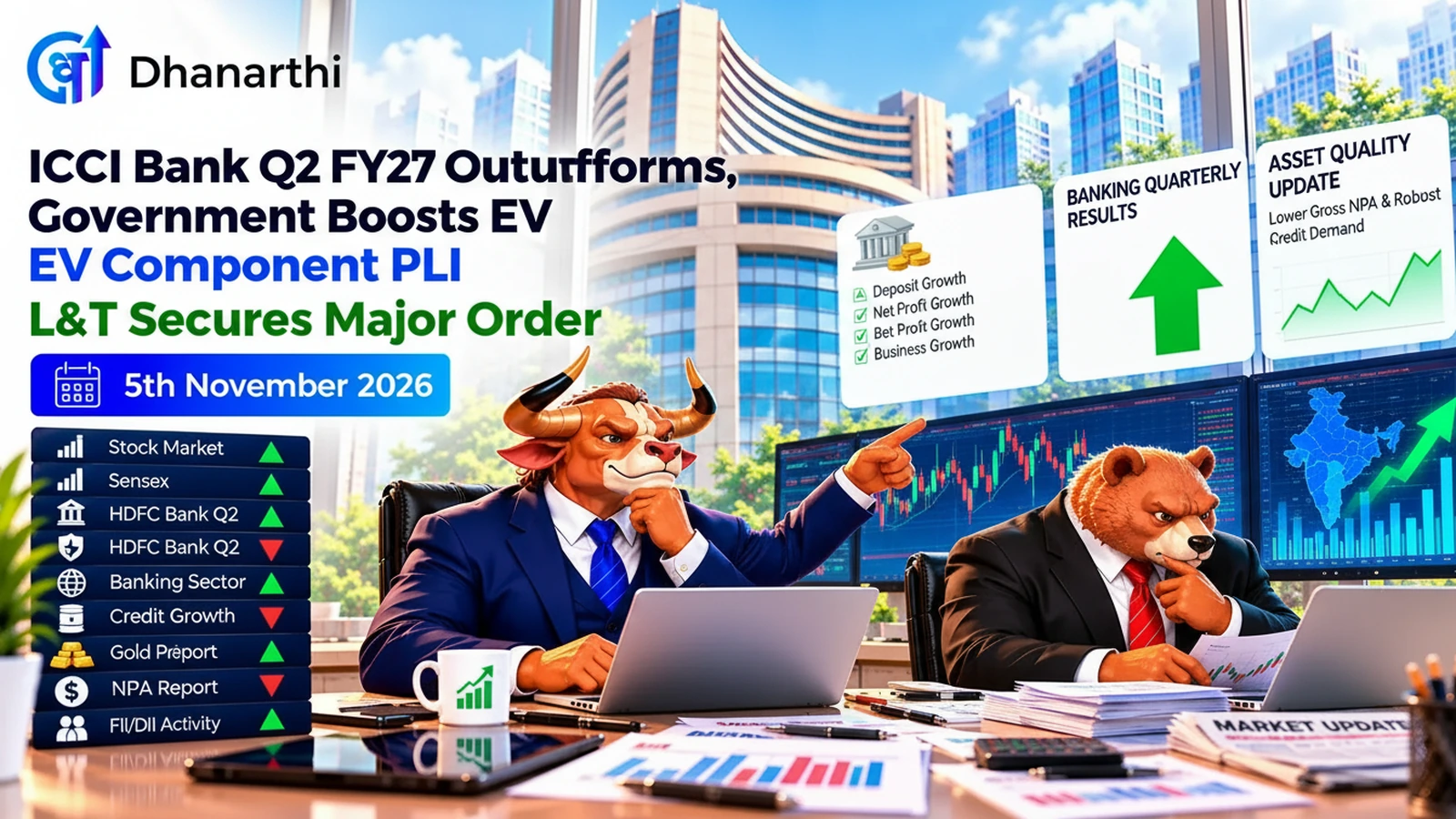
Indian markets are witnessing broad-based gains today, driven by positive global cues and significant domestic developments. ICICI Bank reported robust Q2 FY27 results, with standalone net profit rising 20.1% year-on-year, exceeding market expectations due to strong loan growth and improved asset quality. Concurrently, the government's expansion of the Production-Linked Incentive (PLI) scheme for advanced EV components is set to invigorate domestic manufacturing. The Sensex is trading significantly higher, above 78,700, while the Nifty 50 has crossed 24,350, reflecting investor optimism across key sectors.
Key highlights
- ICICI Bank Q2 FY27: Standalone net profit surged 20.1% year-on-year to ₹14,843 crore, driven by 30% loan growth and improved asset quality.
- EV Component PLI: Government expands Production-Linked Incentive scheme to boost domestic manufacturing of advanced electric vehicle components like batteries and power electronics.
- L&T Order Win: Larsen & Toubro secured a "large" order, valued between ₹2,500 crore and ₹5,000 crore, from NHSRCL for high-speed rail track works.
- Crude Oil Prices: Brent crude oil prices have eased below $95 per barrel, following an 8.7% slide in the previous session, reducing inflation concerns for India.
- Market Rally: Sensex surged over 1,400 points (1.86%) to 78,739.57, and Nifty 50 gained over 400 points (1.7%) to 24,369.10 by 11:00 AM IST, with broad-based buying.
ICICI Bank Delivers Strong Q2 FY27 Performance, Net Profit Up 20.1%
ICICI Bank, India's second-largest private sector lender, reported a robust financial performance for the second quarter of fiscal year 2027 (Q2 FY27), with its standalone net profit increasing by 20.1% year-on-year to ₹14,843 crore. This strong growth was primarily attributed to healthy loan growth, a significant rise in net interest income (NII), and improved asset quality. The bank's results surpassed market expectations, contributing to positive sentiment in the financial sector.
Key Financial Highlights
The bank's Net Interest Income (NII) for Q2 FY27 rose by 17.7% year-on-year to ₹25,339 crore, reflecting strong core operational performance. Total advances grew by an impressive 30% year-on-year to ₹18.32 lakh crore as of September 30, 2026. Excluding loans provided by its international branches against Foreign Currency Non-Resident (Bank) (FCNR-B) deposits, the loan portfolio still demonstrated a healthy growth of 24.1%. Total deposits also saw substantial growth, increasing by 27.1% year-on-year to ₹20.50 lakh crore.
Despite the strong growth in loans and deposits, the bank's Net Interest Margin (NIM) moderated to 4.18% in Q2 FY27, compared to 4.30% in the year-ago quarter and 4.36% in the preceding quarter. This moderation was partly influenced by inflows into FCNR(B) deposits.
Asset Quality Improves
ICICI Bank continued to demonstrate an improvement in its asset quality. The gross non-performing asset (NPA) ratio declined to 1.20% as of September 30, 2026, from 1.58% a year earlier and 1.38% in the preceding quarter. The net NPA ratio also improved significantly, falling to 0.30% from 0.39% in the corresponding period last year. Provisions and contingencies for the quarter decreased to ₹850.69 crore from ₹914.11 crore in Q2 FY26, further supporting profitability.
Why it matters
ICICI Bank's strong Q2 performance underscores the resilience of India's banking sector and its ability to maintain growth momentum amidst evolving economic conditions. The robust loan growth signals healthy credit demand, while improving asset quality indicates effective risk management. These results are likely to bolster investor confidence in private sector banks and could set a positive tone for other financial institutions yet to announce their earnings.
Government Expands PLI Scheme for Advanced EV Components to Boost Domestic Manufacturing
The Indian government is set to significantly expand its Production-Linked Incentive (PLI) scheme, specifically targeting advanced components for electric vehicles (EVs). This move aims to reduce the country's reliance on imports, foster a robust domestic manufacturing ecosystem, and position India as a global hub for EV component production. The expanded scheme is expected to provide substantial incentives for manufacturers of critical EV parts, including battery cells, power electronics, and associated charging infrastructure.
Scheme Details and Objectives
The proposed expansion builds upon existing PLI schemes for Advanced Chemistry Cell (ACC) battery manufacturing and the automotive sector. The new focus is on the upstream supply chain, addressing the cost disadvantages faced by Indian manufacturers compared to international competitors, particularly from China. Key components targeted for incentives include cathode active materials, anode active materials (both natural and synthetic graphite), electrolytes, separators, and battery-grade copper foil.
The immediate objective of this expanded PLI scheme is to build sufficient domestic component manufacturing capacity to support at least 50 GWh of annual cell manufacturing by 2032. This strategic initiative is crucial for achieving self-reliance in the rapidly growing EV sector and for meeting the ambitious electrification targets set by the government. The scheme is designed to attract significant investments into the manufacturing value chain, create economies of scale, and generate substantial employment opportunities.
Impact on the EV Sector
This policy intervention is expected to have a transformative impact on India's EV industry. By incentivizing local production of high-value components, the government aims to lower the overall cost of EVs, making them more accessible to consumers. It will also de-risk supply chains, which have been vulnerable to global disruptions and geopolitical tensions.
Companies involved in battery manufacturing, power electronics, and specialized material production are likely to be the primary beneficiaries. This could lead to increased investment in research and development, technology transfer, and the establishment of new manufacturing facilities across the country. The move is also anticipated to boost exports of Indian-made EV components, enhancing India's position in the global automotive supply chain.
More stocks and market news
Larsen & Toubro Secures "Large" Order for High-Speed Rail Project
Larsen & Toubro (L&T), India's leading engineering and construction conglomerate, has secured a "large" order from the National High Speed Rail Corporation Limited (NHSRCL). The contract, valued between ₹2,500 crore and ₹5,000 crore, is for the construction of 156 route kilometers (RKM) of high-speed ballastless track for the Mumbai-Ahmedabad High Speed Rail (MAHSR) corridor, also known as the Bullet Train project. This marks L&T's second track-work package for the MAHSR project, making it responsible for over 50% of the track-works on the corridor. The project will utilize Japanese Shinkansen J Slab Track Technology, designed for speeds up to 320 kmph, ensuring superior ride quality and durability. This order further strengthens L&T's robust order book and its position in critical infrastructure development.
Crude Oil Prices Ease Below $95/Barrel, Allaying Inflation Fears
Global crude oil prices have seen a significant decline, with Brent crude futures dropping below $95 per barrel. This follows an 8.7% slide in the previous session, largely attributed to easing geopolitical tensions and hopes for a faster resolution of conflicts in the Middle East after recent global political developments. For India, a major oil importer, the softening of crude prices is a significant positive development. It helps alleviate concerns about imported inflation, reduces pressure on the current account deficit, and could provide more headroom for the Reserve Bank of India (RBI) in its monetary policy decisions. Lower oil prices typically benefit sectors like airlines, paints, and logistics, while also improving overall economic sentiment.
Market context
Indian equity benchmarks are trading significantly higher, extending gains from previous sessions. As of 11:00 AM IST, the Sensex was up 1,438.17 points or 1.86% at 78,739.57, and the Nifty 50 was up 408.50 points or 1.7% at 24,369.10. Financial services, auto, cement, and realty stocks are leading the gains, with broad-based buying observed across sectors. The Nifty India Volatility Index (India VIX) has slumped by 23.5% to 11.62, indicating a sharp decline in expectations of near-term market volatility. Global markets are also largely positive, with US markets rallying overnight. The Indian Rupee has strengthened to 94.36 against the US Dollar. Brent crude oil is trading around $93.5 per barrel, down 1% today after a sharp fall yesterday.
Why these stories matter
ICICI Bank's strong earnings reinforce the health of the banking sector, crucial for economic growth, and signal robust credit demand. The government's expanded PLI scheme for EV components is a strategic move to build domestic capabilities, reduce import dependence, and create jobs in a sunrise sector, directly impacting auto ancillaries and EV manufacturers. L&T's major order win highlights continued government focus on infrastructure development, providing visibility for the capital goods sector. The easing of crude oil prices is a significant macro positive for India, potentially taming inflation and improving corporate margins across various industries. Collectively, these developments paint a picture of domestic resilience and strategic policy support amidst a favorable global backdrop.
What to watch next
- ICICI Bank: Investor focus will be on the bank's commentary regarding NIM trajectory and further asset quality improvements in upcoming quarters.
- EV PLI Scheme: Details of the expanded scheme, including specific incentive rates and application windows, will be keenly watched by manufacturers.
- L&T: Further updates on project execution timelines and new order inflows will be key for the infrastructure giant.
- Crude Oil: Continued monitoring of geopolitical developments and global supply-demand dynamics will be crucial for oil price stability.
- RBI Monetary Policy: Any indications from the RBI regarding inflation outlook and interest rate stance in light of easing crude prices.
Sources
- Economic Times: Sensex Today | Nifty 50 | Stock Market Live Updates: Sensex rockets 1,500 pts, Nifty above 24,400; auto, cement indices jump over 3%
- NDTV: Stock Market Live Updates: Indian equity benchmarks opened in the green on Thursday. Overnight, the US Markets rallied on Democrats midterm win. Meanwhile, oil prices have also slipped below $95 per barrel.
- Business Standard: Sensex Today | Stock Market LIVE Updates, Thursday, Nov 5, 2026: The Nifty50 and the Sensex surged as oil prices slumped, with Democrats' win in the US midterm election raising bets on a faster end to West-Asia conflict.
- Financial Express: Share Market Today LIVE, 5th November 2026: The Indian stock market opened sharply higher on Thursday, with both benchmark indices posting strong gains.
- Business Standard: ICICI Bank Q2 net rises 20% to ₹14,843 crore as provisions fall
FAQ
1. What were ICICI Bank's key financial highlights for Q2 FY27?
ICICI Bank reported a 20.1% year-on-year increase in standalone net profit to ₹14,843 crore. Net Interest Income (NII) grew by 17.7% to ₹25,339 crore, and total advances expanded by 30% to ₹18.32 lakh crore.
2. How did ICICI Bank's asset quality perform in Q2 FY27?
The bank's asset quality showed significant improvement, with the gross NPA ratio declining to 1.20% and the net NPA ratio falling to 0.30% as of September 30, 2026.
3. What is the government's new initiative for the EV sector?
The government is expanding its Production-Linked Incentive (PLI) scheme to specifically target advanced components for electric vehicles (EVs), such as battery cells, power electronics, and related materials, to boost domestic manufacturing and reduce import dependence.
4. Which components are covered under the expanded EV PLI scheme?
The expanded PLI scheme will cover critical EV components including cathode and anode active materials, electrolytes, separators, and battery-grade copper foil, aiming to support at least 50 GWh of annual cell manufacturing by 2032.
5. What major order did Larsen & Toubro secure recently?
Larsen & Toubro secured a "large" order, valued between ₹2,500 crore and ₹5,000 crore, from NHSRCL for constructing 156 route kilometers of high-speed ballastless track for the Mumbai-Ahmedabad High Speed Rail corridor.
6. How are crude oil prices impacting the Indian market today?
Brent crude oil prices have eased below $95 per barrel, following a sharp decline. This is positive for India as it helps alleviate concerns about imported inflation, reduces pressure on the current account deficit, and generally improves economic sentiment.
7. What is the current market sentiment in India?
Indian markets are experiencing broad-based buying, with the Sensex up over 1,400 points and the Nifty 50 gaining over 400 points. The India VIX has also slumped, indicating reduced market volatility and positive investor sentiment.
Disclaimer: This article is for educational purposes only. It does not constitute investment advice. Please consult a SEBI-registered financial advisor before making investment decisions.