Indian Markets Edge Higher on Strong FII Inflows; RBI Tightens Payment Security
TABLE OF CONTENTS
- Reading Overview

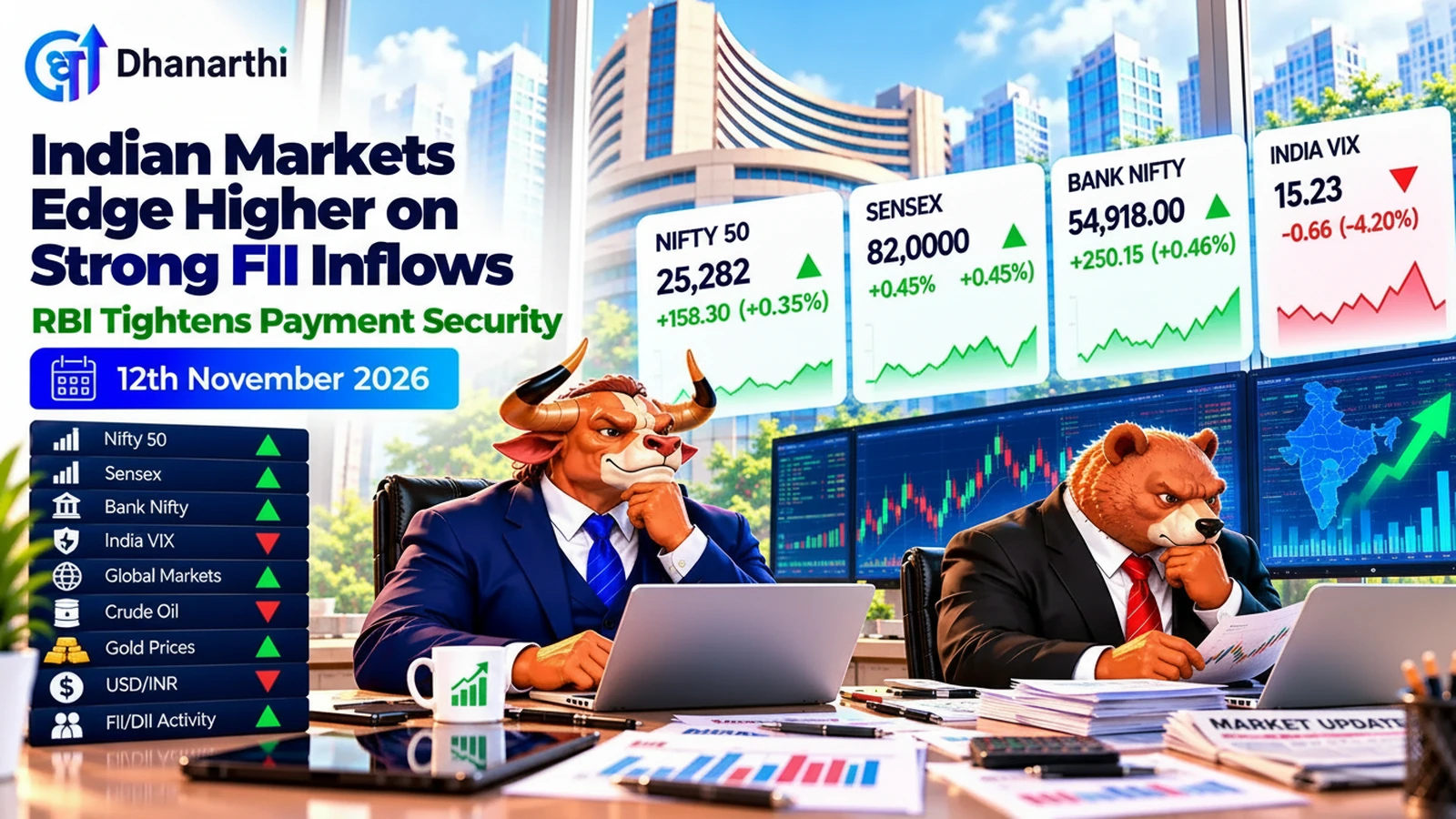
Indian benchmark indices, Sensex and Nifty, traded with modest gains in midday trade, recovering from a subdued opening, primarily driven by sustained foreign institutional investor (FII) inflows and easing crude oil prices. The Sensex hovered near the 82,000 mark, up over 120 points, while the Nifty traded marginally higher at 25,282. This positive momentum comes as the Reserve Bank of India (RBI) has issued new Master Directions to enhance cyber resilience and streamline domestic money transfers, alongside a significant MSCI index rejig set to attract substantial passive inflows.
Key highlights
- Indian Equities: Sensex up 123 points near 82,000, Nifty at 25,282 in midday trade, recovering from a weak open.
- FII Activity: Foreign Institutional Investors bought equities worth ₹12,563.33 crore on Wednesday, contributing to a total of $6.43 billion in net buying for November so far.
- Crude Oil: Brent crude futures fell below $92 per barrel, while US WTI crude traded below $86, easing pressure on India's import bill.
- RBI Directives: The RBI issued new Master Directions on Cyber Resilience for Payment System Operators and consolidated rules for Domestic Money Transfers, effective November 11.
- MSCI Rejig: LIC, Coforge, Meesho, and Adani Green Energy are set to enter the MSCI Standard Index, potentially attracting around $2 billion in passive inflows by November 30.
Indian Benchmarks Rebound on Robust FII Buying and Easing Crude
Indian equity markets demonstrated resilience on Thursday, with benchmark indices Sensex and Nifty trading higher in midday sessions after an initial cautious opening. The 30-share BSE Sensex was up around 123 points, hovering near the 82,000 level, while the 50-share NSE Nifty traded marginally higher at 25,282. This recovery was largely underpinned by a strong influx of foreign institutional investments and a continued decline in global crude oil prices.
Foreign Institutional Investors (FIIs) remained significant buyers, purchasing equities worth ₹12,563.33 crore on Wednesday. This robust buying spree has pushed FII net investments in November to $6.43 billion, marking the highest monthly inflow since September 2024. Analysts suggest this trend is likely to persist, driven by impressive Q2 earnings growth and the macro relief provided by lower crude prices. The Nifty has already seen a rally of 9.55% so far in November, primarily led by these aggressive FII inflows.
Adding to the positive sentiment, Brent crude, the global oil benchmark, traded below $92 per barrel, down over 1% on Thursday morning. US West Texas Intermediate (WTI) crude futures also fell below $86 per barrel. The decline in oil prices is attributed to increasing hopes for progress in peace talks concerning the Middle East conflict and the Russia-Ukraine war, which eases inflationary pressures and improves India's current account outlook as a major oil importer. Despite the overall positive market breadth with more advancing stocks than declining ones on the NSE, some IT heavyweights like TCS, Infosys, and Tech Mahindra, along with Mahindra & Mahindra and Bharti Airtel, faced selling pressure.
RBI Strengthens Cyber Security and Streamlines Domestic Money Transfers
The Reserve Bank of India (RBI) has introduced two significant regulatory updates aimed at bolstering the financial system's security and efficiency. The central bank issued Master Directions on Cyber Resilience and Digital Payment Security Controls for non-bank Payment System Operators (PSOs). These new directions, issued under the Payment and Settlement Systems (PSS) Act, 2007, mandate stricter cybersecurity protocols and impose a stringent six-hour incident reporting window for payment entities. This move is expected to enhance the security framework of digital payment systems, protecting consumers and maintaining the integrity of financial transactions.
In a separate but equally important development, the RBI also consolidated its existing rules for cash-based money transfers into a single rulebook, titled the Reserve Bank of India (Domestic Money Transfer) Directions, 2026. Effective November 11, these directions aim to streamline the process for domestic money transfers, although existing transaction limits remain unchanged. Key provisions include a cap of ₹50,000 for cash deposits by walk-in customers at bank branches for NEFT transfers, and ₹5,000 per transaction through Business Correspondents and ATMs. Cash payouts are limited to ₹10,000 per transaction and ₹25,000 per beneficiary monthly. Furthermore, mandatory mobile verification and additional authentication measures have been introduced for cash pay-in services, enhancing security and compliance. These measures are designed to improve transparency and curb illicit financial activities within the domestic money transfer ecosystem.
More stocks and market news
MSCI Rejig to Drive $2 Billion Inflows into Indian Equities
The November 2026 rejig of the Morgan Stanley Capital International (MSCI) indices is poised to bring significant passive inflows into Indian equities. Life Insurance Corporation of India (LIC), Coforge Limited, Meesho Limited, and Adani Green Energy Limited are set to be added to the MSCI Standard Index, while PI Industries Limited will be removed. These changes, effective from November 30, 2026, are expected to raise India's weight in the MSCI Emerging Markets Index to 11.7% and could attract approximately $2 billion in passive inflows. Coforge is anticipated to receive the largest inflow at $630 million, followed by LIC at $468 million.
SEBI Directs Market Intermediaries on KYC and Tax Reporting
The Securities and Exchange Board of India (SEBI) has directed all registered market intermediaries to update their Know Your Customer (KYC) and tax-reporting systems. This directive, issued on Wednesday, November 11, 2026, is in line with the revised Income-tax Act, 2025, and Income-tax Rules, 2026, which came into effect from April 1, 2026. The aim is to ensure compliance with international financial account reporting requirements under the Automatic Exchange of Information (AEOI) framework, specifically for accounts covered by FATCA and CRS.
Bajaj Finance QIP in Focus
Bajaj Finance shares were in focus today, gaining 1.40% in early trade, following the opening of its Qualified Institutional Placement (QIP) issue. The company has set a floor price of ₹992.25 per share for the QIP, with an option to offer up to a 5% discount. This capital raising initiative is a key development for the non-banking financial company.
Market context
As of midday on November 12, 2026, the Sensex was trading around 82,002.43, up 123.03 points or 0.15%, while the Nifty 50 was at 25,281.60, up 26.55 points or 0.11%. The India VIX, a measure of market volatility, stood at 17.19, down 1.99% as of 9:59 AM IST, indicating a slight easing of investor anxiety. Globally, Asian markets presented a mixed picture, with Japan's Nikkei and South Korea's Kospi showing gains, while some technology stocks faced pressure following Nvidia's after-hours plunge. The Indian Rupee weakened slightly, falling 6 paise to 93.77 against the US Dollar in early trade, influenced by a stronger dollar amidst US inflation data.
Why these stories matter
The sustained FII inflows into Indian equities, coupled with declining crude oil prices, are crucial for maintaining market buoyancy and supporting India's economic growth trajectory. The RBI's new directives on cyber resilience and money transfers underscore a commitment to a secure and transparent financial ecosystem, which is vital for investor confidence and digital economy expansion. The MSCI rejig highlights India's growing prominence in global indices, attracting further passive investments. These developments collectively signal a dynamic and evolving Indian financial landscape, driven by both domestic policy actions and global economic factors.
What to watch next
- Further FII flow data and their impact on market direction.
- Official Q2 FY27 results from companies like HAL, Vodafone Idea, and IRCTC today.
- Global crude oil price movements and geopolitical developments.
- Any further clarifications or implementation details from RBI on its new directives.
- The actual impact of the MSCI rejig on the included stocks as of November 30.
Sources
- ETLegalWorld: SEBI directs market intermediaries to update KYC, tax-reporting systems under new income tax rules
- ETV Bharat: Stock Market Today: Sensex, Nifty Rise Amid Sustained FII Buying, Lower Crude Oil Prices
- Times of India: Stock Market Live Updates Today: Sensex up over 200 points, Nifty trades above 25,300
- Economic Times: Oil Price Today (November 12): Brent crude falls below $92 amid hopes for US-Iran, Russia-Ukraine peace talks
- Kotak Neo: LIC, Coforge And Meesho Set To Enter MSCI Standard Index As India's Weight Rises To 11.7%; $2 Billion Inflows In Focus
FAQ
1. What is driving the Indian market rally today?
The Indian market rally today is primarily driven by sustained buying from Foreign Institutional Investors (FIIs) and a decline in global crude oil prices. FIIs have made significant equity purchases, and lower oil prices ease inflationary concerns for India.
2. What are the new RBI Master Directions about?
The RBI has issued two key Master Directions: one on Cyber Resilience and Digital Payment Security Controls for non-bank Payment System Operators (PSOs), mandating stricter cybersecurity and incident reporting. The other consolidates rules for Domestic Money Transfers, streamlining cash-based transfers with updated limits and mandatory verification.
3. Which Indian companies are being added to the MSCI Standard Index?
Life Insurance Corporation of India (LIC), Coforge Limited, Meesho Limited, and Adani Green Energy Limited are slated to be added to the MSCI Standard Index. This rejig is expected to attract approximately $2 billion in passive inflows into Indian equities.
4. Why are crude oil prices falling today?
Crude oil prices are falling today due to increasing hopes for progress in peace talks related to the Middle East conflict and the Russia-Ukraine war. Brent crude has fallen below $92 per barrel, and US WTI crude is below $86 per barrel.
5. What is SEBI's latest directive for market intermediaries?
SEBI has directed registered market intermediaries to update their Know Your Customer (KYC) and tax-reporting systems. This is to align with the new Income-tax Act, 2025, and Income-tax Rules, 2026, ensuring compliance with international financial account reporting requirements.
6. How much have FIIs invested in Indian markets this November?
Foreign Institutional Investors (FIIs) have made net equity purchases totaling $6.43 billion in November so far, with ₹12,563.33 crore bought on Wednesday alone. This marks the highest monthly inflow since September 2024.
Disclaimer
Disclaimer: This article is for educational purposes only. It does not constitute investment advice. Please consult a SEBI-registered financial advisor before making investment decisions.