RBI's Digital Payment 'Stop Switch' in Focus as Indian Markets Observe Holiday After Monday's Sell-off
TABLE OF CONTENTS
- Reading Overview

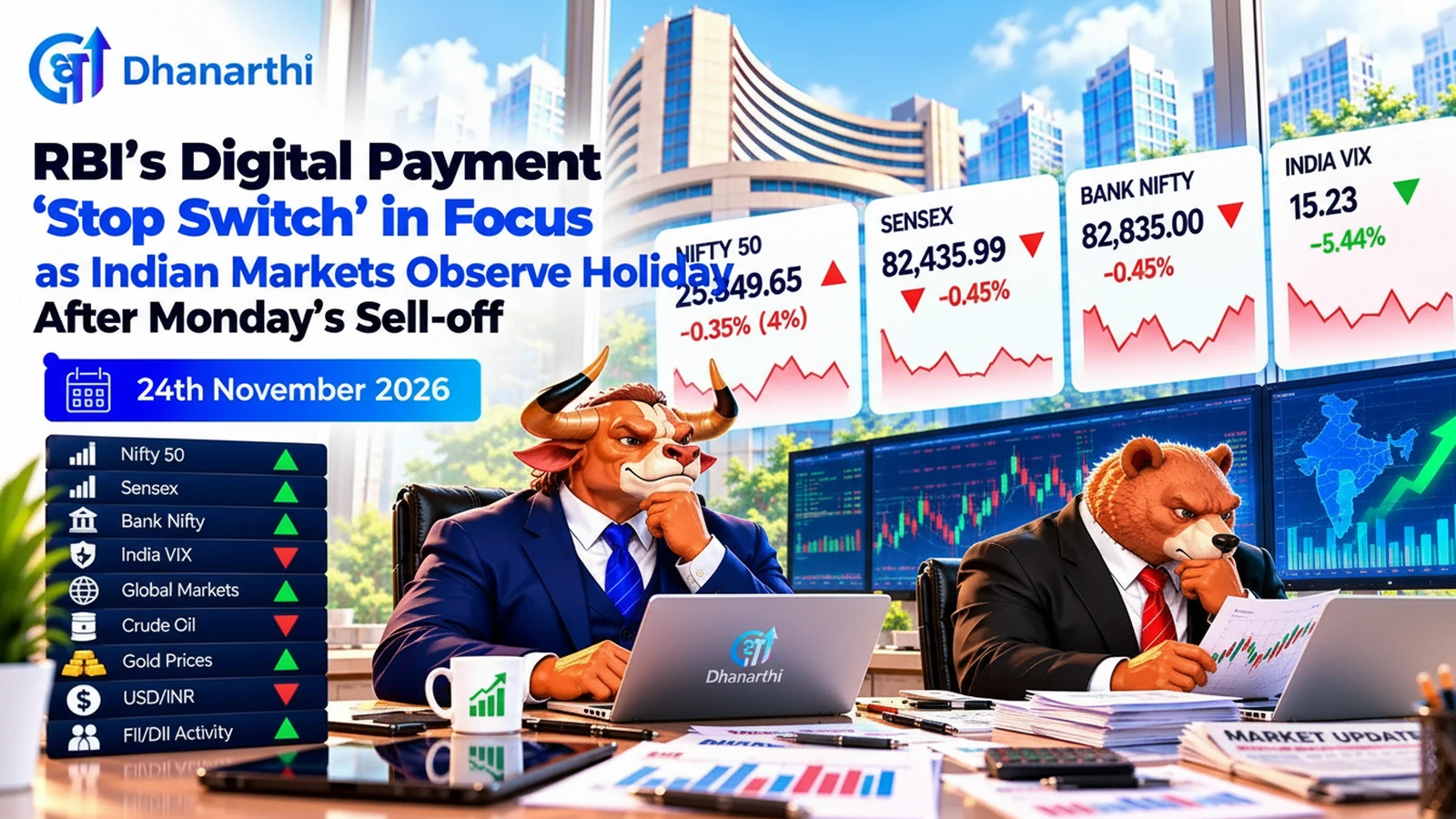
The Reserve Bank of India (RBI) has unveiled draft rules for a "Stop Switch" and "Trusted Person Mechanism" to bolster digital payment security, a significant development for Indian banking. This comes as Indian equity markets, including the NSE and BSE, remain closed today, November 24, for Guru Nanak Jayanti. The holiday follows a sharp sell-off on Monday, November 23, where the Nifty 50 plunged 1.75% and the Sensex fell 1.77%, primarily driven by losses in the metal sector, despite continued foreign institutional investor (FII) inflows.
Key highlights
- RBI's Digital Payments: Draft rules released for a "Stop Switch" to block outgoing digital payments and a "Trusted Person Mechanism" for large transfers, enhancing customer security.
- Indian Stock Market: NSE and BSE are closed today, November 24, 2026, on account of Guru Nanak Jayanti.
- Nifty 50: Closed down 1.75% at 25,349.65 on Monday, November 23, marking a significant correction.
- Sectoral Performance: The metal sector was the biggest laggard on Monday, falling 4.17%, while the Nifty IT sector gained 1.69%.
- FII Activity: Foreign Institutional Investors were net buyers of Indian equities worth ₹5,672.99 crore on November 23, extending their buying streak to 16 consecutive sessions.
RBI Proposes "Stop Switch" and "Trusted Person" for Enhanced Digital Payment Security
The Reserve Bank of India (RBI) has introduced a comprehensive set of draft rules aimed at significantly enhancing the security of digital payments for bank customers. Released on November 23, 2026, these proposals include a "Stop Switch" mechanism and a "Trusted Person Mechanism" (TPM), inviting public comments until December 14, 2026.
What the draft rules entail
The "Stop Switch" is designed to empower bank customers with a one-tap facility to immediately block all outgoing digital payments from their accounts if they suspect fraudulent activity. This feature would be accessible across various banking channels, including branches, ATMs, internet banking, mobile apps, and phone banking. Once activated, all new outgoing debits initiated by the customer, new payment mandates, and new account registrations on third-party UPI apps would be blocked. However, incoming credits, existing recurring mandates, and bank-initiated recoveries would remain unaffected. Re-enabling a disabled channel or deactivating the Stop Switch would require strong authentication and potentially a cooling-off period to prevent misuse.
Complementing the "Stop Switch" is the "Trusted Person Mechanism." Under this voluntary system, customers aged 18 and above can nominate a trusted individual. For large transfers exceeding a pre-set limit, the nominated person would receive an alert and have a one-hour window to approve or reject the transaction. Unapproved transfers would be automatically cancelled. This mechanism specifically excludes UPI, merchant payments, and existing recurring mandates. The trusted person would not incur any financial liability or become a joint holder of the account.
Additionally, the draft amendments propose giving customers greater control over their digital payment channels and transaction limits. Users would be able to switch individual digital channels on or off, set time windows for channel disablement, and define maximum limits per transaction, per beneficiary, and for total daily transfers. These customer-set limits would override any higher limits set by the bank or payment system operator. The RBI also aims to widen the scope of bank liability in cases of fraud, holding financial institutions responsible for authentication failures, alert lapses, system glitches, security breaches, and employee collusion.
Why it matters
These proposals mark a proactive step by the RBI to combat the rising incidence of digital payment fraud and enhance customer protection. By providing immediate control through the "Stop Switch" and an additional layer of verification via the "Trusted Person Mechanism," the central bank aims to significantly reduce financial losses for consumers. The wider bank liability provisions are expected to incentivize banks to invest more in robust security infrastructure and customer support. The implementation of these safeguards is proposed from July 1, 2027, for most measures, with updated bank negligence rules potentially applying from January 1, 2027.
Indian Markets Closed Today After Monday's Steep Sell-off; Metal Stocks Plunge
Indian equity markets are observing a trading holiday today, November 24, 2026, on account of Guru Nanak Jayanti. Both the National Stock Exchange (NSE) and the Bombay Stock Exchange (BSE) remain closed for all segments, including equity and derivatives trading. Trading is scheduled to resume on Wednesday, November 25.
This holiday follows a significant correction in the domestic markets on Monday, November 23. The benchmark Nifty 50 index plunged 1.75%, shedding 450.95 points to close at 25,349.65. Similarly, the BSE Sensex registered a sharp decline of 1.77%, falling 1,483.72 points to settle at 82,435.99. This marked one of the largest single-day losses for the indices in nearly five months.
The sell-off was broad-based, with market breadth remaining weak as declines outnumbered advances across large, mid, and small-cap segments. The metal sector bore the brunt of the selling pressure, emerging as the worst performer with a steep fall of 4.17%. Heavyweight metal stocks contributed significantly to the overall market decline. In contrast, the Nifty IT sector showed resilience, closing with a gain of 1.69%, indicating a rotation towards defensive and technology stocks amidst broader market uncertainty.
The correction on Monday was attributed to a combination of factors, including profit booking after a strong rally in November, mixed global cues, and concerns over commodity prices. Despite the domestic market weakness, Foreign Institutional Investors (FIIs) continued their buying spree, net purchasing ₹5,672.99 crore worth of Indian equities on November 23, extending their buying streak to 16 consecutive sessions. This contrasting trend highlights the divergence in sentiment between foreign and domestic investors.
More stocks and market news
India's Sugar Market Faces Structural Shift, Requires Significant Imports
India's sugar market is undergoing a significant structural shift, moving from an exporter to a potential net importer status for the 2026-27 season. Preliminary estimates suggest domestic sugar production will be between 27.5-28.5 million tonnes, falling short of the expected consumption of around 29 million tonnes. This deficit, primarily due to drought-hit cane yields in key producing states like Maharashtra and Karnataka, necessitates imports of at least 2 million tonnes. The government has already suspended exports and authorized 1 million tonnes of duty-free raw sugar imports, with the import window extended to December 31, 2026, to ease supply tightness. This development is expected to keep domestic prices elevated and could impact global sugar prices.
RBI Approves SBI Mutual Fund's Stake Acquisition in South Indian Bank
The Reserve Bank of India (RBI) has granted approval to SBI Mutual Fund to acquire up to a 9.99% stake in South Indian Bank. The approval was communicated to the private sector lender on November 23, 2026, and is contingent upon compliance with various regulatory provisions, including the Banking Regulation Act, 1949, and RBI's Directions on Acquisition and Holding of Shares or Voting Rights in Commercial Banks, 2025. This development follows South Indian Bank's reported 21% year-on-year rise in net profit to ₹426 crore for the second quarter of FY27, driven by improved margins and asset quality.
FIIs Extend Buying Spree to 16 Sessions Amidst Market Correction
Despite the sharp correction witnessed in the Indian equity markets on Monday, November 23, Foreign Institutional Investors (FIIs) continued their robust buying activity. FIIs net purchased Indian equities worth ₹5,672.99 crore, extending their net buying streak to an impressive 16 consecutive trading sessions. This sustained inflow from foreign investors contrasts with the selling pressure observed from Domestic Institutional Investors (DIIs), who sold shares worth ₹2,760.12 crore on the same day. The continued FII interest highlights India's position as a preferred emerging market destination, even as domestic benchmarks experienced significant declines.
Market context
Indian markets are closed today, November 24, for a holiday. On Monday, November 23, the Nifty 50 closed at 25,349.65, down 1.75%, while the Sensex ended at 82,435.99, a decline of 1.77%. The Nifty Bank index also fell over 3%, while the Nifty Metal index plunged 4.17%. Conversely, the Nifty IT index gained 1.69%. Global markets were mixed, with US indices showing modest gains, while European and Asian markets struggled amid inflation and geopolitical concerns. Crude oil prices saw some decline, with Brent at $91.65/barrel and WTI at $79.79. The Indian Rupee was trading around ₹93.26 against the US Dollar.
Why these stories matter
The RBI's new digital payment security measures are crucial for protecting consumers and fostering trust in India's rapidly expanding digital economy, directly impacting banking sector operations and customer behaviour. The market's sharp decline on Monday, followed by today's holiday, sets a cautious tone for investors, highlighting the current volatility and sector-specific pressures, particularly in metals. The shift in India's sugar market to net importer status has significant implications for domestic food inflation, agricultural policy, and the country's trade balance. Meanwhile, the RBI's approval for SBI Mutual Fund's stake in South Indian Bank signals ongoing consolidation and strategic investments within the financial sector. The sustained FII inflows, despite domestic market weakness, underscore India's attractiveness to global investors, providing a potential floor for market corrections.
What to watch next
- RBI's Digital Payment Rules: Monitor public comments on the draft "Stop Switch" and "Trusted Person Mechanism" until December 14, 2026, and subsequent finalization of the guidelines.
- Market Reopening: Observe market reaction on Wednesday, November 25, as trading resumes after the holiday, particularly in sectors that saw heavy selling on Monday.
- Sugar Imports: Track the progress and impact of sugar imports on domestic prices and the government's policy responses to the supply deficit.
- Corporate Earnings: Watch for upcoming Q2 FY27 results, including Siemens Energy India's earnings due on November 25, for fresh directional cues.
Sources
- Peepalsglobal: RBI Stop Switch draft: block digital debits, trusted person for big transfers
- Dailypioneer: RBI Stop Switch draft: block digital debits, trusted person for big transfers
- Utkarsh: RBI Proposed New Security Measure 'Stop Switch' to Curb Digital Banking Fraud
- Marketsmojo: Indian equity markets witnessed a sharp correction on 24 Nov 2026
- Business Standard: RBI approves SBI MF to acquire up to 9.99% stake in South Indian Bank
FAQ
1. What is the RBI's proposed "Stop Switch" for digital payments?
The "Stop Switch" is a draft mechanism proposed by the RBI that would allow bank customers to instantly block all outgoing digital payments from their accounts if they suspect fraud. It aims to provide immediate control and limit financial losses.
2. How does the "Trusted Person Mechanism" work?
The "Trusted Person Mechanism" is a voluntary feature where a bank customer can nominate a trusted individual. For large transactions exceeding a set limit, this trusted person would receive an alert and have one hour to approve or reject the payment, adding an extra layer of security.
3. Why were Indian stock markets closed on November 24, 2026?
Indian stock markets (NSE and BSE) were closed on Tuesday, November 24, 2026, in observance of Guru Nanak Jayanti, a public holiday. Trading will resume on Wednesday, November 25.
4. What happened in the Indian stock market on Monday, November 23?
On Monday, November 23, the Indian stock market experienced a sharp sell-off, with the Nifty 50 falling 1.75% and the Sensex declining 1.77%. The metal sector was the worst performer, while IT stocks showed gains.
5. Is India becoming a net importer of sugar?
Yes, India's sugar market is projected to shift to a net importer status for the 2026-27 season. Due to drought-affected cane yields, production is expected to fall below domestic consumption, necessitating imports of at least 2 million tonnes.
6. Did Foreign Institutional Investors (FIIs) buy or sell on November 23?
Foreign Institutional Investors (FIIs) were net buyers on November 23, purchasing ₹5,672.99 crore worth of Indian equities. This extended their buying streak to 16 consecutive sessions, despite the domestic market correction.
Disclaimer
Disclaimer: This article is for educational purposes only. It does not constitute investment advice. Please consult a SEBI-registered financial advisor before making investment decisions.