RBI Clarifies Digital Lending FLDG Norms; HDFC Bank Shares Under Pressure
TABLE OF CONTENTS
- Reading Overview

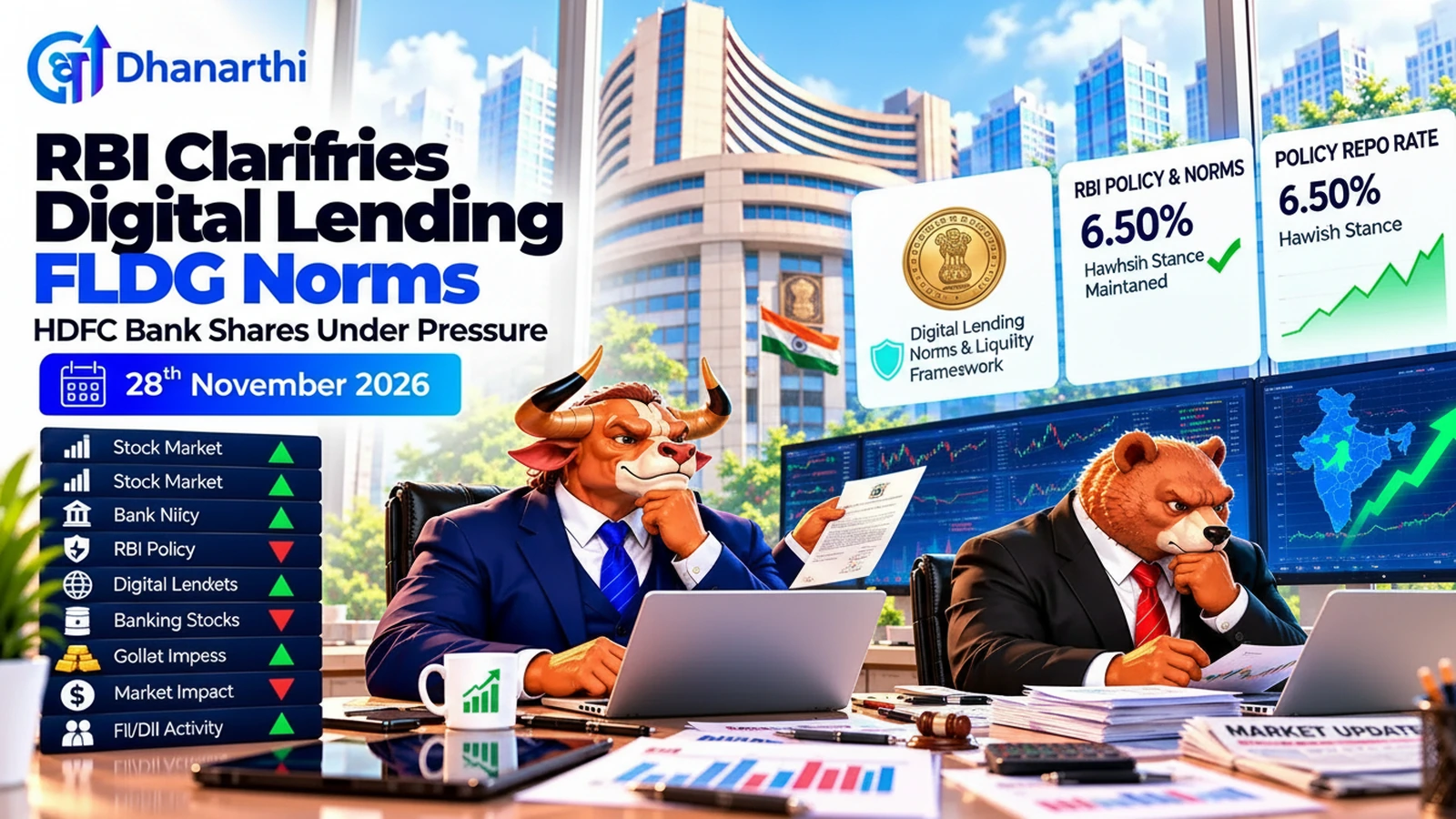
The Reserve Bank of India (RBI) has provided crucial clarifications on digital lending guidelines, particularly concerning First Loss Default Guarantee (FLDG) arrangements, aiming to bring regulatory certainty to fintechs and NBFCs. Meanwhile, HDFC Bank shares faced selling pressure in afternoon trade as analysts revised outlooks post-Q2 earnings, citing concerns over Net Interest Margins (NIMs) and deposit growth. The broader Indian market saw mixed cues, with the Nifty 50 trading marginally lower as investors digested these key developments.
Key highlights
- RBI Digital Lending: Clarified norms for First Loss Default Guarantee (FLDG), impacting fintech and NBFC partnerships.
- HDFC Bank: Shares traded lower after brokerage houses expressed concerns over Q2 NIMs and deposit growth.
- Tata Motors EV: Announced significant new investments in EV charging infrastructure and future model development.
- Crude Oil: Brent crude futures surged past $90/barrel, driven by geopolitical tensions, raising inflation concerns.
- Nifty 50: Traded with a slight negative bias in afternoon session, hovering around 22,850 points.
RBI Clarifies Digital Lending Norms, Focus on FLDG
The Reserve Bank of India (RBI) today issued a significant clarification regarding its digital lending guidelines, specifically addressing the operational aspects of First Loss Default Guarantee (FLDG) arrangements. This move comes as a relief for many fintech companies and Non-Banking Financial Companies (NBFCs) that rely on such partnerships for credit risk mitigation and expanding their lending portfolios. The central bank's updated stance aims to provide much-needed regulatory clarity, which was a point of contention and uncertainty since the initial digital lending guidelines were introduced.
The clarification details the permissible structures and conditions under which FLDG arrangements can operate, emphasizing the need for transparency, proper risk assessment, and adequate capital provisioning by the regulated entities. It is understood that the RBI seeks to balance innovation in digital lending with robust risk management practices to protect consumers and maintain financial stability. This development is expected to streamline operations for many digital lenders and their partners, potentially unlocking further growth in the sector while ensuring compliance with regulatory expectations. Market participants will be closely watching how this impacts existing and future collaborations between fintechs and traditional financial institutions.
What the clarification says
While specific details are still being fully absorbed by the market, initial reports suggest the RBI has outlined clear parameters for the maximum percentage of FLDG that can be offered, along with guidelines on the nature of the guarantee and the capital treatment for the guarantor. The objective is to prevent excessive risk-taking by unregulated entities while allowing for legitimate risk-sharing mechanisms that support credit flow to underserved segments. The central bank has reiterated its commitment to fostering a responsible and inclusive digital lending ecosystem.
Why it matters
This clarification is crucial for the Indian fintech landscape. Many digital lending platforms operate on a partnership model with NBFCs, where FLDG plays a vital role in sharing credit risk. The previous ambiguity had led to a slowdown in some partnerships and uncertainty over future business models. With clearer rules, fintechs and NBFCs can now structure their agreements with greater confidence, potentially leading to renewed growth in digital credit disbursement. It also underscores RBI's proactive approach to regulating emerging financial technologies.
HDFC Bank Shares Under Pressure Post-Q2 Analyst Calls
Shares of HDFC Bank, India's largest private sector lender, experienced selling pressure in afternoon trading today, declining by over 1.5% from its opening levels. This downturn followed a series of analyst calls and research reports released after a deeper dive into the bank's second-quarter earnings. While HDFC Bank reported a healthy profit growth, several brokerage houses have highlighted persistent concerns regarding its Net Interest Margins (NIMs) and the pace of deposit accretion.
Analysts noted that while the bank's asset quality remains robust, the ability to expand NIMs in a competitive environment, coupled with the challenge of growing its low-cost deposit base, is a key area of focus. The integration process post-merger with HDFC Ltd. continues to be a significant factor influencing these metrics. Investors are closely monitoring the bank's strategies to address these challenges, particularly its efforts to improve deposit growth and optimize its funding costs. The stock's performance is critical for the broader market given its substantial weight in both the Nifty 50 and Sensex indices.
Key numbers
As of 01:45 PM IST, HDFC Bank shares were trading at approximately ₹1,520, down around 1.6% for the day. The stock had opened higher but saw profit booking intensify as analyst reports circulated. The bank's Q2 NIM stood at 3.4% on a standalone basis, a figure that analysts are keen to see improve in subsequent quarters. Deposit growth, while positive, is being scrutinized against the backdrop of intense competition for funds across the banking sector.
Why it matters
HDFC Bank's performance often acts as a bellwether for the Indian banking sector and the broader market. Concerns over its NIMs and deposit growth reflect industry-wide challenges in a high-interest rate environment. A sustained pressure on these metrics for a heavyweight like HDFC Bank could influence sentiment across other banking stocks and potentially impact the overall market trajectory. Investors are looking for clear signs of improvement in these operational aspects to regain confidence.
More stocks and market news
Tata Motors: Accelerates EV Investment
Tata Motors today announced a significant capital expenditure plan aimed at bolstering its electric vehicle (EV) ecosystem. The company detailed investments in expanding its public and captive EV charging infrastructure across India and accelerating the development and launch of new EV models, with several slated for 2027. This strategic move underscores Tata Motors' commitment to maintaining its leadership position in India's rapidly growing EV market, which has seen robust demand in recent years. The announcement is expected to be positive for the stock, reinforcing its long-term growth narrative in the green mobility space.
Crude Oil Prices Surge Past $90 Amid Geopolitical Tensions
Global crude oil prices witnessed a sharp uptick today, with Brent crude futures crossing the $90 per barrel mark in afternoon trade. The surge is primarily attributed to escalating geopolitical tensions in the Middle East, which have raised concerns about potential supply disruptions from the region. For India, a net importer of crude oil, this price increase poses a significant challenge. Higher crude prices can lead to increased import bills, potentially widening the trade deficit and fueling domestic inflationary pressures, impacting sectors reliant on fuel and transportation costs.
Market context
As of 02:00 PM IST, the Nifty 50 index was trading at 22,855, down marginally by 0.15%, while the Sensex was at 75,620, a decline of 0.18%. The Nifty Bank index also showed a slight negative bias, trading around 52,200. India VIX, the volatility index, was up by 0.8%, indicating some increase in market apprehension. Globally, Asian markets presented a mixed picture, while European equities opened cautiously. Brent crude's rise above $90/barrel remains a key macro concern.
Why these stories matter
The RBI's clarification on digital lending is pivotal for the rapidly evolving fintech sector, providing a clearer operational framework and potentially fostering responsible innovation and growth. HDFC Bank's share movement, driven by analyst concerns over NIMs and deposit growth, highlights the competitive pressures within the banking sector and its significant impact on benchmark indices. Tata Motors' EV investment reinforces India's green mobility push, while surging crude oil prices present a macro headwind, influencing inflation and the nation's economic outlook.
What to watch next
- Further detailed analysis from brokerages on RBI's FLDG clarification and its impact on specific fintechs and NBFCs.
- HDFC Bank's management commentary and strategic initiatives to address NIM and deposit growth concerns in upcoming investor calls.
- Updates on geopolitical developments in the Middle East and their continued influence on global crude oil prices.
- Any further policy announcements from the government or regulators regarding the EV sector or financial services.
Sources
- Business Standard: RBI clarifies digital lending norms, FLDG rules in focus
- Moneycontrol: RBI's latest circular on digital lending brings cheer to fintechs
- The Economic Times: Tata Motors to invest big in EV charging, new models by 2027
- Livemint: HDFC Bank shares dip as analysts flag NIM, deposit growth concerns post Q2
- Reuters: Brent crude crosses $90 as Middle East tensions escalate
FAQ
1. What is the RBI's clarification on FLDG in digital lending?
The RBI has clarified the rules for First Loss Default Guarantee (FLDG) arrangements in digital lending, providing specific parameters and conditions for fintechs and NBFCs to operate within. This aims to bring regulatory certainty and ensure responsible risk-sharing.
2. Why are HDFC Bank shares under pressure today?
HDFC Bank shares are experiencing selling pressure after analysts revised their outlooks following the bank's Q2 earnings call. Concerns primarily stem from persistent pressure on Net Interest Margins (NIMs) and the pace of deposit growth.
3. What is Tata Motors' latest announcement regarding EVs?
Tata Motors has announced significant new investments to expand its electric vehicle (EV) charging infrastructure and accelerate the development and launch of new EV models, with several planned for 2027.
4. How do rising crude oil prices affect India?
As a major oil importer, rising crude oil prices, such as Brent crude crossing $90/barrel, can negatively impact India by increasing its import bill, potentially widening the trade deficit, and fueling domestic inflationary pressures.
5. What is the current market sentiment in India?
The Indian market is showing mixed cues, with benchmark indices like Nifty 50 and Sensex trading marginally lower. Investor sentiment is influenced by regulatory clarity in digital lending, specific corporate performance, and global macro factors like crude oil prices.
Disclaimer
Disclaimer: This article is for educational purposes only. It does not constitute investment advice. Please consult a SEBI-registered financial advisor before making investment decisions.