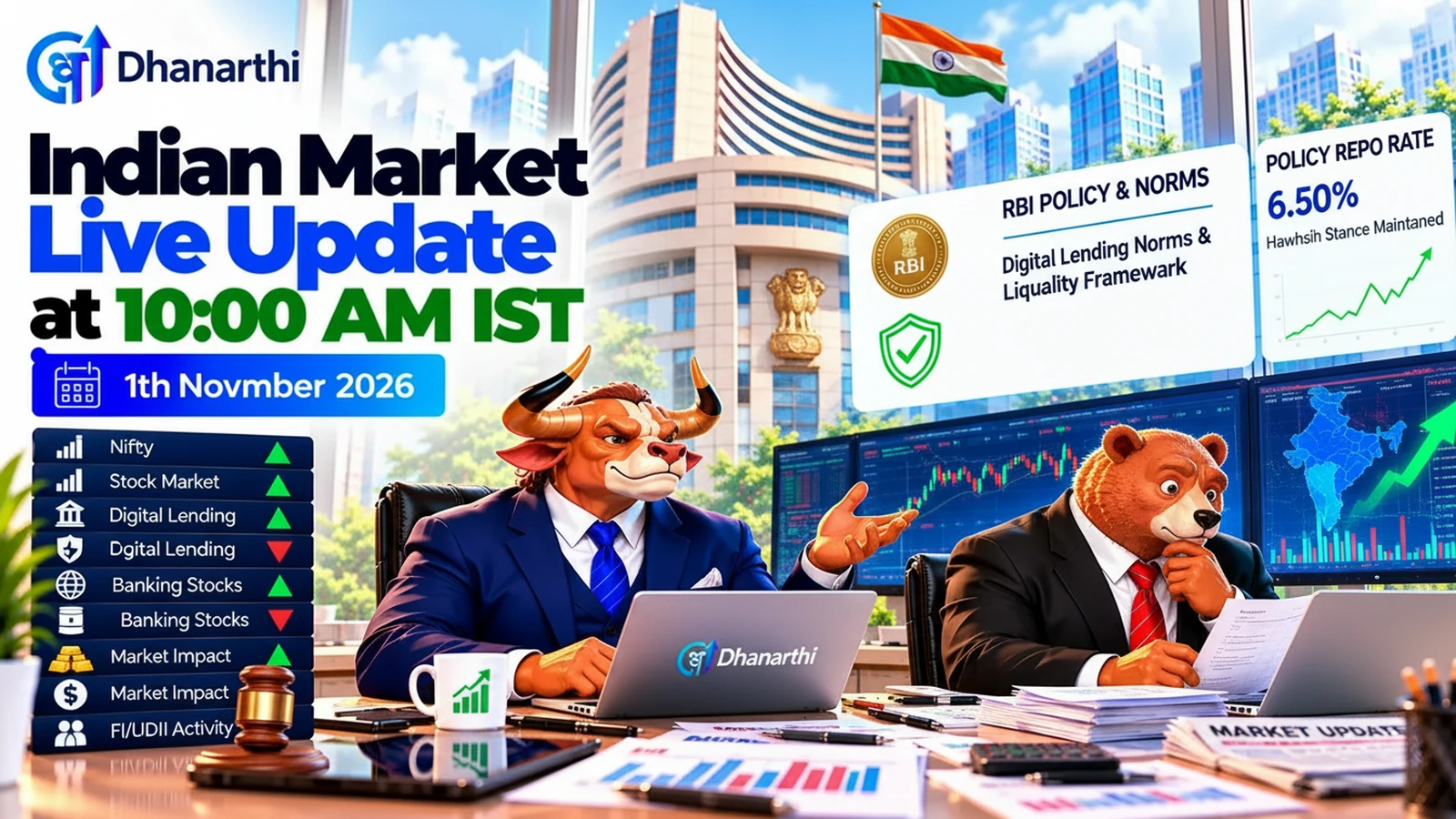
Indian Market Live Update at 10:00 AM IST
TABLE OF CONTENTS
- Reading Overview

RBI Tightens Unsecured Lending Norms; Reliance Boosts Green Energy Ambitions
Direct answer
The Reserve Bank of India (RBI) has introduced stricter guidelines for unsecured lending, including personal loans and credit card outstanding, aiming to curb potential risks in the financial system, a move that has weighed on banking and NBFC stocks. Meanwhile, market heavyweight Reliance Industries Limited (RIL) announced a significant partnership for advanced electrolyzer manufacturing, reinforcing its green energy push. The Nifty 50 opened lower and continued to trade in negative territory, largely influenced by the RBI's regulatory action and broader market sentiment.
Key highlights
- RBI Guidelines: New norms for unsecured lending, including personal loans and credit card outstanding, mandate higher risk weights for banks and NBFCs, impacting credit growth and asset quality.
- Reliance Industries: Signed a Memorandum of Understanding (MoU) with a European firm for advanced electrolyzer manufacturing in India, bolstering its green hydrogen initiatives.
- Nifty 50: Traded down by approximately 0.6% to 22,850 in early morning trade, extending losses as banking and financial stocks faced selling pressure.
- Crude Oil: Brent crude futures edged higher to around $85 per barrel, raising concerns about India's import bill and potential inflationary pressures.
- Tata Motors: Secured a significant order for 500 electric buses from a state transport undertaking, signaling continued momentum in the EV segment.
RBI Tightens Unsecured Lending: Impact on Banks and NBFCs
The Reserve Bank of India (RBI) has announced new, more stringent prudential norms for unsecured lending, a move aimed at addressing the rapid growth and potential risks associated with personal loans and credit card outstanding. The central bank has mandated an increase in risk weights for banks and Non-Banking Financial Companies (NBFCs) on their exposures to unsecured consumer credit. Specifically, the risk weight for banks' and NBFCs' exposures to personal loans and credit card receivables has been raised by 25 percentage points to 125% and 150% respectively, from the previous levels.
What happened
The RBI's circular, issued early this morning, highlighted concerns over the accelerated growth in certain segments of consumer credit, which could pose systemic risks if left unchecked. The new guidelines are effective immediately and require banks and NBFCs to reassess their capital allocation for these loan categories. This regulatory intervention is expected to moderate the pace of growth in unsecured lending and encourage more prudent risk management practices across the financial sector.
Why it matters
This development is significant for Indian financial markets, particularly for banks and NBFCs with substantial exposure to unsecured retail loans. Higher risk weights mean that lenders will need to set aside more capital for the same amount of unsecured loans, which could impact their capital adequacy ratios and profitability. Analysts suggest that this could lead to a slowdown in unsecured credit growth, potentially affecting the revenue streams of some lenders. Shares of major private and public sector banks, as well as NBFCs, witnessed selling pressure in early trade following the announcement, reflecting investor apprehension about the immediate impact on their balance sheets and future growth prospects. The move underscores the RBI's proactive stance on financial stability.
Reliance Industries Forges Key Green Energy Partnership
Reliance Industries Limited (RIL), India's largest conglomerate, has further solidified its commitment to the green energy sector by announcing a strategic partnership for advanced electrolyzer manufacturing. The company confirmed this morning that it has signed a Memorandum of Understanding (MoU) with a leading European technology firm to establish a state-of-the-art manufacturing facility for electrolyzers in India. This collaboration is a crucial step in RIL's ambitious plans to become a global leader in green hydrogen production and reduce India's reliance on fossil fuels.
What the announcement says
According to the official statement, the partnership aims to leverage the European firm's cutting-edge technology and RIL's manufacturing prowess and market reach to produce high-efficiency electrolyzers locally. These electrolyzers are essential for producing green hydrogen through water electrolysis, a key component of the clean energy transition. The facility is expected to significantly boost India's domestic capacity for green hydrogen infrastructure and contribute to the country's net-zero emissions targets.
Why it matters
This development is a positive catalyst for RIL and the broader renewable energy sector in India. RIL has been aggressively investing in its New Energy business, with significant capital expenditure earmarked for building an integrated green energy ecosystem. This partnership not only strengthens RIL's position in the rapidly evolving green hydrogen space but also aligns with the Indian government's focus on promoting indigenous manufacturing and achieving energy independence. The news was well-received by investors, with RIL shares trading higher by approximately 1.5% in morning trade, outperforming the broader market.
More stocks and market news
Nifty 50 Extends Losses; Banking Stocks Under Pressure
The Indian benchmark index, Nifty 50, opened lower and continued its downward trajectory in morning trade, extending losses for the current session. The index was trading around 22,850, down approximately 0.6%, primarily dragged by significant selling pressure in banking and financial services stocks. This decline was largely a direct reaction to the Reserve Bank of India's new, stricter guidelines on unsecured lending, which are expected to impact the growth and asset quality of lenders. Broader market sentiment also remained cautious.
Crude Oil Prices Edge Higher, Fueling Inflation Concerns
Brent crude futures saw a marginal uptick, trading near $85 per barrel in the early hours today. The slight increase in global oil prices, following overnight movements, has reignited concerns about India's import bill and its potential impact on domestic inflation. As a major oil importer, India's economy is highly sensitive to fluctuations in crude prices, which can affect everything from fuel costs to manufacturing expenses and overall consumer prices. Elevated crude prices could also put pressure on the Indian Rupee.
Tata Motors Secures Large EV Bus Order
Tata Motors, a leading Indian automobile manufacturer, announced today that it has successfully secured a substantial order for 500 electric buses from a state transport undertaking. This significant win underscores the company's strong position in the electric vehicle (EV) segment, particularly in public transportation. The order is expected to bolster Tata Motors' revenue and further strengthen its market share in the rapidly expanding EV bus market in India, aligning with the government's push for green mobility solutions.
Market context
The Indian equity markets are experiencing a cautious start to the trading day. The Nifty 50 is down around 0.6%, while the Sensex also trades in negative territory. The Nifty Bank index is notably underperforming, reflecting the impact of the RBI's new lending norms. Global markets are mixed, with some Asian indices showing modest gains while others are flat, providing limited positive cues. India VIX, the volatility index, has seen a slight increase, indicating some investor anxiety. Crude oil prices remain a key macro factor, trading higher and adding to inflationary concerns.
Why these stories matter
The RBI's stricter unsecured lending norms are a critical development for financial stability, potentially reining in aggressive credit growth and fostering healthier balance sheets for banks and NBFCs, albeit with a short-term impact on their profitability and stock performance. Reliance Industries' green energy partnership highlights the accelerating transition towards sustainable energy sources in India, creating long-term growth opportunities and reducing carbon footprint. The broader market's reaction, particularly the underperformance of banking stocks, underscores the immediate sensitivity to regulatory changes. Rising crude oil prices remain a persistent macro headwind, influencing inflation and the nation's economic outlook.
What to watch next
- Further statements or clarifications from the RBI regarding the implementation of new lending norms.
- Detailed project timelines and capital expenditure plans from Reliance Industries for its electrolyzer manufacturing facility.
- Quarterly results from major banks and NBFCs to assess the initial impact of the revised risk weights.
- Global crude oil price movements and their implications for India's macroeconomic indicators.
- Updates on other corporate orders and developments in the EV sector.
Sources
- Reserve Bank of India: Press Release on Prudential Norms for Unsecured Lending
- Moneycontrol: RBI tightens norms for unsecured loans, credit cards; banks, NBFCs to feel the pinch
- Economic Times: Reliance Industries inks MoU for advanced electrolyzer manufacturing in India
- Business Standard: Nifty, Sensex open lower; banking stocks drag on RBI's new norms
- Reuters: Crude oil edges higher on supply concerns, India's inflation outlook
FAQ
1. What are the new RBI guidelines on unsecured lending?
The RBI has increased the risk weights for banks' and NBFCs' exposures to unsecured consumer credit, specifically raising them by 25 percentage points for personal loans and credit card receivables to 125% and 150% respectively.
2. How will the RBI's new norms affect banks and NBFCs?
The new norms will require banks and NBFCs to set aside more capital for their unsecured loan portfolios, potentially impacting their capital adequacy ratios, profitability, and leading to a moderation in unsecured credit growth.
3. What is Reliance Industries' new green energy partnership about?
Reliance Industries has signed an MoU with a European firm to set up an advanced electrolyzer manufacturing facility in India, aiming to boost its green hydrogen production capabilities and contribute to India's clean energy transition.
4. Why are banking stocks falling today?
Banking and financial stocks are experiencing selling pressure today primarily due to the Reserve Bank of India's announcement of stricter prudential norms for unsecured lending, which is expected to impact their business.
5. What is the current trend for crude oil prices and its impact on India?
Brent crude prices have edged higher to around $85 per barrel, raising concerns for India's import bill and potentially contributing to inflationary pressures in the economy.
6. What does Tata Motors' new EV bus order signify?
Tata Motors securing an order for 500 electric buses highlights its strong position in the EV segment for public transport and aligns with India's push for sustainable mobility solutions.
Disclaimer: This article is for educational purposes only. It does not constitute investment advice. Please consult a SEBI-registered financial advisor before making investment decisions.