RBI Hikes Repo Rate, Rupee Hits Record Low as Markets React to Policy Shift
TABLE OF CONTENTS
- Reading Overview

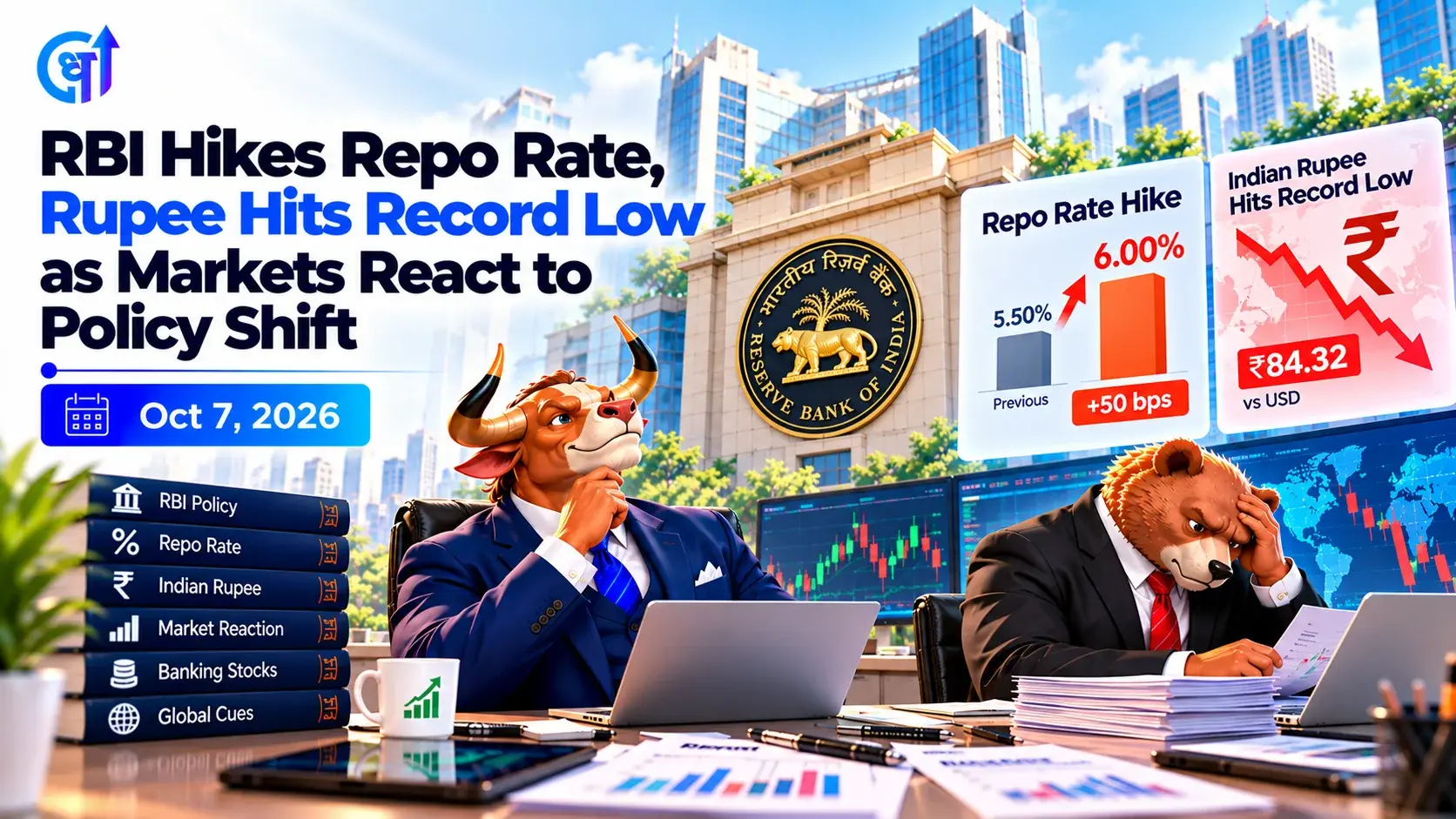
The Reserve Bank of India (RBI) today hiked its key repo rate by 25 basis points to 5.50% and shifted its monetary policy stance to 'calibrated tightening', marking the first rate increase since February 2023. This significant move, aimed at taming inflation, immediately impacted Indian markets, with the Sensex and Nifty paring early losses but still trading lower. The Indian Rupee, under pressure from foreign institutional investor (FII) outflows and a strong US dollar, depreciated to a new all-time low of 96.8650 against the greenback.
Key highlights
- RBI Monetary Policy: Repo rate increased by 25 basis points to 5.50%, with a shift to 'calibrated tightening' stance.
- Indian Rupee: Depreciated to a record low of 96.8650 against the US Dollar, influenced by the rate hike and FII outflows.
- Nifty 50: Trading below 22,700, down around 0.35% by 11:00 AM IST, after recovering from sharper early declines.
- BSE Sensex: Fell over 150 points, trading around 72,900 by 11:43 AM IST, following initial drops of over 450 points.
- Crude Oil: Brent crude remains elevated above $100-$101 per barrel, posing inflationary risks for India.
RBI Raises Repo Rate to 5.50%, Signals Calibrated Tightening
In a widely anticipated but impactful move, the Reserve Bank of India's (RBI) Monetary Policy Committee (MPC) today announced a 25-basis-point hike in the benchmark repo rate, bringing it to 5.50%. This marks the first increase in the key lending rate since February 2023, signaling a renewed focus on inflation management amidst evolving global and domestic economic conditions.
RBI Governor Sanjay Malhotra stated that the MPC voted unanimously to increase the policy repo rate and, by a majority of 4-2, decided to change the monetary policy stance from 'neutral' to 'calibrated tightening'. This shift indicates the central bank's readiness for further policy actions if inflation pressures persist. The decision comes as inflationary concerns have been exacerbated by rising crude oil prices and geopolitical tensions, particularly in the Middle East.
The RBI also revised its real GDP growth forecast for FY27 upwards by 40 basis points to 7.1%, while raising its FY27 CPI inflation forecast to 5.2% from 5% previously. Governor Malhotra emphasized the resilience of domestic economic activity despite global headwinds, but noted that rate cuts are "off the table in the near term." The central bank remains committed to keeping retail inflation within the 2-6% target range. The move is expected to lead to higher lending costs for banks, potentially impacting EMIs for consumers and businesses.
Indian Markets Witness Volatility; Rupee Hits Record Low
Indian equity markets experienced significant volatility today, initially opening lower before paring some losses following the Reserve Bank of India's repo rate hike announcement. The BSE Sensex, which tumbled over 450 points in early trade, was down around 150 points by 11:43 AM IST, trading near 72,900. Similarly, the NSE Nifty 50, after an initial dip of over 150 points, was trading below the 22,700 mark.
The market reaction was mixed across sectors. PSU banks and private banks showed resilience and even turned positive after the policy decision, while auto and metal stocks faced notable selling pressure. Consumer durables, FMCG, IT, pharma, oil & gas, and healthcare sectors also remained under pressure, reflecting a cautious investor sentiment despite the clarity on the monetary policy.
A major concern for investors was the Indian Rupee, which depreciated to a new all-time low of 96.8650 against the US Dollar. This marks a significant weakening from its previous close and eclipses the prior record low of 96.6150. The rupee's decline is attributed to persistent foreign institutional investor (FII) outflows from domestic equities and the strengthening US dollar. FIIs offloaded equities worth ₹2,961.30 crore on Tuesday, continuing a trend of significant selling in recent sessions. The weakening rupee makes dollar-denominated imports, particularly crude oil, more expensive, adding to inflationary pressures.
More stocks and market news
Gradiant Expands India Operations in Semiconductor and AI Infrastructure
Gradiant, a water technology company, announced a significant expansion of its India operations today, including the appointment of Hari Prasad as its new Managing Director for the country. The company secured five new design-build contracts across the semiconductor, printed circuit board (PCB), and solar manufacturing sectors, underscoring India's growing focus on these critical industries. Gradiant plans to increase its India team by over 40% this year, reflecting the rising demand for water solutions in manufacturing, especially as water availability and zero liquid discharge (ZLD) compliance become strategic factors in building AI-driven infrastructure.
Crude Oil Prices Remain Elevated Above $100 Amid Geopolitical Concerns
Global crude oil prices continue to trade at elevated levels, with Brent crude hovering above $100-$101 per barrel. This rebound in oil prices is largely attributed to fresh concerns about Middle East supplies following reports of increased attacks on tankers in the Strait of Hormuz and ongoing geopolitical tensions. The sustained strength in energy prices poses a significant challenge for India, a major oil importer, as it directly impacts the country's import bill, inflation outlook, and current account deficit.
Market context
As of 11:43 AM IST, the Sensex was trading down over 150 points, and the Nifty 50 was below 22,700, reflecting cautious sentiment after the RBI's repo rate hike. The Nifty Bank index, however, turned positive post-policy. India VIX, a measure of market volatility, jumped earlier in the day. Globally, US markets closed higher on Tuesday, with the S&P 500 and Nasdaq hitting record highs, while Asian markets were mixed to lower today. Brent crude is trading around $101.59 per barrel, and the Indian Rupee is at a record low of 96.8650 against the US Dollar.
Why these stories matter
The RBI's rate hike and shift to 'calibrated tightening' signal a more hawkish stance to combat inflation, directly impacting borrowing costs for businesses and consumers. This move, while necessary for price stability, could influence corporate earnings and overall economic growth. The rupee's record depreciation adds pressure on import-dependent sectors and could further fuel inflation, making the RBI's job more challenging. The market's volatile reaction underscores investor uncertainty regarding the combined impact of higher interest rates, a weaker currency, and elevated crude oil prices. Gradiant's expansion highlights India's strategic push into high-tech manufacturing and the critical role of supporting infrastructure.
What to watch next
- RBI Governor's Commentary: Further details from Governor Malhotra's press conference and the MPC minutes will be closely watched for clues on future policy trajectory.
- Inflation Data: Upcoming inflation figures will be crucial in assessing the effectiveness of the RBI's rate hike.
- Global Crude Oil Prices: Continued monitoring of geopolitical developments and their impact on international oil prices.
- FII Flows: Investor sentiment and foreign fund flows into Indian equities will remain a key determinant of market direction.
- Q2 Earnings Season: As more companies announce their Q2 FY27 results, their performance and outlook will provide insights into sectoral health.
Sources
- Livemint: Stock market prediction for Wednesday, 7 October, 2026
- New Indian Express: Benchmark indices Sensex and Nifty drifted lower in early trade
- NDTV Profit: Stock Market Today: All You Need To Know Before Going Into Trade On October 7
- FXStreet: USD/INR remains broadly muted after RBI's 25 bps hike in Repo Rates to 5.5%
- IndiaTimes: RBI MPC Meeting October 2026 Live Updates
FAQ
1. What was the key outcome of the RBI MPC meeting today?
The Reserve Bank of India's Monetary Policy Committee (MPC) hiked the repo rate by 25 basis points to 5.50% and changed its policy stance to 'calibrated tightening'.
2. How did the Indian stock market react to the RBI announcement?
Indian markets initially opened lower but pared some losses after the RBI's repo rate hike. The Sensex and Nifty were trading lower but had recovered from their early morning dips.
3. Why did the Indian Rupee fall to a record low today?
The Indian Rupee depreciated to an all-time low of 96.8650 against the US Dollar due to the RBI's rate hike, continued foreign institutional investor (FII) outflows, and a strong US dollar globally.
4. What is the significance of the RBI's 'calibrated tightening' stance?
The shift to a 'calibrated tightening' stance indicates that the RBI is prepared to take further policy actions, including potential rate hikes, if inflation pressures persist, moving away from a neutral approach.
5. How do elevated crude oil prices affect the Indian economy?
Elevated crude oil prices, currently above $100-$101 per barrel, negatively impact India by increasing its import bill, contributing to higher domestic inflation, and potentially widening the current account deficit.
6. What is Gradiant's recent announcement regarding its India operations?
Gradiant, a water technology company, announced the appointment of a new India MD and secured five new contracts in the semiconductor, PCB, and solar manufacturing sectors, along with plans to grow its India team by 40%.
Disclaimer
Disclaimer: This article is for educational purposes only. It does not constitute investment advice. Please consult a SEBI-registered financial advisor before making investment decisions.