L&T Secures Mega Bullet Train Order; RBI Proposes Tighter NBFC Norms
TABLE OF CONTENTS
- Reading Overview

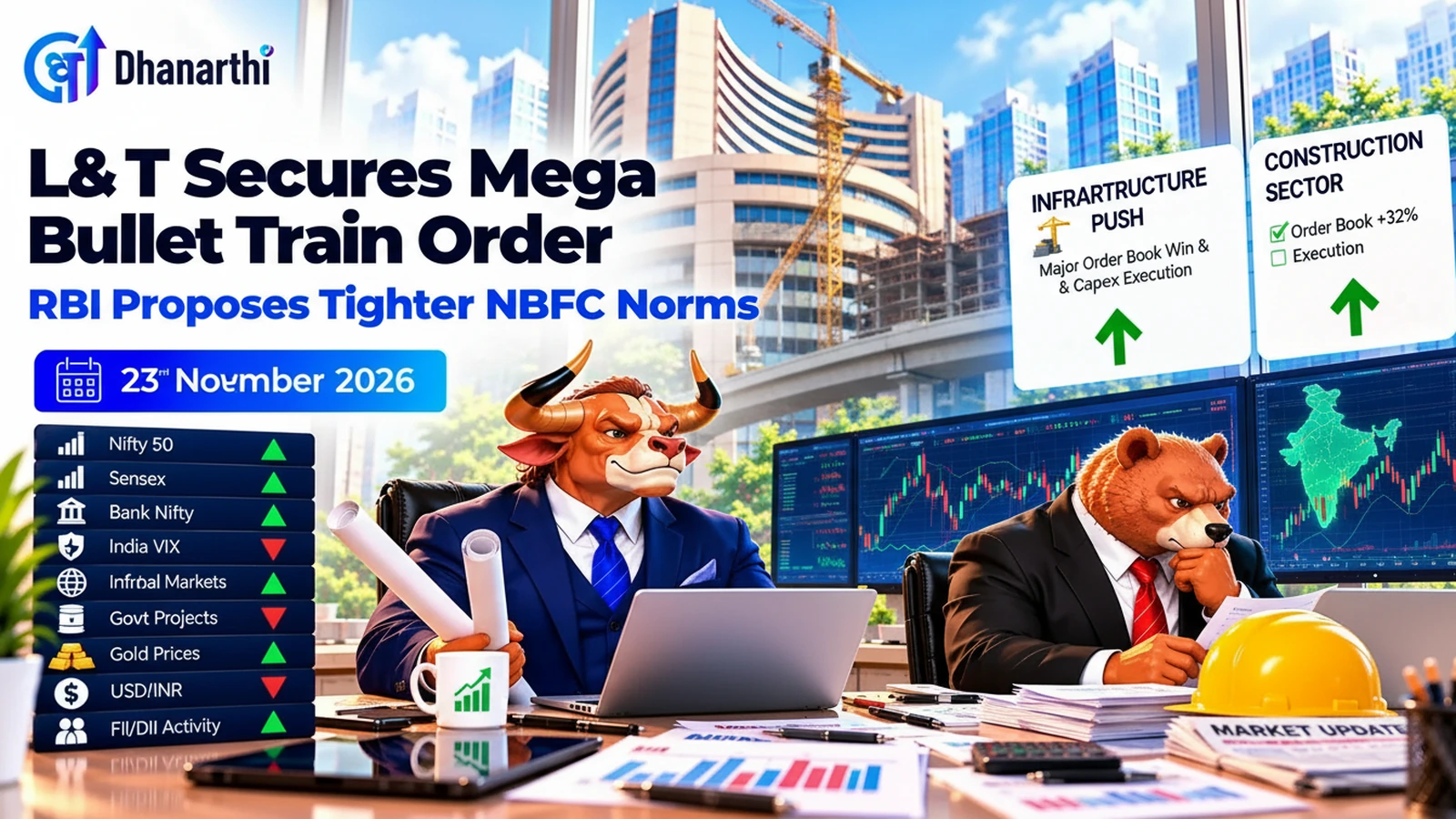
Indian markets traded cautiously this afternoon as Larsen & Toubro (L&T) announced a significant new order for the bullet train project, providing a boost to infrastructure stocks. Simultaneously, the Reserve Bank of India (RBI) released draft guidelines proposing stricter asset classification norms for NBFCs, which could impact the financial sector. The Nifty 50 hovered just below the 23,000 mark, reflecting mixed investor sentiment and ongoing profit booking in select sectors during the 12:00 PM to 2:00 PM IST trading window.
Key highlights
- L&T: Secured a 'Mega' order, valued between ₹7,000-₹15,000 crore, from NHSRCL for a package of the Mumbai-Ahmedabad High-Speed Rail project.
- RBI: Issued a discussion paper proposing tighter asset classification and provisioning norms for NBFCs, aligning them closer to bank standards.
- Crude Oil: Brent crude futures surged over 2% to trade above $95.50 per barrel on speculation of deeper OPEC+ production cuts.
- HCLTech: Announced a multi-year, multi-million dollar deal with a major US healthcare provider for digital transformation services.
- Nifty 50: Traded down around 0.4% at 22,985, struggling to hold the 23,000 level amid profit booking in banking and financial stocks.
L&T Bags Mega Order for Bullet Train Project
Larsen & Toubro (L&T), India's leading engineering and construction conglomerate, announced a significant boost to its order book today, securing a 'Mega' contract from the National High-Speed Rail Corporation Limited (NHSRCL). The order, classified by L&T as being in the range of ₹7,000 crore to ₹15,000 crore, is for a crucial package of the ambitious Mumbai-Ahmedabad High-Speed Rail (MAHSR) project, also known as the bullet train project. The announcement came via an exchange filing around 12:45 PM IST, immediately drawing investor attention.
What the filing says
According to the company's regulatory filing, the construction arm of L&T has won the contract for the design and construction of a 135.45 km stretch of the MAHSR corridor. This package includes the construction of viaducts, bridges, stations, maintenance depots, and other associated infrastructure. This is one of the largest civil works packages awarded for the project, underscoring L&T's continued dominance in large-scale infrastructure development in India. The project is expected to be completed within the stipulated timeframe set by NHSRCL.
Why it matters
This mega order reinforces L&T's strong position in India's burgeoning infrastructure sector, particularly in high-speed rail. Such large contracts provide long-term revenue visibility and strengthen the company's order book, which is a key metric for investors tracking capital goods and infrastructure firms. The win also signals continued momentum in government-led infrastructure spending, which is a significant driver for economic growth. For L&T, this adds to its already robust pipeline of projects and is likely to support its revenue and earnings growth in the coming quarters. The stock reacted positively to the news, trading higher in a generally subdued market.
What to watch next
Investors will be keen to watch L&T's execution progress on this project and its impact on the company's margins. Further order inflows in the infrastructure space, especially from government initiatives like the National Infrastructure Pipeline, will remain a key monitorable. The timely execution of such complex projects is crucial for L&T's reputation and future bidding prospects.
RBI Proposes Tighter Asset Classification Norms for NBFCs
The Reserve Bank of India (RBI) has initiated a significant move to strengthen the regulatory framework for Non-Banking Financial Companies (NBFCs). Around 01:15 PM IST, the central bank released a discussion paper outlining proposed changes to asset classification and provisioning norms for NBFCs. The new guidelines aim to bring NBFC regulations closer to those applicable to commercial banks, potentially impacting the profitability and operational strategies of many players in the sector.
Key proposals
The RBI's discussion paper suggests a more stringent approach to classifying non-performing assets (NPAs) for NBFCs. Key proposals include:
- Harmonisation of NPA recognition: Aligning the NPA recognition period for all NBFCs to 90 days past due, similar to banks, for all loan categories. Currently, some categories of NBFCs have a longer recognition period.
- Provisioning requirements: Reviewing and potentially increasing provisioning requirements for various asset classes to ensure adequate buffers against potential losses.
- Upgradation of accounts: Stricter rules for upgrading NPA accounts to standard assets, requiring full payment of arrears rather than partial payments.
Why it matters
These proposed changes, if implemented, could have a substantial impact across the NBFC sector. Tighter asset classification norms would likely lead to an increase in reported NPAs for some NBFCs, particularly those with less robust credit assessment and recovery mechanisms. This, in turn, would necessitate higher provisioning, directly affecting their profitability and capital adequacy ratios. Smaller and mid-sized NBFCs might face greater challenges in adapting to these stricter norms compared to larger, well-capitalised entities. The move is part of RBI's broader strategy to enhance financial stability and reduce systemic risks by ensuring regulatory arbitrage between banks and NBFCs is minimised.
Sector outlook
The market will closely watch the industry's response to these proposals during the consultation period. While the long-term goal is to create a more resilient financial system, the short-to-medium term could see some pressure on NBFC stock valuations as investors factor in potential hits to earnings and increased capital requirements. Companies with strong asset quality and robust risk management frameworks are likely to navigate these changes more effectively.
More stocks and market news
Crude Oil Surges Past $95 on OPEC+ Speculation
Brent crude futures witnessed a sharp rally today, jumping over 2% to trade above $95.50 a barrel by 01:30 PM IST. The surge was triggered by unconfirmed reports circulating in the market suggesting that OPEC+ might consider deeper production cuts at its upcoming meeting. This development has raised concerns about global oil supply tightness and its potential impact on inflation. For India, a major oil importer, sustained high crude prices could exacerbate inflationary pressures, widen the current account deficit, and put pressure on the rupee, impacting sectors like aviation, paints, and chemicals.
HCLTech Wins Major Digital Transformation Deal
HCLTech, a leading Indian IT services company, announced a significant multi-year, multi-million dollar deal around 12:10 PM IST. The company will provide comprehensive digital transformation services to a prominent US-based healthcare provider. This win underscores HCLTech's growing capabilities in the healthcare vertical and its strong position in the global digital services market. The deal is expected to contribute positively to the company's revenue pipeline and reinforces the positive outlook for the Indian IT sector, which continues to see demand for digital and cloud transformation projects.
Nifty 50 Struggles Around 23,000 Amid Profit Booking
The Indian benchmark Nifty 50 index continued to trade under pressure, hovering just below the psychological 23,000 mark by 02:00 PM IST. The index was down approximately 0.4% at 22,985, extending its intraday losses. Profit booking was visible across banking and financial stocks, which had seen significant gains in recent sessions. Broader market sentiment remained cautious, partly influenced by earlier reports of sustained foreign institutional investor (FII) outflows from Indian equities. The India VIX, a measure of market volatility, also saw a marginal uptick, indicating some investor apprehension.
Market context
As of 02:00 PM IST, the Sensex was trading at 76,120, down 250 points, while the Nifty 50 was at 22,985, down 90 points. The Nifty Bank index was also in the red, declining by about 0.6%. The India VIX stood at 13.85, up marginally. Globally, Asian markets showed mixed trends, while US stock futures pointed to a flat open. Brent crude oil was trading at $95.60 a barrel, and the Indian Rupee was at 83.45 against the US Dollar.
Why these stories matter
Today's developments highlight key themes for Indian investors. L&T's mega order underscores the government's continued thrust on infrastructure, offering long-term growth visibility for capital goods companies. The RBI's proposed NBFC norms signal a move towards greater financial sector stability, though it may introduce short-term headwinds for some lenders. The surge in crude oil prices remains a critical macro concern, directly impacting inflation and the nation's import bill. Meanwhile, HCLTech's deal win reaffirms the resilience and demand for Indian IT services, while the Nifty's struggle at 23,000 reflects ongoing market consolidation and cautious sentiment.
What to watch next
- L&T: Further updates on project execution and new order inflows in the infrastructure sector.
- NBFCs: Industry feedback and finalisation of RBI's asset classification guidelines.
- Crude Oil: Outcome of the upcoming OPEC+ meeting and its impact on global supply.
- IT Sector: More deal wins and commentary from IT majors on demand outlook.
- Market: FII flow trends, domestic institutional investor activity, and Nifty's ability to sustain above 23,000.
Sources
- Larsen & Toubro: Exchange Filings
- Reserve Bank of India: Press Releases
- Reuters: Energy News
- HCLTech: Investor Relations
- Moneycontrol: Indian Markets
FAQ
1. Why are L&T shares in focus today?
L&T shares are in focus today because the company announced securing a 'Mega' order, valued between ₹7,000 crore to ₹15,000 crore, from NHSRCL for a package of the Mumbai-Ahmedabad High-Speed Rail project. This significant order boosts its order book and provides long-term revenue visibility.
2. What are the RBI's new proposals for NBFCs?
The RBI has proposed stricter asset classification and provisioning norms for NBFCs, aiming to align them closer to commercial bank standards. Key proposals include harmonising NPA recognition to 90 days past due and reviewing provisioning requirements, which could impact NBFC profitability.
3. Why is crude oil price rising today?
Crude oil prices are rising today due to speculation that OPEC+ might consider deeper production cuts at its upcoming meeting. Brent crude futures surged over 2% to trade above $95.50 a barrel on these reports, raising concerns about global supply.
4. How does rising crude oil impact India?
As a major oil importer, rising crude oil prices negatively impact India by increasing inflationary pressures, widening the current account deficit, and potentially weakening the Indian Rupee. This can affect sectors like aviation, paints, and chemicals.
5. What is the current status of the Nifty 50?
As of 02:00 PM IST, the Nifty 50 was trading around 22,985, down approximately 0.4%. The index was struggling to hold the 23,000 level, with profit booking observed in banking and financial stocks and cautious sentiment prevailing.
Disclaimer: This article is for educational purposes only. It does not constitute investment advice. Please consult a SEBI-registered financial advisor before making investment decisions.