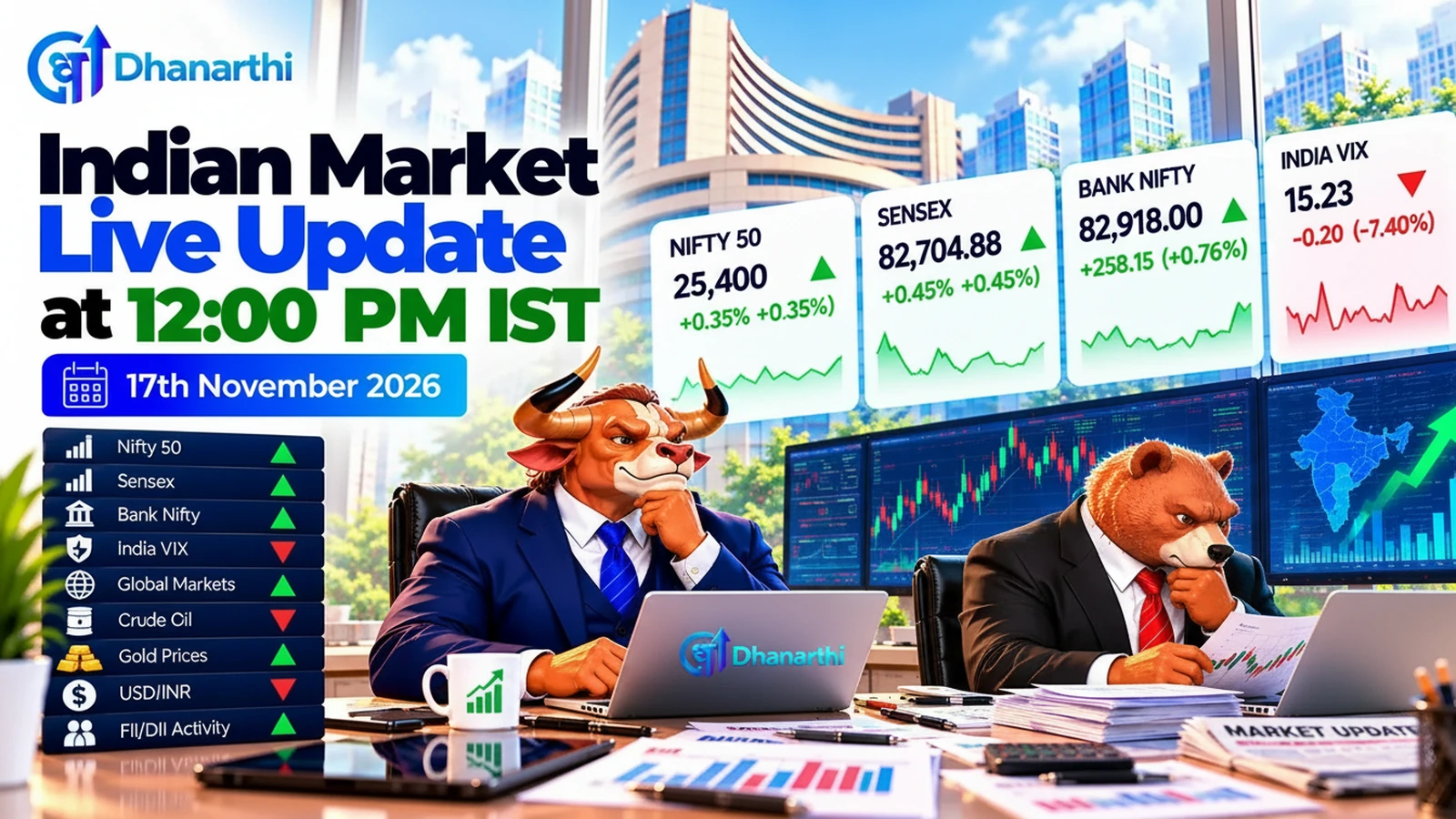
Indian Market Live Update at 12:00 PM IST
TABLE OF CONTENTS
- Reading Overview

Sensex Surges Over 600 Points as RBI Reiterates Tata Sons Listing; Yes Bank AT1 Bond Review Sought
Direct answer
Indian benchmark indices are trading significantly higher at midday, with the Sensex gaining over 600 points and the Nifty surpassing 25,400, driven by robust foreign fund inflows and easing crude oil prices. A major development sees the Reserve Bank of India reiterating its directive for Tata Sons to list as an upper-layer NBFC, sparking a rally in several Tata Group stocks. Concurrently, the RBI has moved the Supreme Court seeking a review of its recent ruling on the Yes Bank AT1 bond write-off, adding a new dimension to the banking sector's regulatory landscape.
Key highlights
- Sensex: Rose over 600 points to 82,704.88, while Nifty50 gained 149.10 points to 25,439.10, extending early gains.
- Tata Group Stocks: Tata Chemicals surged over 8% after the RBI reiterated its stance on Tata Sons' mandatory listing as an upper-layer NBFC.
- Rupee: Appreciated by 31 paise to 93.63 against the US dollar, supported by softer crude prices and strong FII inflows.
- Crude Oil: Brent crude futures fell below $92 per barrel amid expectations of a global supply surplus, easing India's import bill concerns.
- Nifty Bank: Crossed the 62,000 mark for the first time ever, reflecting broad-based gains in banking stocks.
RBI Reiterates Tata Sons Listing Mandate, Boosts Group Stocks
The Reserve Bank of India (RBI) has once again underscored its requirement for Tata Sons Private Limited to list its shares on stock exchanges, classifying it as an upper-layer Non-Banking Financial Company (NBFC). In a letter dated November 16, the central bank reiterated that Tata Sons must adhere to all regulations applicable to upper-layer NBFCs, which includes the mandatory listing provision. This development comes ahead of Tata Sons' board meeting scheduled for November 26, where regulatory compliance and listing obligations are expected to be key discussion points.
The RBI's firm stance has immediately impacted the stock market, particularly shares of listed Tata Group companies that hold stakes in the privately held conglomerate. Tata Chemicals saw its share price jump over 8% to ₹650.30 in early trade on Tuesday. Similarly, Tata Investment Corporation gained approximately 3.3% to ₹595. Other Tata Group entities like Tata Motors Passenger Vehicles and Indian Hotels Company also traded higher following the news.
Tata Chemicals, for instance, holds a 2.53% stake in Tata Sons. The potential initial public offering (IPO) of Tata Sons could bring greater transparency and clarity to the valuation of these cross-holdings, which is a significant factor for investors. Tata Sons has maintained its private status for over a century, controlling major group businesses including Tata Consultancy Services, Tata Motors, and Tata Steel. The RBI had previously rejected Tata Sons' application to surrender its NBFC tag in September, solidifying its classification as an upper-layer NBFC subject to stricter regulatory oversight. This ongoing regulatory push highlights the central bank's commitment to ensuring compliance across all significant financial entities.
RBI Seeks Supreme Court Review on Yes Bank AT1 Bond Ruling
The Reserve Bank of India (RBI) has filed a review petition in the Supreme Court challenging its October 15 ruling that invalidated the write-down of Additional Tier-1 (AT1) bonds worth ₹8,415 crore issued by Yes Bank. This move by the central bank follows a similar review petition filed by Yes Bank itself on November 13. The Supreme Court's earlier decision had upheld the Bombay High Court's January 2023 order, deeming the write-offs as "illegal and arbitrary" and questioning the RBI's authority to sanction such commercial decisions during the bank's reconstruction.
The AT1 bonds were written down in March 2020 as part of the RBI-initiated reconstruction scheme for Yes Bank, which had plunged into a crisis due to governance issues and financial irregularities. The write-down was a crucial component of the bank's revival plan, aimed at shoring up its capital base. The Supreme Court's October ruling created significant uncertainty for the banking sector, particularly regarding the regulatory powers during bank resolutions and the nature of AT1 instruments.
Yes Bank has indicated that a full reinstatement of these bonds could reduce its Common Equity Tier 1 (CET1) ratio from 13.7% to 11.4%. However, the bank maintains that this revised ratio would still be above the regulatory minimum requirement of 8.0%. The RBI's decision to seek a review underscores its concern over the potential systemic implications of the original ruling, particularly concerning its statutory powers in managing distressed financial institutions. The legal proceedings are expected to continue, maintaining a degree of uncertainty around the final allocation of liability and the broader regulatory framework for AT1 bonds.
More stocks and market news
BSE's BANKEX Futures Get US Regulatory Nod
BSE Limited announced that its BANKEX Index Futures contract has received approval from the US Commodity Futures Trading Commission (CFTC) for offer and sale in the United States. This marks a significant milestone as BANKEX becomes the first Indian sectoral index futures contract to secure such clearance from the US regulator. The approval followed a 45-day expedited review process by the CFTC, confirming the contract's compliance with US Commodity Exchange Act requirements. This development is expected to open new avenues for US institutional investors, including asset managers and hedge funds, to gain exposure to India's banking sector through a regulated platform, potentially boosting trading activity and liquidity on BSE's derivatives segment.
Crude Oil Prices Decline Amid Global Supply Surplus Forecasts
Global crude oil prices continued their downward trend on Tuesday, with Brent crude futures trading below $92 per barrel and US West Texas Intermediate (WTI) around $85. This decline is primarily driven by growing expectations of a global supply surplus in the fourth quarter of the year. The International Energy Agency (IEA) and Goldman Sachs have both indicated that supply is likely to outpace demand, with Middle Eastern exports recovering faster than anticipated. While geopolitical tensions in the Gulf remain a concern, the outlook for increased supply has overshadowed these risks, providing relief for major oil importers like India by easing concerns over import bills and inflationary pressures.
SEBI Forms Panel to Review Capital Raising Norms
The Securities and Exchange Board of India (SEBI) has constituted a 10-member committee, chaired by NSE Managing Director and CEO Ashishkumar Chauhan, to undertake a comprehensive review of capital raising regulations. The committee's mandate includes examining rules related to Initial Public Offerings (IPOs), Further Public Offerings (FPOs), preferential issues, and Qualified Institutional Placements (QIPs). The objective is to simplify and rationalize regulatory requirements, enhance ease of access to capital markets for eligible issuers, eliminate duplicative disclosures, and improve overall regulatory clarity while maintaining robust investor protection and market integrity. This initiative aims to streamline the fundraising process and make India's capital markets more efficient.
Market context
As of 12:00 PM IST, the BSE Sensex was trading at 82,704.88, up 600.09 points (0.73%), while the NSE Nifty 50 was at 25,439.10, higher by 149.10 points (0.59%). The Nifty Bank index also saw significant gains, crossing 62,000 for the first time. The India VIX, a measure of market volatility, showed a decline in early trade, indicating some easing of investor anxiety. Globally, Asian markets were mixed, with some facing pressure from technology stocks due to tightened US restrictions on AI chips for China, while US futures pointed to a cautious opening. Brent crude oil was trading around $91.71 per barrel, down 0.79%, and the Indian Rupee strengthened to 93.63 against the US dollar.
Why these stories matter
The RBI's directive to Tata Sons underscores a broader regulatory push for transparency and compliance among systemically important entities, potentially reshaping valuation dynamics for cross-holdings within large conglomerates. The central bank's review petition on Yes Bank's AT1 bonds is crucial for clarifying regulatory powers during financial crises and setting precedents for future debt instrument structures. BSE's US approval for BANKEX futures signifies growing international interest in Indian financial markets and offers new hedging and investment avenues. The continued fall in crude oil prices provides a significant macroeconomic tailwind for India, easing inflation concerns and supporting the rupee. Lastly, SEBI's committee to review capital raising rules signals proactive efforts to enhance market efficiency and accessibility, which could benefit companies seeking to raise funds and investors participating in primary markets.
What to watch next
- Tata Sons: Investors will closely monitor developments leading up to and following the November 26 board meeting for any official statements or plans regarding the listing.
- Yes Bank AT1 Bonds: The Supreme Court's decision on admitting the review petitions from RBI and Yes Bank will be a key event, determining the next phase of legal proceedings.
- Crude Oil: Global supply-demand dynamics, OPEC+ decisions (meeting on November 29), and geopolitical events will continue to influence crude price movements.
- SEBI Committee: Market participants will await the recommendations from the SEBI committee on capital raising rules, which could lead to significant reforms in the primary market.
Sources
- The Economic Times: Stock Market Live Updates: Tata Chemicals, Tata Investment Corp shares rally up to 9% after RBI nudge to comply with listing norms
- The New Indian Express: RBI seeks review of SC ruling on Yes Bank AT1 bonds
- Upstox: BSE's BANKEX Index Futures get US CFTC approval for offer and sale
- Business Standard: Oil prices fall as supply surplus outlook outweighs tanker attack concerns
- The Times of India: Stock Market Today Live Updates: BSE Sensex jumps over 600 points, NSE Nifty50 above 25,400
FAQ
1. Why are Tata Group stocks rallying today?
Tata Group stocks like Tata Chemicals and Tata Investment Corporation are rallying today because the Reserve Bank of India (RBI) has reiterated its directive for Tata Sons to list on stock exchanges as an upper-layer NBFC. This has sparked investor interest in listed entities with holdings in Tata Sons.
2. What is the latest development in the Yes Bank AT1 bond case?
The Reserve Bank of India (RBI) has filed a review petition in the Supreme Court challenging its October 15 ruling that invalidated the write-down of ₹8,415 crore worth of Yes Bank's AT1 bonds. Yes Bank had also filed its own review petition earlier.
3. Why are crude oil prices falling today?
Crude oil prices are falling due to growing expectations of a global supply surplus in the fourth quarter of the year, with Middle Eastern exports recovering faster than demand. This outlook is easing concerns about tight supply despite ongoing geopolitical risks.
4. What does the US CFTC approval for BSE's BANKEX futures mean?
The US Commodity Futures Trading Commission (CFTC) approval allows BSE's BANKEX Index Futures contract to be offered and sold to investors in the United States. This is significant as it opens up avenues for US institutional investors to gain exposure to India's banking sector through a regulated product.
5. What is the SEBI committee on capital raising rules expected to do?
The SEBI committee, chaired by NSE MD Ashishkumar Chauhan, is tasked with reviewing and simplifying regulations related to capital raising, including IPOs, FPOs, preferential issues, and QIPs. The goal is to make it easier for companies to access capital markets while maintaining investor protection.
6. How is the Indian Rupee performing today?
The Indian Rupee has appreciated by 31 paise against the US dollar, trading at 93.63. This strengthening is attributed to falling crude oil prices, sustained foreign institutional investor (FII) inflows, and a positive trend in the domestic equity markets.
Disclaimer: This article is for educational purposes only. It does not constitute investment advice. Please consult a SEBI-registered financial advisor before making investment decisions.