Reliance Secures $15 Billion Green Hydrogen Deal; RBI Tightens NBFC Norms
TABLE OF CONTENTS
- Reading Overview

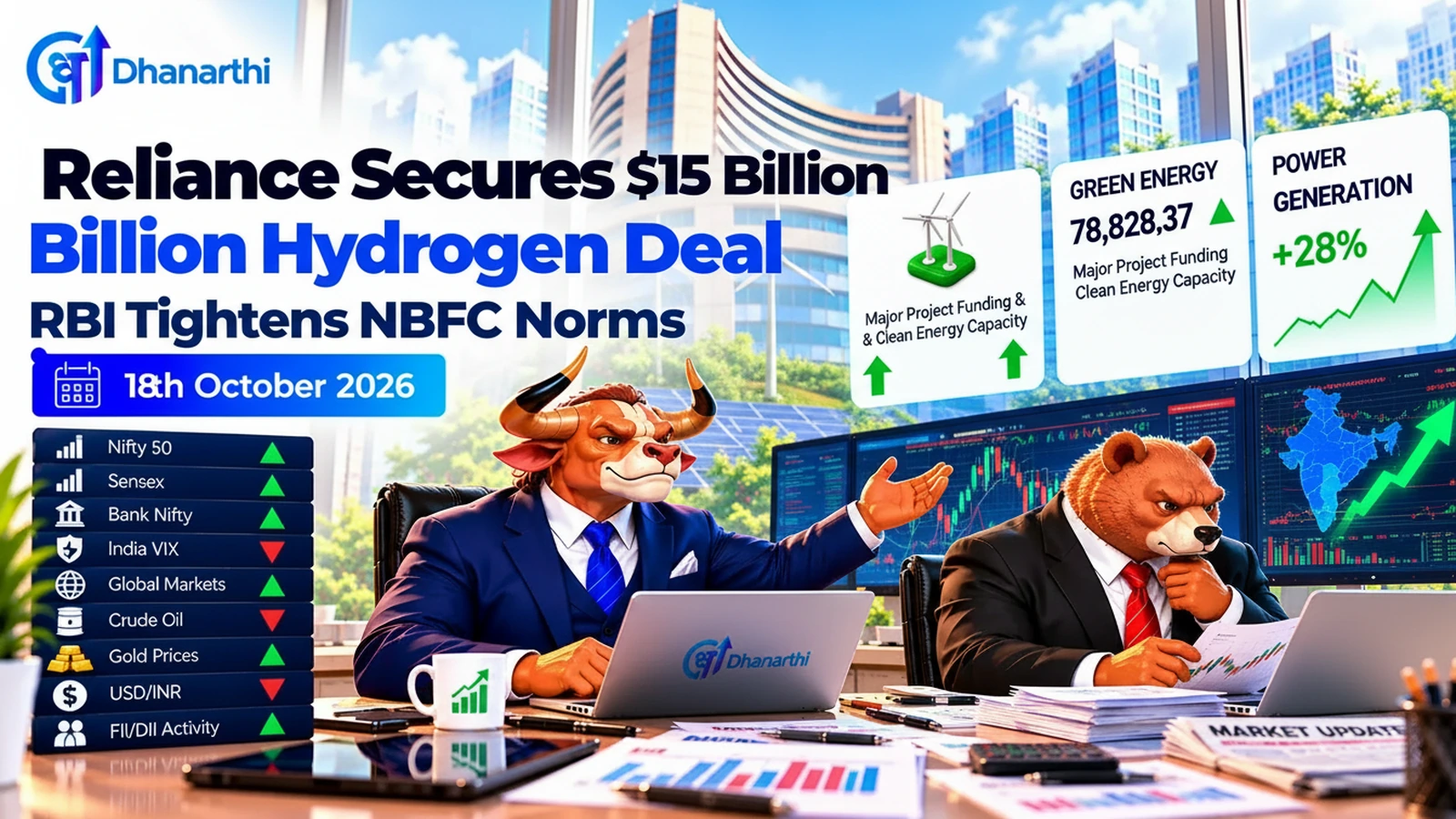
Indian markets traded with cautious optimism this afternoon, with the Nifty 50 and Sensex posting modest gains, primarily buoyed by Reliance Industries' landmark $15 billion green hydrogen export deal. This major strategic move by Reliance significantly boosted investor sentiment in the energy sector. Meanwhile, the Reserve Bank of India introduced stricter asset-liability management and provisioning norms for large NBFCs, leading to mixed reactions across the financial services segment. IT stocks also saw strong buying interest, driven by positive global tech cues and a weakening rupee.
Key highlights
- Reliance Industries: Shares surged over 3.5% after announcing a $15 billion green hydrogen export agreement with a European consortium.
- RBI Guidelines: New, stricter asset-liability management and provisioning norms issued for large NBFCs, effective Q1 FY28, aiming to bolster financial stability.
- IT Sector: Nifty IT index gained 1.8%, with major players like TCS and Infosys leading, on strong US tech earnings and INR weakening past 84.00/USD.
- Larsen & Toubro: Secured a "significant" (₹1,000-₹2,500 crore) EPC contract for a major infrastructure project in Saudi Arabia, boosting its order book.
- Indian Rupee: Weakened to 84.05 against the US Dollar, impacting import costs but potentially aiding export-oriented sectors.
Reliance Industries Secures Landmark $15 Billion Green Hydrogen Export Deal
Reliance Industries Limited (RIL) made a significant announcement this afternoon, sending its shares soaring and providing a substantial boost to the broader market. The conglomerate revealed it has signed a definitive agreement for a $15 billion green hydrogen export deal with a consortium of leading European energy companies. This landmark agreement positions RIL as a key global player in the burgeoning green energy sector and underscores its ambitious transition strategy.
What the filing says
According to the filing submitted to the National Stock Exchange (NSE) around 2:30 PM IST, the multi-year agreement involves the supply of green hydrogen from RIL's integrated green energy complex in Jamnagar, Gujarat. The European consortium, which includes major utilities and industrial players, will off-take specified volumes of green hydrogen, with initial shipments expected to commence by late 2028. The deal is structured with price mechanisms linked to global energy benchmarks, ensuring long-term revenue visibility for Reliance's new energy vertical. This agreement is a crucial step in monetizing RIL's massive investments in renewable energy generation, electrolyser manufacturing, and green hydrogen production capabilities.
Market reaction and why it matters
Following the announcement, Reliance Industries shares witnessed a sharp uptick, trading up 3.5% at ₹2,985 by 3:45 PM IST, significantly outperforming the Nifty 50. The news injected fresh optimism into the market, particularly for companies focused on sustainable energy solutions. This deal is not just about the monetary value; it validates RIL's strategic pivot towards new energy and its capability to execute large-scale, complex projects in emerging sectors. For Indian investors, it signals the potential for significant value creation from RIL's green energy ventures, which have been a major capital expenditure focus for the company in recent years. The deal also highlights India's growing potential as a global hub for green hydrogen production and export, aligning with national energy transition goals.
RBI Tightens Asset-Liability and Provisioning Norms for Large NBFCs
The Reserve Bank of India (RBI) today issued a circular introducing stricter regulatory guidelines for large Non-Banking Financial Companies (NBFCs), focusing on enhancing their asset-liability management (ALM) framework and provisioning norms for specific loan categories. The move, announced via a press release around 3:00 PM IST, aims to further strengthen the financial stability of the NBFC sector and mitigate systemic risks.
Key changes and implications
The new guidelines, which will come into effect from the first quarter of the financial year 2028 (Q1 FY28), mandate more granular reporting and tighter controls over ALM mismatches for NBFCs classified under the Upper Layer and Middle Layer of the RBI's scale-based regulation. Specifically, these NBFCs will be required to maintain more conservative liquidity buffers and conduct stress testing more frequently. Furthermore, the RBI has revised provisioning requirements for certain unsecured retail loan portfolios and loans to specific sectors deemed to carry higher risk. This includes a marginal increase in general provisioning for these categories, aligning them closer to commercial bank standards. The central bank stated that these measures are proactive steps to ensure that NBFCs maintain robust balance sheets and are better equipped to absorb potential shocks.
Market impact and outlook
The immediate market reaction to the RBI's announcement was mixed within the NBFC space. Larger, well-capitalized NBFCs with strong ALM practices and adequate provisioning saw minimal impact, with some even trading marginally higher as investors perceived them as better positioned to comply. However, some mid-sized NBFCs, particularly those with higher exposure to the affected loan categories or less robust ALM frameworks, experienced slight selling pressure. The Nifty Financial Services index saw a minor dip post-announcement but largely recovered. Analysts suggest that while the new norms might lead to a slight increase in operational costs and potentially impact profitability for some players in the short term, they are ultimately beneficial for the long-term health and credibility of the NBFC sector. The extended implementation timeline provides companies sufficient time to adapt their strategies and systems.
More stocks and market news
IT Sector: Rally on Strong US Tech Earnings & Rupee Weakness
Indian IT services stocks witnessed a strong rally this afternoon, with the Nifty IT index gaining 1.8% by 3:45 PM IST. Major players like Tata Consultancy Services (TCS), Infosys, and Wipro were among the top performers. The surge was primarily driven by two factors: robust Q3 earnings reported by several leading US technology companies overnight, which boosted global tech sentiment, and the continued weakening of the Indian Rupee. The INR breached the 84.00 mark against the US Dollar, trading at 84.05, which is generally positive for export-oriented sectors like IT as it improves their revenue realization in rupee terms. This confluence of positive global cues and favorable currency movement fueled buying interest in the sector.
L&T: Bags Significant Infrastructure Project in Middle East
Engineering and construction giant Larsen & Toubro (L&T) announced today that its construction arm has secured a "significant" order for a major infrastructure project in Saudi Arabia. While the exact value was not disclosed, L&T classifies "significant" orders as those ranging between ₹1,000 crore and ₹2,500 crore. The project involves engineering, procurement, and construction (EPC) services for a critical urban development initiative in the Kingdom. This new win further strengthens L&T's robust order book and its presence in the lucrative Middle Eastern market, a key region for the company's international operations. L&T shares traded up 1.2% following the announcement, reflecting investor confidence in its execution capabilities.
Market context
As of 3:45 PM IST, the Nifty 50 was trading at 23,120, up 0.32%, while the S&P BSE Sensex stood at 76,580, gaining 0.38%. The broader market saw mixed performance, with the Nifty Midcap 100 up 0.1% and Smallcap 100 down 0.2%. India VIX, the volatility index, eased slightly to 12.85. Globally, Asian markets closed mostly positive, and European equities opened higher, tracking positive sentiment from Wall Street. Brent crude oil futures remained stable around $88.20 per barrel, while the Indian Rupee weakened to 84.05 against the US Dollar.
Why these stories matter
Today's developments highlight critical themes for Indian investors. Reliance's green hydrogen deal underscores the massive potential and ongoing transition in India's energy sector, offering long-term growth avenues. The RBI's stricter NBFC norms reflect a continued focus on financial sector stability, ensuring robust growth while mitigating risks. The IT sector's rally showcases the strong linkage between global tech performance and Indian equities, further amplified by currency movements. L&T's order win reinforces the ongoing infrastructure boom, both domestically and in key international markets, providing visibility for capital goods companies.
What to watch next
- Reliance Industries: Further details on the European consortium partners and specific project timelines for green hydrogen production and export.
- NBFC Sector: How individual NBFCs adapt their balance sheets and business models to comply with the new RBI ALM and provisioning norms by Q1 FY28.
- IT Sector: Upcoming quarterly results from Indian IT majors for further cues on deal wins, margin outlook, and client spending.
- Global Cues: US inflation data and Federal Reserve commentary for impact on global interest rates and FII flows into India.
Sources
- NSE India: Reliance Industries Ltd. Filings
- Reserve Bank of India: Press Releases
- BSE India: Larsen & Toubro Ltd. Filings
- Moneycontrol: Market News
- Reuters: India Business News
FAQ
1. What is the significance of Reliance's green hydrogen deal?
Reliance Industries' $15 billion green hydrogen export deal is significant as it validates the company's massive investments in new energy, positions it as a global leader in green hydrogen, and provides long-term revenue visibility for its green energy vertical. It also highlights India's potential in the global green energy transition.
2. How will RBI's new NBFC guidelines impact the sector?
The RBI's new guidelines will require large NBFCs to adopt stricter asset-liability management and increase provisioning for certain loan categories. While potentially increasing compliance costs, these measures aim to strengthen the financial stability of the sector, making it more resilient to economic shocks in the long run.
3. Why are IT stocks rallying today?
Indian IT stocks are rallying due to strong Q3 earnings reported by major US technology companies, which has boosted global tech sentiment. Additionally, the weakening of the Indian Rupee past 84.00 against the US Dollar is favorable for IT exporters as it enhances their rupee-denominated revenues.
4. What kind of project did L&T secure in Saudi Arabia?
Larsen & Toubro secured a "significant" (₹1,000-₹2,500 crore) EPC (Engineering, Procurement, and Construction) contract for a major urban infrastructure development project in Saudi Arabia. This further strengthens its order book and presence in the Middle East.
5. What is the current status of the Indian Rupee?
The Indian Rupee has weakened to 84.05 against the US Dollar. This depreciation can make imports more expensive but generally benefits export-oriented sectors like IT and pharmaceuticals by improving their earnings in local currency terms.
Disclaimer
Disclaimer: This article is for educational purposes only. It does not constitute investment advice. Please consult a SEBI-registered financial advisor before making investment decisions.