Indian Market Live Update at 04:00 PM IST
TABLE OF CONTENTS
- Reading Overview

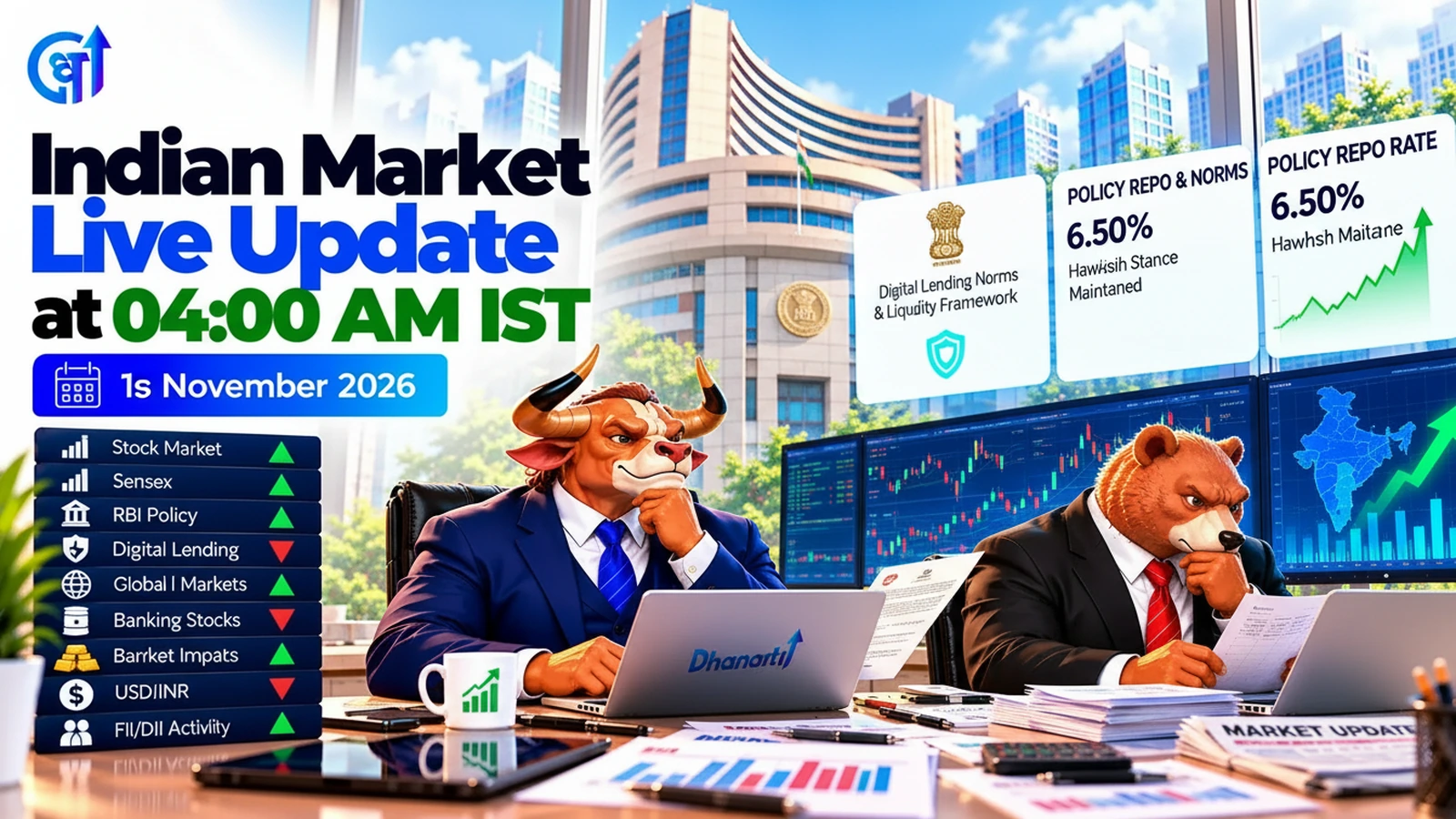
Sensex Gains Marginally as SEBI Moves to Delist Inactive Firms; October GST Collections Surge
Direct answer
The Indian equity market saw a day of cautious trading, with benchmark indices showing marginal gains as investors digested fresh corporate updates and key economic data. A significant development emerged from SEBI, with its chairman announcing plans to delist companies lacking economic activity to safeguard investor interests. This comes as October's gross GST collections surged by 22.9% year-on-year to ₹2.31 lakh crore, signaling robust economic momentum. The market also noted strong operational performance from Coal India and continued FPI outflows in October, albeit with a late-month reversal.
Key highlights
- SEBI Action: Regulator plans to delist companies with no economic activity to protect investors and enhance market integrity.
- GST Collections: Gross Goods and Services Tax revenue for October 2026 rose 22.9% year-on-year to ₹2.31 lakh crore.
- Coal India Output: State-owned miner reported a 19.3% year-on-year increase in October coal production, reaching 67.2 million tonnes.
- FPI Flows: Foreign Portfolio Investors withdrew ₹34,843 crore from Indian equities in October, though they turned net buyers in the last week.
- RBI Initiative: Reserve Bank of India is reportedly planning field trials for polymer-based ₹10 and ₹20 currency notes starting April 1, 2027.
SEBI to Delist Companies with No Economic Activity to Protect Investors
The Securities and Exchange Board of India (SEBI) is actively working towards delisting companies that exhibit no meaningful economic activity from stock exchanges. This significant move, announced by SEBI Chairman Tuhin Kanta Pandey, aims to mitigate potential risks to investors and uphold market integrity.
Chairman Pandey highlighted that a considerable number of listed entities continue to exist on exchanges despite lacking any substantive business operations. Such companies, he noted, pose a "potential danger" to investors, as they can be susceptible to misuse by market manipulators, often for "pump and dump" schemes. The regulator is employing advanced techniques, including artificial intelligence (AI) tools, to identify and scrutinize suspicious accounts associated with these inactive firms.
The initiative underscores SEBI's commitment to investor protection and fostering a transparent and robust capital market. By removing these dormant entities, SEBI intends to reduce avenues for fraudulent activities and enhance the overall credibility of the Indian stock market. This proactive stance is expected to streamline the listed space, making it safer for retail and institutional investors alike. The move is part of broader regulatory efforts to ensure that only genuinely active and compliant companies remain accessible to public investment.
October GST Collections Surge 22.9% to ₹2.31 Lakh Crore, Signalling Economic Strength
India's gross Goods and Services Tax (GST) collections witnessed a robust year-on-year increase of 22.9% in October 2026, reaching an impressive ₹2.31 lakh crore. This significant surge, up from ₹1.88 lakh crore in the corresponding month last year, indicates sustained economic activity and healthy consumption trends across the nation.
The Finance Ministry's provisional data also revealed that the net GST revenue for October rose by an even higher 25.6% compared to the previous year. This strong performance in tax collections reflects a broad-based recovery and expansion in various sectors of the economy. Higher GST revenues are typically seen as a positive indicator of consumer spending, business transactions, and overall economic growth momentum. The consistent growth in GST collections provides the government with greater fiscal room, potentially aiding in infrastructure spending and other developmental initiatives.
Analysts view the October GST figures as a testament to the resilience of the Indian economy amidst global uncertainties. The sustained growth trajectory in indirect tax collections suggests that festive season demand and increased economic activity have contributed significantly to this positive outcome. This strong revenue performance is crucial for the government's fiscal health and its ability to fund public expenditure.
More stocks and market news
Coal India: October Output Jumps 19.3%
Coal India Limited (CIL), the state-owned mining giant, reported a substantial 19.3% year-on-year increase in its coal production for October 2026, reaching 67.2 million tonnes (MT). This marks a significant rise from the 56.4 MT produced in the same month last year, according to provisional data filed with the stock exchanges. The robust production figures highlight CIL's efforts to meet the country's growing energy demand and ensure adequate coal supply for power generation and industrial consumption. This operational strength from a key public sector undertaking is a positive indicator for the energy sector and broader industrial activity.
FPIs Withdraw ₹34,843 Crore in October, Turn Net Buyers Late in the Month
Foreign Portfolio Investors (FPIs) continued their selling streak in Indian equities through October, withdrawing a net amount of ₹34,843 crore. This marks the second consecutive month of significant outflows, driven by concerns over elevated crude oil prices, global interest rate trajectories, and the corporate earnings outlook. However, there was a notable shift towards the end of the month, with FPIs turning net buyers and infusing approximately ₹6,300 crore into the market between October 26 and October 30. This late-month reversal provided some support to market sentiment, helping the Nifty reclaim the 23,000 level.
RBI Plans Field Trials for Plastic ₹10, ₹20 Notes from April 2027
The Reserve Bank of India (RBI) is reportedly preparing to conduct field trials for polymer-based currency notes in denominations of ₹10 and ₹20, with a target start date of April 1, 2027. The central bank plans to introduce 100 crore notes of each denomination for these trials, maintaining the same dimensions as the existing banknotes. This approach aims to allow banks to continue using existing ATMs without requiring costly modifications. The move towards plastic currency is primarily driven by the need to enhance the durability of frequently used notes, which suffer rapid wear and tear, reducing replacement costs and improving the overall quality of currency in circulation.
Market context
As of 4:00 PM IST on November 1, 2026, the Indian equity benchmarks closed with marginal gains. The Sensex ended the day higher, while the Nifty 50 also saw a slight uptick, reflecting a cautious but positive sentiment. Broader markets, including the Nifty Midcap and Smallcap indices, traded mixed. The India VIX, a measure of market volatility, remained relatively stable. Globally, Asian markets showed a mixed trend, while European markets opened with modest gains. Crude oil prices remained a key monitorable, trading around $98-99 per barrel, impacting India's import bill. The Indian Rupee traded around 94.95 against the US Dollar.
Why these stories matter
The SEBI's move to delist inactive companies is crucial for enhancing investor confidence and market transparency, directly addressing potential risks from shell companies. The strong GST collection figures underscore robust domestic demand and economic resilience, providing a positive macro backdrop for corporate earnings and government finances. Coal India's production surge highlights the continued strength in the core sector, essential for industrial growth. FPI flow data remains a key determinant of market direction, with the late-October buying offering a glimmer of hope after sustained outflows. Finally, the RBI's trial of plastic notes, while not directly impacting monetary policy, signifies efforts to improve currency management and reduce operational costs.
What to watch next
- Corporate Earnings: Investors will closely monitor upcoming quarterly results from major companies for insights into sector-specific performance and forward guidance.
- Global Cues: Developments in global crude oil prices, international interest rate decisions, and geopolitical events will continue to influence market sentiment.
- Regulatory Updates: Further announcements from SEBI regarding market reforms and investor protection measures will be keenly watched.
- Economic Data: Upcoming inflation data and industrial production figures will provide further clarity on India's economic trajectory.
Sources
- Business Standard: Coal India's October coal output rises 19.3% to 67.2 million tonnes
- ANI: Gross GST collections rise 22.9% to Rs 2.31 Lakh Crore in October, net revenue up 25.6%
- Business Standard: Sebi working to delist companies with no economic activity: Chairman
- Business Standard: FPIs pull out ₹34,843 cr from equities in Oct, turn net buyers last week
- The Live Nagpur: RBI to Introduce Plastic ₹10, ₹20 Notes from April 1
FAQ
1. What is SEBI's plan regarding inactive companies?
SEBI plans to delist companies that have no economic activity from stock exchanges. This measure is intended to protect investors from potential risks and manipulation, such as "pump and dump" schemes, and to enhance market integrity.
2. How much did GST collections increase in October 2026?
Gross GST collections in October 2026 rose by 22.9% year-on-year to ₹2.31 lakh crore. The net GST revenue for the month saw an even higher increase of 25.6% compared to the previous year.
3. What was Coal India's production in October?
Coal India Limited produced 67.2 million tonnes of coal in October 2026, marking a 19.3% increase compared to the 56.4 million tonnes produced in October of the previous year.
4. What was the trend of FPI investments in October?
Foreign Portfolio Investors (FPIs) withdrew ₹34,843 crore from Indian equities in October 2026. However, they turned net buyers in the last week of the month, infusing approximately ₹6,300 crore.
5. Is the RBI introducing new currency notes?
The RBI is reportedly planning field trials for polymer-based ₹10 and ₹20 currency notes starting April 1, 2027. These trials aim to test the durability of plastic notes, which are expected to have the same dimensions as existing paper notes.
6. Why are SEBI's actions on inactive companies important for investors?
SEBI's move is important because it aims to remove companies that could be used for market manipulation, thereby reducing the risk of investors losing money in fraudulent schemes. It helps ensure that only legitimate companies are listed, fostering a safer investment environment.
Disclaimer: This article is for educational purposes only. It does not constitute investment advice. Please consult a SEBI-registered financial advisor before making investment decisions.