Wipro Q2 Outperformance Lifts IT Stocks; RBI Tightens Unsecured Lending Norms
TABLE OF CONTENTS
- Reading Overview

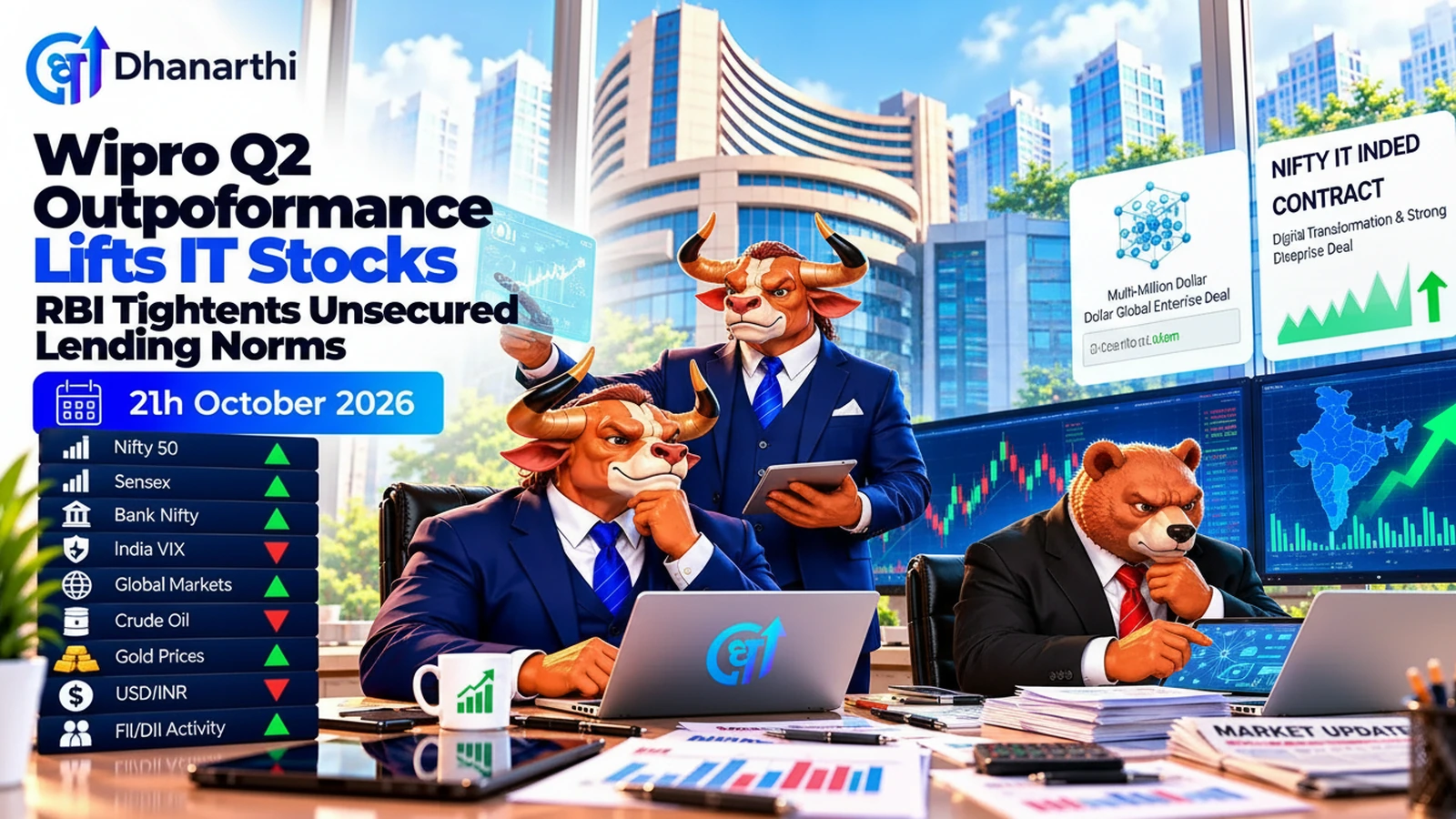
The Indian equity market opened mixed today, with the Nifty 50 trading marginally higher, primarily driven by strong gains in IT stocks following Wipro's better-than-expected Q2 FY27 results and optimistic guidance. Meanwhile, the financial sector, particularly NBFCs and private banks, faced headwinds as the Reserve Bank of India (RBI) announced new, stricter guidelines for unsecured lending, aiming to mitigate potential risks in the retail credit segment. This divergence highlights a sector-specific response to both corporate earnings and regulatory actions in the early trading hours.
Key highlights
- Nifty 50: Trading up 0.25% at 23,850 points by 09:55 IST, recovering from an initial dip.
- Wipro Ltd.: Shares surged over 6% after reporting robust Q2 FY27 earnings and strong deal wins, leading the Nifty IT index higher.
- RBI Announcement: The central bank introduced new prudential norms for unsecured retail loans, impacting lending practices for NBFCs and certain private banks.
- Nifty Bank: Down 0.4% to 54,200, underperforming the broader market due to concerns over the RBI's new lending regulations.
- Indian Rupee: Strengthened to 83.10 against the US Dollar, benefiting from a slight easing in crude oil prices and positive FII inflows.
Wipro's Q2 FY27 Results Outperform, Boosts IT Sector Sentiment
Wipro Ltd. (NSE: WIPRO) emerged as a top gainer in early trade today, with its shares rallying over 6% to ₹585.50 by 09:50 IST, following the announcement of its robust second-quarter results for the financial year 2026-27. The IT services major reported a consolidated net profit of ₹3,520 crore, a 12.5% year-on-year (YoY) increase, surpassing analyst expectations. Revenue from operations grew by 9.8% YoY to ₹25,800 crore, driven by strong performance in its consulting and cloud services segments.
The company's management highlighted significant deal wins totaling $4.2 billion in the quarter, indicating a healthy demand environment despite global macroeconomic uncertainties. Wipro also provided an optimistic revenue guidance for the third quarter, projecting sequential growth of 1.5% to 3.5% in constant currency terms. This positive outlook, coupled with improved operating margins, has instilled confidence among investors regarding the IT sector's resilience and growth trajectory. Analysts noted that Wipro's strong execution and strategic focus on high-growth areas are paying off, positioning the company well for future expansion. The results have provided a much-needed boost to the broader Nifty IT index, which saw gains of over 1.5% in early trading, with other major IT players also witnessing upward momentum.
Why it matters
Wipro's strong Q2 performance is a significant indicator for the Indian IT services sector. It suggests that despite global economic headwinds, demand for digital transformation and technology services remains robust. The substantial deal wins underscore the competitive advantage of Indian IT firms. For investors, this signals potential for continued growth in the sector, making IT stocks an attractive segment amidst broader market volatility. The positive guidance also provides a forward-looking perspective, suggesting sustained momentum for the coming quarters.
RBI Tightens Unsecured Lending Norms, Financial Stocks React Cautiously
The Reserve Bank of India (RBI) today announced new prudential norms for unsecured retail loans, a move aimed at strengthening the financial system and mitigating potential risks associated with rapid growth in this segment. The new guidelines, effective immediately, include increased risk weights for unsecured personal loans and credit card receivables for both banks and Non-Banking Financial Companies (NBFCs). Specifically, the risk weight for such exposures has been raised by 25 percentage points, from 100% to 125%, for commercial banks and NBFCs.
This regulatory action comes amid concerns over the accelerated growth of unsecured retail credit, which the RBI believes could pose systemic risks if left unchecked. The central bank emphasized the need for lenders to exercise greater caution and strengthen their internal risk management frameworks. Following the announcement, shares of several NBFCs and private sector banks with significant exposure to unsecured lending witnessed selling pressure. Bajaj Finance, one of the prominent players in the consumer finance segment, saw its shares decline by over 2.5% in early trade. Other private banks also traded lower, reflecting investor apprehension about the potential impact on their profitability and asset quality.
What the announcement means
The increased risk weights will require banks and NBFCs to set aside more capital for their unsecured loan portfolios, potentially impacting their capital adequacy ratios and reducing their capacity for further lending in this segment. While the move is seen as a prudent step by the regulator to ensure financial stability, it could lead to a slowdown in unsecured credit growth and potentially higher lending rates for consumers.
More stocks and market news
Nifty IT Rallies, Nifty Bank Under Pressure
The Nifty IT index surged over 1.5% in early trade, hitting an intraday high of 36,500, primarily propelled by Wipro's strong Q2 results and a generally positive sentiment towards the technology sector. Conversely, the Nifty Bank index traded lower, shedding 0.4% to 54,200, as investors reacted to the RBI's new, stricter norms for unsecured lending. This divergence highlights a clear sector-specific impact of recent corporate earnings and regulatory actions, with IT stocks benefiting from strong fundamentals and financials facing regulatory headwinds.
Rupee Strengthens as Crude Oil Prices Soften Marginally
The Indian Rupee gained against the US Dollar in early trading, firming up to 83.10, compared to its previous close of 83.25. The appreciation was largely attributed to a slight moderation in global crude oil prices, which eased below $88 per barrel after recent surges. A softer crude oil trajectory is beneficial for India, a major oil importer, as it helps manage the current account deficit and inflationary pressures. Positive foreign institutional investor (FII) inflows into the equity market also contributed to the Rupee's strength.
Market context
As of 10:00 AM IST, the Nifty 50 was trading at 23,850, up 0.25%, while the Sensex gained 0.20% to 79,450. The Nifty Bank index, however, was down 0.4% at 54,200. The India VIX, a measure of market volatility, stood at 12.80, indicating moderate investor anxiety. Globally, Asian markets showed a mixed trend, with some indices in positive territory following overnight gains on Wall Street, providing cautious optimism. Brent crude oil was trading around $87.80 per barrel, while the Indian Rupee strengthened to 83.10 against the US Dollar.
Why these stories matter
Wipro's strong earnings underscore the resilience of India's IT sector, signaling robust demand for digital services globally and potentially setting a positive tone for other IT majors. This performance can attract further foreign investment into the sector. The RBI's move on unsecured lending, while potentially curbing short-term growth for some financial institutions, is a crucial step towards ensuring long-term financial stability and prudent risk management within the banking and NBFC sectors. The softening of crude oil prices and a strengthening Rupee are positive macro indicators for India, helping to manage inflation and import costs, which can boost overall economic sentiment.
What to watch next
- Further Q2 FY27 earnings announcements from other Nifty 50 companies.
- RBI's detailed commentary or FAQs on the new unsecured lending norms.
- Global crude oil price movements and their impact on the Rupee.
- Foreign Institutional Investor (FII) and Domestic Institutional Investor (DII) flow data.
- Any government policy announcements related to economic growth or specific sectors.
Sources
- Moneycontrol: Wipro Q2 Results: Net profit rises 12.5% YoY to Rs 3,520 crore, beats estimates
- Economic Times: Wipro shares jump 6% after strong Q2 earnings, optimistic guidance
- Business Standard: RBI tightens norms for unsecured retail loans, raises risk weights for banks, NBFCs
- Livemint: RBI increases risk weights on unsecured loans; Bajaj Finance, other NBFCs fall
- Reuters: Indian rupee strengthens as crude eases, FII inflows support
FAQ
1. Why did Wipro's share price rise today?
Wipro's share price rose over 6% today after the company announced better-than-expected Q2 FY27 results, reporting a 12.5% year-on-year increase in net profit and strong revenue growth. The company also provided an optimistic revenue guidance for the next quarter, driven by significant deal wins.
2. What are the new RBI guidelines for unsecured lending?
The RBI has increased the risk weights for unsecured personal loans and credit card receivables by 25 percentage points, from 100% to 125%, for both commercial banks and NBFCs. This means lenders must set aside more capital for these types of loans.
3. How do the new RBI norms impact NBFCs and banks?
The increased risk weights will require NBFCs and banks to allocate more capital for their unsecured loan portfolios, potentially impacting their capital adequacy ratios. This could lead to a slowdown in unsecured credit growth and potentially higher lending rates for consumers, affecting the profitability of institutions heavily reliant on this segment.
4. Why is the Nifty IT index performing well today?
The Nifty IT index is performing well today, gaining over 1.5%, primarily due to the strong Q2 FY27 earnings reported by Wipro, which boosted overall sentiment for the technology sector. Positive global tech cues also contributed to the upward momentum.
5. What is the current status of the Indian Rupee?
The Indian Rupee strengthened to 83.10 against the US Dollar today. This appreciation is attributed to a slight easing in global crude oil prices and continued positive inflows from Foreign Institutional Investors (FIIs) into the Indian equity market.
Disclaimer
Disclaimer: This article is for educational purposes only. It does not constitute investment advice. Please consult a SEBI-registered financial advisor before making investment decisions.