





Capital Gains Tax on Shares India 2026 Rates
October 23, 2026



TABLE OF CONTENTS
Get AI Summary





5G stocks are shares of companies participating in India's fifth-generation mobile network rollout, spanning telecom operators, tower and fiber infrastructure, IT services, and equipment manufacturing. Among India's listed 5G-linked companies, Bharti Airtel, Reliance Industries (Jio), and Indus Towers lead the sector for August 2026, backed by 365 million 5G subscribers and a projected Rs 36.4 trillion GDP contribution by 2030.
5G stocks are shares of companies that participate in the development and rollout of fifth-generation mobile networks, spanning telecom services, tower operations, IT solutions, and equipment production.
Investing in 5G stocks provides exposure to India's fastest-growing connectivity market, spanning consumer, enterprise, and government demand simultaneously.
ARPU expansion story: India's current ARPU (Average Revenue Per User) sits around Rs 198. China's is Rs 542. The United States is at Rs 3,913. This gap doesn't stay permanent. As 5G use cases multiply, cloud gaming, industrial IoT, HD streaming, connected vehicles, Indian subscribers migrate to higher-value plans. Bharti Airtel already reports ARPU at Rs 245, and the sector average is rising toward Rs 220-225 in FY26. That ARPU expansion is the long-term investment thesis for telecom operator stocks and Nifty telecom index constituents alike.
Subscriber scale: India's 5G subscriber base is projected to reach 970 million by 2030. Coverage already spans 99.6% of India's districts. This isn't a future build-out story; it's a monetization story that has already begun.
Policy support: The PLI-ACC scheme, BharatNet rural connectivity programme, Make in India telecom equipment push, and 5G spectrum auctions in 2025 all create a sustained policy floor under the sector. The Union Budget allocated Rs 81,005 crore to the Department of Telecommunications, including Rs 22,000 crore for BharatNet alone.
Use the Dhanarthi stock screener to filter 5G-related stocks, telecom stocks, and Make in India telecom equipment names by ARPU growth, ROCE, and revenue CAGR in one place.
Research Stocks Smarter with Dhanarthi AI Screener
Analyze 5,000+ NSE & BSE stocks with 150+ custom filters, real-time volume breakout scans, and transparent fundamental data.
Use Dhanarthi Screener
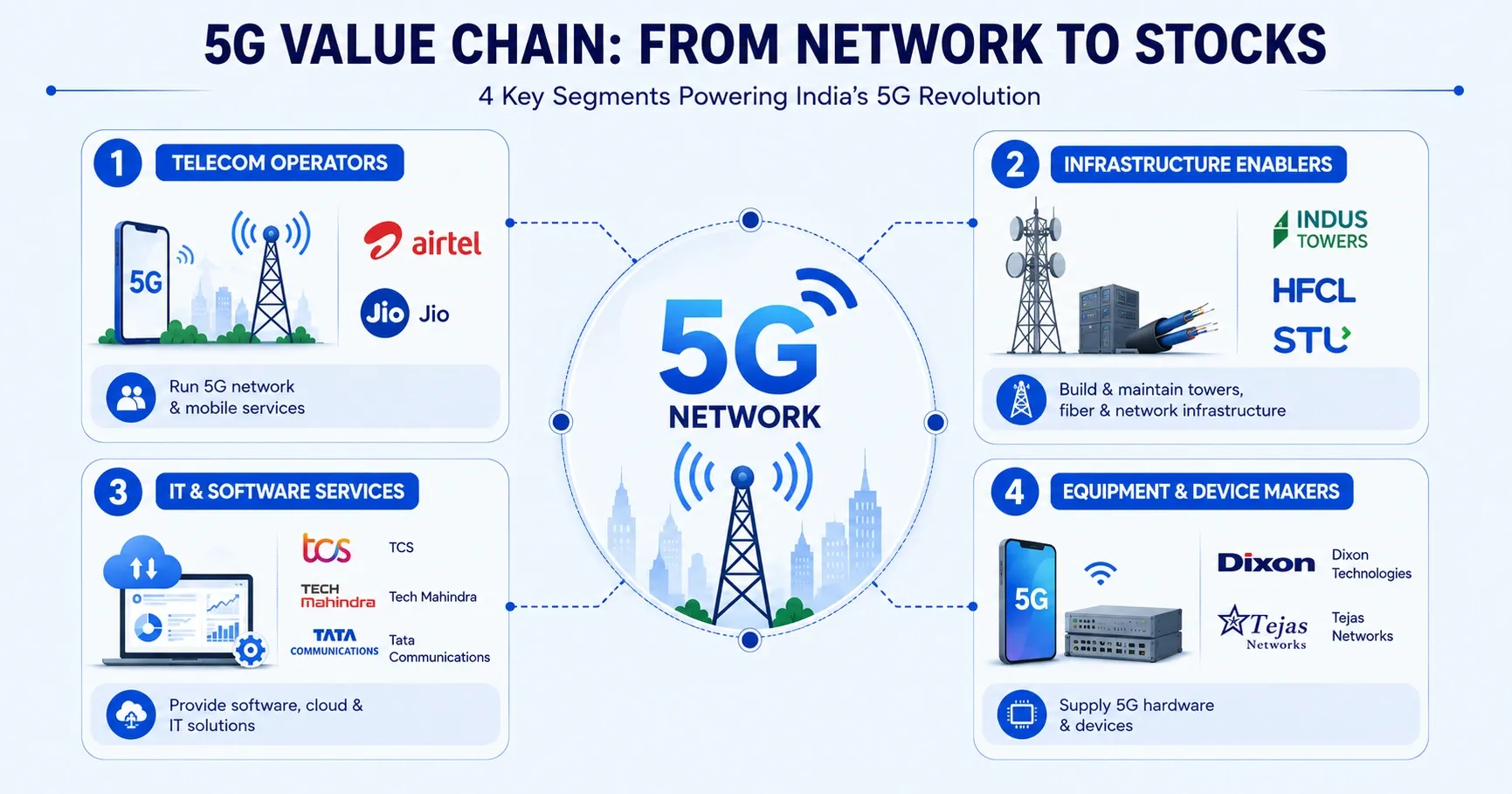
Most competitor articles list companies without specifying which 5G sub-segment each belongs to. That distinction matters, since each carries a different risk-return profile.
1. Telecom operators: Bharti Airtel and Reliance Industries (Jio) operate the 5G network directly, earning revenue through subscriber ARPU. These are the most actively traded names in any 5G stocks list and react strongly to pricing competition within the telecom sector.
2. Infrastructure enablers: Indus Towers, HFCL, and Sterlite Technologies provide the physical backbone, tower infrastructure and fiber networks, that operators depend on. Revenue here comes from B2B contracts, resulting in more stable income than operator-side telecom stocks. These names anchor most 5G infrastructure stocks and 5G tower stocks screens.
3. IT and software services: TCS, Tech Mahindra, and Tata Communications deliver OSS/BSS systems, network management software, and cloud services to global telecom operators. Revenue here comes through indirect, enterprise-linked channels, offering a different exposure than pure telecom sector stocks.
4. Equipment and device makers: Dixon Technologies and Tejas Networks supply the hardware, 5G smartphones and optical networking equipment, powering the rollout. These companies benefit from rising 5G device demand and infrastructure expansion without carrying network capex risk directly. Tejas Networks sits in small-to-mid cap territory and is often searched alongside 5G penny stocks list queries given its volatility.
| Company | Category | Market Cap | PE Ratio | ROCE | Revenue Growth | Risk Level |
|---|---|---|---|---|---|---|
| Bharti Airtel | Operator | Large cap | Moderate | Improving | 12.31% 5Y CAGR | Medium |
| Reliance Industries | Operator + Conglomerate | Rs 18 lakh crore+ | Moderate | Strong | Multi-segment | Low-Medium |
| Indus Towers | Infrastructure | Large cap | Moderate | Stable | Contract-linked | Low-Medium |
| HFCL | Infrastructure | Mid cap | Growth PE | Volatile | Expanding | Medium-High |
| Tech Mahindra | IT Services | Large cap | Recovery PE | Moderate | Improving | Medium |
| TCS | IT Services | Large cap | Premium | High | Consistent | Low |
| Dixon Technologies | Device Maker | Mid-large cap | High growth | High ROCE | Strong | Medium |
| Tejas Networks | Equipment | Small-mid cap | Volatile | Improving | Expanding | High |
| Tata Communications | Network Infra | Mid cap | Moderate | Stable | Steady | Medium |
| Sterlite Technologies (STL) | Fiber Infra | Mid cap | Growth PE | Moderate | Export-linked | Medium-High |
Bharti Airtel operates as India's second-largest telecom service provider by subscriber count, with a business model built around industry-leading average revenue per user. The company has rolled out 5G across 500 cities, with five-year revenue growth reaching 12.31%.
Key financials: Large cap, ARPU of Rs 245 (highest in the sector), improving ROCE as capex normalizes.
Airtel's subscriber market share expanded from 53.88% to 66.86% among quality (high-ARPU) subscribers. The stock carries substantial debt from spectrum acquisitions and ongoing 5G capital expenditure, which investors should assess through the debt-to-equity ratio before taking a position.
Why it belongs here: The best operator pick for quality-focused investors seeking the highest ARPU among Indian telecom stocks.
Reliance Industries isn't a pure-play 5G stock but offers the broadest 5G exposure in a single listed vehicle. Jio has committed Rs 2 lakh crore to pan-India 5G, holds 40.76% subscriber share, and delivers median 5G download speeds above 200 Mbps.
Key financials: Market cap above Rs 18 lakh crore, diversified across oil-to-chemicals, retail, and financial services alongside telecom.
The conglomerate structure cushions 5G capex risk; if Jio's 5G rollout faces margin pressure, the broader business absorbs it.
Why it belongs here: The lowest-risk entry into India's 5G theme, with diversification providing a cushion pure-play telecom stocks don't offer.
Indus Towers operates more than 1,75,000 telecom towers across 22 circles in India, functioning as the core shared infrastructure supporting both Airtel and Jio through B2B contract revenue.
Key financials: Large cap, moderate PE, contract-linked revenue providing predictable cash flows.
Tower infrastructure remains the most structurally secure segment in the 5G value chain, since revenue here is independent of any single operator's subscriber acquisition success. The Financial Report Analysis on Indus Towers over the past three years shows consistent cash flow generation through the capex cycle.
Why it belongs here: The most predictable revenue model in the entire 5G value chain, and a common anchor in 5G infrastructure stocks screens.
HFCL is a mid-cap infrastructure firm producing optical fibre cables, 5G equipment, and networking hardware for government and private telecom projects under the Make in India initiative.
Key financials: Mid-cap, growth-oriented PE, margins volatile due to project mix and raw material cycles.
HFCL benefits directly from government BharatNet contracts and private operator capex. Execution risk is real, since project delays affect quarterly margins, but order book visibility and Make in India alignment make it a medium-term growth story within the fiber optic stocks India and telecom equipment manufacturers India universe.
Why it belongs here: A direct beneficiary of India's fibre and 5G infrastructure build-out with strong order book support.
Tech Mahindra runs the deepest, most dedicated 5G practice among Indian IT majors, providing network management, OSS/BSS transformation, cloud deployment, and 5G network slice management to global telecom operator clients.
Key financials: Large cap, recovery-stage PE as margins improve from FY24 lows, ROCE stabilizing.
Tech Mahindra shows stronger 5G-specific commitment than TCS or Infosys, since telecom operations contribute a larger share of its overall revenue. Understanding the income statement trajectory across recent quarters matters before taking a position.
Why it belongs here: The strongest 5G-specific IT services play among large-cap Indian technology and telecom software stocks.
TCS supports international telecommunications firms through 5G network administration, cloud migration, automation, and OSS/BSS system expertise, though telecom represents a smaller share of its overall, highly diversified revenue base.
Key financials: Largest Indian IT company by market cap, premium PE, high and consistent ROCE.
TCS offers one of the lower-risk routes to indirect, global 5G exposure, serving telecom clients across the US, Europe, and Asia beyond India's domestic rollout.
Why it belongs here: A fit for conservative investors seeking 5G-adjacent upside with large-cap stability and dividend consistency.
Dixon Technologies is India's leading electronics manufacturing services provider, producing 5G smartphones and networking equipment with PLI scheme support, offering a direct play on rising 5G device demand.
Key financials: Mid-to-large cap, high ROCE relative to sector, strong revenue growth from smartphone manufacturing scale.
Every 5G smartphone sold in India creates a new revenue opportunity for Dixon, with the PLI scheme providing direct margin support and no network capex risk. This is one of the semiconductor stocks in India adjacent plays in the electronics manufacturing and 5G handset stocks space.
Why it belongs here: The strongest picks-and-shovels device play on India's 5G smartphone upgrade cycle.
Tejas Networks develops telecommunications and optical networking equipment for 5G backhaul and access networks, now backed by the Tata Group, which has meaningfully strengthened its financial position and contract-winning ability.
Key financials: Small-to-mid cap, volatile profitability, improving as it becomes part of the Tata Group ecosystem.
Tata backing is the game-changer here; before the acquisition, Tejas was a standalone small-cap equipment maker, now part of a larger telecom ecosystem, though volatility remains high. This is one of the more speculative names in the top 10 5G stocks list and a common reference point in 5G penny stocks list and 5G smallcap stocks discussions.
Why it belongs here: The highest-growth, highest-risk pure-play on India's indigenous 5G equipment manufacturing story.
Tata Communications operates globally through network infrastructure, cloud services, and IoT platforms, supporting India's 5G development through enterprise connectivity, data centre services, and managed network solutions.
Key financials: Mid-cap, moderate PE, steady B2B revenue model with recurring contract income.
Because its income comes from long-term enterprise contracts rather than subscriber counts, Tata Communications sees lower price volatility than pure telecom operators, offering investors a steadier route into the 5G and data center stocks theme.
Why it belongs here: Steady B2B revenue with 5G tailwinds from enterprise connectivity and cloud demand.
STL designs and produces fibre optic cables and complete network systems, supplying both Indian telecom operators and global telecommunications companies building 5G fibre backbones.
Key financials: Mid-cap, growth-stage PE, export revenue providing diversification beyond domestic capex cycles.
STL's 5G network deployment work positions it well within the broader 5G network share list conversation. India's $6 billion 5G services and equipment export target creates a direct tailwind for STL, though competition and capex costs remain real risks to monitor.
Why it belongs here: The best export-linked infrastructure play in the 5G fiber optic and network connectivity space.
Before buying any name from this 5G stocks list, evaluate these six metrics:
ARPU (Average Revenue Per User): The single most important metric for telecom operators. Rising ARPU means revenue grows without adding subscribers, pure margin expansion. Track quarterly ARPU for Airtel and Jio closely.
ROCE and ROE: 5G is capex-heavy. A company earning high ROCE despite heavy infrastructure investment demonstrates a genuine competitive moat, a standard worth applying consistently across this sector.
Debt-to-Equity ratio: Spectrum purchases and tower capex push telecom debt up significantly. What matters is whether ARPU growth is outpacing interest cost growth; the deleveraging trajectory matters more than the absolute debt number.
Revenue CAGR over 3 to 5 years: One-year spikes are largely meaningless in a capex-heavy sector. Look for consistent multi-year revenue growth confirming the business model is genuinely scaling. Bharti Airtel's 12.31% five-year CAGR is a reasonable benchmark.
Order book visibility: For infrastructure and IT services stocks, a strong order book signals near-term revenue certainty and confirms the company is winning real business, not just announcing intent.
PLI scheme eligibility: Companies qualifying for Production Linked Incentives in telecom equipment manufacturing receive direct margin support from the government. Dixon and HFCL are strong beneficiaries here.
For a structured way to compare all these metrics across the 5G stocks list, telecom sector stocks, and 5G infrastructure stocks together, the deep stock research tool on Dhanarthi runs multi-metric scans across sectors in one view.

Confused about chart patterns & stock analysis?
Use
Dhanarthi Stock Guru
to chat, analyze price patterns, and ask questions directly.
Four risks most competing articles on this topic don't cover with enough depth:
Spectrum auction costs: India's 2025 spectrum auctions pushed operator debt higher. Elevated spectrum prices increase debt and delay return on investment for operators. Track spectrum holding costs relative to ARPU recovery before building a large position in any telecom operator stock.
Capex intensity: 5G infrastructure requires sustained multi-year capital expenditure before full returns materialize. Investors who bought telecom stocks at peak capex phases in 2022-2024 experienced underperformance; recovery tends to come once free cash flow inflects upward. Studying the cash flow statement alongside ARPU trends helps time this correctly.
ARPU pressure from pricing competition: Jio has historically compressed sector pricing to gain subscribers. Any reversion to aggressive price competition could delay ARPU recovery across the sector and suppress margins for all three operators.
Import dependence: India still relies on Chinese and South Korean equipment for a significant portion of 5G network components. Supply chain disruptions, geopolitical tensions, or import duty changes can materially affect equipment costs across the sector.
India's 5G stocks have moved beyond speculative territory, backed by 365 million subscribers, 99.6% district coverage, and a projected Rs 36.4 trillion GDP contribution over the coming decade.
A reasonable approach spreads investment across the value chain: operators for ARPU growth, infrastructure for stable B2B revenue, and IT services for global 5G-linked capex exposure. Each sub-segment carries a different risk-return profile and timeline, so evaluating ARPU trends, ROCE, and debt trajectory for each individual stock before committing capital matters more than chasing the sector label alone. Checking current fundamentals directly on Dhanarthi helps confirm whether a given 5G stock's data still supports its investment thesis.
Disclaimer: This article is for educational purposes only and does not constitute investment advice. Dhanarthi is not a SEBI-registered investment advisor or research analyst. Stock market investments are subject to market risks. Please consult a qualified, SEBI-registered financial advisor before making any investment decisions.
1. Which 5G stocks are available in India?
The main 5G stocks available in India include Bharti Airtel, Reliance Industries (Jio), Indus Towers, HFCL, Tech Mahindra, TCS, Dixon Technologies, Tejas Networks, Tata Communications, and Sterlite Technologies. These companies cover operators, infrastructure, IT services, and equipment manufacturing across the full 5G value chain.
2. Which companies offer 5G in India?
Jio (Reliance Industries) and Bharti Airtel are the two primary companies offering 5G services to consumers in India. Jio holds 40.76% subscriber share and Airtel leads on ARPU at Rs 245. BSNL is also rolling out 5G using indigenous technology, while Vodafone Idea has a more limited 5G presence currently.
3. How to invest in 5G stocks in India?
Open a Demat and trading account with a SEBI-registered broker. Research companies across the full 5G value chain, operators, infrastructure, IT services, and device makers, and check ARPU, ROCE, and debt levels before buying. Diversifying across at least two sub-types reduces single-segment risk.
4. What are the 7 strongest stocks in India's 5G sector?
Based on fundamentals and market position, seven strong 5G stocks in India are Bharti Airtel, Reliance Industries, Indus Towers, TCS, Tech Mahindra, Dixon Technologies, and Tata Communications, combining strong revenue visibility and direct exposure to different parts of the 5G value chain.
5. Which low-price stocks are worth watching in the 5G sector?
Vodafone Idea is the most well-known low-price 5G-related stock in India, though it carries very high debt and financial stress. Tejas Networks and HFCL have also traded at lower price points historically. A low share price does not equal low risk, so evaluating fundamentals carefully before buying penny-range 5G stocks matters.
6. What is ARPU and why does it matter for 5G stocks?
ARPU stands for Average Revenue Per User, measuring how much a telecom company earns from each subscriber monthly. Rising ARPU means more revenue without needing more subscribers. India's ARPU is rising from Rs 198 toward Rs 220-245 in FY26, the core growth driver behind telecom operator stocks.
7. Is Jio better than Airtel as a 5G stock investment?
Airtel offers a purer telecom play with the highest ARPU in India at Rs 245 and a stronger standalone profitability profile. Jio sits inside Reliance Industries, a large conglomerate, which reduces concentration risk but also dilutes pure 5G upside. Conservative investors often prefer Reliance for diversification, while growth investors prefer Airtel for direct ARPU leverage.
8. What is the PLI scheme benefit for 5G stocks?
The Production Linked Incentive scheme for telecom equipment gives direct financial incentives to Indian companies manufacturing 5G hardware domestically. Dixon Technologies and HFCL are key beneficiaries, with the scheme reducing import dependence and improving margins against Chinese suppliers.
9. What risks should I know before buying 5G stocks?
Key risks include high spectrum auction costs that increase debt for operators, sustained capex requirements before returns materialise, potential pricing pressure if Jio resumes aggressive tariff competition, and import dependence on Chinese equipment components. High PE valuations in some names also reflect years of future growth already priced in.
10. How do I analyse a 5G stock before investing?
Focus on six metrics: ARPU trajectory for operators, ROCE for capital efficiency, debt-to-equity ratio and deleveraging speed, revenue CAGR over three to five years, order book visibility for infrastructure and IT names, and PLI eligibility for equipment makers. Comparing these across at least three to four companies before deciding gives a fuller picture than looking at any single metric alone.
Share Market
IPO
Artificial Intelligence
Semi Conductor