


Tax on Intraday Trading in India: Rules, Rates and Filing
September 15, 2026



TABLE OF CONTENTS
Get AI Summary






A Nifty 50 index fund is a passively managed mutual fund that mirrors the Nifty 50, India's benchmark index of the 50 largest NSE-listed companies, by holding the same 50 stocks in the same proportion, with no fund manager picking stocks.
Almost every Nifty 50 fund delivers near-identical returns; the real differences are expense ratio, tracking error, and AUM.
Navi Nifty 50 Index Fund currently has the lowest direct-plan expense ratio in the category at ~0.06%, versus a 0.15%-0.20% category average.
Direct plans (0.06%-0.20%) always beat Regular plans (0.80%-1.00%) since regular plans carry a distributor commission.
For most beginners, UTI, ICICI Prudential, or Motilal Oswal are the safer starting points on AUM and track record.
A Nifty 50 index fund is a type of passive mutual fund that mirrors the Nifty 50 index, India's benchmark index of the 50 largest, most liquid companies listed on the National Stock Exchange (NSE).
The fund does not try to pick winners. It simply buys all 50 stocks in the same proportion as they appear in the index.
Think of it like this: instead of buying individual shares of Reliance, HDFC Bank, Infosys, TCS, and 46 other companies separately, you buy one fund and own a slice of all 50 at once. This is the core idea behind every Nifty 50 index mutual fund on this list. For a broader look across index mutual funds in India beyond just Nifty 50, see our guide to the best index funds in India.
The Nifty 50 index is built using free-float market capitalisation, meaning only the shares that are freely tradeable in the market are counted, not shares held by promoters or the government.
Companies with a higher free-float market cap get a larger weight in the index.
For example, if HDFC Bank has a 10% weight in the Nifty 50, the fund puts 10% of its money in HDFC Bank.
Smaller companies in the index get proportionally smaller weights.
This is why the Nifty 50 is called a market-cap-weighted index.
NSE reviews the Nifty 50 composition twice a year, typically in March and September.
During each review:
Companies that no longer meet eligibility criteria are removed
New qualifying companies are added
Weights of existing companies are adjusted based on the updated free-float market cap
When NSE rebalances, every Nifty 50 index mutual fund automatically adjusts its portfolio to match the new composition. This happens without any action needed from you as an investor.
| Feature | Nifty 50 Index Fund | Active Large-Cap Fund |
|---|---|---|
| Stock selection | Automatic (mirrors index) | The fund manager decides |
| Expense ratio | 0.06% - 0.20% | 0.80% - 1.50% |
| Returns consistency | Matches index return | Varies, most underperform index over 10+ years |
| Transparency | 100%, you always know holdings | Disclosed monthly with a delay |
| Fund manager risk | None | High, depends on one team's decisions |
| Suitable for | Long-term, low-cost investors | Investors seeking outperformance |
Over long periods, most actively managed large-cap funds struggle to consistently beat the Nifty 50. An index fund guarantees market-matching returns minus a small cost, making it a reliable core holding for most investors.
All Nifty 50 index mutual funds track the same index. So why do outcomes differ slightly? Because of these five factors.
The Total Expense Ratio (TER) is the annual fee the fund charges to manage your investment. With index funds, lower is always better.
Direct plan expense ratios range from 0.06% to 0.20% across the category
A ₹1 lakh investment at 0.06% costs you just ₹60 per year in fees
A regular plan at 1.00% costs ₹1,000 per year for the same investment
Over 20 years, that difference compounds into several lakhs
Always invest in the Direct plan, not the Regular plan. Regular plans include a distributor commission that permanently reduces your returns with zero additional benefit to you.
Tracking error is the gap between what the Nifty 50 actually returned and what your fund returned.
A tracking error of 0% means perfect replication.
Anything below 0.20% is considered excellent for a Nifty 50 index mutual fund.
Higher tracking error means more slippage and lower returns than the index.
Tracking error is caused by cash holdings during rebalancing, transaction costs, and timing differences. Larger funds with better operational systems tend to have lower tracking error.
AUM (Assets Under Management) is the total money managed by the fund.
Larger AUM means better liquidity and smoother index rebalancing
When the index adds or removes a stock, large funds can trade more efficiently with less market impact
Funds with very small AUM may struggle to replicate the index perfectly, leading to higher tracking error
Funds like UTI Nifty 50 and HDFC Nifty 50 sit at the top of AUM rankings in this category, which partly explains their consistently low tracking error.
Most comparison sites show trailing returns, the return from a fixed past date (e.g., exactly 5 years ago) to today.
The problem: trailing returns are heavily influenced by the start and end dates chosen. A fund that happened to be well-positioned on that exact date looks better than it really is.
Rolling returns calculate performance across every possible start date within a period, giving you a far more reliable picture of consistency regardless of when you invest.
When comparing funds, look at both. If trailing returns are nearly identical (as they often are in this category), rolling returns and tracking error become the deciding metrics.
| Direct Plan | Regular Plan | |
|---|---|---|
| Who buys it | Investor directly via AMC/platform | Investor via distributor/advisor |
| Expense ratio | ~0.06% - 0.20% | ~0.80% - 1.00% |
| Distributor commission | None | Included in the expense ratio |
| Long-term impact (₹10L, 20 years) | Significantly higher corpus | Lower corpus by several lakhs |
Rule: Always select the Direct Growth option when investing in any Nifty 50 index fund. Never choose a Regular plan unless you are paying separately for advisory services and your advisor adds clear value.
Here is a side-by-side comparison of the best Nifty 50 mutual funds available in India as of July 2026. Returns shown are actual fund-level 3-year direct-plan CAGR, not a category average, since two funds tracking the same index can still post different real numbers due to expense ratio and tracking error. Verify current data on AMFI or your broker's platform before investing.
| Fund Name | Expense Ratio (Direct) | Tracking Error | AUM | Min. SIP | Exit Load | 3Y CAGR |
|---|---|---|---|---|---|---|
| Navi Nifty 50 Index Fund | ~0.06% | Low | ~₹9,796 Cr (Jul 2026) | ₹100 | Nil | ~10.9% |
| Bandhan Nifty 50 Index Fund | ~0.10% | Low | Medium | ₹100 | Nil | ~9.8% |
| Motilal Oswal Nifty 50 Index Fund | ~0.15% | Very Low | Medium | ₹500 | Nil | ~9.9% |
| ICICI Pru Nifty 50 Index Fund | ~0.17% | Low | Very Large | ₹100 | Nil | ~9.8% |
| UTI Nifty 50 Index Fund | ~0.18% | Low | ~₹28,685 Cr (Jul 2026) | ₹500 | Nil | ~8.4%-9.9% |
| SBI Nifty Index Fund | ~0.20% | Very Low (~0.02%) | ~₹13,368 Cr (Jun 2026) | ₹500 | Nil | ~9.8% |
| HDFC Nifty 50 Index Fund | ~0.20% | Low | Very Large | ₹100 | 0.25% (within 3 days) | ~9.9% |
| Nippon India Index Fund Nifty 50 | ~0.20% | Low | Medium | ₹100 | Nil | ~9.8% |
| DSP Nifty 50 Index Fund | ~0.20% | Low | Medium | ₹100 | Nil | ~9.7% |
| HSBC Nifty 50 Index Fund | ~0.20% | Low | Medium | ₹100 | Nil | ~9.7% |
Data sourced from AMFI, Value Research, and INDmoney fund factsheets.
Note: 3-year CAGR figures across this category sit in a tight 8.4% to 10.9% band since every fund tracks the same benchmark. The spread comes almost entirely from expense ratio drag and tracking error, not stock selection, since there is none. Most Nifty 50 index funds also carry zero exit load after 3 days from allotment; HDFC charges 0.25% only if redeemed within 3 days.
If your main filter is cost, Navi Nifty 50 Index Fund currently carries the lowest expense ratio in the category at approximately 0.06% on the direct plan, well below the category average of 0.15% to 0.20%. On a ₹1 lakh investment, that is the difference between paying ₹60 a year versus ₹150-200 a year at most other large AMCs.
The trade-off: Navi's AUM (₹9,796 Cr) is smaller than category leaders like UTI (₹28,685 Cr) or HDFC, and it has a shorter track record since its 2021 launch. A common investor mistake here is chasing the lowest expense ratio alone and ignoring AUM stability; a fund managing thin assets during a sharp market correction can see wider tracking error precisely when it matters most. For most investors, weigh the cost saving against fund house track record rather than treating expense ratio as the only deciding factor.
Navi Nifty 50 Index Fund
Lowest expense ratio in the category at ~0.06%
Smaller AUM and shorter track record than the established players
Best for: Cost-focused investors comfortable with a newer, smaller AMC
UTI Nifty 50 Index Fund
One of the oldest and most trusted Nifty 50 index mutual funds in India
Very large AUM ensures excellent liquidity and smooth rebalancing
Consistently low tracking error over multiple market cycles
Best for: First-time passive investors who prefer an established, high-trust fund house
ICICI Prudential Nifty 50 Index Fund
Lower expense ratio than UTI and HDFC at ~0.17%, from a large, established AMC
Very large AUM with a strong track record of low tracking error
Best for: Investors who already bank or invest with ICICI and prefer a single platform
Motilal Oswal Nifty 50 Index Fund
Among the lowest expense ratios from an established mid-size AMC at ~0.15%
Very low tracking error, a strong operational performer
Best for: Cost-conscious investors who want a balance between low TER and an established fund house
The DSP Nifty 50 Equal Weight Index Fund is a variant worth understanding separately.
In a standard Nifty 50 fund, the top 10 companies account for roughly 55-58% of the portfolio weight. In an equal-weight fund, all 50 companies get the same allocation, roughly 2% each.
| Standard Nifty 50 Fund | Equal Weight Nifty 50 Fund | |
|---|---|---|
| Weighting method | Free-float market cap | Equal (2% per stock) |
| Concentration risk | Higher (top stocks dominate) | Lower |
| Volatility | Lower | Higher |
| Historical outperformance potential | Moderate | Higher in certain cycles |
| Suitable for | All investors | Experienced investors who accept higher volatility |
The equal-weight variant has delivered higher returns in certain periods but with greater volatility. It is not a straight upgrade over the standard version. Understand the trade-off before investing.
When investing in any Nifty 50 index fund, you will be asked to choose between two options:
All dividends received from underlying Nifty 50 stocks are reinvested back into the fund
Your NAV (Net Asset Value) grows over time as earnings compound
No tax is triggered until you redeem your units
Best for long-term wealth building
The fund periodically distributes dividends to your bank account
Each distribution reduces the NAV by the amount paid out
Dividends received are added to your income and taxed at your income tax slab rate
Results in lower compounding over time
Verdict: Almost always choose the Growth option for a Nifty 50 index fund. The IDCW option makes sense only if you need regular income from your investment, for example, in retirement.
Here is why index mutual funds in India, and specifically Nifty 50 funds, have become the go-to starting point for millions of investors:
Very low cost: Expense ratios as low as 0.06%, compared to 1-2% for active large-cap funds. The savings compound significantly over 15-20 years.
Instant diversification: One fund gives you exposure to 50 large-cap companies across 13+ sectors of the Indian economy.
No fund manager risk: Your returns are not dependent on a single person's decisions, biases, or errors.
Complete transparency: The Nifty 50 is publicly available. You always know exactly what your fund holds and in what proportion.
No lock-in period: Standard open-ended Nifty 50 index funds have no lock-in. You can redeem anytime, though investing with a long horizon is strongly recommended.
Simplicity: No need to analyse balance sheets or track quarterly results. Set up a SIP and let compounding work.
Passive mutual fund AUM in India crossed ₹14 lakh crore by March 2026 (Source: AMFI), a clear signal that low-cost, index-based investing has moved well beyond niche territory and into the mainstream.
When you invest in a Nifty 50 mutual fund, here is roughly where your money is allocated:
| Sector | Approximate Weight |
|---|---|
| Financial Services | ~33% |
| Information Technology | ~13% |
| Oil and Gas | ~10% |
| Fast Moving Consumer Goods | ~8% |
| Healthcare | ~5% |
| Automobile | ~5% |
| Metals and Mining | ~4% |
| Others | ~22% |
The key thing to understand: approximately one rupee in every three you invest goes into banking and financial services stocks, and the top 10 stocks alone make up roughly 55-58% of the index weight.
This is not necessarily a problem. Indian banks are large, well-regulated businesses, but it does mean:
If the banking sector underperforms, the index gets pulled down significantly
The fund does not offer equal exposure across all sectors of the economy
Investors who want more balanced sector exposure may consider a Nifty 100 or multi-cap index fund alongside
For a deeper look at how the Nifty 50 fits in the broader equity landscape, read our guide on large-cap vs. mid-cap vs. small-cap funds.
If you are comparing index fund options beyond just the Nifty 50, here is how the main alternatives compare:
| Nifty 50 | Nifty Next 50 | Nifty 100 | |
|---|---|---|---|
| What it covers | Top 50 companies by market cap | Companies ranked 51-100 by market cap | Top 100 = Nifty 50 + Next 50 combined |
| Risk level | Moderate | Moderate-High | Moderate |
| Return potential | Market returns | Slightly higher (more mid-cap-like behaviour) | Blended |
| Volatility | Lower | Higher | In between |
| Who it suits | All investors, beginners | Investors comfortable with higher risk | Investors wanting broader exposure |
| Expense ratio | 0.06% - 0.20% | 0.15% - 0.35% | 0.15% - 0.25% |
Nifty Next 50 covers companies ranked 51st to 100th by market cap, often considered future candidates for the Nifty 50. These companies behave more like mid-cap stocks and carry higher volatility, but have historically delivered higher returns over long periods compared to the Nifty 50.
If you are specifically looking for the best Nifty Next 50 index fund, ICICI Prudential and UTI's Nifty Next 50 offerings are widely considered the most stable on AUM and tracking error, while lower-cost options like DSP and Navi trade a slightly smaller AUM for a lower expense ratio.
Recommended approach for most investors:
Start with a Nifty 50 index fund as your core holding
Add a Nifty Next 50 or Nifty 100 fund only after you are comfortable with how index investing works
Do not chase the best Nifty Next 50 index fund based on recent returns alone; look at tracking error and expense ratio first
Both a Nifty 50 index fund and a Nifty 50 ETF (like Nippon India ETF Nifty BeES or SBI ETF Nifty 50) track the same index, but how you buy and hold them is different.
| Factor | Nifty 50 Index Fund | Nifty 50 ETF |
|---|---|---|
| How you buy it | Directly from the AMC or platform, at end-of-day NAV | On the stock exchange, like a stock, at live market price |
| Demat account needed | No | Yes |
| SIP support | Yes, easy auto-debit SIP | Harder, needs manual buying or a broker-supported SIP |
| Typical expense ratio | 0.06% - 0.20% | Often lower, 0.05% - 0.15% |
| Liquidity risk | None, AMC always processes redemption | Depends on trading volume; low-volume ETFs can trade at a premium or discount to NAV |
| Best for | Most retail SIP investors | Investors who already have a Demat account and prefer exchange-traded pricing |
For most retail investors doing a monthly SIP, a Nifty 50 index fund is simpler since it needs no Demat account and supports automated SIPs directly. An ETF can work out marginally cheaper on paper, but you need to actively place buy orders and watch that the ETF is not trading at a premium to its NAV, an extra step most beginners skip.
A Nifty 50 index fund is among the lower-risk equity investment options available in India, but it is not risk-free.
It is safer than:
Investing in individual stocks (no single-stock concentration risk)
Investing in sectoral or thematic funds (no sector-bet risk)
Investing in small-cap or mid-cap funds (less volatility)
It carries risk because:
It is 100% equity; it will fall when the market falls
It offers no downside protection of any kind
It requires patience across full market cycles (3-5 years minimum, 10+ years ideal)
Most Nifty 50 index funds also carry a riskometer rating of "Very High" as per SEBI's risk classification norms, which reflects the equity category as a whole rather than fund-specific risk. This is standard for all pure equity index funds, not a red flag unique to any one fund.
Bottom line: For a long-term investor with a 7-10 year horizon, a Nifty 50 index fund is one of the most sensible and battle-tested ways to participate in India's economic growth.
Index funds fall when the market falls, with no active management stepping in to reduce exposure. During a sharp correction like 2020 or 2022, your fund's NAV will drop meaningfully. Staying invested through these periods is essential for realising long-term returns.
With ~33% in financial services, a banking crisis or regulatory shock can significantly drag the index. This is manageable over long periods but worth understanding before you invest.
A small but real gap exists between the index return and your fund's actual return, caused by:
The fund's expense ratio
Cash held during rebalancing periods
Timing differences in buying and selling during index reconstitution
Choose funds with consistently low tracking error to minimise this gap.
A Nifty 50 index mutual fund will never beat the index. If you want the possibility of market-beating returns, you need a different fund category such as an active flexi-cap fund or a factor-based smart beta fund. Accepting market returns (minus a small cost) is the deliberate trade-off you make with passive investing.
Here is exactly how to start, even if you are investing for the first time:
Step 1: Choose your fund. Use the comparison table above. For most beginners, UTI, ICICI Pru, or Motilal Oswal Nifty 50 are strong starting points based on expense ratio and tracking error. If cost is your only filter, Navi Nifty 50 currently has the lowest expense ratio.
Step 2: Open an account. Open a Demat and trading account with a SEBI-registered platform. Zerodha, Groww, Kuvera, or Paytm Money are popular options. Kuvera and Groww are particularly beginner-friendly for direct mutual fund investing.
Step 3: Complete your KYC. Keep these ready:
PAN card
Aadhaar card
Bank account details and a cancelled cheque
A selfie or video KYC (most platforms do this in minutes)
Step 4: Search and select the correct plan. Search for the fund by name. Critically:
Select Direct (not Regular)
Select Growth (not IDCW)
Step 5: Choose SIP or lump sum
For beginners: start with a monthly SIP, even ₹500 is enough
If markets have corrected sharply (10%+ fall), consider adding a lump sum on top of your SIP
Step 6: Set up auto-debit. Link your bank account for automatic monthly debits. This removes the temptation to time the market and builds investing discipline automatically.
Step 7: Review annually, not monthly. Check your portfolio once or twice a year, not every week. Short-term NAV movements are normal and expected. The long-term trajectory is what matters.
| SIP | Lump Sum | |
|---|---|---|
| Best for | Regular income, beginners, building discipline | Large one-time surplus |
| Market timing needed? | No | Ideally, yes (add during corrections) |
| Rupee cost averaging | Yes, automatic | No |
| Minimum amount | ₹100 - ₹500 depending on the fund | ₹100 - ₹5,000 depending on the fund |
| Recommended? | Yes, for most investors | Selectively, during market corrections |
Practical approach: Start a monthly SIP immediately. Separately, keep 10-15% of your investable surplus as a lump-sum reserve to deploy during sharp market corrections of 10% or more.
Nifty 50 index funds qualify as equity-oriented funds (65%+ allocation in domestic equities), so equity tax rules apply:
| Holding Period | Tax Type | Tax Rate |
|---|---|---|
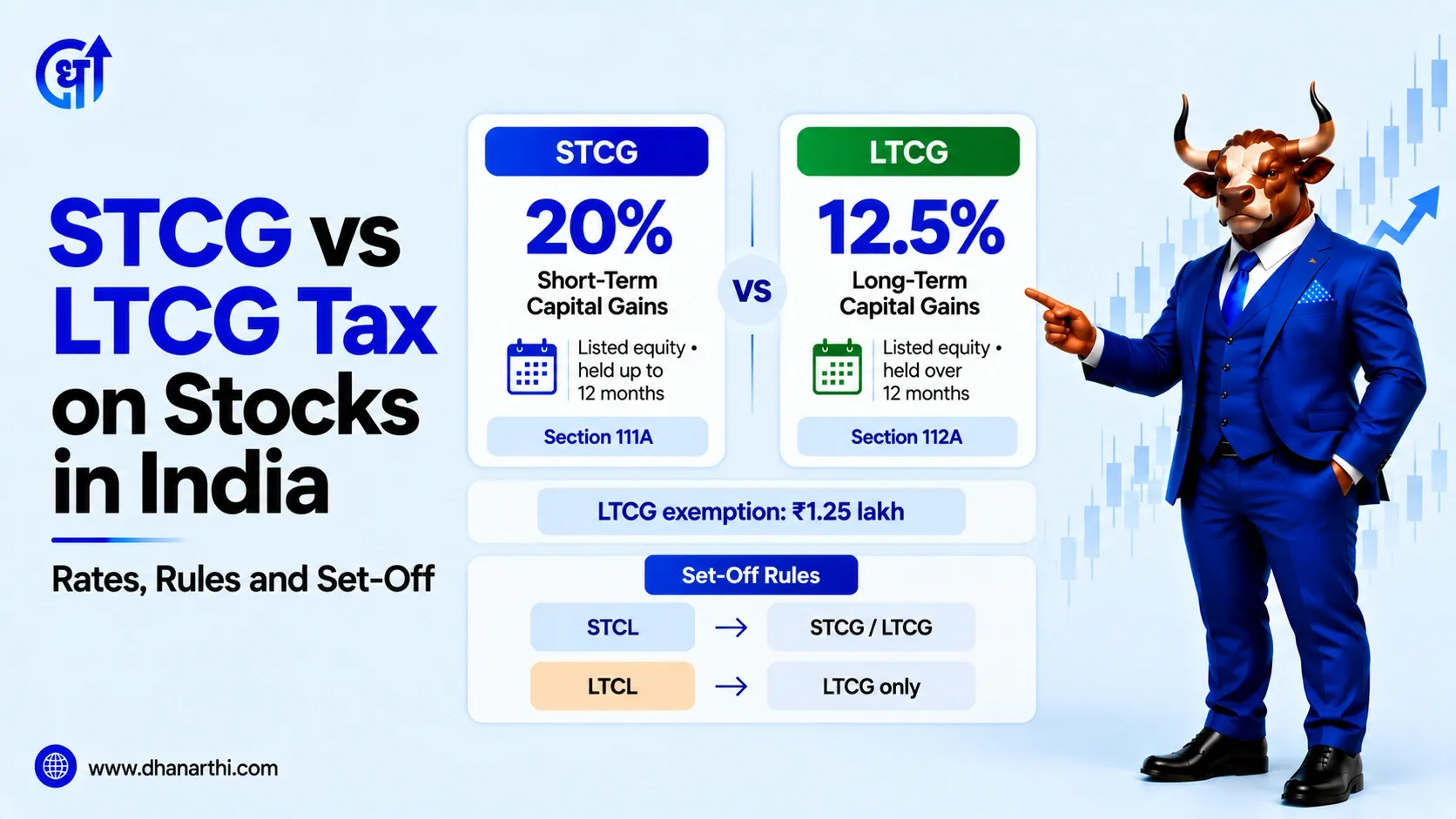
| Under 12 months | Short-Term Capital Gains (STCG) | 20% |
| Over 12 months | Long-Term Capital Gains (LTCG) | 12.5% |
| LTCG exemption | First ₹1.25 lakh per financial year | Tax-free |
In plain terms:
Hold your units for more than one year before redeeming
You pay 12.5% tax only on gains above ₹1.25 lakh per year
Gains up to ₹1.25 lakh per year are completely tax-free
This makes Nifty 50 index funds far more tax-efficient than fixed deposits, which are taxed at your full income slab rate
Tax planning tip: If your long-term gains are approaching ₹1.25 lakh in a financial year, consider partially booking profits before March 31 and reinvesting. This resets your cost basis and makes use of the annual exemption, a strategy called tax harvesting.
For more details, read our article on capital gains tax rules in India.
You are new to equity investing and want a simple, proven starting point
You have a long-term horizon of 7 years or more
You do not want to research individual stocks or track markets daily
You want to build wealth steadily through the power of compounding
You want to keep investing costs as low as possible
You want to beat the market: Consider an active flexi-cap or large-and-mid-cap fund
You want broader market exposure: Consider a Nifty 100 or total market index fund
You want higher growth potential with more risk: Consider the best Nifty Next 50 index fund options
You want mid and small-cap exposure: Consider a separate Nifty Midcap 150 or Smallcap 250 index fund alongside your Nifty 50 core
The most practical approach for most investors: Start with a Nifty 50 index fund as the core (60-70% of your equity allocation). Add Nifty Next 50 or mid-cap exposure progressively as your investment knowledge and risk tolerance grow.
The best Nifty 50 index fund in India is the one you actually stay invested in consistently, across market cycles, without panic-selling during corrections.
The differences between top funds in this category are small. What matters far more is:
Choose Direct Growth, not Regular, not IDCW
Start a SIP today, even ₹500 per month is a meaningful beginning
Pick a fund with a low expense ratio and tracking error. UTI, ICICI Pru, or Motilal Oswal are strong starting points for balance; Navi if cost is your only filter
Stay invested for 7-10 years; compounding needs time to work
₹5,000 per month invested in a Nifty 50 index fund at a 12% CAGR over 20 years grows to approximately ₹49 lakh. The strategy is not complicated. The discipline is what makes the difference.
The best time to start was 10 years ago. The second-best time is today. See the complete list of Nifty 50 index funds in the comparison table above before you decide.
Want to check the actual stocks and sector exposure inside any of these funds before you invest? Use Dhanarthi's stock screener to analyse Nifty 50 constituents directly.
Disclaimer: This article is for educational purposes only. It does not constitute investment advice. Please consult a SEBI-registered financial advisor before making investment decisions.
1. What is a Nifty 50 index fund?
A Nifty 50 index fund is a passively managed mutual fund that tracks India's top 50 companies listed on NSE. It mirrors the index automatically, requires no active stock picking, and offers broad large-cap exposure at a very low cost.
2. Which is the best Nifty 50 index fund in India in 2026?
There is no single best fund as all track the same index. UTI Nifty 50, ICICI Prudential Nifty 50, and Motilal Oswal Nifty 50 consistently rank among the top picks based on low expense ratio, low tracking error, and large AUM. If cost is your main filter, Navi Nifty 50 currently has the lowest expense ratio in the category.
3. Which Nifty 50 index fund has the lowest expense ratio?
Navi Nifty 50 Index Fund currently has the lowest direct-plan expense ratio in the category at approximately 0.06%, compared to a category average of 0.15% to 0.20%. It has a smaller AUM and shorter track record than established players like UTI or HDFC, so weigh cost against fund house stability.
4. What is the minimum amount to invest in a Nifty 50 index fund?
Many funds like HDFC, ICICI Prudential, Navi, and Bandhan allow SIPs starting at just ₹100 per month. UTI and SBI require a minimum SIP of ₹500. For lump sum investments, minimums range from ₹100 to ₹5,000 depending on the AMC.
5. What is the difference between Direct and Regular plan in a Nifty 50 index fund?
A Direct plan has no distributor commission, giving you a lower expense ratio of 0.06% to 0.20%. A Regular plan includes distributor fees, raising costs to around 1%. Over 20 years, this difference can reduce your final corpus by several lakhs. Always choose Direct.
6. Should I buy a Nifty 50 index fund or a Nifty 50 ETF?
For most retail investors doing a monthly SIP, an index fund is simpler since it needs no Demat account and supports automated SIPs directly from your bank. An ETF can be marginally cheaper but requires a Demat account and active buying, and can trade at a premium or discount to its NAV depending on liquidity.
7. What is tracking error in a Nifty 50 index fund?
Tracking error is the gap between what the Nifty 50 index actually returned and what your fund delivered. It is caused by expense ratio, cash held during rebalancing, and timing differences. Anything below 0.20% is considered excellent. Lower tracking error means better fund execution.
8. Is a Nifty 50 index fund safe?
A Nifty 50 index fund is among the lower-risk equity options in India but is not risk-free. It is safer than individual stocks or sectoral funds, but will fall when markets fall. For investors with a 7-10 year horizon, it is one of the most reliable ways to participate in India's economic growth.
9. Can I lose money in a Nifty 50 index fund?
Yes, in the short term. If you invest and redeem within 1-2 years, you may exit at a loss depending on market conditions. However, over any rolling 7-10 year period historically, the Nifty 50 has delivered positive returns. The key is staying invested long enough for compounding to work.
10. What is the difference between Nifty 50 and Nifty Next 50 index funds?
A Nifty 50 fund tracks India's top 50 companies, stable, large blue-chips. A Nifty Next 50 fund tracks companies ranked 51st to 100th by market cap, future large-cap candidates with higher growth potential but also higher volatility. Nifty 50 is more stable; Nifty Next 50 is more aggressive.
11. How is a Nifty 50 index fund taxed in India?
Nifty 50 index funds are taxed as equity funds. Gains from units held under 12 months attract 20% Short-Term Capital Gains (STCG) tax. Gains from units held over 12 months attract 12.5% Long-Term Capital Gains (LTCG) tax, with the first ₹1.25 lakh of gains per year being completely tax-free.
12. What is the full list of Nifty 50 index funds in India?
The major Nifty 50 index mutual funds in India include Navi, Bandhan, Motilal Oswal, ICICI Prudential, UTI, SBI, HDFC, Nippon India, DSP, and HSBC Nifty 50 index funds. All track the same benchmark, so compare them on expense ratio, tracking error, and AUM rather than fund name alone.
Share Market
IPO
Artificial Intelligence
Semi Conductor