





Capital Gains Tax on Shares India 2026 Rates
October 23, 2026



TABLE OF CONTENTS
Get AI Summary





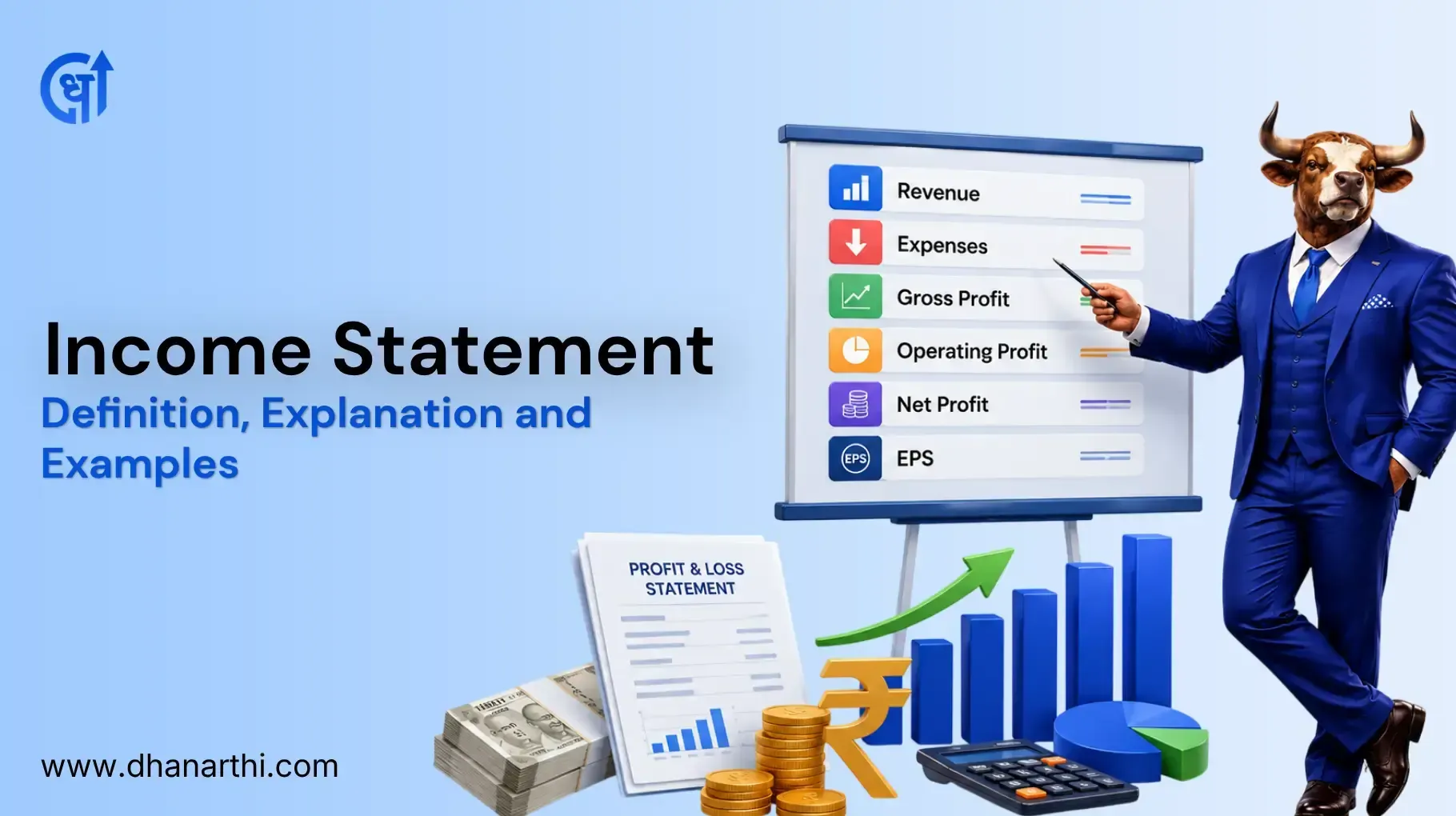
Income statement analysis is the process of reading a company's revenue, expenses, and profit line-by-line to assess financial performance. Investors analyze gross margin, EBITDA, net profit margin, and EPS to judge whether a company is growing profitably. This analysis is the first step in evaluating any Indian stock before investing.
Knowledge of how to interpret a Profit & Loss Statement is what makes the difference between people who invest wisely based on their knowledge and those who invest according to tips.
In this article, we discuss all the important aspects of the income statement, including revenue and net profit, in detail and explain how to interpret them using actual examples from India-based companies. For a broader picture of financial health, pair this with financial statement analysis.
The income statement is an important document that highlights the earnings, expenses, and profits made by a business during a certain time period, usually quarterly or annually.
As per SEBI rules, all listed Indian companies are required to declare their quarterly performance within 45 days after every quarter ends. These results are then available on the filing websites of both BSE and NSE.
The income statement is the starting point for any stock analysis. It answers three basic questions:
Is the company earning more than it spends?
Are margins improving or declining?
Is profit coming from the core business or one-time sources?
To understand the income statement in full detail, read the income statement guide on Dhanarthi.
An income statement follows a waterfall structure. Revenue at the top; net profit at the bottom. Every line between them is a deduction.
Revenue refers to the aggregate amount generated through sales of products or services in that time period. This does not include income from any other source like investments or interest earned.
A healthy trend is a continuous growth rate in revenue between 10% to 15% per year. If the revenue increases lower than the industry average, it indicates a loss of market share or competitive pricing.
COGS covers the direct costs of producing what the company sells raw materials, manufacturing labor, and direct overheads.
Gross Profit = Revenue minus COGS
Gross Profit Margin = (Gross Profit / Revenue) x 100
An increasing gross margin on a number of consecutive quarterly periods shows a positive change in terms of pricing or control over input costs. A decreasing gross margin despite a growing top line reflects higher cost increases compared to price growth.
EBITDA stands for Earnings Before Interest, Taxes, Depreciation, and Amortisation. It measures profit from operations before accounting and financing decisions.
EBITDA = Gross Profit minus Operating Expenses (SG&A, employee costs, marketing, R&D)
Earning Before Interest, Tax, Depreciation, and Amortization can be utilized for comparisons among firms having various levels of capital structures. A firm having huge debts will exhibit lower net earnings but still have high EBITDA. Nevertheless, EBITDA is not enough and must be followed by other factors.
Net profit is what remains after deducting all expenses, interest, depreciation, and taxes from revenue.
Net Profit Margin = (Net Profit / Revenue) x 100
EPS (Earnings Per Share) = Net Profit / Total Shares Outstanding
EPS growth drives the P/E ratio and directly influences stock price over time. A company growing EPS at 15-20% annually with stable margins is typically rewarded with a higher valuation. For understanding how EPS connects to valuation, read the P/E ratio guide.
The five metrics below form the core of any income statement review. Every investor should calculate and track all five before making a buy or sell decision.
| Metric | Formula | What It Measures | Benchmark (General) |
|---|---|---|---|
| Gross Profit Margin | (Gross Profit / Revenue) x 100 | Core product profitability | Varies by sector (see table in next section) |
| EBITDA Margin | (EBITDA / Revenue) x 100 | Operating profitability before D&A | 15-20% for mid-size Indian companies |
| Net Profit Margin | (Net Profit / Revenue) x 100 | Final profitability after all costs | 10%+ is generally healthy |
| Revenue Growth (YoY) | (Current Revenue - Prior Revenue) / Prior Revenue x 100 | Business expansion rate | 10-15% YoY for growing companies |
| EPS Growth (YoY) | (Current EPS - Prior EPS) / Prior EPS x 100 | Shareholder earnings growth | Above 15% signals strong earnings momentum |
Data sourced from NSE/BSE filings and standard financial analysis methodology. Last updated: June 2026.
Follow these seven steps every time you open a quarterly P&L:
Check revenue growth YoY. Is the company growing its top line? Compare the current quarter's revenue to the same quarter last year.
Check gross margin trend. Is gross margin stable, improving, or falling? Compare the last four quarters.
Evaluate EBITDA margin. Calculate EBITDA as a percentage of revenue. Is it expanding or contracting?
Check Other Income as a percentage of total income. If Other Income exceeds 20-25% of net profit, flag it (explained in detail below).
Track net profit trend. Net profit growing faster than revenue indicates margin improvement a positive signal.
Calculate EPS and compare to the previous year. Rising EPS confirms genuine earnings growth for shareholders.
Cross-read with cash flow. Verify that rising net profit is matched by rising cash from operations. (Covered in the section below.)
For reading actual company financial reports directly, the Financial Report Analysis tool on Dhanarthi walks through P&L filings line by line.
Infosys reported its Q3 FY25 results on January 16, 2025. Here is how a retail investor would read the key figures:
| Metric | Q3 FY25 | Q3 FY24 | YoY Change |
|---|---|---|---|
| Revenue | Rs 41,353 crore | Rs 38,821 crore | +6.3% |
| Net Profit | Rs 6,806 crore | Rs 6,106 crore | +11.4% |
| Net Profit Margin | 16.5% | 15.7% | +0.8 percentage points |
| EPS | Rs 16.40 (approx.) | Rs 14.71 (approx.) | +11.5% |
Source: BSE filing, Infosys Q3 FY25 results, January 16, 2025.
What these numbers tell an investor:
Revenue grew 6.3% YoY, steady but not exceptional for a large-cap IT company.
Net profit grew faster than revenue (11.4% vs 6.3%). This confirms margin improvement, a positive signal.
Net profit margin improved from 15.7% to 16.5%, operating leverage at work.
EPS growth of 11.5% YoY directly supports the stock's P/E valuation.
This is how income statement analysis works in practice: not reading numbers in isolation, but reading the relationships between numbers across periods.
These are the two standard methods used to analyze any income statement.
| Method | What It Does | How to Use It |
|---|---|---|
| Horizontal Analysis | Compares each line item across multiple periods (quarters or years) | Use to identify trends is revenue growing? Are margins expanding? |
| Vertical Analysis | Expresses each line item as a percentage of revenue | Use to compare companies of different sizes in the same sector |
Data sourced from standard financial analysis methodology. Last updated: June 2026.
Horizontal analysis answers: "Is this company improving over time?"
Vertical analysis answers: "How efficiently is this company converting revenue into profit, relative to peers?"
Use both together. A company where employee costs as a % of revenue are shrinking while revenue grows, that is, operating leverage, visible only through vertical analysis.
Margins cannot be compared across sectors. A 10% net profit margin is exceptional for an auto company but weak for an IT firm. Use the table below to benchmark what you read in any income statement.
| Sector | Typical Gross Margin | Typical EBITDA Margin | Typical Net Profit Margin | Example Companies |
|---|---|---|---|---|
| IT Services | 30-35% | 22-28% | 15-20% | Infosys, TCS, Wipro |
| FMCG | 45-55% | 18-25% | 12-18% | HUL, ITC, Marico |
| Auto | 12-18% | 10-16% | 5-10% | Maruti Suzuki, Bajaj Auto |
| Pharma | 55-70% | 18-28% | 12-22% | Sun Pharma, Dr. Reddy's |
| Banking / NBFC | N/A (NIM used) | N/A | 15-25% (RoE-based) | HDFC Bank, Kotak Bank |
Data sourced from NSE/BSE company filings (FY24-FY25). Last updated: June 2026. Note: Ranges are indicative and vary by company size and business model.
Key rule: Never reject a stock because its net margin looks "low" without first checking the sector average. Maruti Suzuki, at 8% net margin, is performing well for an auto OEM. Infosys at 8% net margin would be a serious concern.
Other Income appears as a separate line in Indian company P&L statements. It includes interest earned on cash, gains from selling investments, forex gains, and income from subsidiaries.
Other Income is not operating income. It does not repeat reliably quarter to quarter.
How to check it:
Calculate Other Income as a percentage of Net Profit:
(Other Income / Net Profit) x 100
If this number exceeds 25%, a significant portion of the company's reported profit is not coming from its core business. This profit may not repeat in future quarters, making the stock's earnings less reliable as a valuation base.
Example pattern: A manufacturing company reports Rs 200 crore net profit. Rs 80 crore came from selling a piece of land. The core business only generated Rs 120 crore. Next quarter, with no land to sell, net profit could fall 40% even if operations are unchanged.
Always read the notes to the financial statements to find out the factors behind Other Income. If you want to reconcile your assets and liabilities in terms of Other Income, compare the balance sheet with the income statement.
The business entity may show profits increasing despite negative cash flows from operations. This is one of the crucial red flags in the stock analysis, and hardly any beginner investors will notice it.
How it happens: Under accrual accounting, revenue is recorded when goods are sold not when cash is received. If receivables pile up, the income statement shows profit while the business has not actually collected cash.
The check:
Compare Net Profit (income statement) with Cash from Operations (cash flow statement):
Net Profit: Rs 500 crore
Cash from Operations: Rs 480 crore
This is healthy, profit is being converted to cash.
Net Profit: Rs 500 crore
Cash from Operations: Rs 50 crore
This is a red flag. The company is booking profit on paper but not collecting cash. Over multiple quarters, this pattern can signal revenue manipulation or deep receivables problems.
For a full explanation of how to read cash flow data, refer to the cash flow statement guide on Dhanarthi.
Manually tracking revenue growth, net profit margin, and EBITDA across dozens of companies takes hours. The right tools reduce that to minutes.
Dhanarthi Screener: Filter all NSE-listed companies by net profit margin, revenue growth YoY, and EBITDA margin simultaneously. Set thresholds and get a filtered list in seconds.
Dhanarthi Financial Report Analysis: Read actual quarterly P&L filings company by company, with key metrics pre-calculated and visualized.
Use the Dhanarthi stock screener to filter NSE-listed companies by net profit margin above 15% and YoY revenue growth above 10% in under 30 seconds.
Income statement analysis is not about looking at one number and making a quick judgment. A company may show strong profit, but the real story comes from understanding how revenue, margins, expenses, profit, and cash flow move together over time.
The first thing to check is whether revenue is growing consistently year over year. Strong businesses usually show steady sales growth, not just one lucky quarter. After that, look at gross margin and EBITDA margin. If margins are stable or improving, it means the company is managing costs well and maintaining pricing power.
Finally, always compare Cash from Operations with Net Profit. A company can report profit on paper, but if cash flow is weak, there may be issues with receivables, inventory, or working capital. These five checks help investors separate genuinely profitable companies from businesses that only appear profitable in the income statement.
Disclaimer: This article is for educational purposes only. It does not constitute investment advice. Please consult a SEBI-registered financial advisor before making investment decisions.
1. What is income statement analysis?
Income statement analysis is the process of examining a company's revenue, expenses, and profit figures to assess its financial performance and profitability.
2. How do you read a profit and loss statement in India?
Start with revenue and check its YoY growth. Then move down to gross margin, EBITDA margin, and net profit margin.
3. What is the difference between gross profit and net profit?
Gross profit is revenue minus the direct cost of producing goods (COGS). Net profit is what remains after deducting operating expenses, employee costs, depreciation, interest, and taxes.
4. What is EBITDA, and why do investors use it?
EBITDA stands for Earnings Before Interest, Taxes, Depreciation, and Amortisation. Investors use it to compare operating profitability across companies with different debt levels and depreciation schedules.
5. How do you calculate net profit margin?
Net profit margin = (Net Profit / Revenue) x 100. If a company reports a net profit of Rs 6,806 crore on revenue of Rs 41,353 crore, its net profit margin is approximately 16.5%.
6. What is horizontal analysis of an income statement?
Horizontal analysis compares the same line items (revenue, EBITDA, net profit) across multiple periods, quarters, or financial years. It identifies whether the company is growing, stagnating, or declining.
7. What is the vertical analysis of an income statement?
Vertical analysis expresses each line item as a percentage of total revenue. For instance, if employee costs are 55% of revenue for an IT company, that percentage can be tracked over time or compared against peers.
8. What are the red flags to look for in an income statement?
Key red flags include: revenue growing but margins falling; Other Income making up more than 25% of net profit; net profit rising while Cash from Operations is flat or negative.
9. How does income statement analysis help in picking stocks?
Income statement analysis helps identify companies with consistent revenue growth, expanding margins, and high-quality earnings. These companies typically deliver better stock performance over the long term.
10. How often do Indian companies publish income statements?
Under SEBI regulations, all listed Indian companies must publish quarterly financial results within 45 days of the quarter's end. They also publish annual results (full-year P&L) within 60 days of the financial year end (March 31).
Share Market
IPO
Artificial Intelligence
Semi Conductor