


Best Nifty Next 50 Index Fund India 2026
October 20, 2026



TABLE OF CONTENTS
Get AI Summary





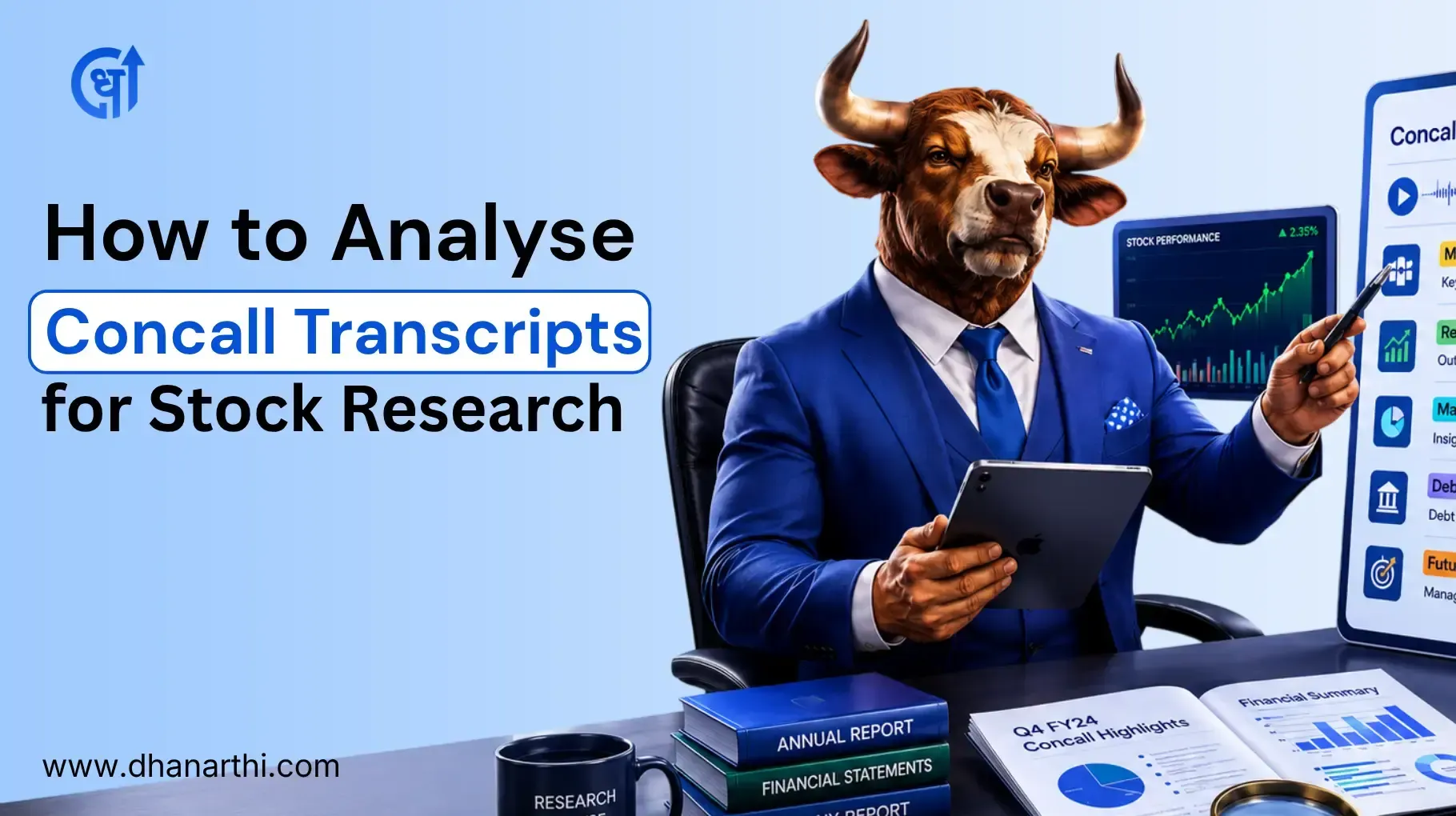
Concall transcripts for stock research are written records of a company's post-results earnings call with analysts. To analyse them: read prepared remarks for business updates, focus on the Q&A section for unscripted management responses, flag hedge words and evasive answers, compare guidance against past results, and verify claims against quarterly financials. Free transcripts are available on BSE, NSE, and Trendlyne.
In this guide, you will be taught to analyse the transcripts for stock analysis in a systematic manner via five steps. If you are also learning how to analyse a stock before investing, conference call transcripts are a natural complement to financial statement analysis.
A conference call transcript is a written record of a company’s earnings conference call. These calls are usually conducted one to three days after quarterly results are announced on BSE or NSE.
The transcript captures the full discussion from the call, including management’s prepared remarks and the live question-and-answer session with analysts.
A conference call, on the other hand, is live. Management answers analyst questions in real time, which often gives investors deeper insights into the company’s actual business situation.
Under SEBI’s Listing Obligations and Disclosure Requirements regulations, listed companies are expected to follow fair and timely disclosure practices. SEBI does not specifically make call transcript publication mandatory, but the broader disclosure framework has encouraged many large-cap companies to voluntarily publish transcripts on BSE, NSE, or their investor relations pages within 24 to 48 hours after the call.
For retail investors, a conference call transcript is one of the closest sources to understanding how management thinks, explains performance, responds to difficult questions, and discusses future business outlook.
The most common question for investors new to concall analysis is where to find the transcripts in the first place. Here are the main free platforms available to Indian retail investors.
| Platform | Type | Free / Paid | Indian Coverage |
|---|---|---|---|
| BSE Corporate Filings (bseindia.com) | Official Exchange | Free | All BSE-listed companies |
| NSE Exchange Filings (nseindia.com) | Official Exchange | Free | All NSE-listed companies |
| Company Investor Relations (IR) Page | Company Source | Free | Varies by company |
| Trendlyne | Aggregator | Free (basic) / Paid | BSE + NSE listed |
| Stockadda | Aggregator | Free | BSE + NSE listed |
| Dhanarthi AI Financial Research Assistant | AI Analysis Tool | Free | BSE + NSE listed |
You can find call transcripts on both the BSE and the NSE websites.
To find a transcript on BSE, visit bseindia.com and search for the company using its name or BSE code. Then go to the Corporate Announcements section and check for filings related to investor presentations, earnings calls, or conference call transcripts.
To find a transcript on NSE, visit nseindia.com and search for the company name or symbol. Open the company page, go to the Corporate Filings section, and check the Announcements tab. Companies usually upload conference call transcripts, investor presentations, and earnings call updates in this section.
If you want to skip the manual process, the Dhanarthi AI Financial Report Analysis tool reads BSE/NSE-filed transcripts automatically and extracts the key management guidance, risks, and sentiment.
Most concall transcripts run between 30 and 60 pages. Reading them end-to-end without a framework wastes time. The following five-step process structures your reading to extract maximum signal in minimum time.
Each call starts with an opening statement. Either the MD or the CEO starts with a brief business update focusing on revenue and margin performance for the quarter, future demand expectations, capex plans, and order book status.
Since this part is always scripted, there isn't much that you can extract from the language. Just go through it fast and catch any numbers or trends emphasised by management. More importantly, keep an eye out for things not being mentioned.
Analysis commences in the Q&A portion of the presentation. The analysts who belong to the institutional investors pose tough questions regarding margin pressure, debts, working capital, delayed orders, customer concentration, and other risks.
The company’s management answers the questions. It is in this phase that you would find the inconsistencies, contradictions, and admission of weaknesses in their statements. When the management is evasive regarding the numbers, this is another indication that you should take notice of.
Management commentary stock research requires understanding the difference between confident language and hedge language. Phrases that signal uncertainty or evasion include: "we are in a challenging environment," "it was a one-off quarter," "we are monitoring the situation closely," "it is still early days," and "that is an aspirational target." These phrases are not always dishonest, but when they appear repeatedly, or in response to direct questions about specific numbers, they are a signal to investigate further.
Contrast this with confident language: "our order book is at an all-time high of Rs 4,200 crore," "margin recovery is clearly visible from Q2 numbers," "we have firm repeat orders from three of our top five clients." Specificity is confidence. Vagueness is a flag.
All the assertions made by management during a conference call have to be cross-checked with the quarterly filing. In case management claims that gross margins are stabilising, go through the P&L report on BSE and find out whether margins have improved, remained flat, or fallen by 200-300 basis points.
If management says working capital is under control, go through the cash conversion cycle from the balance sheet report. This process is what sets apart a decent analysis of conference calls from mere reading.
A guide to financial statement analysis explains how to read each financial statement in detail.
Single-quarter analysis is useful but incomplete. The real value of cConcalltranscripts comes from building a guidance tracking log across quarters. After each call, note the specific forward guidance management provided, for example, "we expect EBITDA margins to expand by 150 basis points in the next two quarters." Then, after the results, compare the actual delivery against that guidance. Consistent over-promise and under-delivery is a structural credibility signal, not a one-time event.
The table below is compiled from language patterns observed in BSE/NSE-filed concall transcripts across Indian sectors as of June 2026. It is intended as a reference guide, not an exhaustive list. Context always matters; a single phrase is not sufficient to form an investment view.
| Red Flag Language | Positive Signal Language |
|---|---|
| "It was a challenging environment this quarter." | "Revenue grew 18% year-on-year with broad-based demand across segments." |
| "This was a one-off quarter due to external factors." | "We have been delivering on our guidance for the past three quarters." |
| "We are monitoring the situation and will update you." | "Our order book stands at Rs 5,800 crore, up 22% year-on-year." |
| "That is an aspirational target for the longer term." | "We are guiding for EBITDA margins of 17 to 18% in Q2 FY26." |
| "It is still early days; we need one more quarter." | "Margin recovery is clearly visible in our Q1 gross margin numbers." |
| "Our working capital is broadly in line with expectations." | "We reduced debtor days from 82 to 63 days this quarter." |
| "We do not wish to quantify guidance at this stage." | "We have firm purchase orders from five anchor clients for H2 FY26." |
| "Pricing pressure is temporary and should normalise." | "We implemented a 4% price increase in January with full client acceptance." |
Source: Language patterns compiled from BSE/NSE-filed concall transcripts across IT, banking, FMCG, and capital goods sectors, June 2026. Not investment advice.
How to use this table:
A single red-flag phrase in isolation is not a sell signal. Look for a cluster of three or more red flag phrases in the same Q&A that are meaningful.
Pay special attention to red flag language that appears in response to direct analyst questions about margins, cash flow, or debt.
When positive signal language is backed by specific numbers (e.g., debtor days, order value), it is more credible than vague optimism.
Track whether the language used changes from quarter to quarter. A management team shifting from specific guidance to vague commentary is worth investigating.
The most powerful use of call transcripts is tracking management guidance accuracy over time. The table below illustrates this method using publicly available data from Infosys FY25 quarterly results and concalls filed on NSE. For how this fits into broader stock selection, see how to pick stocks in India.
| Quarter | Guidance Given (Prior Concall) | Actual Delivered | Assessment |
|---|---|---|---|
| Q1 FY25 | Revenue growth guidance of 1–3% in constant currency for FY25 (given in Q4 FY24 concall) | CC revenue growth of 2.5% for Q1 FY25 | Within guidance range |
| Q2 FY25 | Maintained FY25 CC revenue guidance at 1–3% | CC revenue growth of 3.1% for Q2 FY25 (above mid-point) | Guidance met; raised full-year range to 2–3% |
| Q3 FY25 | Guided FY25 CC revenue at 4.5–5% | CC revenue growth of 4.9% for Q3 FY25 | Top of the range delivered |
Source: Infosys concall transcripts and quarterly results, BSE/NSE filings, FY25. Data is illustrative of the guidance tracking methodology.
Infosys is used as an example because it is one of the most disciplined guidance providers among Indian large-cap companies. The company gives clear, quantified annual guidance and updates it every quarter. Most Indian companies do not provide this level of precision.
For companies that do not give exact numerical guidance, investors should create their own tracking log.
Every quarter, note the qualitative guidance shared by management. This may include comments such as margin expansion, volume recovery, working capital normalisation, demand improvement, or cost pressure reduction.
Then, compare these statements with the company’s actual performance in the next quarter. Over three to four quarters, a clear pattern starts to emerge.
Consistent guidance delivery is a strong indicator of management quality and execution reliability. It shows that the management understands its business, has good visibility, and communicates honestly with investors.
On the other hand, repeated guidance misses are a warning sign. Even if each miss is explained separately, a consistent pattern of misses may suggest that management either does not have proper visibility into the business or is trying to manage investor expectations instead of reporting the situation clearly.
For retail investors, tracking guidance versus actual performance is one of the simplest ways to judge management credibility over time.
Different sectors in India produce concalls with different primary metrics. The table below lists the key data points to extract and track in a call by sector.
| Sector | Key Metrics to Track in Concall |
|---|---|
| IT Services | Deal wins (number and TCV), large deal pipeline, revenue growth guidance by vertical, attrition rate, utilisation, and margin trajectory |
| Banking / NBFC | Net Interest Margin (NIM) guidance, slippage and GNPA trends, CASA ratio, credit cost guidance, and loan book growth by segment |
| FMCG / Consumer | Volume growth vs price growth split, rural vs urban demand commentary, gross margin trajectory, distribution expansion |
| Capital Goods / Infrastructure | Order book value, L1 pipeline, order inflow guidance, capex plans, execution timeline, working capital cycle |
| Pharma / Healthcare | US FDA observations and resolution timeline, chronic vs acute mix, ANDA filing pipeline, price erosion in US generics |
| Cement / Commodities | Realisations per tonne, fuel cost trajectory, utilisation rates, capacity addition timeline, regional demand commentary |
| Real Estate | Bookings value and volume, collections, launch pipeline, debt reduction trajectory, and unsold inventory levels |
Reading a 40 to 60-page call transcript manually and applying the five-step framework can take a lot of time. For one company, it usually takes around 45 to 90 minutes per transcript, every quarter.
For investors tracking a portfolio of 15 to 20 stocks, this process becomes time-consuming very quickly.
Dhanarthi’s AI Financial Research Assistant helps simplify this process by automatically reading concall transcripts filed on NSE and BSE. It identifies important management guidance statements, detects cautious or unclear language, summarises sector-specific metrics, and highlights possible inconsistencies between management commentary and reported financial numbers.
The tool is specifically built for NSE and BSE-listed Indian companies. It understands the Indian market context, sector-specific terminology, financial reporting language, and SEBI filing formats.
For retail investors, this makes concall analysis faster, more structured, and easier to apply across multiple companies. Use the AI Financial Research Assistant on Dhanarthi to get instant call sentiment, management guidance, and risk flags for any NSE/BSE-listed company without reading the full transcript.
Call transcripts for stock analysis constitute some of the richest but least utilised sources of information for Indian individual investors.
By adopting the five-step process outlined in this guide, including understanding prepared statements for factual data, analysing unscripted Q&As for insights, identifying hedge statements, validating statements by matching them with numbers, and analysing the accuracy of guidance, you can paint a much more detailed picture of any Indian public firm than is revealed through press releases alone.
The process requires some initial investment of time to set up a guidance tracking log. Once in place, it becomes a powerful systematic tool for evaluating management quality, arguably the single most important variable in long-term stock performance.
Disclaimer: This article is for educational purposes only. It does not constitute investment advice. Please consult a SEBI-registered financial advisor before making investment decisions.
1. What is a concall transcript in the stock market?
A conference call transcript is a written record of a company's earnings conference call, typically held after quarterly results. It includes prepared remarks by management and a live Q&A session with analysts.
2. How do I find concall transcripts of Indian companies for free?
BSE corporate filings (bseindia.com), NSE exchange filings (nseindia.com), and company investor relations pages are the primary free sources. Aggregator platforms such as Trendlyne and Stockadda also compile transcripts.
3. Does SEBI make it mandatory for companies to publish concall transcripts?
SEBI does not currently mandate publication of concall transcripts under LODR regulations. However, SEBI guidelines encourage listed companies to maintain fair disclosure.
4. What is the difference between prepared remarks and Q&A in a concall?
Prepared remarks are scripted statements read by the CEO, CFO, or MD at the start of the call. They are carefully worded and PR-reviewed. The Q&A section that follows is unscripted analysts ask direct questions and management answers in real time.
5. What are the red flags to watch in a concall transcript?
Key red flags include: overuse of hedge words such as "challenging environment" or "we are monitoring the situation"; deflection of specific analyst questions; attributing every miss to "one-off factors.
6. How often do Indian companies hold concalls?
Most listed Indian companies hold concalls quarterly, after announcing their Q1, Q2, Q3, and Q4 results. Large-cap companies in sectors such as IT, banking, FMCG, and pharma tend to hold structured calls with high analyst participation.
7. How do I compare what management guided vs what they delivered?
Create a simple tracking table per company. After each concall, note the specific metric management guided (for example, EBITDA margin expansion of 100 to 150 basis points in the next quarter) and the period cited. After results are announced, compare the actual reported figure against the guidance.
8. Which sectors in India give the most useful concall information?
IT services (deal wins, TCV, attrition), banking and NBFCs (NIM trajectory, slippages, CASA), capital goods and infrastructure (order book, L1 pipeline, capex plans), and FMCG (volume vs price growth, rural-urban demand split) tend to produce the most data-rich concalls.
9. Can AI tools help me analyse concall transcripts faster?
Yes. AI tools can scan 40 to 60 page concall transcripts in seconds, extract management guidance statements, flag hedge language, summarise key risks, and produce sector-relevant metric summaries.
10. How do I use concall transcripts alongside financial statements?
After identifying a claim in the call for example, "margins are recovering" verify it against the gross margin and EBITDA figures in the quarterly P&L filed on BSE. If management states capex is under control, cross-check against the cash flow from investing activities. This cross-verification step is the most important discipline in concall analysis.
Share Market
IPO
Artificial Intelligence
Semi Conductor