





Best Banking Stocks in India 2026
October 26, 2026



TABLE OF CONTENTS
Get AI Summary





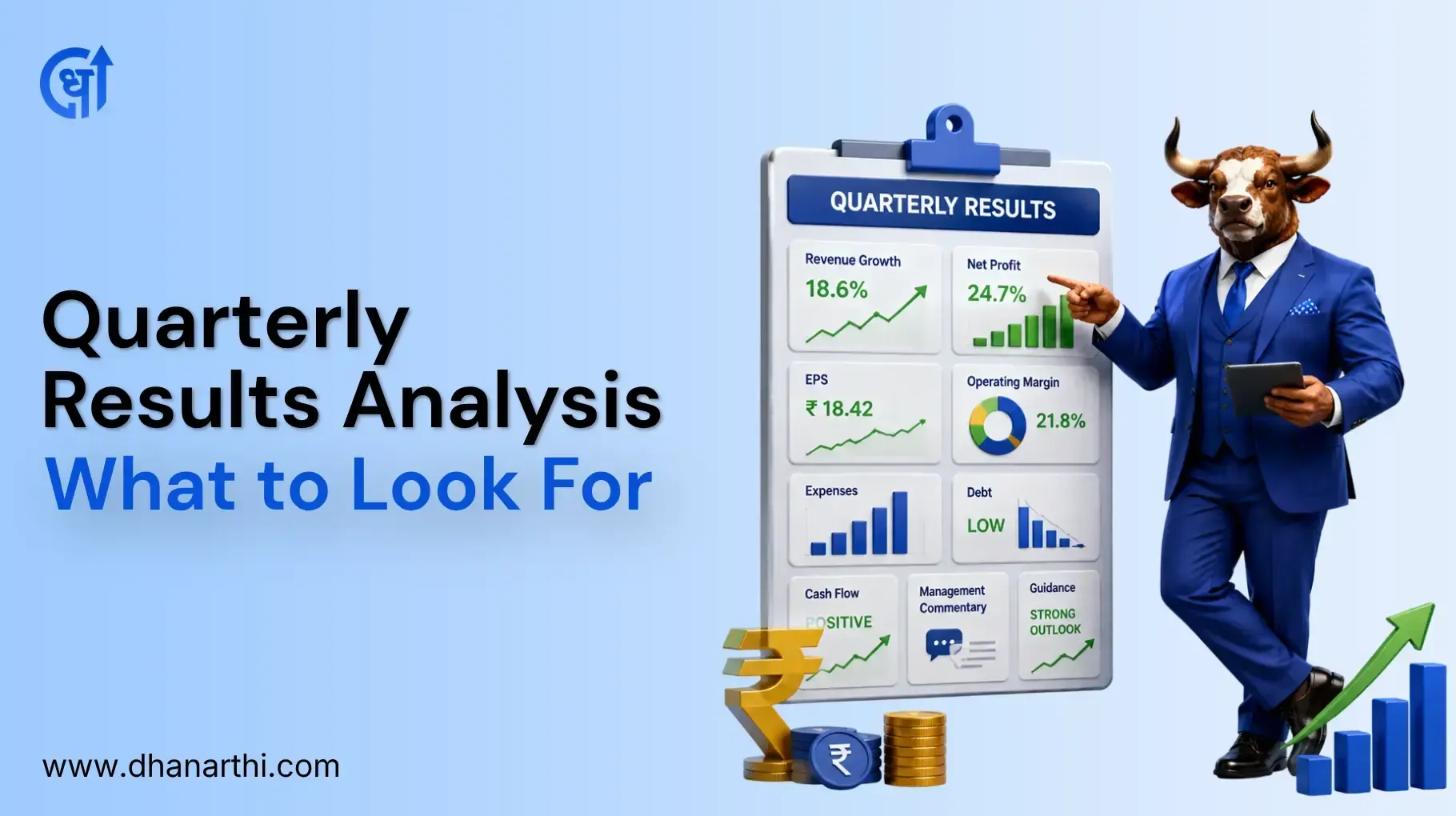
Quarterly results analysis means reading a listed company's Q1 to Q4 financial filings to check whether its revenue, profits, and margins are improving. Key metrics are revenue growth (YoY/QoQ), EBITDA margin, PAT, EPS, and cash flow. SEBI requires all listed companies to publish results within 45 days of each quarter's end on the BSE and the NSE.
Most individual investors stop there with the net profits figures. Those who make more sound judgments look beyond and analyse the margins, quality of cash flows, earnings forecasts, and even those warning signs within the strong figures.
This article covers the exact metrics to check, the order to check them, and what the numbers actually signal. For a strong base before you begin, read this guide on financial analysis definition types and examples first.
Quarterly results analysis is the process of examining a listed company's financial disclosures for three months to assess its business health, growth trajectory, and risks.
In India, companies follow an April-to-March fiscal year. This creates four reporting quarters:
Q1: April to June
Q2: July to September
Q3: October to December
Q4: January to March
When a company says "Q2 FY26 results," it means the July to September 2026 financials.
SEBI mandates that all listed companies publish quarterly results within 45 days of the quarter ending (60 days for Q4, which accompanies annual results). This creates four earnings seasons every year: mid-August (Q1), mid-November (Q2), mid-February (Q3), and mid-May (Q4). Source: SEBI Listing Obligations and Disclosure Requirements (LODR) Regulations, 2015.
All the quarterly reports are open to the public. Log on to bseindia.com or nseindia.com, type the name of the company under “Corporate Announcements,” and find the "Financial Results" option. The results will consist of the Profit & Loss account, Balance sheet, Cash Flow statement, and notes.
Six metrics tell you most of what you need to know in the first five minutes of reading a quarterly result.
| Metric | What It Measures | Good Signal | Warning Signal |
|---|---|---|---|
| Revenue (Net Sales) | Core business income | Growing 10%+ YoY | Flat or declining |
| EBITDA Margin | Operating efficiency | Stable or expanding | Shrinking despite revenue growth |
| PAT (Net Profit) | Bottom-line profit | Growing consistently | One quarter spike, then flat |
| EPS (Earnings Per Share) | Profit per share | Rising trend over 4+ quarters | Sudden jump from a one-time tax credit |
| Interest Cost | Debt load | Stable or declining | Rising faster than revenue |
| Other Income % | Non-core gains | Below 10% of the total profit | Above 20% profit quality poor |
Data framework based on BSE/NSE quarterly filing structure and SEBI LODR format. Last updated: June 2026.
Sales growth will determine if the company is increasing its sales or not. For companies operating in the seasonal industry segment, it is always necessary to analyse year-on-year (YoY).
Sales in the FMCG, retail, and auto industries are highly seasonal. A cement business's first-quarter performance from April to June is hampered due to the monsoon. Analysing quarter-on-quarter comparison (QoQ) in this case would provide misleading results. The accurate comparison should be on a YoY basis, i.e., Q1 FY26 compared with Q1 FY25.
For the IT Services and Telecoms industry, QoQ analysis is relevant too.
Rule: Use YoY for seasonal sectors. Use both YoY and QoQ for non-seasonal sectors to get a complete picture.
EBITDA margin or EBITDA/Revenues measures the efficiency of operations.
If a company has revenues of Rs 1,000 crore and EBITDA of Rs 200 crore, its EBITDA margin will be 20%. In the next quarter, if revenues increase to Rs 1,100 crore and yet EBITDA stays at Rs 200 crore, the margin will now become 18.2%.
This is a bad sign because costs are going up faster than revenues.
According to the Motilal Oswal Q3 FY26 report (February 2026), the Nifty EBITDA margin (excluding Financials) fell by 90 basis points Year-on-Year even as revenues increased 12%.
PAT (Profit after Tax) is the final amount that remains after taking into account all expenses, interest, tax, etc. Operating profit (EBIT or EBITDA) shows just the bottom line from the core business operations.
This distinction is important as the PAT may be exaggerated by some one-off items such as the sale of a property, tax rebate received, and forex profit earned.
Always check: Is PAT growth driven by operating profit growth, or by "other income"? If operating profit is flat but PAT jumped, the result is weaker than it looks.
This is the most typical misinterpretation made by retail investors: A firm announces 20% profit growth but sees its share price fall 8% within one trading day of that announcement. And this happens because of analysts’ projections.
In advance of each quarterly earnings announcement, numerous institutional analysts release their predictions for large firms' performance. The mean forecast is called a consensus estimate, and stocks have already priced this performance before an actual announcement.
Infosys reported Q4 FY26 revenue growth of 6.6% YoY in rupee terms and an operating margin of 20.9% (Source: Infosys BSE filing, April 23, 2026). FY26 basic EPS grew 11% YoY to Rs 71.58. The results were largely in line with analyst expectations, and the stock's reaction was measured with no sharp move in either direction, consistent with a result that confirmed rather than surprised.
Contrast this with a scenario where guidance is cut. Even if current-quarter numbers are strong, a guidance reduction signals weaker future earnings, and the market reprices the stock immediately.
Key takeaway: Before reading results, check what analysts expected. The gap between reported numbers and consensus estimates drives stock reactions, not the absolute numbers alone. Analyst estimates for large-cap Indian companies are tracked on platforms such as NSE's investor relations data and financial research portals.
To compare financial metrics across quarters for Indian stocks, use financial ratio analysis tools that let you benchmark against consensus.
Strong financial results can sometimes hide deeper business problems. Retail investors often look only at revenue growth or profit growth, but the real picture is usually hidden inside the details.
Here are five warning signs that most investors miss while reading quarterly results.
Profit after tax may look strong, but investors should always check where that profit is coming from.
Other income includes interest earned, asset sales, forex gains, tax credits, or one-time gains. These are usually not part of the company’s core business operations.
For example, if operating profit grows only 5 per cent but PAT grows 30 per cent, the profit growth may not be sustainable. In such cases, investors should carefully check the other income line before assuming that the business has improved.
A sharp rise in PAT without similar growth in operating profit is a major red flag.
A company can record revenue when an invoice is raised, even if the customer has not paid yet. If receivables or debtors keep rising every quarter, it means the company is booking sales but not collecting enough cash.
Investors should always compare PAT with operating cash flow. If profits are rising but operating cash flow is flat or negative, the company’s earnings may not be as strong as they appear.
Revenue growth alone is not enough. A company must also protect its margins.
If revenue grows by 1 per cent year-on-year but EBITDA margin falls by 200 basis points, it means costs are rising faster than sales. This may happen due to pricing pressure, raw material inflation, higher employee expenses, or weak cost control.
Sustainable companies usually maintain stable or improving margins along with revenue growth.
A rising interest cost usually indicates that the company is taking on more debt.
For example, if revenue grows by a percentage but interest cost grows by 25 per cent, the company may be borrowing aggressively. This can affect future profitability because a larger portion of earnings will go toward interest payments.
Investors should check the company’s debt-to-equity ratio, finance cost trend, and cash flow position over the last few quarters.
Timely filing of quarterly results is an important sign of good governance.
SEBI requires listed companies to declare quarterly results within the prescribed deadline. If a company regularly delays its results or misses deadlines, it may indicate weak internal controls, poor accounting systems, or possible governance issues.
A company that struggles to report numbers on time may also have deeper problems inside its financial reporting process.
Generic advice to "check margins" is not enough. The right metric depends entirely on the sector.
| Sector | Primary Metric | Secondary Metric | Why It Differs |
|---|---|---|---|
| Banking / NBFC | NIM (Net Interest Margin) | Gross NPA % | Banks earn on the spread between lending and borrowing rates; NPA signals credit risk |
| FMCG | Volume Growth | PAT Margin | Revenue can grow by price hikes; volume tells you if consumers are actually buying more |
| IT Services | Revenue growth in USD (constant currency) | EBIT Margin | INR revenue is distorted by currency movement; USD CC growth shows real demand |
| Manufacturing (Steel, Cement) | EBITDA per tonne / per unit | Capacity Utilisation % | Per-unit margins matter more than total margin in commodity industries |
| Pharma | Domestic formulations growth | ANDA pipeline (US approvals) | India's business is steady; US approvals drive future earnings |
| Real Estate | Pre-sales (bookings) | Collections | Revenue is recognised on possession; bookings are the leading indicator of future revenue |
Framework based on sectoral analysis of NSE-listed companies across major indices. Last updated: June 2026.
Example: HUL's Q2 FY26 results showed revenue growth, but domestic volume growth was flat. For an FMCG company, flat volumes despite revenue growth mean growth came entirely from price increases, not demand expansion. The market correctly treated this as a weaker result than the headline revenue growth suggested.
Management's comments can be found in two sources: the Management Discussion and Analysis section of the quarterly report and the earnings conference call (concall).
The latter often contains more useful information than the former, since while the management has scripted the introduction to the conference call, the Q&A session consists of unrehearsed responses to questions posed by investors.
Watch for these language patterns:
"Challenging macro environment": management is flagging demand weakness
"One-time impact" identifying an item they don't want you to count against them
"Strong order book/pipeline" forward-looking confidence signal
"We are guiding for...": guidance numbers matter more than current results
"Headwinds in [segment]": that segment is underperforming
Forward guidance, the company's own forecast for the next quarter or year, often moves the stock more than the current result. A company that beats Q4 but cuts FY27 guidance will typically fall despite the strong result.
Both comparisons appear in every quarterly result. Use them correctly.
| Comparison | Meaning | Best Used For |
|---|---|---|
| YoY (Year-on-Year) | Same quarter, last year | Seasonal sectors: FMCG, auto, retail, cement |
| QoQ (Quarter-on-Quarter) | Previous quarter, same year | Non-seasonal: IT, telecom, banking, pharma |
A cement company's Q1 (April-June) is naturally weak due to the monsoon. Comparing Q1 to Q4 (QoQ) would show a large drop that is entirely seasonal. The meaningful comparison is Q1 FY26 vs Q1 FY25 (YoY).
For IT companies, use both. Seasonal effects are minimal in IT, so QoQ captures momentum, and YoY confirms the direction.
Financial Report Analysis from Dhanarthi helps you retrieve and analyse all the quarterly reports of a company listed at NSE/BSE in one go.
You no longer need to download and read separate PDF files from BSE, but simply compare the past 8 quarters' revenues, EBITDA, Profit after Tax, and EPS together within just a couple of minutes.
The program automatically identifies the outliers and even computes the year-over-year and quarter-over-quarter growth rate.
Use the Dhanarthi Financial Report Analysis tool to read 8 quarters of revenue, EBITDA, PAT, and EPS for any NSE/BSE-listed company in one view, and identify margin trends and one-time income items without opening a single PDF.
Apply this to every time a company in your portfolio or watchlist reports.
Check revenue growth YoY: Is the business growing in real terms?
Check EBITDA margin YoY: Are margins stable, expanding, or compressing?
Check PAT vs operating profit: does profit growth come from core business or other income?
Check EPS trend across 4 quarters: Is earnings per share growing consistently?
Check interest cost trend: Is debt rising faster than revenue?
Check operating cash flow vs PAT: Is the reported profit converting to real cash?
Check analyst estimate beat/miss: did the company beat, meet, or miss consensus?
Read management commentary for guidance language: what is the company signalling for next quarter?
Check promoter shareholding: any significant increase or decrease at the time?
Compare results to 2 to 3 sector peers: is this company performing better or worse than the industry?
For a broader framework on how this fits into stock selection, read the guide on how to analyse a stock before investing.
Quarterly result analysis consists of three components. The first component is the numbers: growth in sales, EBITDA margins, PAT, and EPS give you the data you need. The second component is the analysis: was the number higher than analysts expected, and is PAT growth really happening or being driven by one-offs?
The third component is the indicator: What is the guidance from management, and is the cash flow generated by operations backing up profits?
A single quarter is an individual piece of information. Four to eight consecutive quarters tell the true story about the company. Learn to read through all three components, and quarterly results will be one of the most dependable ways of analysing your portfolio holdings.
Disclaimer: This article is for educational purposes only. It does not constitute investment advice. Please consult a SEBI-registered financial advisor before making investment decisions.
1. What is the quarterly results analysis in the Indian stock market?
Quarterly results analysis means examining a listed company's financial filings for three months' revenue, EBITDA, PAT, EPS, and cash flow to assess whether the business is growing, stable, or declining.
2. How do I read quarterly results of an Indian company as a beginner?
Start with three numbers: revenue growth (YoY), EBITDA margin (compared to the same quarter last year), and PAT. Then check whether PAT growth is coming from core operations or other income.
3. What is the difference between YoY and QoQ in quarterly results?
YoY (Year-on-Year) compares the current quarter to the same quarter last year. QoQ (Quarter-on-Quarter) compares the current quarter to the immediately preceding one. Use YoY for seasonal sectors like FMCG, auto, and cement.
4. Why does a stock fall after reporting good quarterly results?
Stock prices move based on whether results beat, meet, or miss analyst consensus estimates, not just the absolute numbers. If a company reports 20% profit growth but analysts expected 25%, the stock can fall.
5. When are quarterly results announced in India?
India's fiscal year runs from April to March. Q1 results (April-June) are announced by mid-August. Q2 (July-September) by mid-November. Q3 (October-December) by mid-February. Q4 (January-March) by mid-May. SEBI mandates a 45-day deadline for Q1 to Q3 and a 60-day deadline for Q4.
6. What is other income in quarterly results, and why does it matter?
Other income includes interest earned on cash, gains from asset sales, forex gains, and tax credits. These are non-recurring items that do not reflect core business performance.
7. What is EBITDA margin, and how do I use it in quarterly analysis?
EBITDA margin is EBITDA divided by revenue, expressed as a percentage. It measures how much of every rupee of revenue becomes operating profit before interest, tax, and depreciation. A stable or expanding EBITDA margin alongside revenue growth is a strong signal.
8. What is management commentary in quarterly results, and should I read it?
Management commentary is found in two places: the written MD&A section of the quarterly filing and the earnings conference call (concall). It contains management's explanation of performance and, critically, their guidance for upcoming quarters.
9. Which metrics should I look at for banking stocks in quarterly results?
For banking and NBFC stocks, the most important metrics are NIM (Net Interest Margin), which shows the spread between lending and borrowing rates, and Gross NPA percentage, which indicates the proportion of loans at risk of default.
10. How many quarters of results should I compare before making an investment decision?
A minimum of four consecutive quarters gives you one full year of data and removes seasonal distortions. Eight quarters (two years) is better, as it shows how the business performs across different economic conditions. A single strong quarter without a consistent trend is an insufficient basis for an investment decision.
Share Market
IPO
Artificial Intelligence
Semi Conductor