



Brokerage Account: Meaning, Types and How to Open It
July 27, 2026



TABLE OF CONTENTS
Get AI Summary





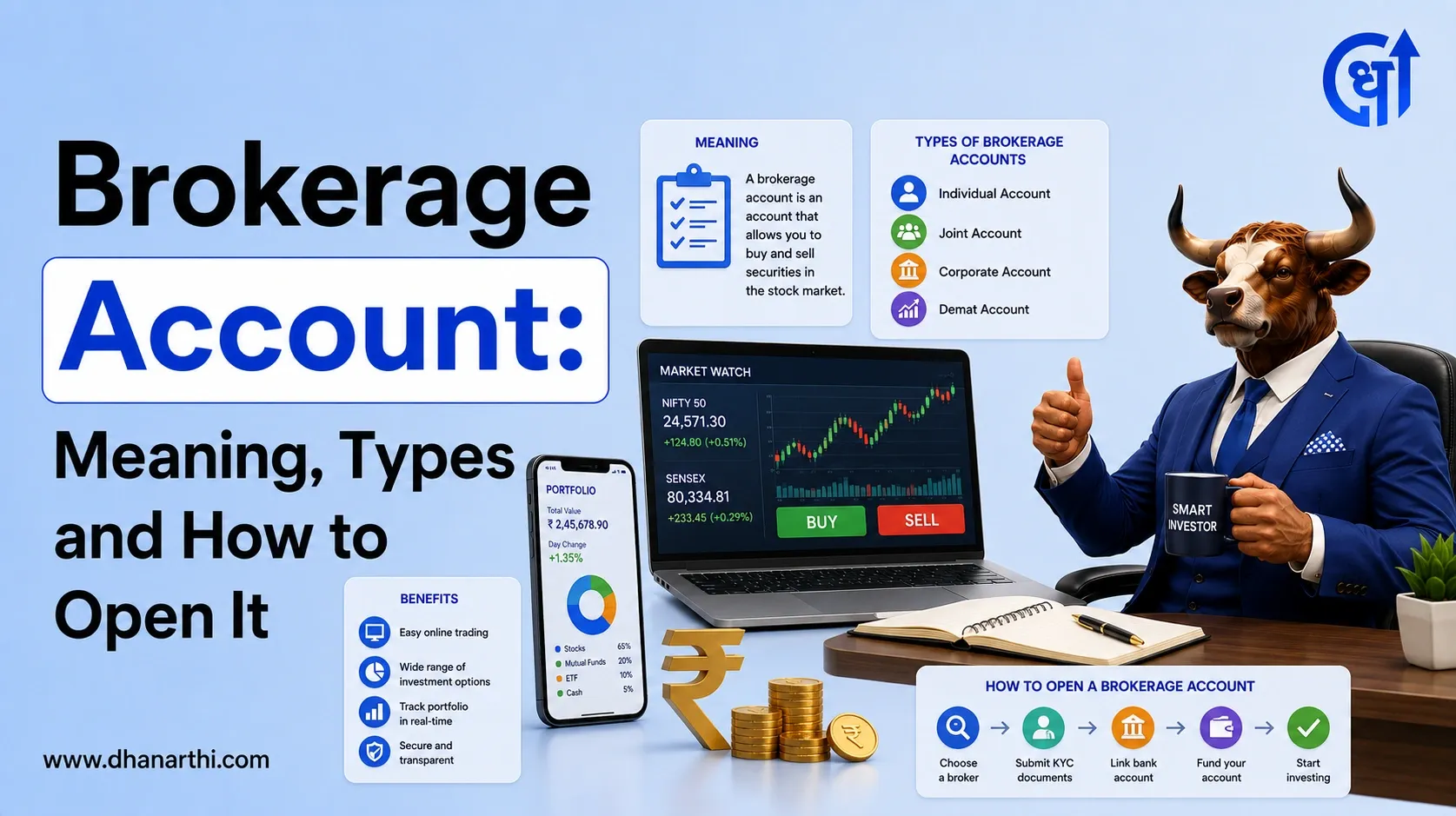
A brokerage account is an account that a trader opens with a SEBI-registered broker to trade in shares in the stock exchanges like NSE, BSE, etc. However, it is usually opened along with a demat account that holds the shares of stocks you purchase and a bank account from where money is transferred to your demat account while trading in the stock markets. All three accounts are required to invest in the stock market legally in India.
A brokerage account lets you place orders on stock exchanges. In India, it works alongside a separate demat account that holds your shares.
Discount brokers like Zerodha and Groww charge flat fees per order. Full-service brokers charge more but add research and advisory support.
SEBI registration, CDSL, and NSDL protect your holdings even if a broker shuts down.
Opening an account takes under 30 minutes online with PAN, Aadhaar, and a linked bank account.
A brokerage account is an account that you open with a SEBI-registered broker to enable you to buy/sell securities over the stock exchanges. It is not a savings account. It is a transactional account which is simply used to route your orders to NSE/BSE and settle the trades.
Thus, when you place the order on the trading platform provided by your broker, it is the broker that actually executes it on the exchanges. Your account will then be updated with the new position and value along with the order history.
It is this account maintenance facility that fundamentally differentiates a brokerage account from a regular savings account. To learn more about the intermediary function performed by a stockbroker, you may refer to this post on stockbroking and its services.
Bajaj Financial Securities, a SEBI-registered broker, reports a combined active client base of over 9 lakh users across its trading platform as of 2026 (Source: Bajaj Broking).
This is where most novices get confused for the first time. In India, you cannot trade with just one account. You need both a trading account and a demat account, which brokers typically offer as a package, hence the term brokerage account.
| Account | What It Does | Mandatory? |
|---|---|---|
| Trading account | Places buy and sell orders on the exchange | Yes |
| Demat account | Holds your shares and securities in electronic form | Yes |
| Bank account | Funds your trades and receives payouts | Yes, linked to both above |
The trading account and demat account are mostly opened together through a single broker as the same application can cover both. Trading account is for the action while demat account is a depository of ownership.
Brokers in India fall into two broad categories based on service model, and two more based on how you fund your trades.
Full-service brokers like ICICI Direct and HDFC Securities offer research reports, relationship managers, and advisory services in exchange for higher fees. This option is suitable for investors who want guidance rather than researching and making decisions on their own.
Discount brokers like Zerodha, Groww, and Upstox offer low flat fees for executing orders. Zerodha and Groww together have nearly 50% of demat accounts on NSE as of 2026 (Sharenox broker analysis May 2026). This is a good option for self-directed investors who are comfortable making their own decisions.
Discount brokers like Zerodha, Groww, and Upstox offer low flat fees for executing orders. Zerodha and Groww together have nearly 50% of demat accounts on NSE as of 2026 (Sharenox broker analysis May 2026). This is a good option for self-directed investors who are comfortable making their own decisions.
A margin account also known as MTF (Margin Trading Facility) in India, is a type of account that allows an investor to take loans from his broker to buy securities. It increases both the gains and losses; therefore, be aware of the mechanics before investing. Check our detailed guide on MTF in the stock market before considering this option.
MTF positions carry interest charges from the broker and can trigger a forced sell-off if your margin falls below the required level. This is not free leverage.
Real numbers matter more than broad claims. Here is how three of India's largest discount brokers compared as of April 2026.
| Broker | Equity Delivery | Intraday | Demat AMC | Account Opening |
|---|---|---|---|---|
| Zerodha | Free | Rs 20 or 0.03%, whichever is lower | Rs 300 per year | Free |
| Groww | Rs 20 or 0.1%, whichever is lower | Rs 20 or 0.1%, whichever is lower | Free | Free |
| Upstox | Rs 20 or 2.5%, whichever is lower | Rs 20 flat | Rs 300 per year (free first year) | Free |
Real numbers matter more than broad claims. Here is how three of India's largest discount brokers compared as of April 2026.
| Broker | Equity Delivery | Intraday | Demat AMC | Account Opening |
|---|---|---|---|---|
| Zerodha | Free | Rs 20 or 0.03%, whichever is lower | Rs 300 per year | Free |
| Groww | Rs 20 or 0.1%, whichever is lower | Rs 20 or 0.1%, whichever is lower | Free | Free |
| Upstox | Rs 20 or 2.5%, whichever is lower | Rs 20 flat | Rs 300 per year (free first year) | Free |
The data used in this article was collected from broker pricing pages and Downstox comparison and verified in May 2026.
For an investor executing a delivery-intensive portfolio in which 1 lakh worth of stock is being traded ten times a month, a free-delivery broker versus a percentage-based one will make a difference of approximately 1,000 to 3,000 INR on an annual basis (see source: InvestingPro.in cost analysis 2026)
Full-service brokers usually carry a significantly higher fee than their discounted counterparts, although they often come with added benefits such as equity research reports not available to discount brokers. For a detailed review and comparison of brokers, see our list of share brokers in India.
Every genuine broker in India will have a SEBI registration number on their website and contract note, which indicates that they are a registered trading member of NSE and BSE.
The shares or equity that one buys through a broker are not in the name of the broker. They are kept in a demat account which is maintained by either CDSL or NSDL, the two depositories in India. The broker has no control over your demat account, unlike your bank account, and hence even if your broker is shut down or banned, your shares are safe with the depository.
NSE and BSE also have an investor protection fund through which they cover losses incurred by investors due to default by a broker, up to a stipulated amount decided by the exchange.
Match the account to how you actually plan to invest, not to the lowest advertised fee.
Trading frequency: Frequent traders benefit more from flat-fee discount brokers. Occasional investors may not notice the fee difference either way.
Need for research: If you want analyst reports and advisory calls, a full-service broker justifies its higher cost.
Platform reliability: Check app uptime and order execution speed, especially during high-volatility sessions.
Charges beyond brokerage: Factor in AMC, DP charges per sell transaction, and call-and-trade fees if you plan to use them.
Product range: Confirm the broker supports the segments you want, such as equity, F&O, mutual funds, or commodities.
The process is fully digital with most brokers today.
Choose a SEBI-registered broker that matches your needs
Enter your PAN, mobile number, and email
Complete Aadhaar-based e-KYC
Upload address proof and a cancelled cheque or bank statement
Complete in-person verification through video KYC
E-sign the account opening form
Link your bank account for fund transfers
Receive your trading and demat account credentials, usually within 24 to 48 hours
Total time for the online process typically runs under 30 minutes of active effort, with account activation following broker verification.
| Feature | Brokerage Account | Bank Account |
|---|---|---|
| Purpose | Buying and selling securities | Storing money, daily transactions |
| Regulator | SEBI | RBI |
| Interest | None on idle cash in most cases | Yes, on savings balance |
| Risk | Market-linked, value can fall | Principal generally protected up to insured limits |
Data sourced from SEBI and RBI investor education material.
A brokerage account is your entry point for the Indian stock market, where it only works alongside a linked demat and bank account. Discount brokers were given to self-directed investors which chasing lower costs, while full-service brokers those who want guidance alongside execution. Whichever you pick, verify SEBI registration and understand the fee structure before you fund the account.
Disclaimer: This article is for educational purposes only. It does not constitute investment advice. Please consult a SEBI-registered financial advisor before making investment decisions.
1. What is a brokerage account?
A brokerage account is an account opened with a SEBI-registered broker that lets you buy and sell shares on NSE or BSE. In India it works together with a linked demat account that holds your securities.
2. What is meant by brokerage?
Brokerage is the fee a broker charges for executing your buy or sell order. It can be a flat amount per order, like Rs 20, or a small percentage of the trade value.
3. What is the difference between a brokerage account and a demat account?
A trading account, often bundled as a brokerage account, is used to place orders. A demat account holds the shares you own in electronic form. Both are required to invest in India.
4. How do I open a brokerage account in India?
You can open one online in under 30 minutes using your PAN, Aadhaar, and a linked bank account. Most brokers complete video KYC digitally, and your account activates within 24 to 48 hours.
5. What documents are required to open a brokerage account?
You need PAN, Aadhaar for e-KYC, a cancelled cheque or bank statement, and a passport-size photo. Some brokers also ask for income proof if you want F&O trading enabled.
6. Can I have multiple brokerage accounts?
Yes. You can open accounts with different brokers, for example one for delivery investing and another for intraday or F&O trading, as long as each completes its own KYC process.
7. Is a brokerage account safe in India?
Yes, when opened with a SEBI-registered broker. Your shares sit in a demat account with CDSL or NSDL, independent of the broker, and the Investor Protection Fund covers verified losses from broker default.
8. What is the difference between a full-service and a discount broker?
Full-service brokers like ICICI Direct charge more but include research and advisory support. Discount brokers like Zerodha and Groww charge flat, low fees and focus purely on order execution.
9. How much does it cost to maintain a brokerage account?
Most brokers charge zero account opening fees. Annual demat maintenance charges range from free at Groww to around Rs 300 per year at Zerodha and Upstox as of 2026.
10. Is a brokerage account the same as a bank account?
No. A brokerage account is regulated by SEBI and used for market transactions where value can fall. A bank account is regulated by RBI and used for storing and transacting money with principal protection up to insured limits.
Share Market
IPO
Artificial Intelligence
Semi Conductor