


Tax on Intraday Trading in India: Rules, Rates and Filing
September 15, 2026



TABLE OF CONTENTS
Get AI Summary





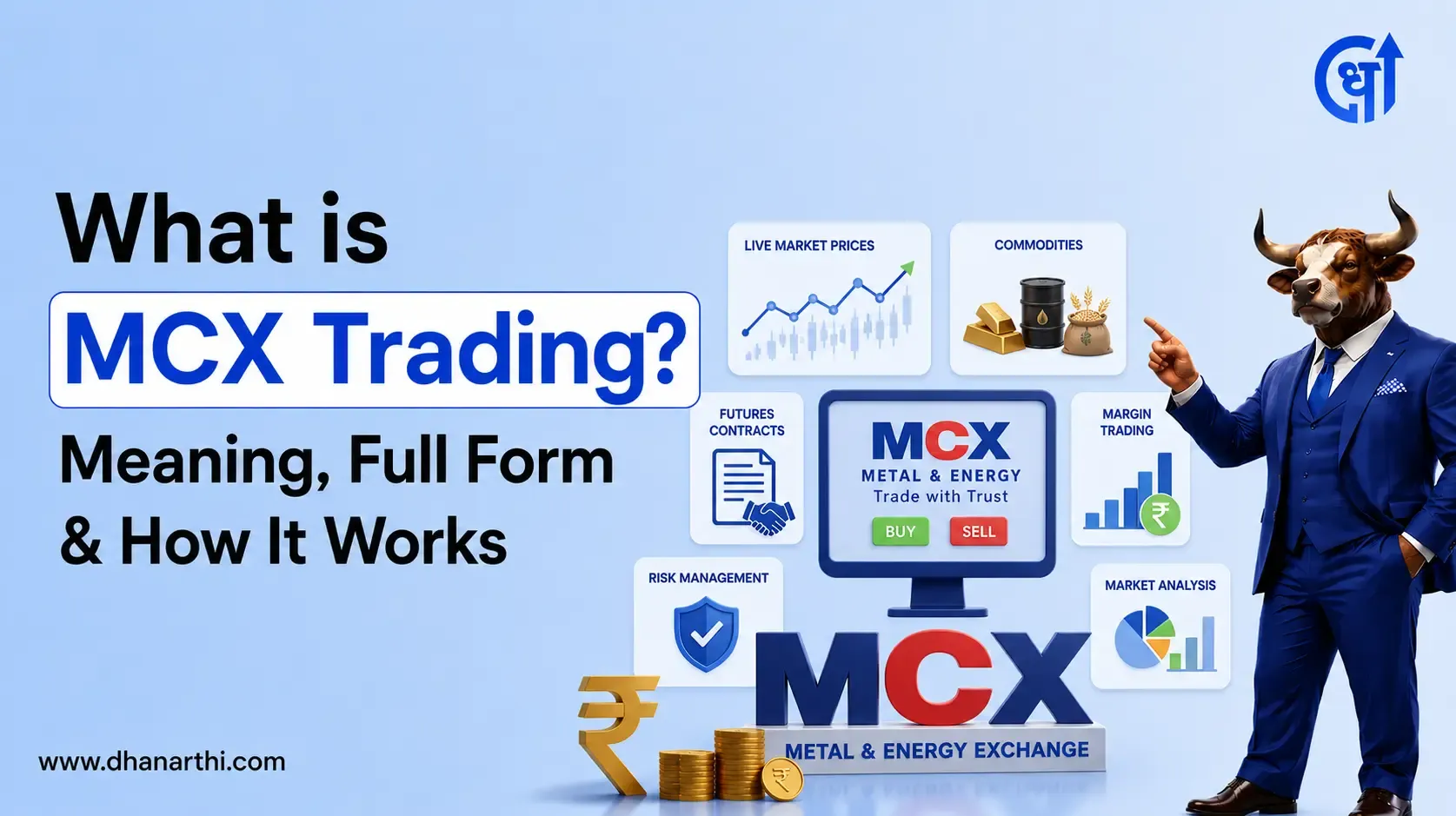
MCX, or Multi Commodity Exchange of India, is India's leading commodity derivatives exchange where traders buy and sell futures contracts on commodities like gold, silver, crude oil, and base metals. MCX trading means participating in this futures market through a registered broker, separate from buying shares of MCX Ltd, the company that operates the exchange and is itself listed on the NSE.
MCX lets you trade commodity futures without ever touching the physical goods. Here is what to know before you start.
Meaning: India's largest commodity derivatives exchange, regulated by SEBI
Full form: Multi Commodity Exchange of India Limited
Commodities: Gold, silver, crude oil, natural gas, copper, zinc, and more
Regulator: SEBI, since 2015, previously the Forward Markets Commission
Note: MCX the exchange is different from MCX Ltd, the listed stock
Data source: MCX exchange disclosures, SEBI regulatory filings, NSE data.
MCX stands for Multi Commodity Exchange of India Limited, the country's largest commodity derivatives exchange, headquartered in Mumbai. It was launched in November 2003 as a dedicated electronic platform for commodity derivatives trading, giving Indian investors a regulated way to trade futures contracts on gold, silver, crude oil, natural gas, and various metals.
MCX trading means buying and selling standardized futures contracts on the exchange rather than physical commodities. Regulatory oversight of MCX was transferred from the Forward Markets Commission (FMC) to the Securities and Exchange Board of India (SEBI) on September 28, 2015, following the FMC-SEBI merger, bringing commodity derivatives under the same regulatory framework as equities.
This is where a lot of confusion starts. MCX the exchange is the platform where traders buy and sell commodity futures contracts, gold, silver, crude oil, and more. MCX Ltd, the company that owns and runs this exchange, is itself a separate, publicly listed entity trading on the NSE under the ticker MCX.
So when someone asks "why is MCX share price falling," they are usually asking about MCX Ltd's stock price, not about commodity prices on the exchange. MCX Ltd's stock traded around Rs 2,818, with a 52-week range of Rs 1,460.80 to Rs 3,480, and had actually gained roughly 70 percent over the preceding year, driven by strong quarterly results, including a 205 percent year-on-year jump in revenue for Q4 FY26. Short-term dips in the stock have occurred around specific events, such as brokerage downgrades or regulatory news, but these are separate from day-to-day movements in commodity prices traded on the exchange itself.
In short: trading commodities on MCX and buying MCX Ltd's stock are two completely different activities, using two different types of accounts.
MCX plays a significant role in India's financial markets by giving traders and businesses a regulated, transparent way to manage commodity price risk. It commands the largest share of India's commodity futures trading volume, making it the primary venue for price discovery in gold, silver, crude oil, and industrial metals. Farmers, manufacturers, and jewelers use MCX to hedge against price swings, while investors use it to diversify beyond equities.
MCX operates as an electronic platform where buyers and sellers trade standardized futures contracts. Each contract specifies the commodity, quantity, quality, and delivery date, and prices move based on real-time supply and demand.
A trader wanting exposure to gold, for instance, does not buy physical gold. Instead, they buy a gold futures contract representing a fixed quantity, and their profit or loss depends on how the futures price moves before the contract expires or is squared off. Most retail traders close their positions before the delivery date rather than taking physical delivery of the commodity.
MCX offers futures contracts across several commodity categories.
| Category | Key Commodities |
|---|---|
| Bullion | Gold, Silver |
| Energy | Crude Oil, Natural Gas |
| Base Metals | Copper, Zinc, Aluminium, Nickel, Lead |
| Agricultural | Cotton, Mentha Oil, Castor Seed |
Silver contracts, including the newly launched Silver 100 futures contract introduced in 2026, have seen strong trading interest given the sharp price movements in the silver market this year. Investors exploring commodity exposure through funds instead of futures can also compare it with the best silver ETF in India for a lower-risk alternative.
While both are regulated exchanges, MCX and the stock market differ in what they offer and how trading works.
| Feature | MCX (Commodity Market) | Stock Market (NSE/BSE) |
|---|---|---|
| What's Traded | Commodity futures contracts | Company shares, equity derivatives |
| Underlying Asset | Physical commodities | Business ownership |
| Trading Hours | Extended, often until 11:30 PM/11:55 PM | Standard 9:15 AM to 3:30 PM |
| Leverage | Higher margin-based leverage | Lower leverage on cash equity |
| Price Drivers | Global supply/demand, weather, geopolitics | Company earnings, business performance |
| Delivery | Most traders square off before expiry | Actual share ownership on settlement |
Understanding the difference between equity vs commodity investing can help decide how much of a portfolio, if any, should go toward commodity trading.
Getting started with MCX trading follows a clear process.
Step 1: Understand the Commodities Available. Review the categories, bullion, energy, base metals, and agricultural commodities, to decide which market fits your risk appetite and interest.
Step 2: Open an MCX Trading Account. A separate commodity trading account is required alongside a regular Demat and trading account. Most share brokers in India that offer equity trading also provide MCX access, so check whether your existing broker supports commodity trading before opening a new account.
Step 3: Learn the Trading Platform. Spend time understanding contract specifications, lot sizes, margin requirements, and expiry dates before placing real trades.
Step 4: Place Your First Trade. Start with a small position size, use a market or limit order, and monitor margin requirements closely, since commodity futures carry meaningful leverage.
Commodity prices can move sharply on global supply-demand shifts, geopolitical events, and currency fluctuations, creating trading opportunities in both rising and falling markets since futures contracts allow positions in either direction.
Commodities often move independently of equity markets. Gold, in particular, tends to hold or gain value when stock markets face uncertainty, offering a genuine diversification benefit beyond a pure equity portfolio.
MCX futures trade on margin, meaning a trader only needs to deposit a fraction of the contract's total value to take a position, amplifying both potential gains and losses.
Suppose gold trades at Rs 1,00,000 per 10 grams, and a trader buys one gold futures contract of that size with a margin requirement of 5 percent, or Rs 5,000. If gold prices rise 2 percent to Rs 1,02,000, the trader's contract gains Rs 2,000, a 40 percent return on the Rs 5,000 margin deployed. The same leverage works in reverse if prices fall, which is why margin-based trading carries meaningfully higher risk than buying the physical commodity outright.
A good MCX trading platform should offer real-time price data, transparent margin and brokerage disclosures, reliable order execution, and access to research or market updates. Checking a broker's SEBI registration, MCX membership status, and customer support quality before opening an account helps avoid execution or withdrawal issues later. Tools like Dhanarthi's financial analysis can also help evaluate how commodity-linked companies are performing before deciding how much portfolio exposure to allocate.
Commodity futures carry higher volatility than most equities, so risk management matters more here than in typical stock trading.
Use stop-loss orders to cap downside on every position
Size positions conservatively relative to total trading capital, given the leverage involved
Avoid over-leveraging, since margin trading can amplify losses as quickly as gains
Track the specific factors driving each commodity, such as OPEC decisions for crude oil or monsoon data for agricultural contracts
Following MCX circulars, global commodity news, and macroeconomic indicators like US Federal Reserve rate decisions and dollar strength helps traders anticipate price moves. Many brokers also provide daily commodity market commentary that summarizes key drivers for gold, silver, crude oil, and metals.
MCX is India's largest commodity derivatives exchange, regulated by SEBI since 2015
MCX (the exchange) and MCX Ltd (the listed stock) are two separate things
Commodities trade across bullion, energy, base metals, and agricultural categories
Margin-based trading amplifies both gains and losses, requiring careful risk management
A separate commodity trading account is needed alongside a standard Demat account
MCX trading gives Indian investors a regulated way to participate in commodity price movements through futures contracts, spanning everything from gold and silver to crude oil and industrial metals. The key distinction to keep in mind is that trading on MCX and buying shares of MCX Ltd are entirely separate activities, requiring different accounts and driven by different price factors altogether.
For anyone starting out, understanding contract specifications, margin requirements, and risk management matters more in commodity trading than in equities, given the leverage involved. The Dhanarthi Screener can help track how commodity-linked stocks and sectors are performing alongside direct commodity exposure.
Disclaimer: This article is for educational purposes only and does not constitute investment advice. Dhanarthi is not a SEBI-registered investment advisor or research analyst. Commodity and stock market investments are subject to market risks, including leverage-related risks specific to futures trading. Please consult a qualified, SEBI-registered financial advisor before making any investment decisions.
1. What does MCX mean?
MCX means Multi Commodity Exchange of India Limited, the country's largest commodity derivatives exchange, where traders buy and sell futures contracts on commodities like gold, silver, and crude oil.
2. What is the full form of MCX?
The full form of MCX is Multi Commodity Exchange of India Limited, headquartered in Mumbai and regulated by SEBI since 2015.
3. What is MCX in the share market?
In the share market context, MCX can refer to two things: the commodity exchange itself, where futures contracts trade, and MCX Ltd, the company operating the exchange, whose own shares trade on the NSE under the ticker MCX.
4. What is MCX silver?
MCX silver refers to silver futures contracts traded on the exchange, including the newer Silver 100 futures contract launched in 2026, allowing traders to take positions on silver price movements without holding physical silver.
5. Why is MCX share price falling?
This usually refers to MCX Ltd's stock, not commodity prices. As of July 2026, MCX Ltd's stock had actually risen roughly 70 percent over the past year on strong quarterly earnings, though it has seen short-term dips tied to specific events like brokerage rating changes or regulatory news, separate from movements in commodities traded on the exchange.
6. What commodities are on the MCX commodity list?
MCX offers futures across bullion (gold, silver), energy (crude oil, natural gas), base metals (copper, zinc, aluminium, nickel, lead), and select agricultural commodities like cotton and castor seed.
7. What does MCX trading mean?
MCX trading means buying and selling standardized futures contracts on the Multi Commodity Exchange, allowing traders to take positions on commodity price movements without physically holding the underlying goods.
8. Is MCX trading safe for beginners?
MCX trading carries higher risk than typical equity investing due to margin-based leverage. Beginners should start with small position sizes, use stop-loss orders, and fully understand contract specifications before trading.
9. Do I need a separate account for MCX trading?
Yes, a separate commodity trading account is required alongside a regular Demat and trading account, though most major brokers offer both under a single sign-up process.
10. What is the difference between MCX and NSE?
MCX is a dedicated commodity derivatives exchange, while NSE is primarily an equity and equity derivatives exchange. MCX Ltd's own shares, however, are listed and traded on the NSE, which is a separate matter from commodity trading itself.
Share Market
IPO
Artificial Intelligence
Semi Conductor