

Trading vs Investing: Key Differences for Beginners
September 12, 2026



TABLE OF CONTENTS
Get AI Summary





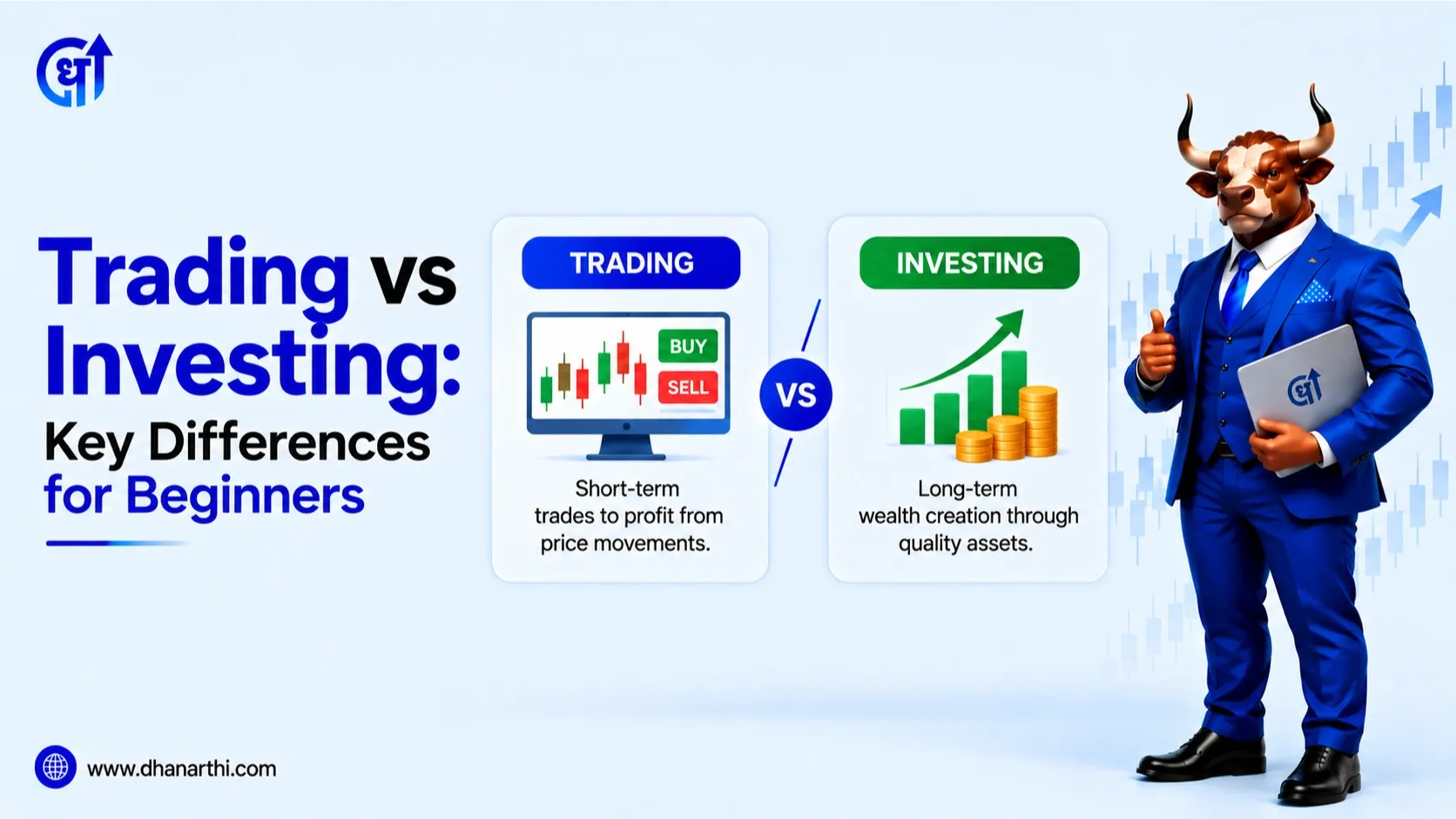
Trading vs investing comes down to time horizon and approach: trading involves buying and selling frequently to profit from short-term price movements, typically using technical analysis, while investing means buying and holding assets for years based on company fundamentals, aiming to build wealth through long-term compounding.
Research Stocks Smarter with Dhanarthi AI Screener
Analyze 5,000+ NSE & BSE stocks with 150+ custom filters, real-time volume breakout scans, and transparent fundamental data.
Use Dhanarthi Screener
Trading means buying and selling financial instruments, stocks, F&O contracts, or other securities, over short time frames, from minutes to a few weeks, aiming to profit from price movements rather than the underlying business's long-term growth. Traders rely heavily on technical analysis, chart patterns, and market timing rather than a company's fundamentals.
Trading styles range from scalping and intraday trading, closing positions within the same day, to swing trading, holding for a few days to a few weeks. What unites all forms of trading is the short time horizon and the reliance on price action rather than business ownership as the primary decision driver.
Investing means buying a financial asset, most commonly stocks or mutual funds, with the intention of holding it for years, aiming to build wealth through the underlying business's growth and the power of compounding over time. Investors generally focus on fundamentals, such as revenue growth, profitability, and competitive position, rather than short-term price fluctuations.
The Nifty 50 index illustrates the kind of long-run outcome investing is built around. Over the 20 years ended February 2026, the Nifty 50 Total Return Index delivered an annualised return of 12.44%. This figure captures multiple market cycles, including sharp downturns, showing how patient, long-term equity ownership has historically compounded through volatility rather than around it.
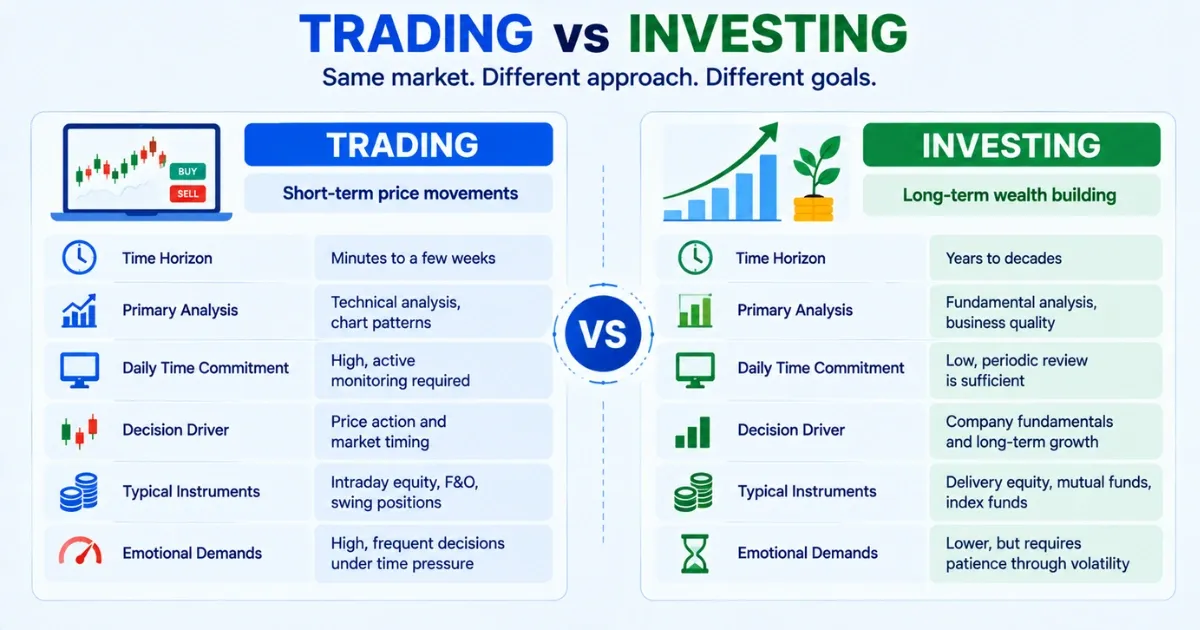
| Factor | Trading | Investing |
|---|---|---|
| Time horizon | Minutes to a few weeks | Years to decades |
| Primary analysis | Technical analysis, chart patterns | Fundamental analysis, business quality |
| Daily time commitment | High, active monitoring required | Low, periodic review is sufficient |
| Decision driver | Price action and market timing | Company fundamentals and long-term growth |
| Typical instruments | Intraday equity, F&O, swing positions | Delivery equity, mutual funds, index funds |
| Emotional demands | High, frequent decisions under time pressure | Lower, but requires patience through volatility |
Neither approach is inherently superior, they serve different goals and require different skills, capital commitments, and temperaments.
This is a detail that meaningfully affects real returns and is often glossed over in beginner comparisons. Short-term capital gains (STCG) on listed equity shares sold within 12 months are taxed at a flat 20% under Section 111A of the Income Tax Act. Long-term capital gains (LTCG) on equity held beyond 12 months are taxed at 12.5% under Section 112A, but only on gains exceeding Rs 1.25 lakh in a financial year, with that threshold amount remaining fully tax-free. These rates, introduced through the Finance (No. 2) Act 2024, apply for FY 2025-26 and continue into FY 2026-27.
This tax structure directly rewards the investing approach over frequent trading for delivery-based equity, holding a position for just over 12 months instead of selling a day earlier can mean the difference between paying 20% on the full gain versus 12.5% on the gain above the exempted threshold. F&O trading income is taxed differently still, generally treated as business income and taxed at the trader's applicable income slab rather than under these capital gains sections, since F&O activity is treated as a business activity rather than a capital asset transaction.
Trading and investing place very different demands on a person's time and temperament. Trading requires quick decision-making under time pressure, since prices can move meaningfully within minutes, and a trader who hesitates or second-guesses a plan mid-session can turn a manageable loss into a larger one. This constant decision-making is mentally taxing over a full trading day, every day the markets are open.
Investing asks for a different kind of discipline, patience through periods of volatility or stagnation, sometimes lasting months or years, without the daily adrenaline trading involves. The primary emotional risk in investing isn't split-second decision fatigue, it's the temptation to panic-sell during a downturn or chase a rallying stock without a clear thesis, undermining the long-term compounding the approach depends on.
Trading, particularly F&O trading, tends to demand more specialized skill and often more capital upfront than basic delivery investing. A trader needs to understand chart reading, risk management and position sizing, and order execution mechanics well before consistently profitable trading becomes realistic.
Investing has a lower barrier to entry for both capital and required skill to begin, a new investor can start with a single share or a small mutual fund SIP and gradually build knowledge of fundamental analysis over time, without the same pressure to make fast, high-stakes decisions from day one. For anyone just opening their first demat account, starting with investing before attempting active trading is a common and reasonable sequence.
Yes, and many market participants are. It's entirely possible to maintain a long-term investment portfolio for wealth building while separately allocating a smaller, clearly defined portion of capital to active trading. The key to doing this successfully is keeping the two activities genuinely separate, across capital, goals, and decision-making process, rather than letting a trading loss tempt a change in an unrelated long-term investment thesis, or vice versa.
Treating these as two distinct activities with their own rules, rather than blending them into one undefined approach, tends to produce clearer decision-making in both.

Confused about chart patterns & stock analysis?
Use
Dhanarthi Stock Guru
to chat, analyze price patterns, and ask questions directly.
Trading vs investing ultimately comes down to time horizon, method, and temperament, not one being objectively better than the other. Trading demands active, technical, fast-paced decision-making over short windows, while investing rewards patience and fundamental analysis over years, with India's tax structure explicitly favoring longer holding periods for equity gains. Understanding which approach, or combination of both with clearly separated capital, fits your available time, skill, and risk tolerance is a more useful starting question than asking which one is simply "better."
1. What is the main difference between trading and investing?
The main difference is time horizon and approach: trading involves buying and selling over short periods using technical analysis, while investing means holding assets for years based on company fundamentals.
2. Which is better for beginners, trading or investing?
Investing generally has a lower barrier to entry for capital and required skill, making it a common starting point, while trading typically demands more time, specialized knowledge, and emotional discipline.
3. How are trading and investing taxed differently in India?
Short-term equity gains held under 12 months are taxed at a flat 20%, while long-term equity gains held beyond 12 months are taxed at 12.5% above a Rs 1.25 lakh annual exemption, rewarding longer holding periods.
4. Can I be both a trader and an investor at the same time?
Yes, many people maintain a long-term investment portfolio while separately allocating a smaller portion of capital to active trading, as long as the two activities are kept genuinely separate in goals and capital.
5. What returns has long-term investing delivered in India historically?
The Nifty 50 delivered a 20-year annualised return of 12.44% as of February 2026, according to NSE Indices data, illustrating the kind of long-term compounding investing is built around, though past returns don't guarantee future performance.
6. Does trading require more time than investing?
Yes, trading generally requires active daily monitoring during market hours, while investing typically requires only periodic review, since the underlying strategy plays out over years rather than days.
7. What analysis method do traders use compared to investors?
Traders primarily use technical analysis, studying charts and price patterns, while investors primarily use fundamental analysis, evaluating a company's financial health and long-term growth prospects.
8. Is F&O trading taxed the same as equity investing?
No, F&O trading income is generally treated as business income and taxed at the trader's applicable income slab, unlike equity investing gains, which fall under capital gains tax rules.
9. What is a common mistake beginners make when choosing between trading and investing?
A common mistake is applying a trader's short-term mindset to a long-term investment, panic-selling during ordinary volatility that doesn't reflect any real change in the underlying business's fundamentals.
10. Do I need more capital to start trading than investing?
Trading, especially F&O, often requires more capital upfront due to margin requirements, while investing can start with a relatively small amount, such as the price of a single share or a small SIP.
11. Which carries more risk, trading or investing?
Trading generally carries higher short-term risk due to leverage and rapid price movements, while investing carries risk that plays out over a longer horizon, primarily tied to business performance and broader market cycles.
12. Why does holding period matter for equity taxation in India?
Holding period determines whether a sale is classified as short-term or long-term capital gains, with long-term gains taxed at a lower rate and given an annual exemption, directly rewarding patient, longer-term equity holding.
Share Market
IPO
Artificial Intelligence
Semi Conductor