



Capital Gains Tax on Shares India 2026 Rates
October 23, 2026



TABLE OF CONTENTS
Get AI Summary





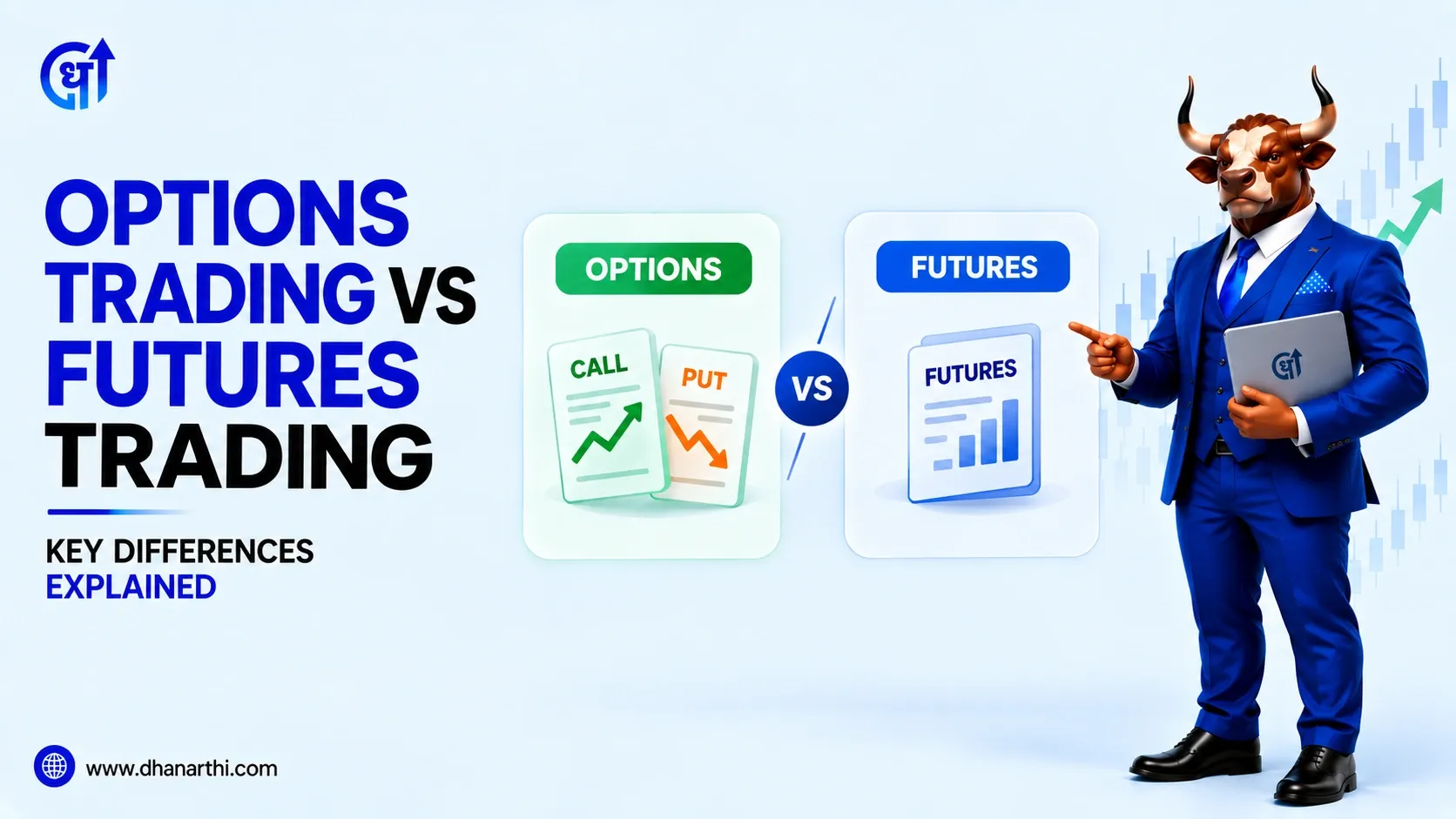
Options trading vs futures trading comes down to one core structural difference: a futures contract obligates both the buyer and seller to complete the transaction at expiry, while an options contract gives the buyer a right, not an obligation, to buy or sell. This single difference cascades into everything else, risk profile, capital required, and how each instrument behaves as expiry approaches.
Options and futures are both exchange-traded derivative contracts deriving their value from an underlying asset, such as a stock or index, without requiring ownership of that asset. Despite this shared foundation, they behave very differently once a position is opened, and the difference traces back to a single structural distinction: obligation versus right.
A futures contract commits both the buyer and the seller to complete the transaction at the agreed price on the expiry date, regardless of where the market has moved by then. An options contract instead gives the buyer the right, but not the obligation, to buy (call option) or sell (put option) the underlying asset at a fixed strike price, while the seller of that option carries the obligation if the buyer chooses to exercise it.
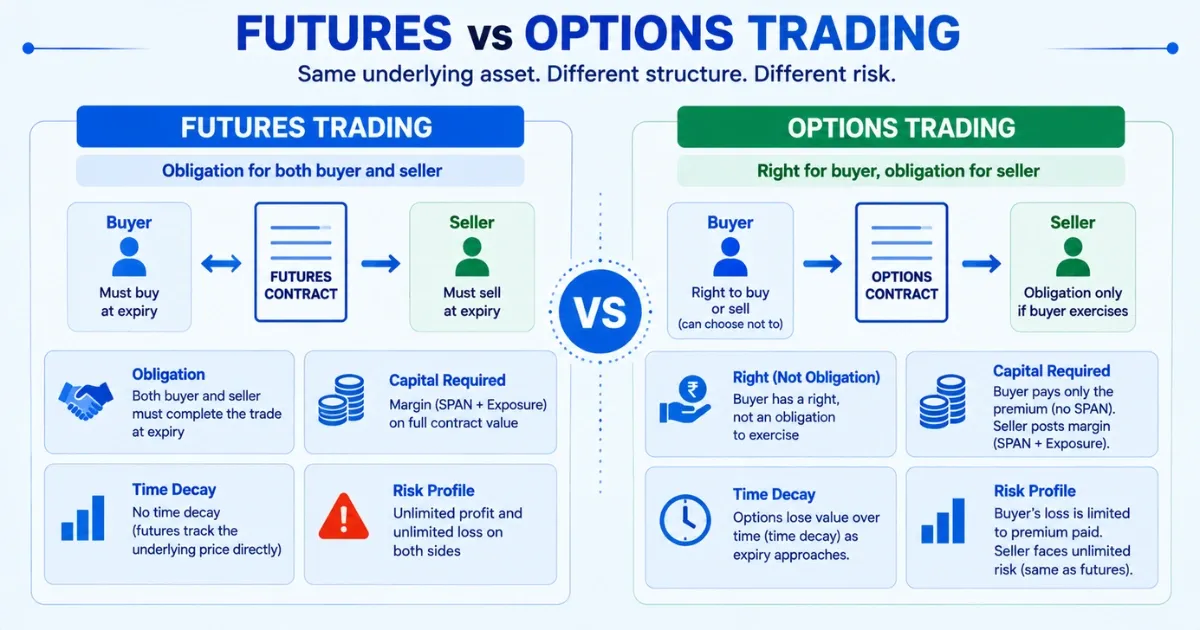
This distinction is worth spelling out clearly, since it explains nearly every other difference between the two instruments.
| Factor | Futures | Options |
|---|---|---|
| Buyer's obligation | Must complete the trade at expiry | Right only, can choose not to exercise |
| Seller's obligation | Must complete the trade at expiry | Obligated only if buyer exercises |
| Upfront payment | Margin (percentage of contract value) | Premium (buyer) or margin (seller) |
| Position exit | Close before expiry or settle | Let expire worthless, exercise, or close early |
A futures buyer who is wrong about direction cannot simply walk away paying only a small fee, the position must be closed or settled at whatever price prevails. An options buyer who is wrong can simply let the option expire worthless, losing only the premium paid.
This is a genuinely important correction that most comparisons skip. It's common to hear that options are inherently safer than futures because a buyer's loss is capped at the premium paid, while futures carry unlimited loss potential on both sides. This is true, but only for option buyers.
Option sellers face a completely different risk profile. Since a seller's potential loss is not capped at a fixed amount the way a buyer's is, selling options carries the same uncapped risk exposure as holding a futures position, and exchanges treat it accordingly, requiring full SPAN plus exposure margin from option sellers, the same margin category applied to futures traders. A trader who assumes "options are safer" because they've only ever bought options, then starts selling options without adjusting their risk assumptions, is taking on futures-equivalent risk without necessarily realizing it.
Numbers make this comparison concrete. Nifty futures currently use a lot size of 65 units. With Nifty at 24,000, contract value works out to 65 x 24,000, or Rs 15,60,000. At a combined SPAN plus exposure margin of roughly 13%, holding one lot of Nifty futures requires depositing approximately Rs 2,02,800.
Buying one lot of a Nifty call or put option, by contrast, only requires paying the premium for that lot, no SPAN margin at all. Depending on how far the strike is from the current price and how much time remains to expiry, a single lot's premium might range from roughly Rs 15,000 to Rs 50,000, a fraction of the capital a futures position demands. This capital efficiency is a major reason options attract retail traders who want index exposure without deploying lakhs of rupees in margin, though it's worth remembering this comparison applies specifically to buying options, not selling them.
Research Stocks Smarter with Dhanarthi AI Screener
Analyze 5,000+ NSE & BSE stocks with 150+ custom filters, real-time volume breakout scans, and transparent fundamental data.
Use Dhanarthi Screener
Futures positions don't experience time decay, a futures contract's value tracks the underlying asset's price directly, with no separate erosion simply from the passage of time. Options work differently entirely.
An option's premium consists partly of intrinsic value and partly of time value, and that time value erodes continuously as expiry approaches, a phenomenon known as theta decay. This decay accelerates in the final days before expiry, meaning an option buyer needs the underlying asset to move favorably within a limited window, not just eventually. Option sellers benefit from this same decay working in their favor, collecting more of the premium as time passes if the underlying stays within a favorable range. This asymmetry, decay working against buyers and for sellers, has no equivalent in futures trading at all.
Both instruments offer leverage, control over a large notional position using a smaller upfront amount, but the mechanics differ.
| Factor | Futures | Options (Buying) | Options (Selling) |
|---|---|---|---|
| Margin required | Full SPAN + exposure margin | Premium only, no SPAN | Full SPAN + exposure margin |
| Leverage source | Margin vs contract value | Premium vs potential payoff | Margin vs contract value |
| Daily settlement | Mark-to-market | Not applicable until exercised/closed | Mark-to-market style margin monitoring |
This table shows why lumping "options" together as one risk category is misleading, buying options and selling options sit at opposite ends of the capital and risk spectrum, with only options buying offering the lower-capital, capped-loss profile retail traders often associate with the word "options." For a deeper look at how futures margin and mark-to-market settlement actually work day to day, see the full breakdown in what is futures trading.
The right choice depends on a few practical factors rather than a universal answer. Traders with strong directional conviction and enough capital to meet full margin requirements often prefer futures, since there's no time decay working against the position and no premium being paid away simply for holding it. Traders who want to express a view with limited capital, or who want a defined, capped maximum loss, often prefer buying options instead, accepting time decay as the tradeoff for that protection.
Traders considering more advanced approaches, like the straddle, strangle, and covered call strategies covered separately, are working within the options framework specifically to structure risk and reward around a particular market view, something futures' simple obligation-based structure doesn't offer in the same way.

Confused about chart patterns & stock analysis?
Use
Dhanarthi Stock Guru
to chat, analyze price patterns, and ask questions directly.
Options trading vs futures trading ultimately comes down to obligation versus right, and every other difference, risk profile, capital required, and behavior over time, follows from that single structural distinction. Futures commit both sides to the trade and carry no time decay, while options give buyers a capped-risk alternative at the cost of a decaying premium, though that capped-risk framing only applies to buying options, not selling them. Choosing between the two, or using both for different purposes, depends on available capital, directional conviction, and comfort with the specific risk profile each side of each instrument actually carries.
1. What is the main difference between options trading and futures trading?
The main difference is obligation versus right: a futures contract obligates both buyer and seller to complete the transaction at expiry, while an options contract gives the buyer a right, not an obligation, to buy or sell.
2. Are options always safer than futures?
No, this is true only for option buyers, whose maximum loss is capped at the premium paid. Option sellers carry the same uncapped risk exposure as futures traders and are margined accordingly.
3. Which requires more capital, options or futures?
Buying options generally requires less capital, since only the premium is paid with no margin. Futures, and selling options, both require full margin on the position, which is typically far larger than an option premium.
4. Do futures experience time decay like options?
No, futures contracts track the underlying asset's price directly with no separate time-based erosion. Options lose time value as expiry approaches, a phenomenon called theta decay that futures don't experience.
5. Is futures trading riskier than options trading?
Futures trading is riskier than buying options specifically, since futures carry potentially unlimited loss on both sides while an option buyer's loss is capped at the premium. Selling options carries risk comparable to futures.
6. What is the margin requirement difference between options and futures?
Futures require full SPAN plus exposure margin on the contract value. Buying options requires only the premium with no SPAN margin, while selling options requires full margin similar to futures.
7. Can I lose more money than I invest in options trading?
If you are buying options, no, your maximum loss is capped at the premium paid. If you are selling options, yes, losses can exceed the premium received and are not capped in the same way.
8. Which is better for beginners, options or futures?
Buying options is often considered more approachable for beginners due to the capped maximum loss, while futures and options selling require a stronger understanding of margin and unlimited-risk exposure before starting.
9. Do options and futures use the same lot size?
Options and futures on the same underlying typically share the same lot size, since both are standardized contracts set by the exchange for that specific underlying asset.
10. What happens if I don't close a futures position before expiry?
If a futures position remains open at expiry, it gets settled according to the exchange's rules, cash settlement for index futures or physical settlement for stock futures, depending on the contract type.
11. Why do options sellers need more margin than options buyers?
Options sellers need more margin because their potential loss is not capped at a fixed amount, similar to a futures position, while an option buyer's maximum loss is already limited to the premium paid, requiring no additional margin.
12. Can futures and options be used together in a strategy?
Yes, many traders combine futures and options, using futures for direct directional exposure and options for hedging or structuring defined-risk strategies around a specific market view.
Share Market
IPO
Artificial Intelligence
Semi Conductor