





Capital Gains Tax on Shares India 2026 Rates
October 23, 2026



TABLE OF CONTENTS
Get AI Summary





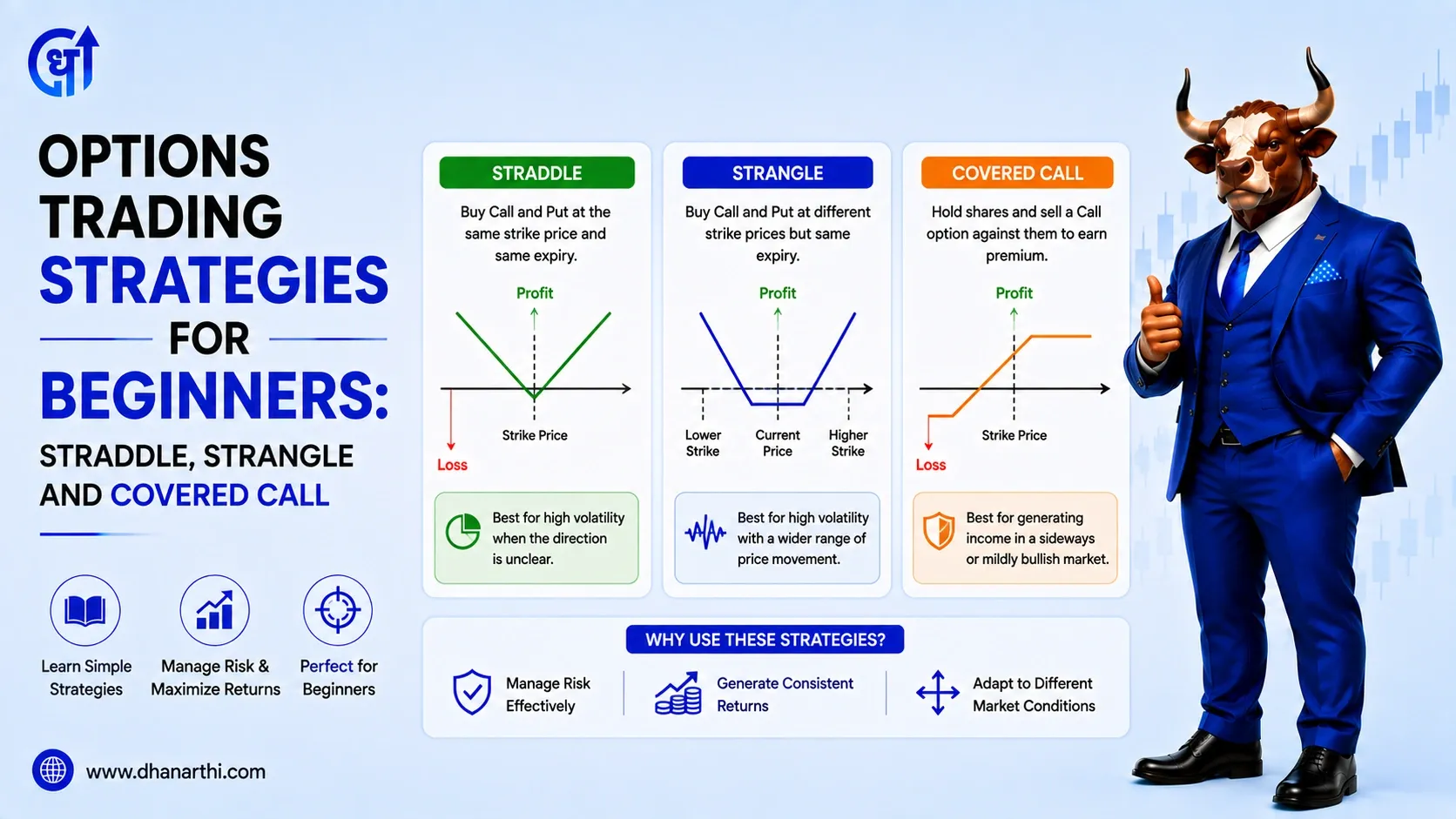
Options trading strategies combine buying and selling call and put options to profit from a stock's price movement, volatility, or time decay, rather than simply buying or selling the underlying stock. Three of the most common beginner-level strategies are the straddle, the strangle, and the covered call, each suited to a different market outlook and risk tolerance.
Options trading strategies are structured combinations of buying and selling call and put options, sometimes alongside the underlying stock itself, designed to express a specific view on price direction, volatility, or time. Unlike simply buying a stock, options strategies can be built to profit from a big move in either direction, from a stock staying flat, or from generating income on shares already owned.
For beginners entering F&O (Futures and Options) trading in India, three strategies are commonly introduced first: the straddle and strangle, both built around expecting significant volatility, and the covered call, built around generating income from an existing stock holding. Each carries a different risk profile, and understanding these differences matters more than memorizing the mechanics alone.
Research Stocks Smarter with Dhanarthi AI Screener
Analyze 5,000+ NSE & BSE stocks with 150+ custom filters, real-time volume breakout scans, and transparent fundamental data.
Use Dhanarthi Screener
A straddle involves buying a call option and a put option on the same underlying stock or index, with the same strike price and the same expiration date. Since the position profits from a large move in either direction, a straddle is considered a directionally neutral strategy, the trader doesn't need to predict whether price will rise or fall, only that it will move significantly.
Example: A stock is trading at Rs 1,000. A trader buys a call option at the Rs 1,000 strike for a premium of Rs 25, and a put option at the same Rs 1,000 strike for a premium of Rs 20, paying a total premium of Rs 45. If the stock moves to Rs 1,100, the call gains significantly in value while the put expires worthless, and the trader profits if the gain exceeds the Rs 45 total premium paid. The same logic applies in reverse if the stock instead falls sharply.
The maximum loss on a long straddle is limited to the total premium paid, since both options can expire worthless if the stock stays close to the strike price. The maximum profit is theoretically unlimited on the call side and substantial on the put side, since a stock's price can rise indefinitely but only fall to zero.
A strangle is similar to a straddle but uses two different strike prices instead of one. A trader buys an out-of-the-money call at a strike above the current price, and an out-of-the-money put at a strike below the current price, both with the same expiration date.
Example: With the same stock trading at Rs 1,000, a trader instead buys a call at the Rs 1,050 strike for Rs 15, and a put at the Rs 950 strike for Rs 12, paying a total premium of Rs 27. This is cheaper than the straddle example above, since out-of-the-money options cost less than at-the-money options, but the stock now needs to move further, beyond Rs 1,050 or below Rs 950, before the position becomes profitable.
Because a strangle costs less to enter than an equivalent straddle, it requires a larger price move to reach profitability, but offers a lower upfront risk if that larger move doesn't materialize.
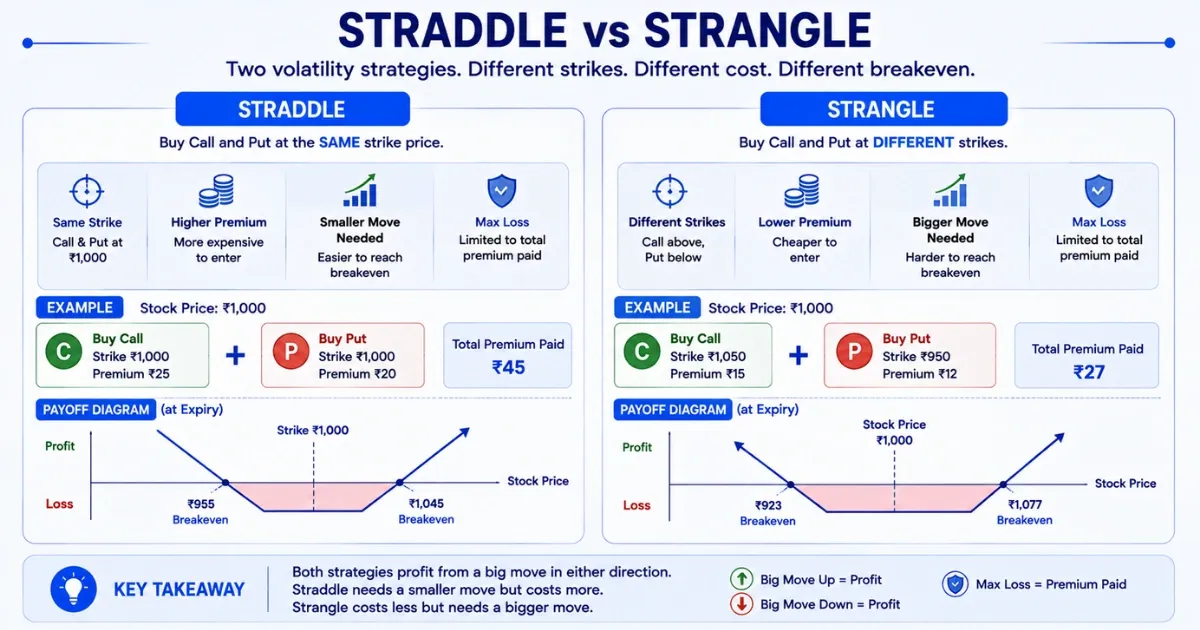
To easily understand how Straddle and Strangle strategies compare across key parameters, check out the comparison table below:
| Factor | Straddle | Strangle |
|---|---|---|
| Strike prices | Same strike for call and put | Different strikes, call above and put below current price |
| Premium cost | Higher, since both options are at-the-money | Lower, since both options are out-of-the-money |
| Breakeven distance | Smaller move needed to profit | Larger move needed to profit |
| Maximum loss | Total premium paid | Total premium paid, but lower in rupee terms |
| Best suited for | Traders expecting a strong move with confidence | Traders expecting volatility but wanting lower upfront cost |
Both strategies work best when a trader anticipates a significant event, such as quarterly results or a major policy announcement, that could move the stock or index sharply in either direction.
A covered call involves owning the underlying stock and simultaneously selling a call option against those shares. This strategy generates income from the premium received for selling the call, but caps the potential upside if the stock rises significantly.
Example: A trader owns 100 shares of a stock trading at Rs 1,000. They sell a call option at the Rs 1,050 strike for a premium of Rs 20 per share, collecting Rs 2,000 in total premium. If the stock stays below Rs 1,050 by expiration, the call expires worthless, and the trader keeps both the shares and the full premium. If the stock rises above Rs 1,050, the trader may need to sell the shares at that strike price, missing out on gains beyond it, though still keeping the premium collected.
A covered call strategy limits potential losses compared to plain stock ownership, since the premium received offsets some downside, but it also caps the upside, making it best suited to a neutral-to-mildly-bullish outlook rather than a strongly bullish one.
This is a detail that directly affects how straddles, strangles, and covered calls function in practice today, and it's a detail many beginner guides overlook or leave outdated. Starting in October 2024, SEBI introduced a phased set of reforms to the equity index derivatives framework, aimed at curbing excessive retail speculation. Key changes included raising the minimum contract size for index derivatives to roughly Rs 15-20 lakh, limiting each exchange to a single weekly expiry benchmark index, mandating that option buyers pay the full premium upfront rather than on margin, and applying an additional 2% Extreme Loss Margin on short index options specifically on expiry day (Source: SEBI circular, reported by Business Standard, October 2024).
These changes have a direct, practical impact on the strategies covered here. Larger contract sizes mean straddles and strangles on index options now require significantly more capital than they did before late 2024. The shift to a single weekly expiry per exchange also affected strategies built around frequent weekly theta decay, Bank Nifty's weekly expiry, once the most actively traded contract on NSE, moved to a monthly-only schedule, changing the rhythm many short-term options strategies were built around.
This question deserves an honest answer rather than a marketing-style dismissal. SEBI's own study on individual F&O participants found that a large majority, over 90% of individual traders, incurred losses over the multi-year period studied, with aggregate losses to individual traders exceeding Rs 1.81 lakh crore (Source: SEBI study, widely reported including by Business Standard and multiple financial publications, 2023-24).
This data does not mean the strategies covered in this article cannot work. It means that, based on regulator-published figures, the odds facing the average retail options participant have historically been difficult, and strategies involving buying options, like straddles and strangles, face time decay working against them constantly, while strategies involving selling options, like covered calls, carry their own risk of capped upside or, in more complex variations, potentially larger losses. Anyone approaching options trading strategies for beginners should weigh this data seriously rather than skip past it.

Confused about chart patterns & stock analysis?
Use
Dhanarthi Stock Guru
to chat, analyze price patterns, and ask questions directly.
Options carry risk profiles that behave differently from simple stock positions, since time decay, volatility changes, and strike price selection all affect outcomes in ways a straightforward buy-and-hold stock position doesn't. A stop loss approach used in equity trading doesn't translate directly to options in the same way, since option premiums can move nonlinearly relative to the underlying stock's price.
For beginners, position sizing matters even more in options than in equity trading, since a small number of losing trades on undercapitalized options positions can wipe out a disproportionate share of total trading capital quickly. Watching open interest alongside a chosen strategy can also help gauge how much market participation exists at a given strike before committing capital to it. Starting with strategies that have a clearly defined maximum loss, like the long straddle or long strangle described above, where the maximum loss is limited to the premium paid, is generally considered a more measured starting point than strategies involving uncapped losses on the selling side.
Options trading strategies reward a clear understanding of the specific mechanics, current regulatory structure, and realistic probability of success, rather than treating them as a quick way to generate outsized returns.
Options trading strategies for beginners, straddle, strangle, and covered call among them, each offer a structured way to express a view on price movement, volatility, or income generation rather than simply buying or selling a stock outright. Straddles and strangles profit from significant price moves regardless of direction, while covered calls generate income at the cost of capped upside. All three now operate within a meaningfully changed regulatory environment following SEBI's F&O reforms, and the regulator's own data on how often retail participants lose money in this segment is worth treating as a serious input into any decision to trade options, not a footnote to skip past.
Disclaimer: This article is for educational purposes only. It does not constitute investment advice. Please consult a SEBI-registered financial advisor before making investment decisions.
1. What are options trading strategies for beginners?
Options trading strategies for beginners typically include the straddle, strangle, and covered call, each offering a defined risk structure suited to different market views, from expecting a big move in either direction to generating income on shares already owned.
2. What is a straddle in options trading?
A straddle involves buying a call and a put option at the same strike price and expiration date, profiting when the underlying stock makes a large move in either direction beyond the total premium paid.
3. What is a strangle in options trading?
A strangle involves buying a call and a put option at different strike prices, typically both out-of-the-money, on the same underlying stock and expiration date. It generally costs less than a straddle but requires a larger price move to become profitable.
4. What is the difference between a straddle and a strangle?
A straddle uses the same strike price for both the call and put, while a strangle uses different strikes. Straddles cost more upfront but need a smaller price move to profit, while strangles cost less but require a bigger move.
5. What is a covered call strategy?
A covered call strategy involves owning the underlying stock and selling a call option against those shares to collect premium income, in exchange for capping potential upside if the stock rises above the strike price sold.
6. Are options trading strategies profitable for retail traders in India?
SEBI's own study found that over 90% of individual F&O traders lost money over the multi-year period studied, with aggregate losses exceeding Rs 1.81 lakh crore, suggesting options trading is genuinely difficult for most retail participants to execute profitably.
7. How did SEBI's F&O rules affect options trading strategies?
SEBI's reforms, phased in from late 2024, raised minimum contract sizes for index options to roughly Rs 15-20 lakh, limited each exchange to one weekly expiry benchmark, and mandated upfront premium payment, all of which increased the capital needed for strategies like straddles and strangles on index options.
8. What is the maximum loss in a long straddle or strangle?
The maximum loss in a long straddle or long strangle is limited to the total premium paid for both options, since the position simply expires worthless if the underlying stock doesn't move enough in either direction.
9. Does a covered call limit potential losses?
A covered call reduces potential losses compared to plain stock ownership since the premium collected offsets some downside, but it does not eliminate the risk of the stock falling in value, and it also caps potential gains above the strike price sold.
10. What is the best options strategy for beginners?
There is no single best strategy, but long straddles, long strangles, and covered calls are commonly introduced first to beginners since each has a clearly defined and limited maximum loss compared to more complex strategies involving uncapped risk.
11. Do options strategies require a stop loss like stock trading?
Options don't use stop losses in exactly the same way stocks do, since premiums move nonlinearly with the underlying price and time decay, but defined-risk strategies like long straddles and strangles inherently cap the maximum loss to the premium paid.
12. Can beginners trade weekly index options like they used to?
Not in the same way, SEBI's reforms limited each exchange to a single weekly expiry benchmark index, and contracts like Bank Nifty's weekly expiry moved to a monthly-only schedule, changing how frequent, weekly-expiry-based strategies can be structured.
Share Market
IPO
Artificial Intelligence
Semi Conductor