



What is Swing Trading? Meaning, Strategy & How to Start
August 25, 2026



TABLE OF CONTENTS
Get AI Summary





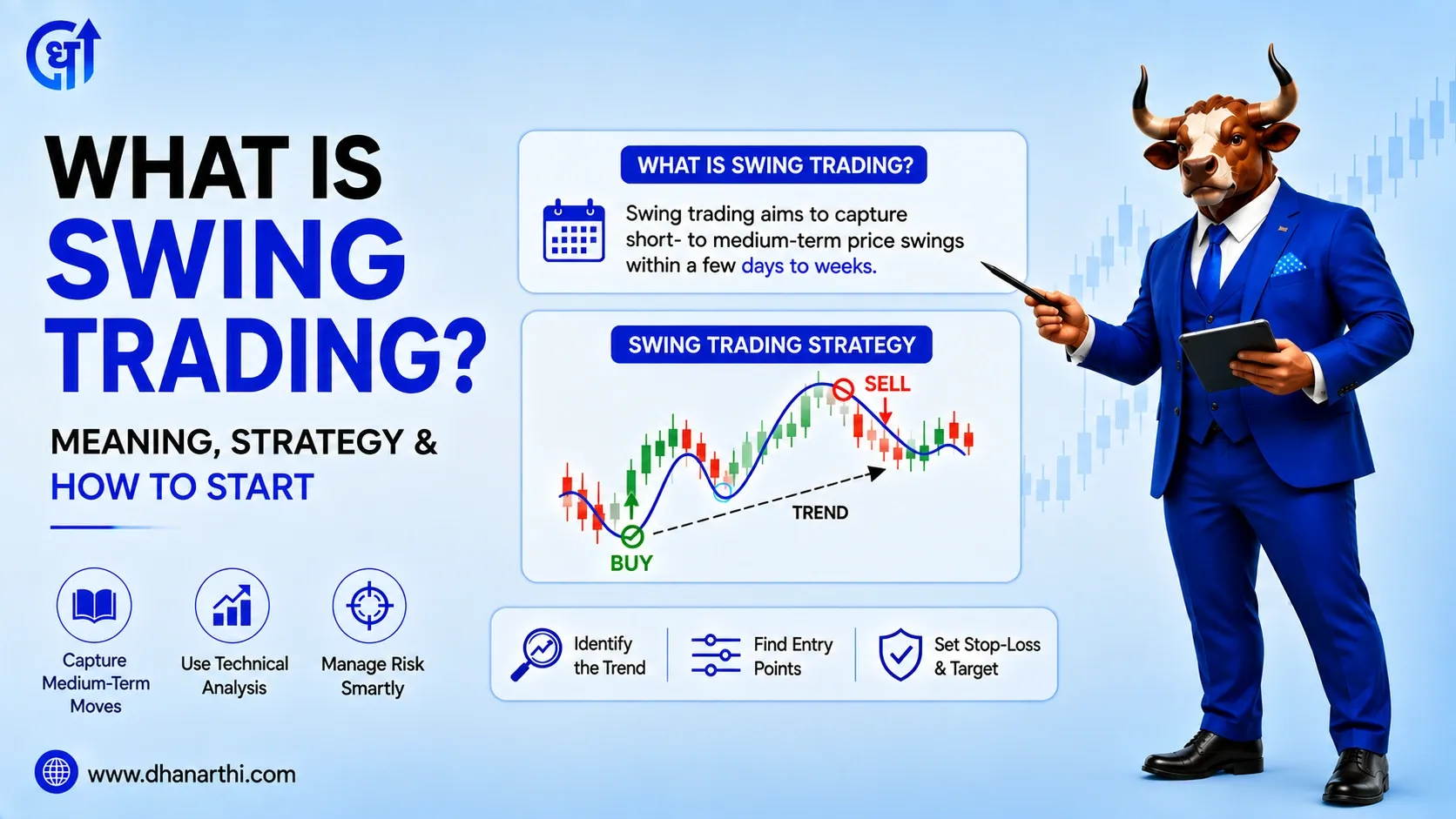
Swing trading is a short-to-medium-term trading style where traders hold a stock position for anywhere from two days to a few weeks, aiming to capture a directional price "swing" rather than intraday moves or long-term growth. Swing traders rely mainly on technical analysis, using daily and weekly charts to time entries and exits between clear support and resistance levels.
Swing trading is a trading style that sits between intraday trading and long-term investing. Instead of closing a position within the same trading session, or holding a stock for years based on fundamentals, a swing trader holds a position for a few days to a few weeks, aiming to capture one clear directional move, or "swing," in the stock's price.
The core idea is straightforward: identify a stock likely to move meaningfully in one direction over the coming days or weeks, enter after the move has started to show signs of confirmation, and exit before the trend reverses. Swing traders typically don't try to capture the entire move from the very bottom to the very top, they aim to capture the middle, more reliable portion of the swing.
Swing trading works across equities, index futures, and even commodities on MCX, though equity swing trading remains the most common entry point for Indian retail traders learning the style.
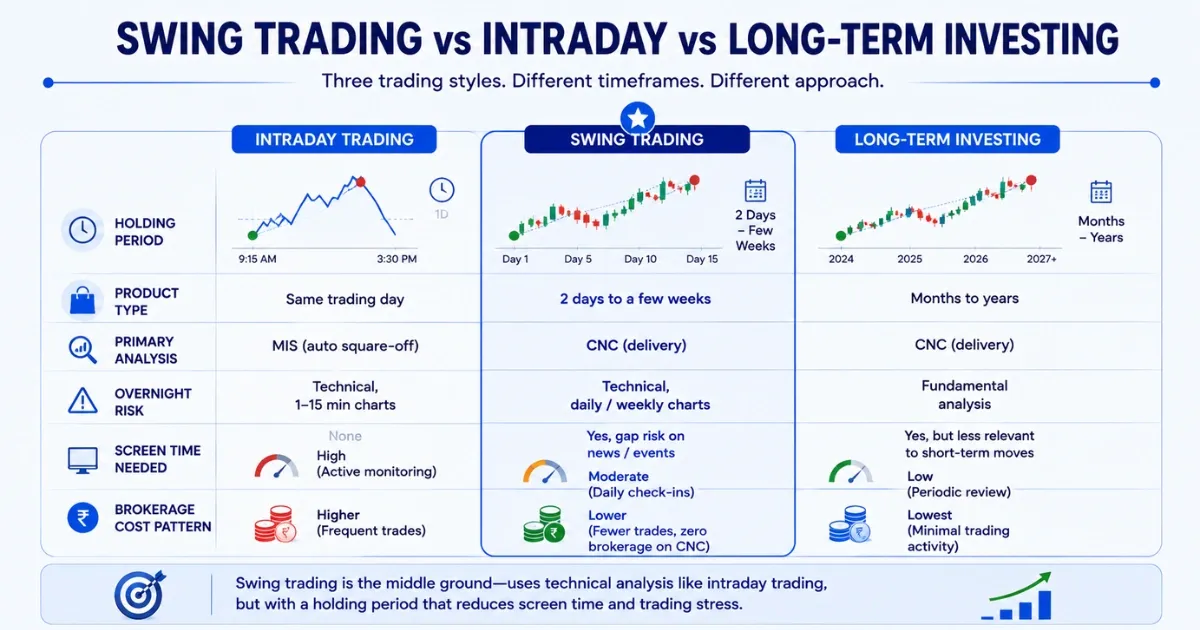
The three trading styles differ mainly in holding period, tools used, and the type of risk each one carries.
| Factor | Intraday Trading | Swing Trading | Long-Term Investing |
|---|---|---|---|
| Holding period | Same trading day | 2 days to a few weeks | Months to years |
| Product type | MIS (auto square-off) | CNC (delivery) | CNC (delivery) |
| Primary analysis | Technical, 1-15 min charts | Technical, daily/weekly charts | Fundamental analysis |
| Overnight risk | None | Yes, gap risk on news/events | Yes, but less relevant to short-term moves |
| Screen time needed | High, active monitoring | Moderate, daily check-ins | Low, periodic review |
| Brokerage cost pattern | Higher due to frequent trades | Lower, fewer trades, zero brokerage on CNC | Lowest, minimal trading activity |
Swing trading is often described as the middle ground precisely because it borrows tools from both ends, technical analysis like intraday trading, but a holding period long enough to avoid the constant screen-watching that intraday demands.
Example: Suppose Reliance Industries is trading at Rs 2,500. A swing trader spots a bullish breakout pattern on the daily chart, with a measured target suggesting potential upside toward Rs 2,750 over the next two weeks. The trader buys at Rs 2,500, sets a stop loss below the recent swing low, and holds the position as the move develops. If the stock reaches the target zone, the trader exits around Rs 2,720 to Rs 2,750, capturing a swing of roughly Rs 220 to Rs 250 per share.
This example illustrates the core swing trading process: identify a setup with a clear technical trigger, define risk before entering, hold through the natural back-and-forth of daily price action, and exit at a predetermined target rather than trying to guess the exact top.
Research Stocks Smarter with Dhanarthi AI Screener
Analyze 5,000+ NSE & BSE stocks with 150+ custom filters, real-time volume breakout scans, and transparent fundamental data.
Use Dhanarthi Screener
Swing trading in India uses the CNC (Cash and Carry) product type for equities, meaning the trader takes actual delivery of shares into their demat account rather than trading on margin with a same-day square-off requirement. This has a meaningful cost advantage that beginners often overlook.
On most Indian discount brokers, including Zerodha, Groww, and Dhan, equity delivery (CNC) trades carry zero brokerage. Traders only pay statutory charges like STT, stamp duty, and exchange charges, typically working out to roughly Rs 50 to Rs 80 per Rs 1 lakh traded, compared to Rs 130 to Rs 180 for intraday trades on the same value.
Over a month, this difference compounds. A swing trader executing around 8 trades a month can save tens of thousands of rupees annually in brokerage costs compared to an intraday trader placing several trades per day, a cost edge that exists before a single chart pattern is even analyzed.
Swing traders generally rely on one or a combination of the following approaches:
| Strategy | Core Idea | Tools Commonly Used |
|---|---|---|
| Pullback Trading | Enter when price briefly retraces within an established trend, then resumes | Moving averages, support/resistance |
| Breakout Trading | Enter when price breaks decisively above resistance or below support with volume confirmation | Chart patterns, volume |
| Mean Reversion | Enter when price moves to an extreme and is likely to revert toward its average | RSI, Bollinger Bands, moving averages |
Most swing traders don't rely on a single strategy exclusively, they adapt based on whether the broader market is trending or range-bound, since pullback and breakout strategies work best in trending conditions while mean reversion tends to work better in sideways markets.
Not every stock suits swing trading equally well. A few practical filters help narrow the selection:
Because swing trades are held overnight and across weekends, they carry gap risk that intraday trades don't, a stock can open significantly higher or lower than its previous close based on news, making risk management even more important than in intraday trading.
Proper stop loss placement and position sizing are essential parts of every swing trade, not optional extras. A common practice among swing traders is targeting a minimum risk-reward ratio of 1:2, meaning the potential profit target is at least twice the distance of the stop loss, which allows a strategy to remain profitable even without an especially high win rate.
Swing trading profits are generally taxed differently from long-term investment gains, and this is a detail many beginner guides skip entirely. Since swing trades are typically held for a few days to a few weeks, well under the 12-month threshold, profits are treated as Short-Term Capital Gains (STCG) and taxed at a flat rate under Indian tax rules, rather than at the lower long-term capital gains rate that applies to holdings beyond 12 months.
This is an important distinction from intraday trading, where profits are typically treated as business income and taxed according to the trader's income slab, often alongside GST-like treatment for trading as a business activity. Because swing trading involves actual delivery, it generally falls under capital gains taxation rather than business income, though traders with very high transaction frequency should consult a tax professional, since classification can depend on individual trading patterns.
One of swing trading's biggest appeals is the reduced time commitment compared to intraday trading. Rather than watching 1-minute or 5-minute charts throughout the trading session, most swing traders review their open positions and scan for new setups once a day, often after market close when daily candles have formed, along with a lighter check during market hours if a stop loss or target is close to being hit.
A realistic weekly routine for a beginner swing trader might involve 30-45 minutes each evening reviewing charts and open positions, plus a longer weekend session scanning for new setups across a watchlist. This is a fraction of the screen time intraday trading demands, which is precisely why swing trading appeals to working professionals who want active market participation without dedicating their entire day to it.

Confused about chart patterns & stock analysis?
Use
Dhanarthi Stock Guru
to chat, analyze price patterns, and ask questions directly.
Swing trading rewards patience and discipline more than speed. Traders who treat every setup as urgent, rather than waiting for genuinely favorable risk-reward opportunities, tend to underperform those who trade less frequently but more selectively.
Swing trading meaning, in practical terms, comes down to capturing a stock's directional move over days to weeks rather than minutes or years. It offers a middle path between the intensity of intraday trading and the passivity of long-term investing, using technical analysis to time entries while avoiding the constant screen-watching intraday demands. The real edge for beginners lies not just in picking the right setups, but in respecting position sizing, stop losses, and the tax and cost realities that come with holding positions over days and weeks rather than trading within a single session.
Disclaimer: This article is for educational purposes only. It does not constitute investment advice. Please consult a SEBI-registered financial advisor before making investment decisions.
1. What is swing trading in simple terms?
Swing trading is a short-to-medium-term trading style where a trader holds a stock position for roughly 2 days to a few weeks to capture a directional price move, rather than trading within a single session or investing for years.
2. What is the difference between swing trading and intraday trading?
Intraday trading closes all positions within the same trading day using auto square-off, while swing trading takes actual delivery of shares (CNC) and holds the position over several days or weeks, accepting overnight and weekend gap risk in exchange for a potentially larger move.
3. Is swing trading good for beginners?
Swing trading is often considered approachable for beginners since it does not require watching charts all day like intraday trading, while still teaching technical analysis, chart reading, and risk management skills.
4. What is the best swing trading strategy?
Common swing trading strategies include pullback trading, breakout trading, and mean reversion, each suited to different market conditions. Most swing traders combine strategies depending on whether the market is trending or range-bound.
5. How is swing trading profit taxed in India?
Swing trading profits are generally taxed as short-term capital gains when the holding period is under 12 months, since swing trades typically involve actual delivery of shares rather than intraday speculation.
6. What is CNC in swing trading?
CNC stands for Cash and Carry, the product type used for equity delivery trades in India. Swing traders use CNC since they take actual delivery of shares into their demat account rather than trading on intraday margin.
7. How much capital is needed to start swing trading?
There is no fixed minimum, but starting with a modest amount and gradually increasing capital as experience grows is a common approach, since risk management should always take priority over deploying large capital early on.
8. How much time does swing trading take daily?
Swing trading typically requires less daily time than intraday trading, often 30-45 minutes reviewing charts and open positions each evening, plus a longer weekend session for scanning new setups.
9. What stocks are best for swing trading in India?
Liquid, moderately volatile stocks with clear technical structure, respecting support and resistance levels cleanly, are generally preferred for swing trading over illiquid or extremely choppy small-cap stocks.
10. Do swing traders need a stop loss?
Yes, stop losses are essential in swing trading since positions are held overnight and across weekends, carrying gap risk that intraday trades don't face, making predefined risk management critical.
11. What is a good risk-reward ratio for swing trading?
Many swing traders target a minimum risk-reward ratio of 1:2, meaning the potential profit target is at least twice the size of the stop-loss distance, which helps keep a strategy profitable without requiring an especially high win rate.
12. Can swing trading be combined with long-term investing?
Yes, many traders use swing trading for shorter-term opportunities while maintaining a separate long-term investment portfolio based on fundamentals, treating the two as distinct strategies with different goals and time horizons.
Share Market
IPO
Artificial Intelligence
Semi Conductor