





SGB vs Gold ETF: Which Is Better in 2026?
October 22, 2026



TABLE OF CONTENTS
Get AI Summary





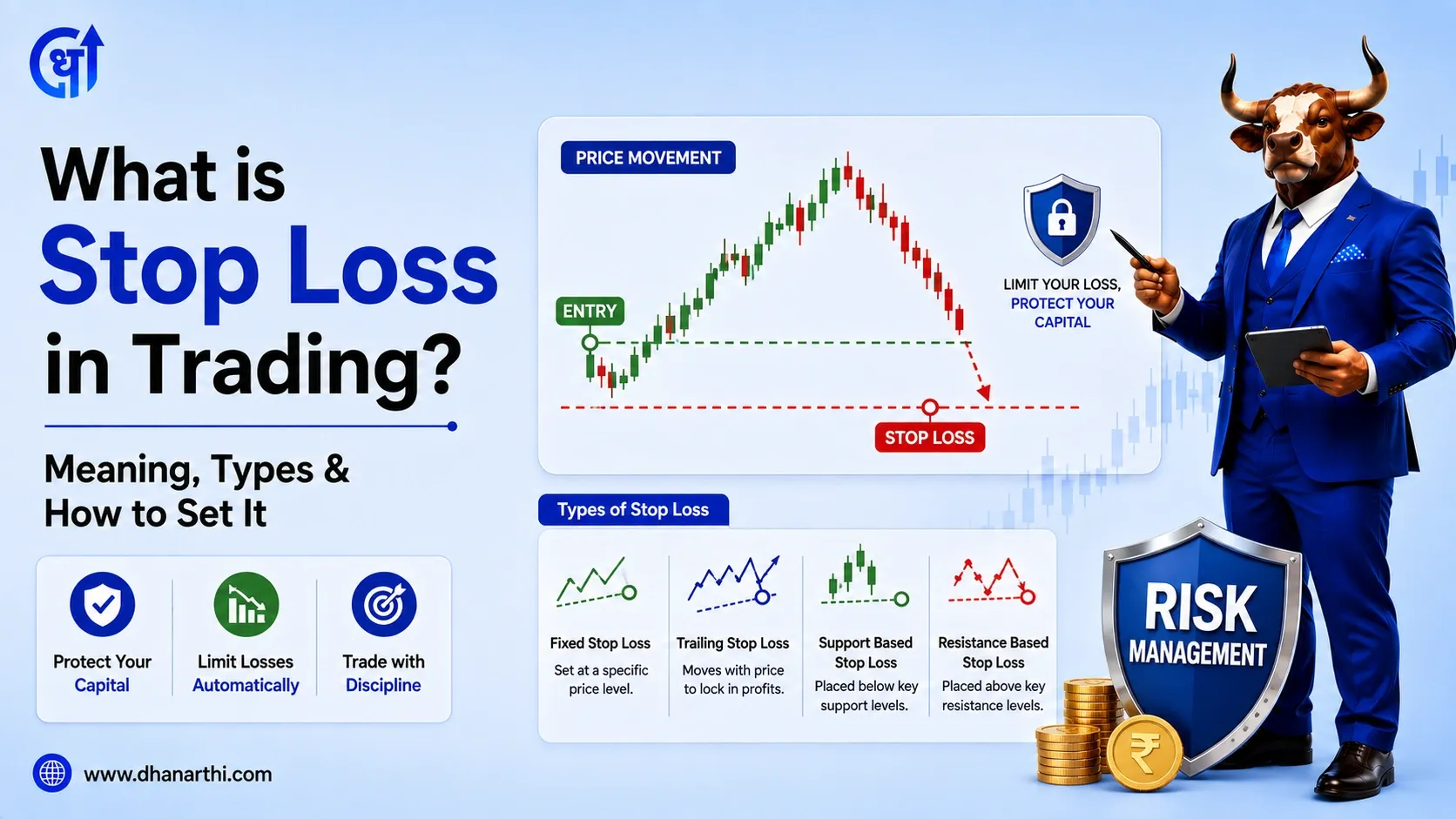
Stop loss is an order placed with a broker to automatically buy or sell a stock once it reaches a specified price, limiting potential losses on a trade. It is one of the most fundamental risk management tools in trading, helping traders exit a losing position before the loss grows larger than planned.
Research Stocks Smarter with Dhanarthi AI Screener
Analyze 5,000+ NSE & BSE stocks with 150+ custom filters, real-time volume breakout scans, and transparent fundamental data.
Use Dhanarthi Screener
Stop loss, often written as SL, is an order placed with a broker to automatically buy or sell a security once it reaches a specified trigger price. The purpose is simple: limit how much a trader loses on a single trade if the market moves against their position.
Without a stop loss, a trader has to manually watch a position and decide when to exit, which often leads to emotional decision-making during volatile sessions. A stop loss removes that emotional element by setting the exit level in advance, before the trade even begins to move against the trader.
Stop loss in trading applies across intraday trading, swing trading, and even longer-term positions, though how strictly it is used tends to vary by trading style, as covered later in this article.
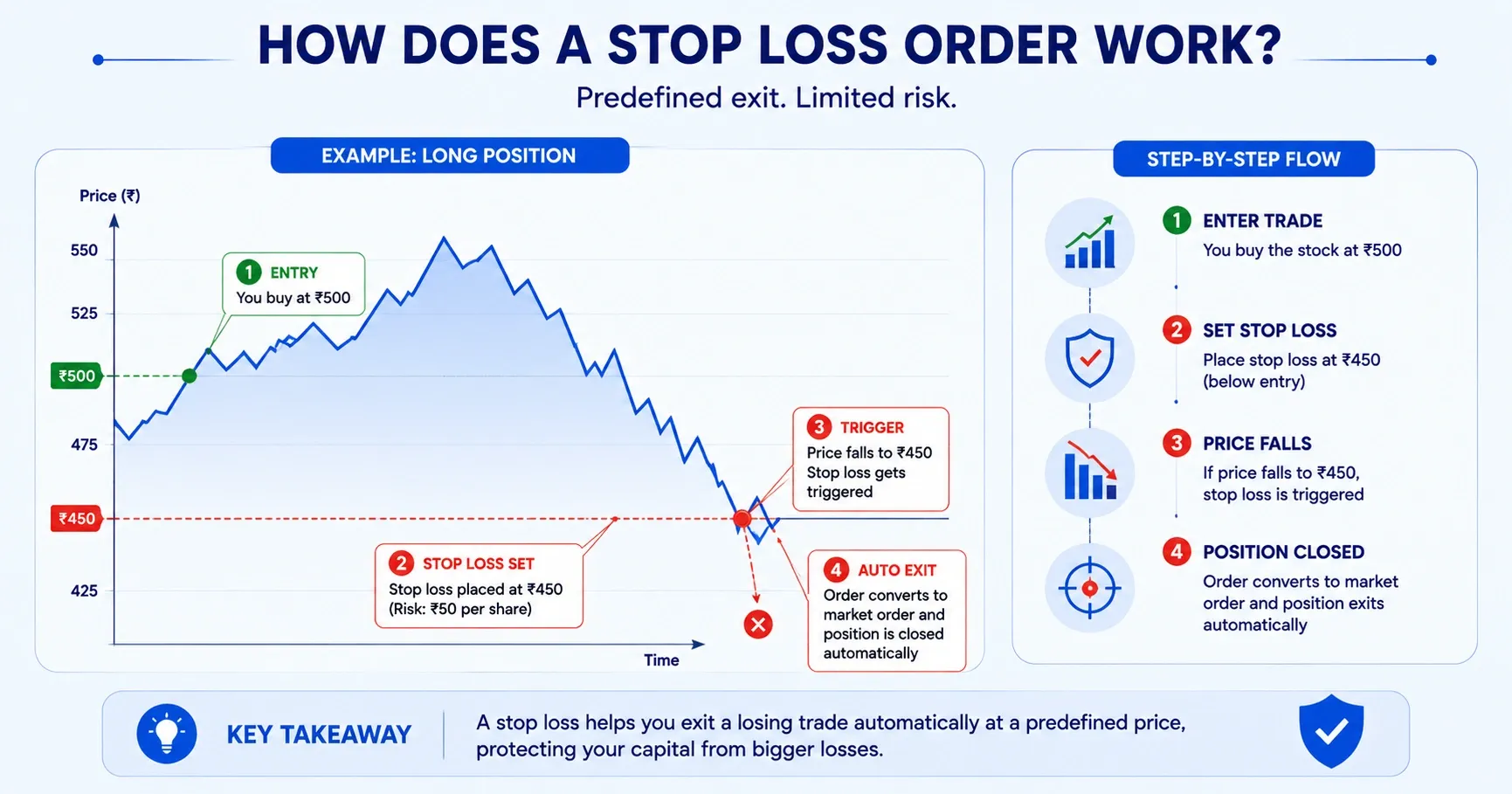
When a trader places a stop loss, they select a specific price level, known as the stop price, at which the order activates. Once the stock reaches that price, the order is triggered and typically converts into a market order, executing at the next available price.
Example: A trader buys a stock at Rs 500 and sets a stop loss at Rs 450, accepting a maximum risk of Rs 50 per share. If the price falls to Rs 450, the stop loss triggers, and the position closes automatically, preventing further losses if the stock continues to fall.
It's worth noting that a triggered stop loss does not always execute at exactly the stop price. In fast-moving or gap-down conditions, the actual execution price can differ slightly from the trigger price, since the order becomes a market order once activated.
Indian brokers typically offer a few variations of the stop loss order, each suited to different situations.
| Type | How It Works | Best For |
|---|---|---|
| SL-M (Stop Loss Market) | Triggers a market order once the stop price is hit, guarantees execution but not exact price | Traders who prioritize getting out over getting a specific price |
| SL-L (Stop Loss Limit) | Triggers a limit order at a specified price once the stop price is hit, guarantees price but not execution | Traders who want price certainty and can accept the risk of the order not filling in fast markets |
| Trailing Stop Loss | Automatically moves the stop level as price moves favorably, locking in gains while still allowing room to run | Traders looking to protect profits on a winning trade without capping the upside manually |
SL-M orders are the most commonly used by retail traders in India, since guaranteed execution generally matters more than the exact exit price during a stop-out.
There is no single correct way to set a stop loss. Most traders use one of three broad approaches, often adjusting based on the specific stock and trade setup.
1. Percentage-based stop loss (including the 2% rule): A fixed percentage of the entry price or account capital. The widely referenced 2% rule states that a trader should not risk more than 2% of total trading capital on any single trade. For a short-term trade, a tighter 1% stop is common, while a longer-term position might use a wider stop, though anything beyond 12-15% generally signals a poor entry rather than a reasonable risk allowance.
2. Support/resistance-based stop loss: Placing the stop just beyond a key support level for long positions, or just beyond resistance for short positions, rather than at an arbitrary percentage. Placing the stop exactly on the level is generally avoided, since minor price noise can trigger an early exit, a small buffer beyond the level, roughly 0.5%, is often used instead.
3. Volatility-based stop loss: Using a stock's recent price volatility, such as its Average True Range (ATR), to set a stop distance that reflects how much the stock naturally moves. A highly volatile stock needs a wider stop to avoid being stopped out by normal price swings, while a low-volatility stock can use a tighter stop.
| Method | Basis | Works Best When |
|---|---|---|
| Percentage-based | Fixed % of price or capital | Simple, consistent risk sizing across trades |
| Support/resistance-based | Chart structure | Trader has identified clear technical levels |
| Volatility-based (ATR) | Stock's average price movement | Stock has unusual or above-average volatility |
Stop loss placement and position sizing are directly connected, the distance between entry and stop loss determines how many shares can be bought while keeping total risk within an acceptable limit.
Formula: Stop Loss Price (Long) = Entry Price - Risk Amount per Share
Worked example: Suppose a trader has Rs 1,00,000 in trading capital and follows the 2% rule, meaning they are willing to risk Rs 2,000 on a single trade. They plan to buy a stock at Rs 500 with a stop loss at Rs 480, a risk of Rs 20 per share. Position size = Rs 2,000 / Rs 20 = 100 shares. Buying more than 100 shares at this stop distance would risk more than the intended 2% of capital.
This approach keeps risk consistent across trades regardless of the stock price, since the stop-loss distance directly determines position size rather than the other way around.
Not always, and this is a nuance many beginner guides skip. Active traders, especially those trading intraday or short-term swings, generally benefit from strict stop losses since they are trying to protect capital over a short holding period where technical levels matter more.
Long-term investors, on the other hand, don't always need a stop loss in the same way. Since their decisions are typically based on company fundamentals and valuation rather than short-term price action, a strict stop loss can trigger an unnecessary exit during normal volatility, even when the underlying investment thesis hasn't changed. That said, many long-term investors still use a much wider, fundamentals-based exit rule, for instance, exiting if the company's core financials deteriorate meaningfully, rather than a tight, price-based stop loss.
The right approach depends on trading style. A trader relying on technical analysis needs a stop loss tied to chart levels. An investor relying on fundamental analysis may be better served by monitoring the underlying business rather than reacting to daily price swings.
A well-placed stop loss protects capital, reduces emotional decision-making, and allows a trader to step away from constantly monitoring a position, but only if it is set with a clear, consistent method rather than guesswork.
A stop loss (or stop-market) order and a stop-limit order behave differently once triggered, and the difference matters in fast-moving markets like intraday sessions on Nifty and Bank Nifty.
| Factor | Stop Loss (Market) | Stop Limit |
|---|---|---|
| Execution | Guaranteed once triggered | Not guaranteed, only fills at or better than the limit price |
| Price certainty | Not guaranteed, fills at next available price | Guaranteed price or better |
| Risk | May execute at a worse price during gaps | May not execute at all if price gaps past the limit |
Most retail traders in India default to a standard stop-loss market order for its execution certainty, reserving stop-limit orders for situations where getting a specific price matters more than guaranteed execution.

Confused about chart patterns & stock analysis?
Use
Dhanarthi Stock Guru
to chat, analyze price patterns, and ask questions directly.
Stop loss meaning in trading comes down to a single purpose: limiting how much a trade can lose before it's allowed to run further against you. Whether using a percentage-based rule, support and resistance levels, or volatility-based sizing, the method matters less than having one and sticking to it consistently. Pairing stop-loss placement with proper position sizing, rather than treating them as separate decisions, is what keeps risk consistent across every trade, and long-term investors should weigh whether a strict price-based stop even fits their fundamentals-driven approach in the first place.
Disclaimer: This article is for educational purposes only. It does not constitute investment advice. Please consult a SEBI-registered financial advisor before making investment decisions.
1. What is stop loss in trading?
Stop loss is an order placed with a broker to automatically buy or sell a stock once it reaches a specified price, helping traders limit potential losses on a position.
2. What is stop loss meaning in simple terms?
Stop loss meaning is straightforward: it is a predetermined exit price set in advance so that a losing trade closes automatically before the loss grows larger than the trader intended.
3. What are the types of stop loss orders?
The main types are SL-M (stop loss market), which guarantees execution once triggered, SL-L (stop loss limit), which guarantees price but not execution, and trailing stop loss, which moves automatically as price moves favorably.
4. How to set stop loss properly?
Stop loss can be set using a percentage of capital (like the 2% rule), based on support and resistance levels on the chart, or based on a stock's volatility using tools like the Average True Range.
5. What is the 2 percent rule in stop loss?
The 2% rule states that a trader should not risk more than 2% of their total trading capital on any single trade, helping ensure that a string of losses doesn't significantly damage the overall portfolio.
6. What is trailing stop loss?
A trailing stop loss automatically adjusts and moves in the direction of a favorable price move, locking in gains progressively while still giving the trade room to continue running.
7. Does everyone need a stop loss in trading?
Active traders generally benefit from strict stop losses to protect capital over short holding periods. Long-term investors don't always need one in the same way, since their decisions are usually based on fundamentals rather than short-term price movements.
8. What is the difference between stop loss and stop limit order?
A stop loss order guarantees execution once triggered but not the exact price, while a stop limit order guarantees the price but may not execute at all if the market gaps past the limit level.
9. How does stop loss connect to position sizing?
The distance between entry price and stop loss determines position size when following a fixed risk amount, since dividing the total risk allowed by the per-share risk gives the maximum number of shares to buy.
10. What is a common mistake with stop loss placement?
Setting the stop loss too tight, very close to the entry price, is a common mistake that causes normal price fluctuations to trigger an exit even when the broader trend hasn't actually changed.
11. Can a stop loss fail to execute at the exact price?
Yes, once triggered, a stop-loss market order executes at the next available price, which can differ from the stop price during fast-moving or gap-down market conditions.
12. Is stop loss useful for intraday trading in India?
Yes, stop loss is considered essential for intraday trading in India, since positions need to be actively protected within a single trading session where price can move quickly in either direction.
Share Market
IPO
Artificial Intelligence
Semi Conductor