





Best Nifty Next 50 Index Fund India 2026
October 20, 2026



TABLE OF CONTENTS
Get AI Summary





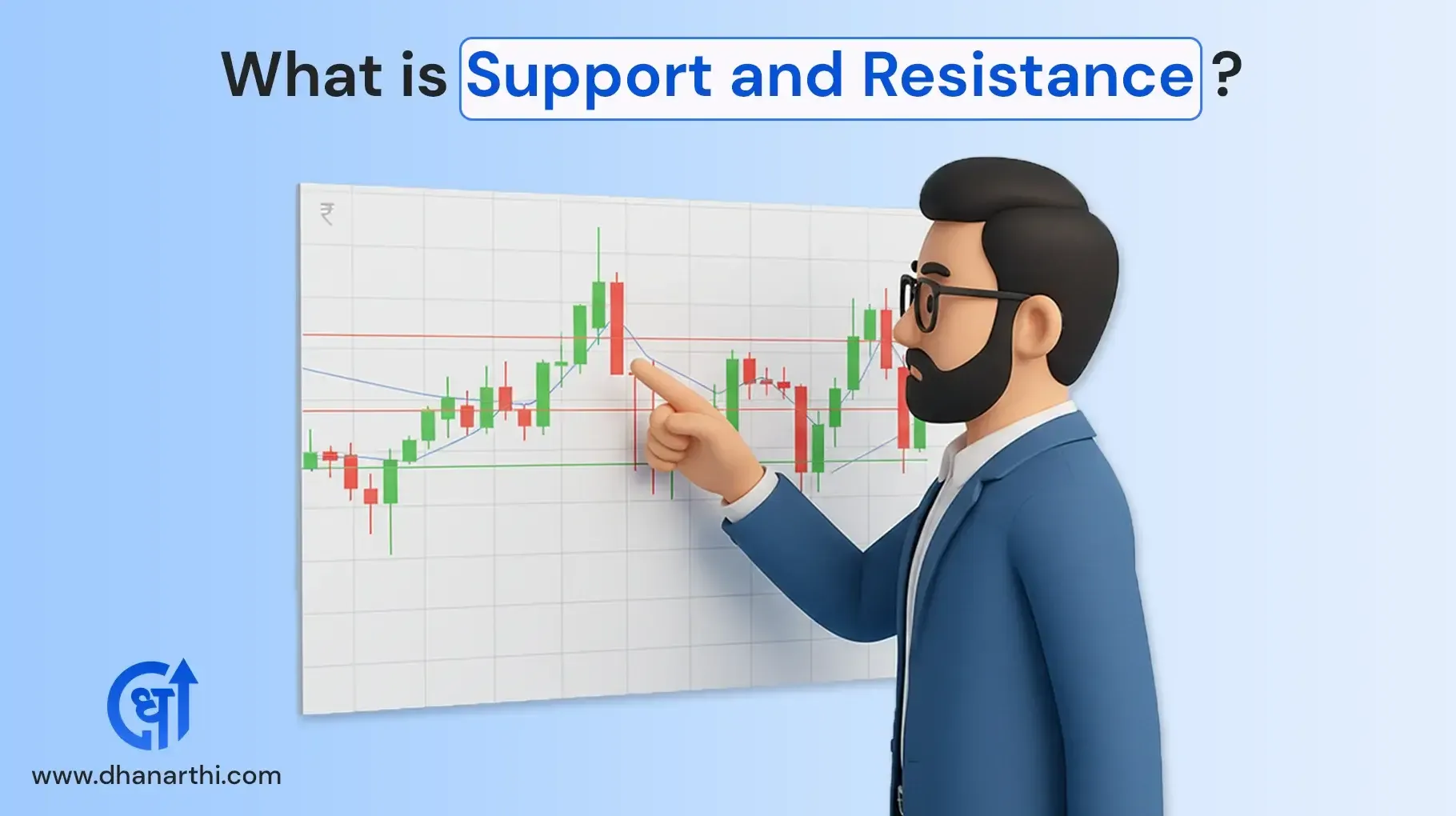
At the beginning of my trading journey, the experienced traders were constantly mentioning support and resistance as if it were some kind of secret. To be honest, I was pressured. However, as soon as I got the hang of these technical analysis concepts, the whole thing became clear to me. I am going to explain the support and resistance concept in the simplest terms possible, just as I wished it had been explained to me.
However, as soon as I got the hang of these notions, the whole thing became clear to me. I am going to explain the support and resistance concept in the simplest terms possible, just as I wished it had been explained to me.
Let’s discuss one by one what it means and how it plays an important role in terms of investing, which has been described as follows :
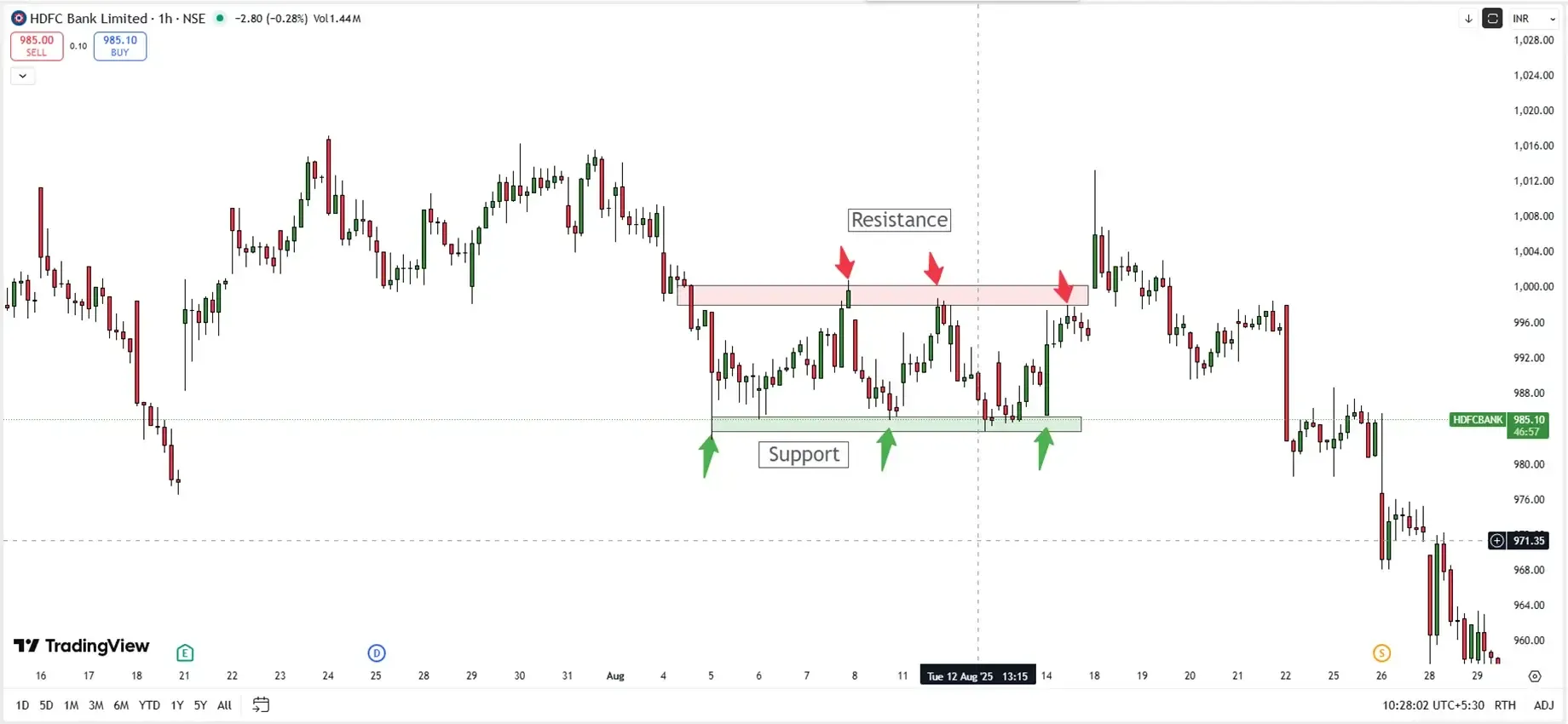
Support refers to the particular level of pricing that a stock usually can´t fall beyond, since the buying interest at that level becomes very strong. At this point, the price does not go down any further because of the high demand.
The price, when it comes to the support area, often stops or goes up, much like a ball that hits the floor and then bounces back.
The price is then stabilized and moved up thanks to the higher demand. The traders usually spot buying chances at the strong support levels.
Resistance represents the price at which a stock finds difficulty in moving up due to the strength of selling pressure. Here, the level of supply is sufficient to prevent the price from going up anymore.
Whenever the price touches the resistance level, it usually either halts or turns back; this is like a ball hitting the ceiling and bouncing down again.
The reason for this phenomenon is that when prices reach near the resistance level, sellers consider the stock as being overpriced and hence they begin to sell, while on the other hand, the buyers are waiting for the prices to go down before they start taking their positions at what they consider the high levels.
This supply increase restricts the price rise further. Resistance levels are often used by traders to decide when to sell or take profits.
Support is basically a price point where the demand is so high that the price cannot decline any further. Whenever a stock reaches its support level, the buyers see it as a good time to buy, and thus they come into the market. The arrival of buyers increases the price again.
Consider a real-world scenario. For instance, Reliance Industries keeps dropping, but each time it reaches around ₹2,400 and stops doing so in a few weeks. The ₹2,400 mark is termed as a support level. Following this, traders pay marked attention to it. A few may even acquire shares close to ₹2,400, hoping the stock will only increase, just like it did earlier.
Dhanarthi.com is one of the important platforms that can assist you in learning how to analyze financial statements to find out whether it is really worth buying if the stock is bouncing off the support or if the company is having underlying issues.
On the other hand, let us consider resistance in stock market terms. Resistance is a level at which selling pressure becomes dominant and thus prevents the stock price from going up any further.
Resistance in trading is akin to a ceiling that prices find it difficult to break through. I prefer to refer to it as a psychological barrier. It may be that the stock reached the price of ₹500 and then fell back three times before. The fourth time it gets to ₹500, a lot of traders will remember the previous failures and decide to sell off their shares before it falls again.
Here is a genuine illustration of the chart from my very own trading. I was keeping an eye on TCS, and it was continually trying to surpass the price point of ₹3,800, but it was unsuccessful every time. That price level was a strong barrier. The third time it came close to ₹3,800, I anticipated that it would fall back again, and it did.
The amazing aspect of resistance is that it occurs frequently at prior significant highs. If a stock reached a peak of ₹1,000 six months ago and is pushing up to that level, ₹1,000 would probably be the resistance. Traders who have bought at ₹1,000 in the past and are still holding on to a loss may wish to sell at break-even, thereby exerting downward pressure on the price.
As I went deeper into trading, I realized that support and resistance are not limited to simple horizontal lines on a chart. They exist in multiple forms, and understanding these different types significantly improved my trading decisions.
In technical analysis, horizontal support and resistance are indeed the most common levels. The price points where the market has consistently reversed in the past are marked by these levels. A stock or index bouncing several times from the same price shows powerful demand or supply at that level.
To illustrate, in case a stock persistently receives buying support around the price of ₹500, that price will be established as a major support level. Equally, if the price does not manage to break above a certain level several times, that level will be considered as resistance.
Support and resistance levels are dynamic, and their movements follow price changes over time. Generally, these levels are established through the use of trendlines or technical indicators like moving averages. They are not static at a single price point, unlike horizontal levels.
According to what I have seen, the 50-day and 200-day moving averages often serve as dynamic support in uptrends and as dynamic resistance in downtrends. Because these indicators are price-dependent, they give traders changing support and resistance levels.
Static support and resistance levels are established by taking into consideration major historical highs and lows. These levels are valid for a long time and often affect the price even after several years.
To illustrate, suppose Nifty had a peak of around 20,000 before; that level might create strong resistance when the index gets to that point again. Similarly, a significant low created in the course of a market correction can be regarded as long-term support.
Modern trading has witnessed one of the significant changes in perceiving support and resistance as zones rather than exact lines. Price seldom reacts at one precise level, but instead, it responds within a tiny range around that level.
Practicality is better to recognize a support zone between ₹495 and ₹505 rather than defining it exactly at ₹500. This manner has a good side of flexibility, and will not create false signals as easily, while at the same time closely matching actual market behavior.
Support and resistance levels are one of the thingsthate most beginners frequently question. Just let me explain my method to you.
To begin with, I check the chart for swing highs and swing lows. A swing high refers to the highest point of the price where it was reversed and then fell. A swing low is the lowest point of the price where it has stopped falling and then started to rise. Naturally, these points are the ones that turn into the resistance and the support levels, respectively.
Good screening tools are very helpful when analyzing different stocks and trying to find these levels in a lot of companies. The Dhanarthi stock screener is the one I prefer to use when comparing multiple stocks and their technical levels. It not only saves time but also helps in quicker spotting of opportunities.
Now, let's talk about real-life applications. The correct way of drawing support and resistance lines is a skill that will take time and practice before being mastered. So, let me give you my step-by-step method.
When I am drawing horizontal lines, first I look for two or more major swing lows and swing highs that lie at almost the same level. After that, I connect those points with a horizontal line.
Here are some common mistakes I made when I was starting, and I want you to avoid them:
Don't force lines where they don't exist: If you can't find at least two clear touches, the level probably isn't significant enough.
Don't draw too many lines: Your chart shouldn't look like a prison cell with lines everywhere. Focus on the most obvious and significant levels.
In the case of drawing trendlines for dynamic support or resistance, I at least connect two swing lows (for an uptrend support line) or two swing highs (for a downtrend resistance line).
Touching as many points as possible without bisecting the price action is the ideal line. The ability to do this comes with experience, so don't get upset if it seems uneasy to you at the beginning.
What I employ is a method that I name touch points. The frequency of a price touching a support or resistance level without breaking it determines the strength of that level.
I require a minimum of three touches before I deem a level really important. Nonetheless, I have also concluded that after numerous touches, the level loses its strength and is more prone to breaking eventually.
Although the process of manually drawing lines is quite essential, there are various indicators of support and resistance that can assist in affirming your analysis. I would like to share with you the indicators that I consider the most helpful.
These levels are monitored by a lot of traders, particularly day traders. I check pivot points every morning to determine the Nifty support and resistance levels for that day, as many other traders are also monitoring them, which makes them, if not entirely then partially, self-fulfilling.
Fibonacci retracements are very captivating. It is often observed that after a major price move, the prices go back to the Fibonacci levels (23.6%, 38.2%, 50%, 61.8%) before they move again in the same direction. In most cases, these levels are the ones where the price stops in uptrends or reverses in downtrends. At first, I was doubtful about Fibonacci, but later on, I found it really effective, as it happened to me too many times.
Volume Profile and Point of Control (POC) are indicators that reveal the trading volume distribution at various price levels. The areas with high volumes commonly serve as the main support or resistance levels due to the fact that the traders involved have placed their positions there. For options traders, understanding options trading metrics like open interest alongside volume helps identify even stronger support and resistance zones. This concept is rather advanced yet extremely helpful as soon as you understand the idea.
As a large portion of Indian traders are into indices, let us take a deep dive into the support and resistance of Nifty today, and also the resistance and support levels of Bank Nifty.
For Nifty support and resistance, I check three things every morning:
Pivot points: Calculated from yesterday's price action
Nearest swing high and low: From recent days
Major moving averages: Where the 50-day and 200-day are currently positioned
Support and resistance levels of Bank Nifty are critically significant for options traders. The movement of Bank Nifty is quicker than Nifty, and it really rates technical levels pretty well. I have concluded that whole numbers such as 44,000, 45,000, and 46,000 are mostly the major levels for Bank Nifty.
Daily pivot points for Indian indices are provided by numerous websites and YouTube channels, which might be useful starting points. Always, however, I check these levels by analyzing the actual support resistance diagram myself. Never, ever trust any level until you check it on your chart.
A practical tip is that the previous day's high and low very often turned out to be resistance and support for the very next day, particularly in range-bound markets. Understanding trading day dynamics is important here. In case Nifty reached a high of 19,850 yesterday, that point will most probably be resistance for today unless it is broken.
The understanding of price levels at which the reaction is seen made a great impact on my trading perception. No longer magic; it is all about psychology and human behavior. This is where technical and fundamental analysis converge to explain market movements.
Try to visualize the behavior of the market participants. Let’s suppose that a stock gets down to ₹500, and a lot of traders are buying it there because they think it is a good price. The stock has gone up to ₹600, and these traders are very pleased and still holding on.
However, if the stock comes down to ₹500 again, two things will occur. On the one hand, the traders who missed out on the first buying opportunity will be given a second one and will buy again.
Besides, emotional factors are always involved, and sometimes, they are the major players. The market is ruled by fear and greed. A stock that has just tested support and rebounded a few times makes the traders think that it is going to bounce again, and thus, their belief actually contributes to the bounce.
On the other hand, when resistance gets tested several times, traders get scared to buy at those levels, and thus, the fear creates stronger resistance.
For several weeks, I was totally lost in this idea until the day it finally made sense. The most interesting flip phenomenon occurs when a support level is shattered, but it very frequently turns into the resistance level in the next round.
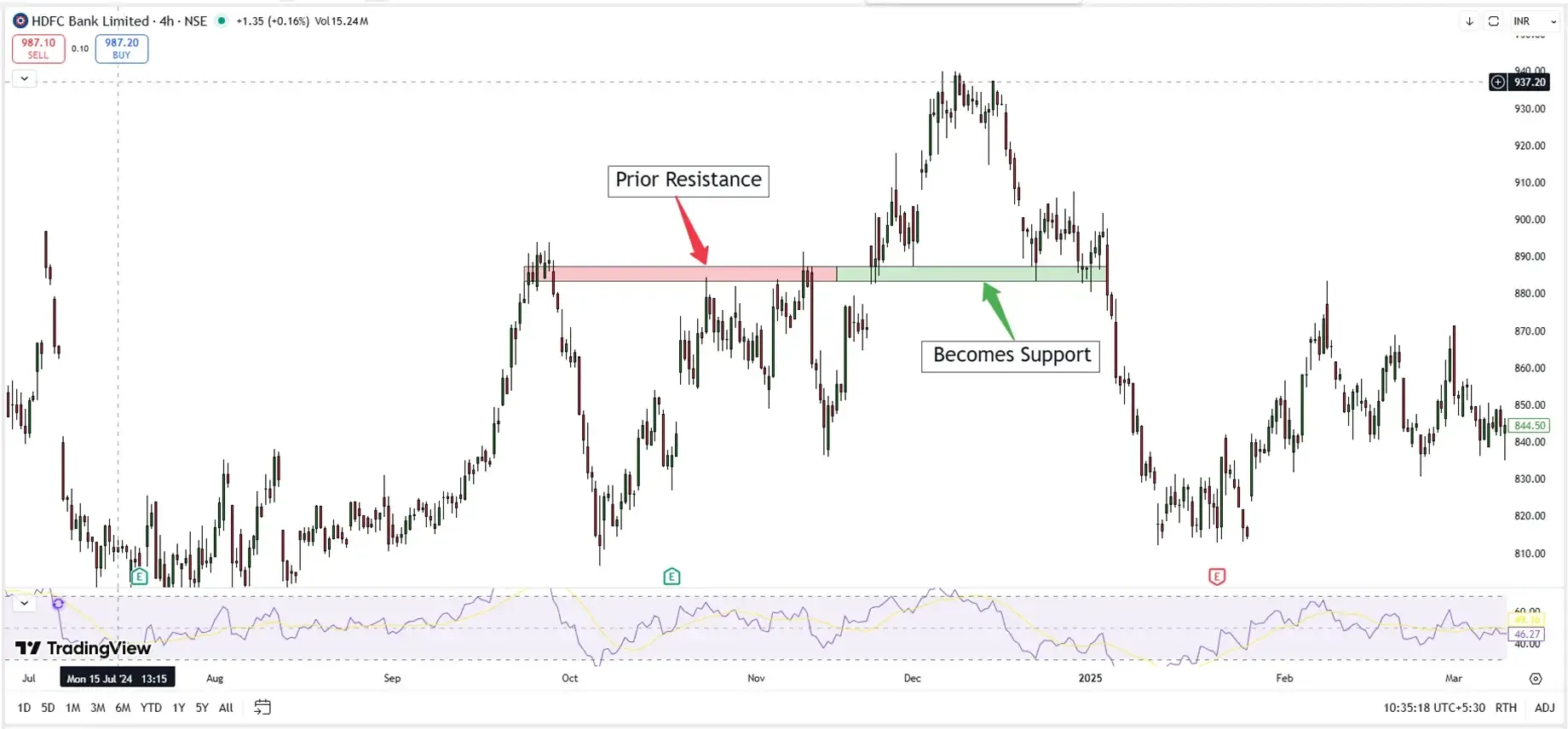
Let me support this reasoning with a practical example of why broken support becomes resistance. Imagine a stock that has found support at ₹500, where it has been repeatedly bouncing back from. Then one day, the stock suddenly breaks down below ₹500 and goes down to ₹450.
Traders who bought at ₹500 are now experiencing losses. If the stock price moves back toward ₹500, a lot of these traders would like to sell at breakeven or with very small losses. This sale of shares creates pressure that is strong enough to turn the old support into new resistance. This pattern is particularly important for intraday trading where quick recognition of role reversals can lead to profitable trades.
Then, the stock rose above the ₹1,600 level to ₹1,650, then retraced to ₹1,600 once again for a test. At this point, ₹1,600 was support, and the stock climbed up again. That's how role reversal works!
When a support or resistance level is finally broken, it indicates that the market has changed in terms of supply and demand. I'll describe the two cases.
A breakout is when the price goes up above resistance and keeps going even higher. This indicates that the buyers have taken control over the sellers at least at that point. Breakouts usually result in a big rally because after such resistance is taken off, there is no close limit to stop the price from advancing further.
A breakdown occurs whenever the market price moves downwards below the support level and keeps going lower. This is a clear signal that the selling pressure has surpassed the buying interest completely. The breakdowns can cause drastic drops since, after the support is gone, there is no floor in place to prevent the price from going down.
Before implementing any breakout or breakdown strategy with real money, it's crucial to verify its effectiveness through backtesting your strategy using historical data to understand success rates and optimal entry/exit points.
Allow me to discuss the practical trading strategies that support and resistance, and these are the methods I apply regularly.
Bounce trading is the easiest and most simple strategy. Buying close to the support levels would mean you are expecting the price to bounce back up, while selling/shorting at the resistance levels will mean you are expecting the price to go down.
This is exactly the point where financial statement analysis is to be considered as a must-do. Using fundamental analysis platforms like Dhanarthi.com provides financial report analysis in an easier way for beginners, enabling you to determine whether the stock bouncing off support has the strong fundamentals backing it or not.
The secret is still patience. Up to the last moment of the breakout, do not chase; instead, wait for a slight pullback to the resistance level that has been broken (now support) and get in with a stop loss placed below this new support area.
Confluence trading can be regarded as the most effective method. It is actually the combination of different support or resistance indicators. Consider if a price point corresponds with a Fibonacci retracement area, an average, and a previous swing l inn that case, it is a very strong confluence zone. I will always be more confident in my trades when several factors come together in the same place.
If I could go back to the first day, one of the things I would want someone to tell me is that good risk management is greater than perfect support and resistance levels finding. You can pinpoint the levels with precision, yet still eat up your account if proper risk management is not applied.
I have been able to avoid false breakouts, which is why I've saved myself thousands of rupees. A false breakout takes place when there is a price level that gets broken, but the price does not go further and eventually comes back to the original level. Understanding market volatility indicators like India VIX helps assess when false breakouts are more likely to occur during high volatility periods.
To successfully identify these fakeouts, I have and continue to use these filters:
Wait for candle close: Rather than just an intraday touch beyond the level
Check volume: True breakouts have above-average volume
Watch for follow-through: If the breakout happens on Friday, wait to see Monday's confirmation
It is very important to set stop losses at support and resistance levels. In the case of buying at support, I will put my stop loss below the support level. If the support is broken, I prefer to exit right away instead of waiting for it to return. Likewise, when I am selling at resistance, I place my stop loss just above the resistance level. This method reduces my losses and defines them at a small scale.
Position sizing considerations are often disregarded. Using quantitative metrics to calculate proper position sizes, I always put on the line only 1-2% of my total capital in a single trade, regardless of how sure I am about a support or resistance level.
Allow me to tell you the truth. Support and resistance levels are powerful, yet they are not flawless. Knowing their weaknesses will turn you into a more skilled trader.
There have been many cases where support and resistance did not work. There are times when a level that was resistant for a number of times suddenly breaks without any notice. This frequently occurs when there are major news events, unexpected earnings, or market-wide crashes.
It is important to combine with other indicators. Support and resistance alone do not determine my trading decisions. The overall trend, momentum indicators such as RSI, volume patterns, and moving averages are also considered. My confidence is greatly boosted when various indicators are in agreement.
Here are my best practices for using support and resistance:
A 5-minute chart support level is not as important as a daily chart support level; it is recommended to look at higher timeframes always.
Support and resistance zones should be given more importance based on the number of times they have been tested: This is how it goes, more hits, more strength of the level.
Do not consider price levels as certain amounts: Treat them as areas.
Always wait for the volume to confirm the break before you take a position: In this case, volume is the determining factor that separates real breaks from the fake ones.
It is advisable to combine technical levels with fundamental analysis: Combining technical and fundamental approaches is the way to get the best results.
The support and resistance levels are, in the end, the must-know areas for every serious trader. The levels indicate the natural floors and ceilings of the market, where exactly the buying and selling pressures are equal.
By doing so, the trader will still gain an edge on his performance by treating them as zones rather than rigid prices, in addition to good risk management, volume confirmation, and a combination of both technical and fundamental analyses.
Take the time to slowly increase your trading size, keep track of your trading activities, and show patience and discipline. A Dhanarthi method will eventually, slowly but surely, make you a better trader.
Disclaimer: This article aims to provide general information about financial topics. It is not a recommendation to buy or sell any investment. For investment decisions, please consult a professional financial advisor.
1. What is support and resistance in simple terms?
Support is a price level where buying interest stops the stock from falling further, acting like a floor. Resistance is where selling pressure prevents prices from rising, acting like a ceiling. Both help traders predict price movements and make better trading decisions.
2. How do I find support and resistance levels on a chart?
Look for swing highs and swing lows on your chart. Swing lows become support levels, while swing highs become resistance. Also check round numbers, previous significant highs or lows, and areas where price bounced multiple times. Use multiple timeframes for stronger confirmation.
3. Why do prices bounce off support and resistance?
Prices bounce because many traders watch these levels and place orders around them. At support, buyers step in thinking it's a good price. At resistance, sellers exit to book profits. This collective behavior creates actual buying and selling pressure at these levels.
4. What is the best indicator for support and resistance?
Moving averages (50-day and 200-day) work great as dynamic support and resistance. Pivot points are excellent for daily levels. Fibonacci retracements help identify potential levels after big moves. Volume Profile shows high-volume areas that act as strong support or resistance zones.
5. How do I draw support and resistance lines correctly?
Connect at least two or three swing lows for support lines and swing highs for resistance lines. Draw horizontal lines at these levels. Remember to treat them as zones rather than exact prices. Use line charts instead of candlesticks to avoid false signals.
6. What happens when support is broken?
When support breaks with strong volume, it often becomes new resistance. Prices typically fall further after breaking support because sellers gain control. This is called a breakdown. Always check volume confirmation before trading breakdowns to avoid false signals.
7. What is the difference between support and resistance?
Support is a price floor where buying demand prevents further decline. Resistance is a price ceiling where selling pressure stops upward movement. Support comes from buyers stepping in, while resistance comes from sellers booking profits or entering short positions.
8. How do I use support and resistance for day trading?
Use previous day's high and low as resistance and support. Check pivot points every morning for intraday levels. Buy near support with stop loss below it, sell near resistance with stop above. Always confirm with volume before entering trades.
9. Where can I find daily Nifty support and resistance levels?
Calculate pivot points using yesterday's high, low, and close for daily Nifty levels. Check where 50-day and 200-day moving averages are positioned. Previous swing highs and lows also act as important levels. Many financial websites publish daily pivot points for reference.
10. Are support and resistance levels reliable?
Support and resistance are useful but not perfect. They work best when combined with other indicators like volume, moving averages, and trend analysis. Levels that have been tested multiple times are more reliable. Always use stop losses because any level can break unexpectedly.
11. What is role reversal in support and resistance?
Role reversal happens when broken support becomes new resistance, or broken resistance becomes new support. This occurs because traders who bought at old support want to exit at breakeven when price returns, creating selling pressure at that level.
12. How do I identify false breakouts?
Wait for candle close beyond the level rather than just intraday touch. Check if volume is higher than average during the break. Look for follow-through in the next session. If these confirmations are missing, it's likely a false breakout or fakeout.
13. Can I use support and resistance for Bank Nifty options?
Yes, support and resistance are very useful for Bank Nifty options trading. Identify key levels using pivot points and previous day's high-low. These levels help you choose strike prices and set stop losses. Round numbers like 44,000, 45,000 often act as significant levels.
14. Should I treat support and resistance as exact prices or zones?
Always treat them as zones, not exact prices. Prices rarely respect levels to the exact rupee. Create a small zone around each level (like ₹495-₹505 instead of exactly ₹500). This approach reduces false signals and gives you more realistic trading expectations.
15. How many support and resistance lines should I draw?
Draw only the most obvious and significant levels to avoid cluttering your chart. Focus on 2-3 major support levels and 2-3 major resistance levels. Too many lines make charts confusing and reduce effectiveness. Quality matters more than quantity when identifying these levels.
Share Market
IPO
Artificial Intelligence
Semi Conductor