

What is Bracket Order and Cover Order? Key Differences
August 31, 2026



TABLE OF CONTENTS
Get AI Summary





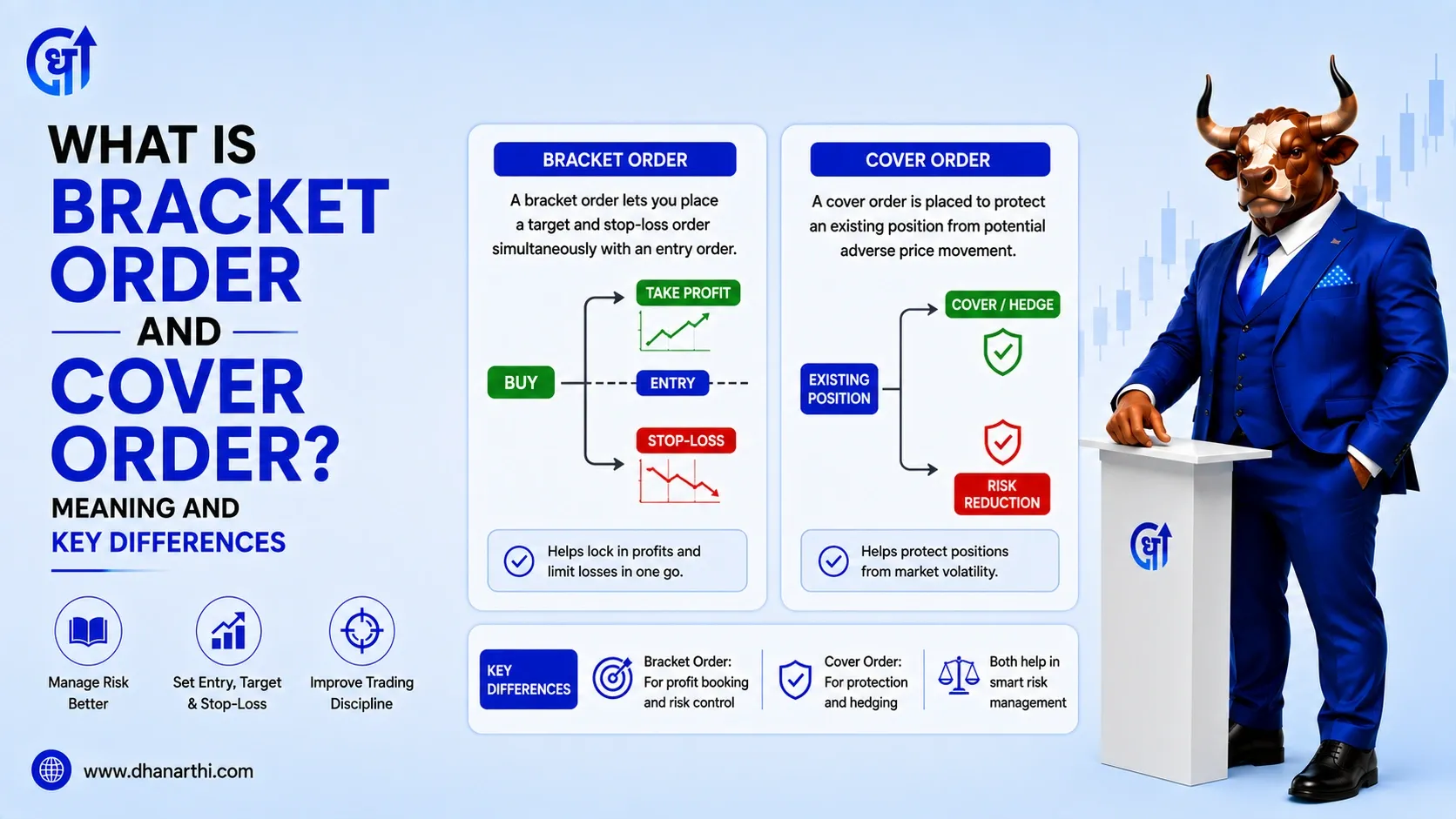
Bracket order and cover order are advanced intraday order types that combine a trader's entry with automatic exit orders. A bracket order (BO) places an entry, a target, and a stop loss together in one instruction. A cover order (CO) places only an entry with a compulsory stop loss, without a defined target. Both are designed to control risk automatically and reduce the margin required for intraday positions.
Bracket order and cover order are both advanced order types offered by Indian brokers specifically for intraday trading, designed to automate risk management at the moment a trade is placed. Instead of manually placing a separate stop-loss order after entering a position, both BO and CO bundle the stop loss (and, in the case of BO, a profit target) into the original order itself.
The core purpose behind both is the same: reduce the chance that a trader forgets to place a stop loss, or delays doing so, while also lowering the margin required to take the position, since a mandatory stop loss reduces the broker's risk exposure on that trade. The key difference lies in structure, a bracket order manages both the profit and loss side of the trade automatically, while a cover order only manages the loss side, leaving the trader to decide when to book profits.
A bracket order places three linked instructions simultaneously: the entry order, a target order for booking profit, and a stop-loss order for limiting loss. Once the entry order executes, both the target and stop-loss orders become active at the same time. Whichever one is triggered first executes, and the other is automatically cancelled.
Example: A trader buys a stock at Rs 500 using a bracket order, setting a target at Rs 520 and a stop loss at Rs 490. If the price rises and hits Rs 520 first, the position closes with a profit and the pending stop-loss order is cancelled. If instead the price falls and hits Rs 490 first, the position closes with a loss and the target order is cancelled.
Bracket orders are considered useful for traders who want a fully rule-based approach to a trade, defining both the acceptable loss and the desired profit before the trade even begins, removing the need to actively monitor the position throughout the session.
Research Stocks Smarter with Dhanarthi AI Screener
Analyze 5,000+ NSE & BSE stocks with 150+ custom filters, real-time volume breakout scans, and transparent fundamental data.
Use Dhanarthi Screener
A cover order places two linked instructions: the entry order and a compulsory stop-loss order. Unlike a bracket order, there is no target order attached. Once the stop loss is placed, it typically must fall within a broker-defined range and generally cannot be removed for the life of the trade.
Example: A trader buys a stock at Rs 500 using a cover order, with a mandatory stop loss set at Rs 485. The trader can then exit the position manually whenever they choose, whether the price rises to Rs 530 or anywhere else, as long as the stop loss at Rs 485 isn't hit first.
Cover orders suit traders who are comfortable managing their own exit timing but still want a guaranteed downside safety net, particularly useful for traders who believe a stock could run further than a fixed target would capture.

Below is a quick summary of the key differences between these two intraday order types:
| Factor | Bracket Order (BO) | Cover Order (CO) |
|---|---|---|
| Number of linked orders | Three: entry, target, stop loss | Two: entry, stop loss |
| Target order | Included and automatic | Not included, manual exit |
| Exit flexibility | Fixed at entry, limited modification | Trader decides exit timing manually |
| Best suited for | Rule-based traders wanting full automation | Traders confident managing their own profit-taking |
| Margin benefit | Lower margin due to defined stop loss | Lower margin due to defined stop loss |
Neither order type is inherently better, the right choice depends on whether a trader wants the discipline of a fixed target locked in advance, or the flexibility to let a winning trade run further before deciding to exit.
This is a detail that has changed significantly in recent years and is often missing from generic explanations of bracket orders. Zerodha, one of India's largest stockbrokers by active client count, disabled bracket orders on its Kite platform back in March 2020, citing the operational issues bracket orders created during periods of high volatility, alongside SEBI's peak margin regulations introduced from July 2020, which reduced permissible intraday leverage in a phased manner through August 2021 (Source: Zerodha Support, support.zerodha.com). Zerodha continues to offer cover orders.
This means a trader opening an account on Zerodha specifically to use bracket orders would be disappointed, since the feature simply isn't available there anymore. This detail matters enough that it's worth checking directly with your specific broker before assuming bracket order support, rather than assuming every Indian broker offers identical order types.
Broker support for these order types varies, and this is a practical detail worth checking before opening or relying on a specific account for this purpose.
| Broker | Bracket Order (BO) | Cover Order (CO) |
|---|---|---|
| Zerodha | Not available (discontinued March 2020) | Available |
| ICICI Direct | Available | Available |
| Angel One | Available | Available |
| 5paisa | Available | Available |
Since broker feature availability can change over time, confirming current support directly on your broker's platform or with their support team before planning a strategy around either order type is a sensible practice, rather than relying solely on older articles or outdated assumptions.
Both bracket orders and cover orders typically require significantly less margin than a plain intraday order on the same stock. The reason comes down to risk, from the broker's perspective, a position with a compulsory, pre-defined stop loss carries less potential downside than an equivalent position with no stop loss attached, since the maximum possible loss on the trade is effectively capped in advance.
Because the broker's own risk exposure is reduced when a mandatory stop loss exists, they can offer the position at a lower margin requirement compared to a standard MIS intraday order without a bound stop loss. This is part of why some traders specifically choose BO or CO over a standard intraday order, even when they would have placed a manual stop loss anyway, purely for the margin efficiency it provides. This margin benefit works differently from MTF (Margin Trading Facility), which extends leverage for taking delivery positions rather than reducing margin through a built-in stop loss on intraday trades.
The right choice depends on trading style and available broker support. Traders who want a fully hands-off, rule-based trade, with both profit-taking and loss-limiting decided in advance, tend to prefer bracket orders where available. Traders who are more confident reading live price action and want the flexibility to let a strong move continue beyond a fixed target often lean toward cover orders instead.
For traders on brokers that no longer offer bracket orders, cover orders combined with disciplined manual profit booking can achieve a broadly similar risk-management outcome, it simply requires more active attention from the trader rather than relying on an automated target.
Understanding these limitations, alongside the broker-specific availability differences, matters more with BO and CO than with many other order types, since assuming universal functionality can lead to a trader building a strategy around a feature their specific broker doesn't actually support.

Confused about chart patterns & stock analysis?
Use
Dhanarthi Stock Guru
to chat, analyze price patterns, and ask questions directly.
Bracket order and cover order both automate risk management for intraday trades by attaching a mandatory stop loss at the moment of entry, with bracket orders adding an automatic profit target on top. The choice between them depends on whether a trader wants a fully rule-based trade or the flexibility to manage exits manually, and increasingly, on which order type their specific broker actually supports, since bracket orders are no longer available on every major Indian platform. Checking current broker support directly, rather than assuming based on general descriptions, is a practical first step before relying on either order type.
Disclaimer: This article is for educational purposes only. It does not constitute investment advice. Please consult a SEBI-registered financial advisor before making investment decisions.
1. What is bracket order and cover order?
Bracket order and cover order are intraday order types that combine an entry order with automatic exit orders. A bracket order includes both a target and a stop loss, while a cover order includes only a compulsory stop loss.
2. What is BO order meaning in trading?
BO order meaning in trading refers to a bracket order, an intraday order that places an entry, a target order, and a stop-loss order together in a single instruction, with the target and stop loss linked so that one cancels the other once triggered.
3. What is CO order meaning in trading?
CO order meaning in trading refers to a cover order, an intraday order that places an entry along with a compulsory stop loss, without an automatic target, leaving the exit timing up to the trader.
4. What is the difference between bracket order and cover order?
A bracket order includes three linked orders, entry, target, and stop loss, while a cover order includes only two, entry and stop loss, without a defined target order.
5. Does Zerodha offer bracket orders?
No, Zerodha discontinued bracket orders in March 2020 due to operational concerns during volatile markets and subsequent SEBI margin regulations, though it continues to offer cover orders.
6. Which brokers still offer bracket orders in India?
Brokers including ICICI Direct, Angel One, and 5paisa continue to offer bracket orders as of 2026, though availability can change, so confirming directly with your broker is recommended.
7. Why do bracket and cover orders require lower margin?
Bracket and cover orders require lower margin because the compulsory stop loss caps the maximum potential loss on the position in advance, reducing the broker's risk exposure compared to a standard intraday order without a bound stop loss.
8. Can bracket orders be carried overnight?
No, both bracket orders and cover orders are intraday only and are automatically squared off by the exchange or broker before the end of the trading session if not closed manually.
9. Can I modify the stop loss in a cover order?
Modification options for the stop loss in a cover order are generally limited once placed, and adjusting it usually requires cancelling the existing order and placing a new one with updated levels, depending on the broker's specific platform rules.
10. Are bracket orders available for options trading?
Most Indian brokers do not currently offer bracket orders for options trading, due to the high volatility and unpredictable price gaps that can occur in options premiums.
11. Which is better, bracket order or cover order?
Neither is universally better, bracket orders suit traders who want a fully automated, rule-based trade with both target and stop loss fixed in advance, while cover orders suit traders who prefer flexibility in deciding when to book profits manually.
12. Is a stop loss compulsory in both bracket and cover orders?
Yes, both bracket orders and cover orders require a compulsory stop loss to be placed at the time of entry, and this is what allows the reduced margin requirement compared to a standard intraday order.
Share Market
IPO
Artificial Intelligence
Semi Conductor