





Capital Gains Tax on Shares India 2026 Rates
October 23, 2026



TABLE OF CONTENTS
Get AI Summary





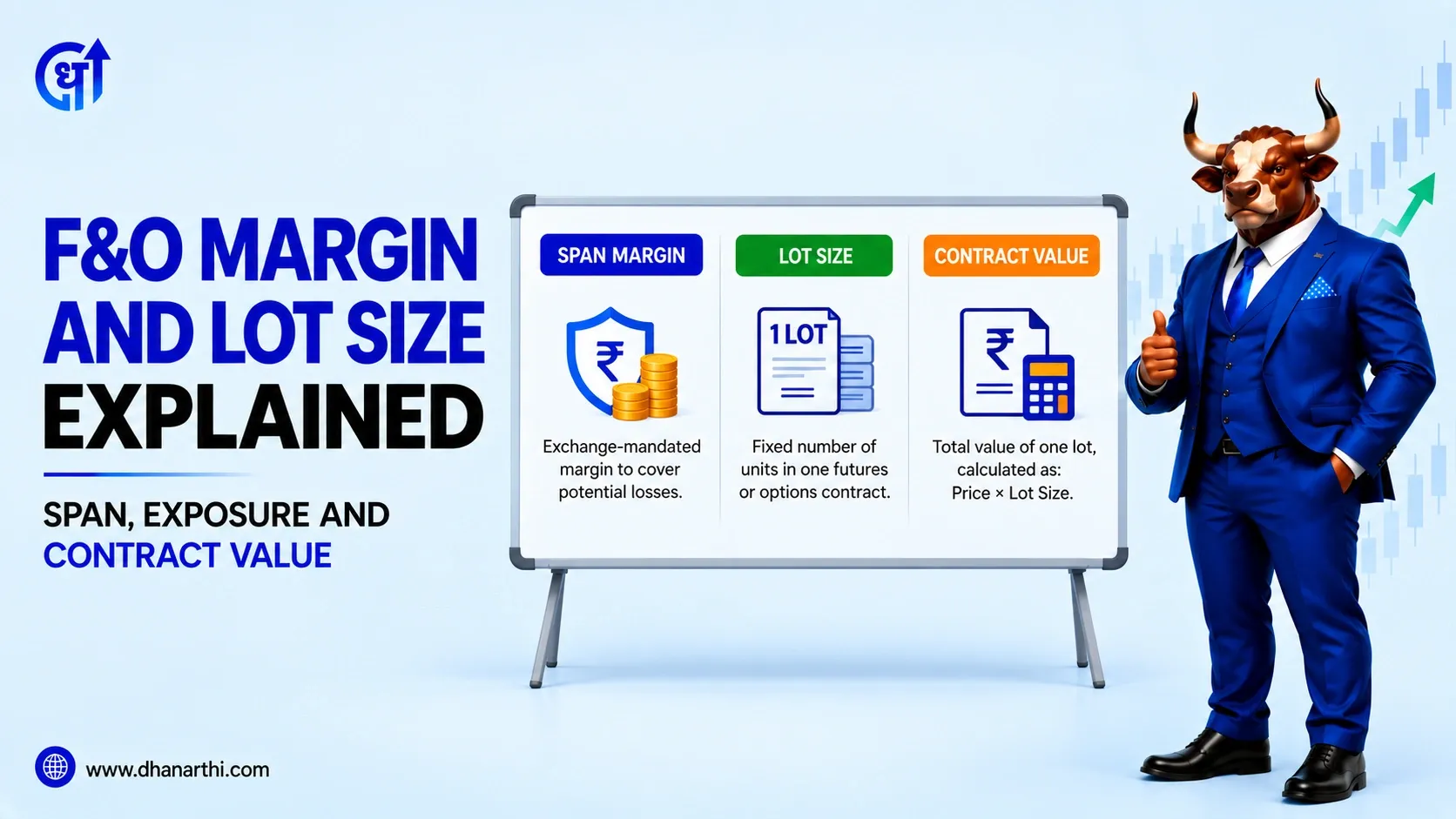
F&O margin is the collateral NSE Clearing blocks to cover potential losses on a futures or short options position, calculated as SPAN margin plus exposure margin. Lot size is the fixed number of units per contract, set by the exchange so contract value stays within SEBI's prescribed band, currently Rs 15 lakh to Rs 20 lakh for index derivatives.
F&O margin is the upfront collateral a trader must maintain with the broker to open and hold a futures or options position. It exists because derivatives are leveraged instruments, and the exchange needs assurance that a trader can absorb adverse price moves without defaulting. Understanding margin trading facility alongside F&O margin helps you see how leverage works differently across trading products.
Total margin has two parts.
| Component | What it covers |
|---|---|
| SPAN margin | Worst-case one-day loss on the position |
| Exposure margin | Extra buffer for gap risk and tail-risk moves |
Margin applies to futures contracts and to short (written) option positions. It does not apply the same way to option buyers, who pay only the premium.
SPAN margin is the core, risk-based collateral NSE Clearing charges to cover the worst expected loss on a position over one trading day. SPAN stands for Standard Portfolio Analysis of Risk, a system originally built by the Chicago Mercantile Exchange and adopted by NSE Clearing for Indian derivatives.
Instead of a flat percentage, SPAN runs a position through 16 simulated price and volatility scenarios and picks the largest probable loss. That number becomes the minimum margin.
Rule: SPAN margin is recalculated daily. NSE Clearing publishes a fresh risk parameter file every trading session, so the same position can need more or less margin from one day to the next depending on volatility.
Example: A Nifty futures contract during a calm market might need a SPAN margin close to 10 percent of contract value. During high volatility around results season or a policy event, that percentage rises because the worst-case scenario grid widens.
Exposure margin is an additional buffer collected on top of SPAN margin to cover risks SPAN does not fully capture, such as an overnight gap after a weekend or a surprise macro announcement.
The rate depends on the instrument.
Rule:
Total margin blocked by your broker equals SPAN margin plus exposure margin. Both sit with the clearing corporation until the position is closed.
Margin requirements are not the same for every F&O participant. What you pay depends entirely on whether you are buying or writing (selling) the contract.
Rule: Option buyers pay only the premium, upfront, with no SPAN margin. Futures traders and option writers must post full SPAN plus exposure margin, since their potential loss is open-ended or contract-sized.
Since February 2025, exchanges collect this options premium upfront from buyers at the client level, closing an old loophole where some traders effectively got same-day leverage before settlement. This makes the buyer side of options the lowest-capital way to participate in F&O, while writing options or trading futures needs the full margin block.
Reading up on option Greeks helps option buyers understand what actually drives their premium before committing capital to a trade.
| Position Type | Margin Required |
|---|---|
| Buy a call or put option | Premium only, no SPAN |
| Sell (write) a call or put option | SPAN + Exposure margin |
| Buy or sell a futures contract | SPAN + Exposure margin |
Lot size is the fixed quantity of the underlying asset bundled into one F&O contract. You cannot trade a single unit of Nifty in derivatives, you trade in exchange-defined lots.
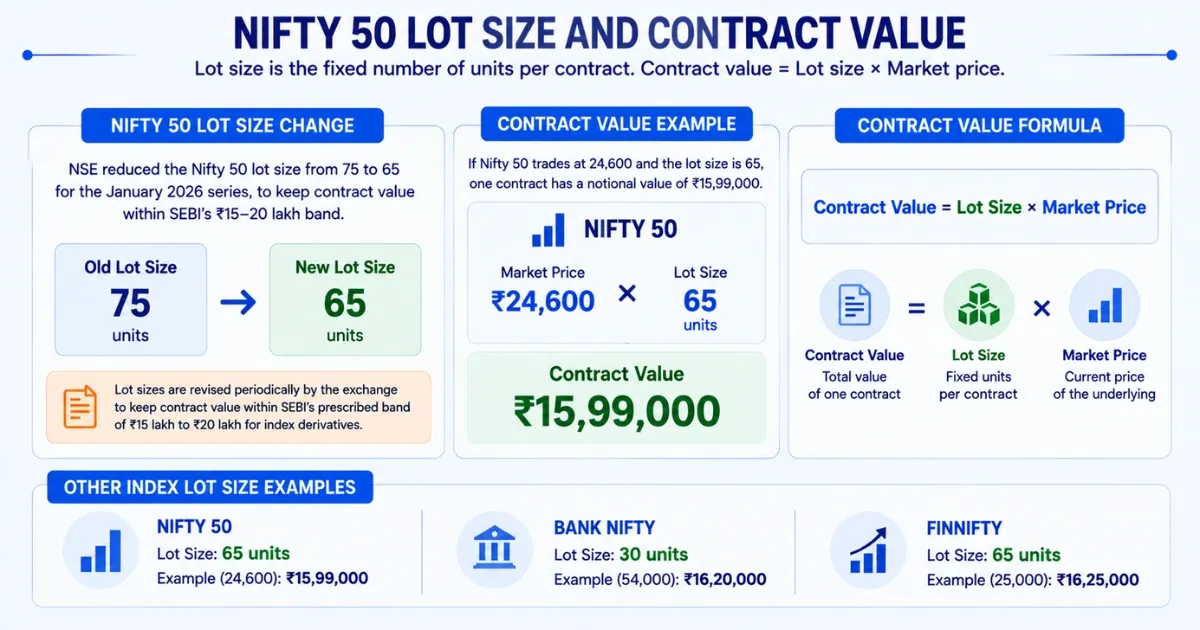
Rule: Contract Value = Lot Size × Current Market Price of the underlying.
Example: If Nifty 50 trades at 24,600 and the lot size is 65, one Nifty futures contract has a notional value of 24,600 × 65, which works out to Rs 15,99,000. This is the number SPAN and exposure margin percentages are applied to, not the premium alone.
Lot size is not fixed forever. Exchanges review it periodically and revise it when the underlying's price moves the contract value outside the permitted band.
NSE cuts or raises index F&O lot sizes because SEBI requires every index derivative contract to stay within a fixed rupee value band, and lot size is the only lever exchanges can adjust to hold that band as index prices move.
Under SEBI's October 2024 circular strengthening the equity index derivatives framework, an index derivative contract must have a value of at least Rs 15 lakh when introduced, and the lot size must keep contract value between Rs 15 lakh and Rs 20 lakh at each periodic review. When the index rallies enough to push contract value above Rs 20 lakh, the exchange cuts the lot size to bring it back in range.
That is exactly what happened heading into 2026. NSE revised the Nifty 50 lot size from 75 units to 65 units for contracts from the January 2026 series. In the same revision, the Nifty Bank lot size was reduced from 35 units to 30 units.
Why it matters for you: A smaller lot size lowers the capital needed to take one lot, which is why exchanges also use this mechanism to keep retail participation manageable as indices climb.
Here is the lot size table effective for the January 2026 series onward, applicable uniformly across weekly, monthly and quarterly contracts.
| Index | Symbol | Lot Size (Jan 2026 onward) |
|---|---|---|
| Nifty 50 | NIFTY | 65 |
| Nifty Bank | BANKNIFTY | 30 |
| Nifty Financial Services | FINNIFTY | 60 |
| Nifty Midcap Select | MIDCPNIFTY | 120 |
| Nifty Next 50 | NIFTYNXT50 | 25 |
| BSE Sensex | SENSEX | 20 |
Data sourced from NSE and BSE circulars on the January 2026 index derivatives lot size revision.
Before trading a new lot size for the first time, check the current contract specs on the Dhanarthi Stock Screener rather than relying on memory, since exchanges revise these figures every few months.
This table shows how margin obligation changes across the same underlying, depending on whether you buy or write the contract, using the revised 2026 lot sizes.
| Trade | Lot Size | What You Pay Upfront |
|---|---|---|
| Buy 1 lot Nifty call option | 65 | Premium × 65 only |
| Write 1 lot Nifty call option | 65 | SPAN + Exposure on full contract value |
| Buy 1 lot Nifty futures | 65 | SPAN + Exposure on full contract value |
| Buy 1 lot Bank Nifty call option | 30 | Premium × 30 only |
| Write 1 lot Bank Nifty call option | 30 | SPAN + Exposure on full contract value |
Rule: The gap between buying and writing is the single biggest reason beginners underestimate F&O capital needs. A trader comfortable buying options with a small premium can be shocked by the margin call when they try writing the same strike.
MIS (intraday) and NRML (overnight, carry-forward) are the two margin products brokers offer for the same F&O position, and they require very different amounts of capital.
Rule: NRML margin covers the full SPAN plus exposure requirement because the position can be held overnight, exposed to gap risk. MIS margin, meant only for same-day squared-off trades, typically needs a fraction of that, often around 40 percent of the NRML figure, since the broker auto-squares the position before market close.
Example: If holding one Nifty futures lot overnight (NRML) needs roughly Rs 1 lakh in margin, taking the same lot intraday (MIS) might need closer to Rs 40,000, since the position carries no overnight gap risk and gets closed by the broker's system around 3:20 PM if not closed manually.
The catch: if you do not close an MIS position in time and it converts or fails to square off, you can face a sudden margin shortfall penalty. Understanding how intraday trading margin rules work at your specific broker before relying on MIS leverage is essential.
New F&O traders repeatedly lose money not from bad trade ideas but from misjudging margin mechanics.
A lesson from past market cycles: during the 2020 volatility spike, several retail traders holding NRML futures positions got margin calls overnight because SPAN margin jumped sharply within a single session, a reminder that margin is a moving target, not a one-time calculation.
F&O margin and lot size are two sides of the same risk framework. SPAN and exposure margin decide how much capital a futures or short-options position needs, while lot size decides how large that position is, tied to SEBI's contract value rules. Track both figures actively, since exchanges revise lot sizes and margin rates in response to price moves and volatility, not on a fixed schedule.
Disclaimer: This article is for educational purposes only. It does not constitute investment advice. Please consult a SEBI-registered financial advisor before making investment decisions.
1. What is SPAN margin in simple terms?
SPAN margin is the minimum collateral NSE Clearing requires to cover the worst-case one-day loss on your F&O position. It changes daily based on price volatility.
2. What is the current Nifty 50 lot size in 2026?
The Nifty 50 lot size is 65 units, revised from 75 units, effective for contracts from the January 2026 series onward.
3. What is the current Bank Nifty lot size?
The Bank Nifty lot size is 30 units, down from 35 units, revised in the same January 2026 lot size cycle as Nifty 50.
4. Do I need margin to buy options?
No. Option buyers pay only the premium upfront, with no SPAN or exposure margin. Margin applies to futures positions and to option writers.
5. Why did NSE change Nifty and Bank Nifty lot sizes for 2026?
SEBI requires index derivative contracts to stay within a contract value band of Rs 15 lakh to Rs 20 lakh. As index prices rose, NSE cut lot sizes to bring contract value back within that band.
6. How is F&O contract value calculated?
Contract value equals lot size multiplied by the current market price of the underlying index or stock. For example, Nifty at 24,600 with a lot size of 65 gives a contract value of about Rs 15.99 lakh.
7. What happens if my margin is insufficient?
Your broker issues a margin call and can square off part or all of your position if you do not add funds in time. Running a position with insufficient margin risks forced liquidation at unfavorable prices.
8. What is the difference between MIS and NRML margin?
MIS margin is for intraday trades and typically needs a smaller amount than NRML, since the broker auto-squares the position before market close. NRML margin covers overnight positions and requires the full SPAN plus exposure amount.
9. Does margin stay the same every day?
No. SPAN margin is recalculated daily using updated risk parameters from NSE Clearing, so the required margin on the same position can rise or fall with market volatility.
10. Is exposure margin the same for index and stock derivatives?
No. Exposure margin for index futures and options is 3 percent of notional value, while for individual stock derivatives it is the higher of 5 percent or 1.5 standard deviations of the notional value.
Share Market
IPO
Artificial Intelligence
Semi Conductor