



Capital Gains Tax on Shares India 2026 Rates
October 23, 2026



TABLE OF CONTENTS
Get AI Summary





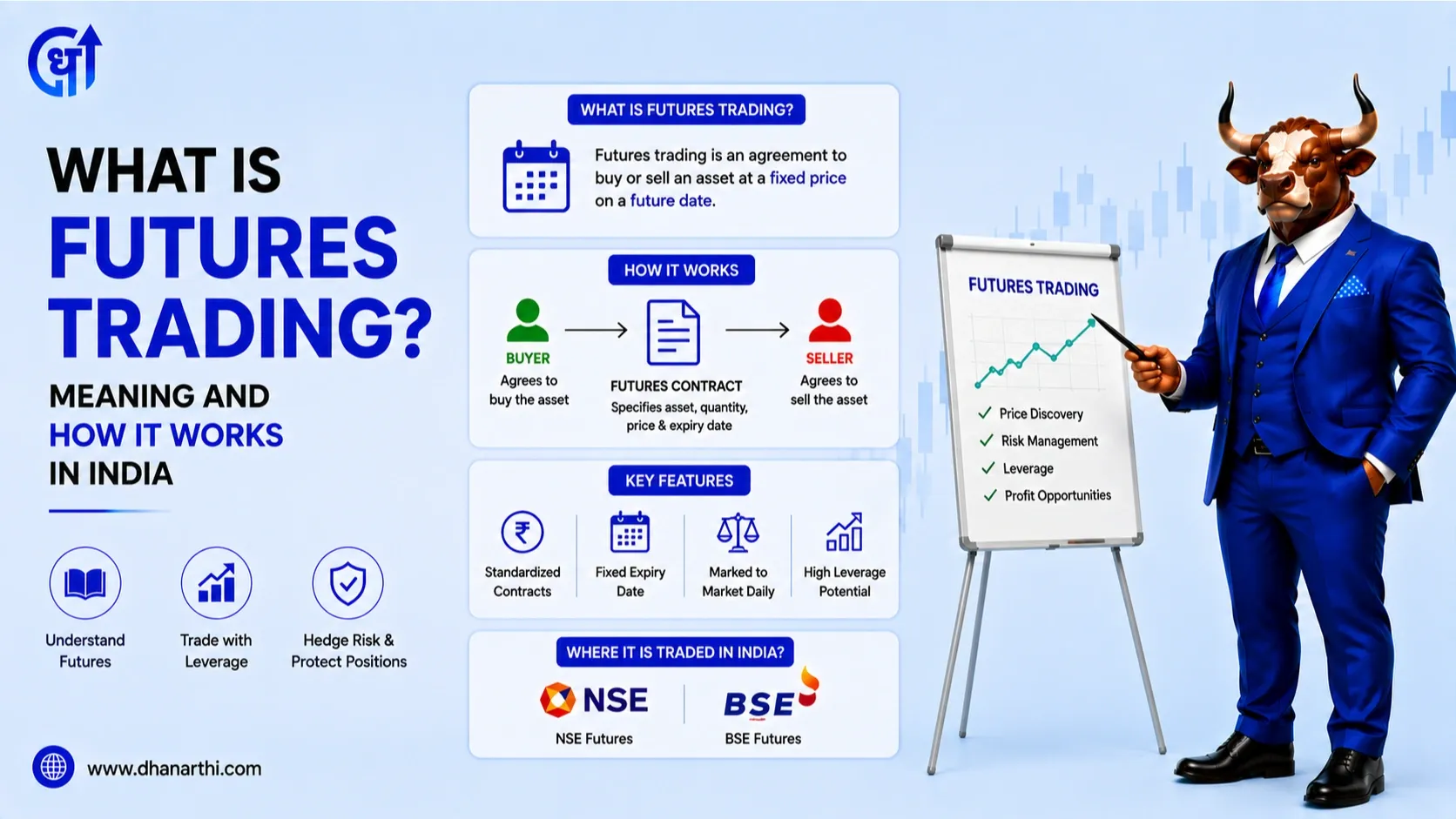
Futures trading involves buying or selling a standardized contract that obligates the trader to purchase or sell an underlying asset, such as a stock or index, at a predetermined price on a specific future date. Unlike options, which give a right without an obligation, a futures contract commits both parties to the trade, with daily mark-to-market settlement adjusting gains and losses in the trading account.
Futures trading involves buying or selling standardized contracts on a regulated exchange, where both parties agree today on a price for an asset to be bought or sold at a specific date in the future. The buyer of a futures contract is obligated to purchase the underlying asset at the agreed price on expiry, and the seller is equally obligated to deliver it, unless the position is closed out before that date.
Futures trading meaning in the Indian share market covers both index futures, such as Nifty and Bank Nifty, and stock futures on individual companies. These contracts are standardized for lot size, expiry date, and settlement terms by the exchange, which makes them straightforward to trade compared to a customized private agreement between two parties. This standardized structure is part of why futures require a different margin approach than MTF (Margin Trading Facility), which extends leverage specifically for delivery-based stock purchases rather than derivative contracts.
Example: A trader believes a stock currently priced at Rs 1,000 will rise. They buy one futures contract with a lot size of 500 shares, giving the contract a notional value of Rs 5,00,000. Rather than paying the full amount, the trader only needs to deposit margin, say 15% of contract value, or Rs 75,000, to hold this position.
If the stock rises to Rs 1,020 the next day, the trader's position gains Rs 20 per share, or Rs 10,000 total (500 shares x Rs 20), credited to their account through daily mark-to-market settlement. If instead the stock falls to Rs 980, the trader loses Rs 10,000, debited from their account the same way. This daily cash flow continues every trading session until the position is closed or the contract expires.
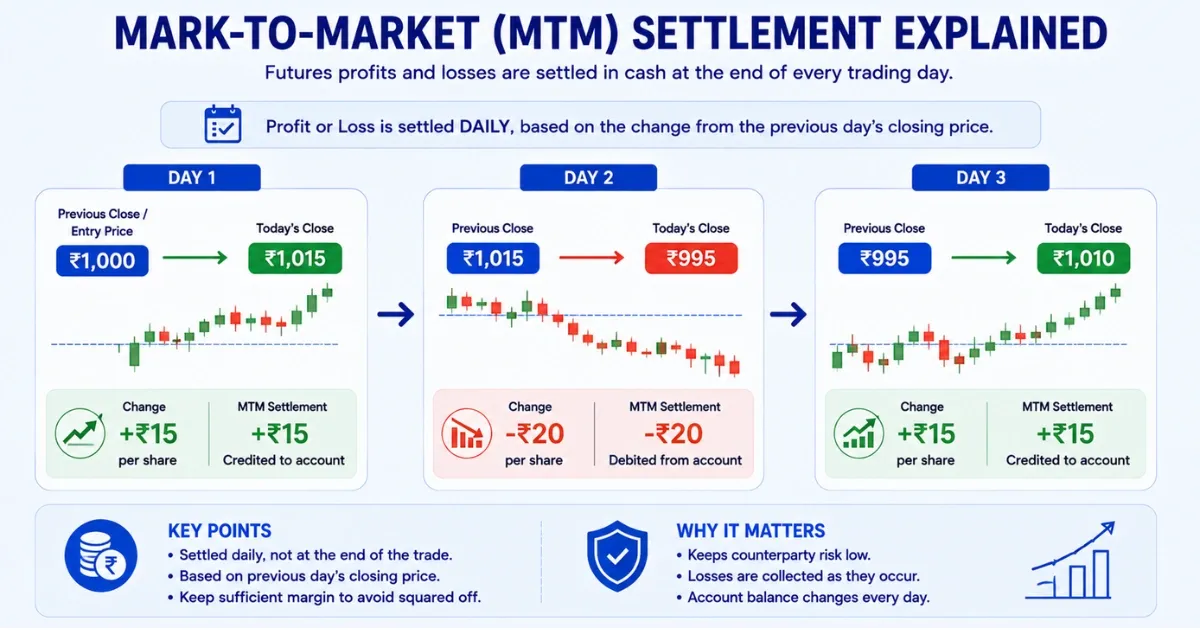
Mark-to-market, often abbreviated MTM, is the process by which futures positions are revalued at the end of every trading session based on that day's closing price, with the resulting gain or loss settled in cash immediately rather than waiting until the position is closed.
Day-by-day example: A trader buys a futures contract at Rs 1,000. On Day 1, the stock closes at Rs 1,015, crediting a Rs 15 per share gain to the account. On Day 2, the stock falls to Rs 995, debiting a Rs 20 per share loss (the difference from Day 1's closing price, not the original entry). On Day 3, the stock rises to Rs 1,010, crediting a Rs 15 per share gain again. Each day's settlement is based on the previous day's closing price, not the original entry price, which is why futures require maintaining sufficient margin in the account at all times, since losses are deducted daily rather than only at the end of the trade.
This daily settlement process is what keeps the futures market functioning with reduced counterparty risk, since losses are collected as they occur rather than allowed to build up until expiry.
This is a distinction that matters a great deal, and is frequently misunderstood, in Indian futures trading. Since October 2019, following a phased SEBI mandate first circulated in April 2018, all stock futures and options contracts in India must be physically settled if a position remains open at expiry (Source: Zerodha Varsity, SEBI circular). This means a trader holding a stock futures position through expiry must either pay the full contract value in cash to take delivery of the shares, or ensure sufficient shares are available in their demat account to deliver, depending on whether they are long or short.
Index futures, such as Nifty and Bank Nifty, work differently and remain cash-settled, since there is no physical underlying asset to deliver for an index. The difference between the contract price and final settlement price is simply credited or debited in cash.
| Contract Type | Settlement at Expiry | Practical Requirement |
|---|---|---|
| Stock Futures | Physical delivery | Full contract value in cash (buyer) or shares in demat (seller) |
| Index Futures (Nifty, Bank Nifty) | Cash settlement | Difference between contract price and settlement price, credited or debited |
Because physical settlement of stock futures requires significant capital or existing share holdings, most retail traders close out their stock futures positions before expiry rather than allow them to be physically settled, since the logistics and funding requirement can be considerably more demanding than a simple cash settlement.
Futures and options are both derivative instruments, but they carry fundamentally different obligations. A futures contract obligates both the buyer and seller to complete the transaction at expiry. An options contract gives the buyer a right, not an obligation, to buy or sell, while the seller of the option carries the obligation if the buyer chooses to exercise it.
| Factor | Futures | Options |
|---|---|---|
| Obligation | Both buyer and seller obligated | Buyer has a right, not an obligation; seller is obligated if exercised |
| Maximum loss for buyer | Potentially unlimited | Limited to premium paid (for option buyers) |
| Upfront cost | Margin deposit, no premium | Premium paid to purchase the option |
| Settlement | Daily mark-to-market | At expiry or when closed, based on premium and exercise |
Traders exploring straddle, strangle, and covered call strategies are working with options specifically because buying options caps the maximum loss to the premium paid, a protection futures do not offer on either side of the trade.
Futures trading uses margin to allow traders to control a contract worth significantly more than the amount deposited upfront. This margin typically covers a percentage of the total contract value, known as SPAN margin plus exposure margin, calculated based on the volatility and risk of the specific underlying asset.
This leverage magnifies both gains and losses proportionally. A 2% move in the underlying asset can translate into a much larger percentage gain or loss on the margin deposited, depending on how much leverage the position uses. This is precisely why futures trading carries meaningfully higher risk than simply buying the underlying stock outright, since losses are not limited to the capital deposited if the margin requirement isn't maintained through additional funding.
A disciplined stop-loss approach is considered particularly important in futures trading given this leverage, since the rupee impact of a given percentage move is amplified compared to holding the equivalent value in the underlying stock directly.

Confused about chart patterns & stock analysis?
Use
Dhanarthi Stock Guru
to chat, analyze price patterns, and ask questions directly.
Futures trading meaning, in practical terms, is an obligation-based derivative contract where both buyer and seller commit to a future transaction at a price fixed today, with daily mark-to-market settlement keeping gains and losses current throughout the life of the position. The distinction between physically settled stock futures and cash-settled index futures is a detail specific to the Indian market that meaningfully affects how positions should be managed near expiry. Given the leverage and unlimited loss potential involved on both sides of a futures trade, understanding these mechanics thoroughly before committing capital matters more here than in most other trading instruments.
Disclaimer: This article is for educational purposes only. It does not constitute investment advice. Please consult a SEBI-registered financial advisor before making investment decisions.
1. What is futures trading in simple terms?
Futures trading involves buying or selling a standardized contract that obligates the trader to purchase or sell an underlying asset at a predetermined price on a specific future date, with both parties committed to completing the transaction.
2. What is futures contract meaning?
A futures contract is a standardized agreement, traded on a regulated exchange, specifying the quantity, price, and expiry date for buying or selling an underlying asset such as a stock or index at a future point in time.
3. How does futures trading work?
Futures trading works through a margin deposit that allows a trader to control a larger contract value, with daily mark-to-market settlement crediting or debiting gains and losses in the trading account based on each day's closing price.
4. What is the difference between futures and options?
Futures obligate both the buyer and seller to complete the transaction at expiry, with potentially unlimited loss on both sides, while options give the buyer a right without an obligation, capping the buyer's maximum loss to the premium paid.
5. Are stock futures physically settled in India?
Yes, since October 2019, all stock futures and options contracts in India must be physically settled if held open at expiry, requiring the buyer to pay the full contract value or the seller to deliver actual shares.
6. Are index futures like Nifty physically settled?
No, index futures such as Nifty and Bank Nifty are cash-settled, since there is no physical underlying asset to deliver, with the difference between contract price and final settlement price simply credited or debited.
7. What is mark-to-market in futures trading?
Mark-to-market is the daily process of revaluing a futures position based on that day's closing price, with the resulting gain or loss settled in the trading account immediately rather than only at the end of the trade.
8. How much margin is needed for futures trading?
Margin requirements vary based on the underlying asset's volatility and the specific contract, typically calculated as a percentage of total contract value using SPAN and exposure margin methodologies set by the exchange.
9. Can I lose more than my margin in futures trading?
Yes, futures trading carries potentially unlimited loss on both the buy and sell side, since losses are not capped the way they are for an options buyer, making it possible to lose more than the initial margin deposited if the position isn't managed carefully.
10. What happens if I hold a stock futures position until expiry?
If a stock futures position remains open at expiry, physical settlement is triggered, requiring the buyer to pay the full contract value in cash to take delivery of shares, or the seller to have sufficient shares available in their demat account.
11. Is futures trading riskier than options trading?
Futures trading is generally considered riskier for buyers specifically, since options buyers have their maximum loss capped at the premium paid, while both sides of a futures trade carry potentially unlimited loss exposure.
12. What is the lot size in futures trading?
Lot size refers to the fixed quantity of the underlying asset specified in one futures contract, standardized by the exchange, and SEBI periodically revises minimum contract values to discourage under-capitalized retail participation.
Share Market
IPO
Artificial Intelligence
Semi Conductor