


Tax on Intraday Trading in India: Rules, Rates and Filing
September 15, 2026



TABLE OF CONTENTS
Get AI Summary





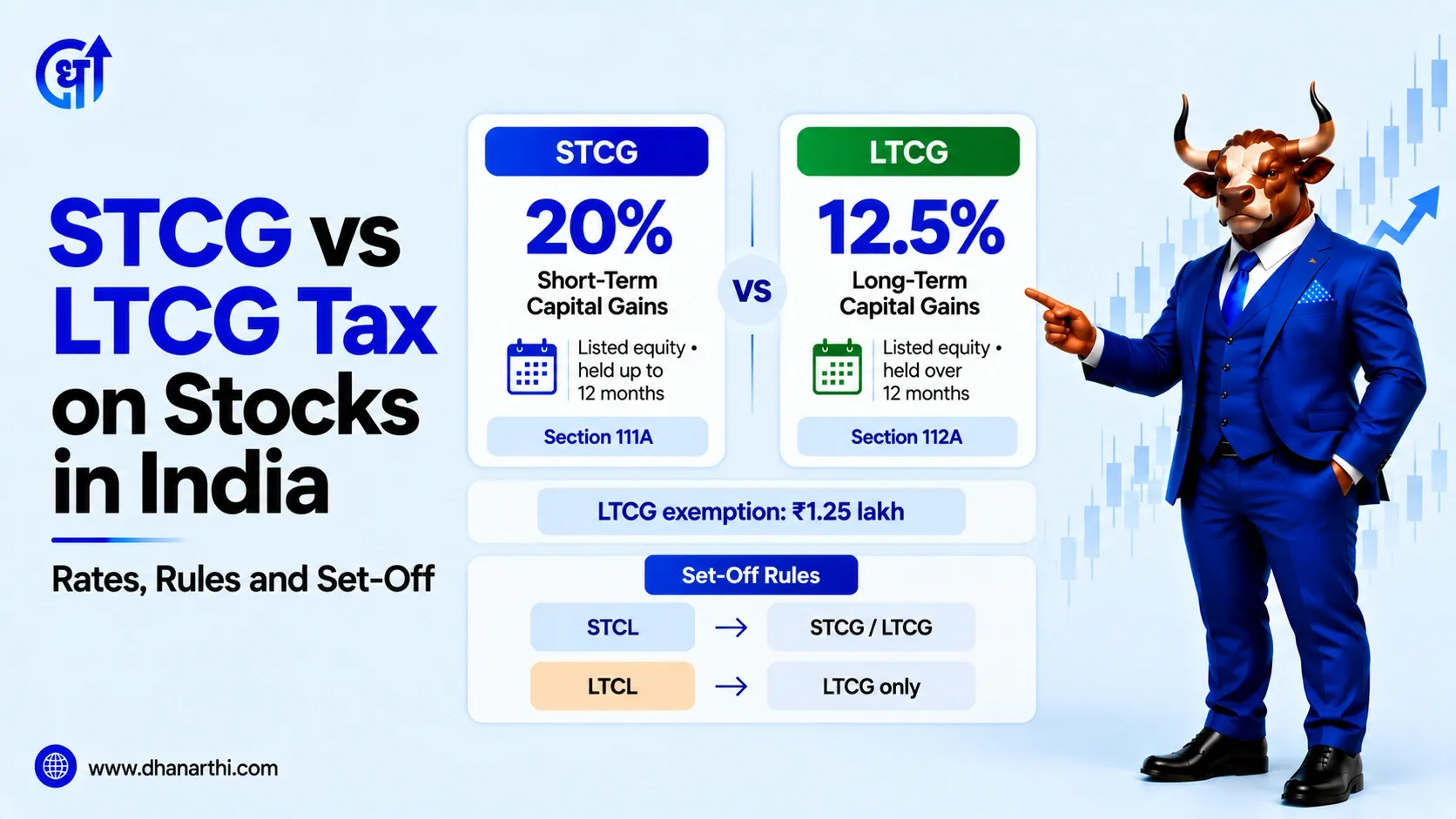
STCG vs LTCG tax on stocks depends entirely on holding period. Shares sold within 12 months attract Short-Term Capital Gains (STCG) tax at a flat 20%, while shares held beyond 12 months attract Long-Term Capital Gains (LTCG) tax at 12.5%, with the first Rs 1.25 lakh of long-term gains in a financial year fully exempt.
Capital gains tax applies to the profit made when selling shares, and which category that profit falls into depends entirely on how long the shares were held before sale. Short-Term Capital Gains (STCG) apply when listed equity shares are sold within 12 months of purchase. Long-Term Capital Gains (LTCG) apply when listed equity shares are held for more than 12 months before sale.
This 12-month threshold is specific to listed equity shares and equity mutual funds, other asset classes like debt funds, real estate, and gold follow different holding-period rules for the same short-term versus long-term classification.
Research Stocks Smarter with Dhanarthi AI Screener
Analyze 5,000+ NSE & BSE stocks with 150+ custom filters, real-time volume breakout scans, and transparent fundamental data.
Use Dhanarthi Screener
Tax rates on equity capital gains were revised in the Union Budget 2024 and remain in effect for FY 2025-26 and FY 2026-27. STCG on listed equity shares is taxed at a flat 20% under Section 111A of the Income Tax Act. LTCG on listed equity shares is taxed at 12.5% under Section 112A, applied without the benefit of indexation.
| Gain Type | Holding Period | Tax Rate | Applicable Section |
|---|---|---|---|
| STCG (equity) | 12 months or less | 20% flat | Section 111A |
| LTCG (equity) | More than 12 months | 12.5% (above Rs 1.25 lakh exemption) | Section 112A |
This rate structure directly rewards holding equity positions past the 12-month mark, selling even a day before completing 12 months converts what could have been a 12.5% tax into a 20% tax on the full gain.
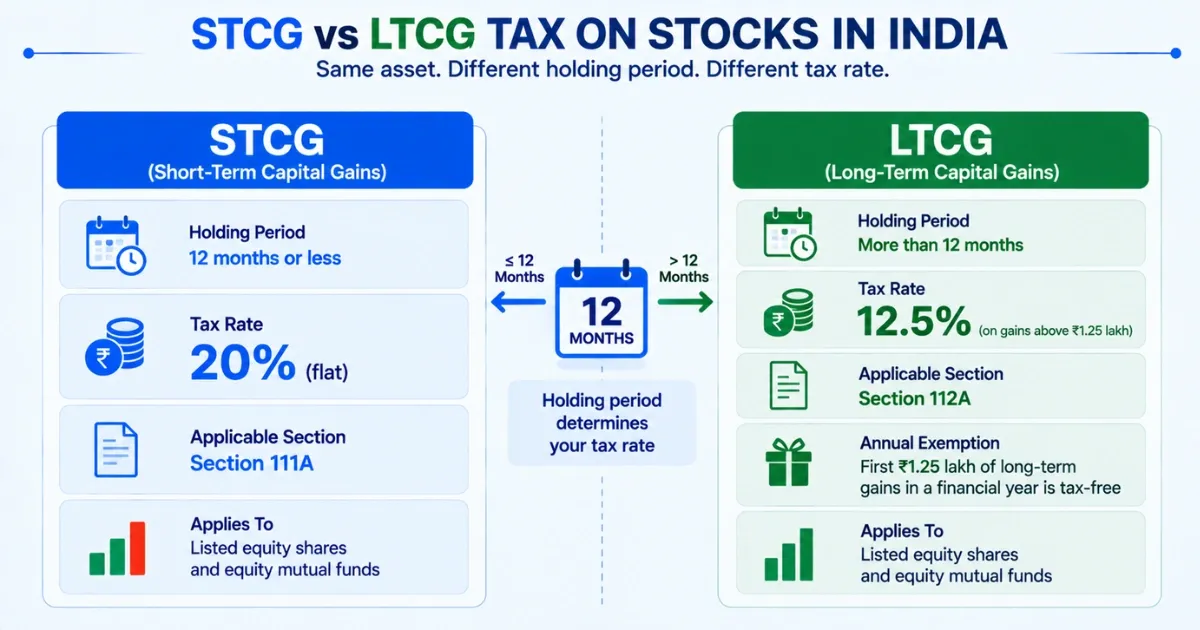
Long-term capital gains on listed equity shares and equity mutual funds enjoy an annual exemption of Rs 1.25 lakh, meaning the first Rs 1.25 lakh of such gains in a financial year is entirely tax-free, with only the amount exceeding this threshold taxed at 12.5%.
Example: An investor books Rs 3 lakh in long-term equity gains during a financial year. The first Rs 1.25 lakh is exempt, leaving Rs 1.75 lakh taxable at 12.5%, resulting in a tax liability of Rs 21,875, plus applicable cess. This exemption applies once per financial year across all long-term equity gains combined, not per transaction or per stock.
For shares purchased before January 31, 2018, a grandfathering provision protects gains accumulated up to that date from LTCG taxation. Under this rule, the cost of acquisition for tax purposes is treated as the higher of the actual purchase price or the fair market value (FMV) of the share as on January 31, 2018.
This means any appreciation in a share's value that occurred before January 31, 2018 is effectively shielded from LTCG tax entirely, only gains accruing after that date are taxed when the shares are eventually sold. Investors holding shares purchased well before 2018 should factor in this stepped-up cost basis when calculating their actual taxable gain, rather than using the original purchase price alone.
This is one of the more frequently misunderstood areas of equity taxation, and getting it wrong can mean paying more tax than necessary. Short-term capital loss (STCL) can be set off against both STCG and LTCG in the same financial year. Long-term capital loss (LTCL), however, can only be set off against LTCG, it cannot be used to reduce STCG at all.
Example: An investor has Rs 5 lakh in LTCL and Rs 3 lakh in STCG in the same year, with no LTCG to offset against. Despite having a larger loss on paper, that LTCL cannot touch the STCG at all, the investor still pays full 20% tax on the entire Rs 3 lakh STCG. This asymmetry surprises many investors who assume any capital loss can reduce any capital gain, when in fact the direction of the offset matters significantly.
| Loss Type | Can Offset STCG? | Can Offset LTCG? |
|---|---|---|
| STCL | Yes | Yes |
| LTCL | No | Yes only |
This is a detail that changed very recently and is worth flagging clearly, since earlier drafts of tax reform suggested a different outcome. The original Income Tax Bill, 2025, contained a savings clause that many tax professionals interpreted as allowing brought-forward long-term capital losses, incurred before April 1, 2026, to be set off against any capital gains going forward, including short-term capital gains, as a one-time transitional relaxation.
However, the finalized Income Tax Act, 2025 revised this savings clause to explicitly require that brought-forward capital losses be carried forward and set off strictly in accordance with the mechanism under the repealed Income-tax Act, 1961, confirmed in coverage as recently as February 2026. In practical terms, this means the standard restriction remains firmly in place: long-term capital losses can only be set off against long-term capital gains, never against short-term capital gains, even for losses carried forward from before the new Act took effect. Investors and tax planners who assumed the more generous transitional rule would apply should recalculate their tax planning around the standard, more restrictive rule instead.
Capital losses that cannot be fully absorbed in the year they occur can be carried forward for up to 8 assessment years, but this benefit comes with a strict condition: the loss can only be carried forward if the Income Tax Return is filed on or before the original due date for that financial year.
Missing the ITR filing deadline in the year a loss occurs permanently forfeits the right to carry that loss forward, regardless of how the loss might otherwise have been used to offset future gains. This makes timely ITR filing a meaningful part of tax planning for any investor who has booked a capital loss in a given year, not simply an administrative afterthought.
A detail that catches many smaller investors off guard: the Section 87A tax rebate, which can reduce or eliminate tax liability for individuals with total income below a specified threshold, does not apply to long-term capital gains on equity shares under Section 112A. This means LTCG tax above the Rs 1.25 lakh exemption must be paid in full, even if an investor's total taxable income would otherwise fall below the level where Section 87A rebate would normally zero out their tax liability.
This exclusion is a specific carve-out for equity LTCG and is worth understanding clearly, since many investors mistakenly assume that a low overall income automatically shields all forms of income, including capital gains, from tax. Anyone opening a demat account for the first time should factor these tax mechanics into their planning from the very first trade, rather than treating tax as an afterthought once gains start appearing.
STCG and LTCG rules apply specifically to delivery-based equity transactions, F&O and intraday trading are taxed under an entirely different framework. Intraday equity trading is classified as speculative business income, while F&O trading is classified as non-speculative business income, both taxed at the trader's applicable income tax slab rate rather than under the capital gains sections covered here, and both are typically reported using ITR-3 rather than the capital gains schedule used for delivery-based equity. This distinction is a core part of why trading and investing are treated so differently by India's tax system, not just in approach but in the specific tax rules that apply to each.

Confused about chart patterns & stock analysis?
Use
Dhanarthi Stock Guru
to chat, analyze price patterns, and ask questions directly.
STCG vs LTCG tax on stocks in India hinges on a single factor, the 12-month holding period, with a meaningful rate difference, 20% versus 12.5%, on either side of that line. The Rs 1.25 lakh LTCG exemption, the grandfathering clause for pre-2018 shares, and the strict asymmetry in loss set-off rules all shape how much tax an investor actually pays, and the recent confirmation that the proposed LTCL-against-STCG relaxation did not survive into the final tax law means the older, more restrictive set-off rule remains the one to plan around. Understanding these mechanics, and filing the ITR on time in any year a loss is booked, can meaningfully affect an investor's real, post-tax returns.
1. What is the difference between STCG and LTCG on stocks?
STCG applies to listed equity shares sold within 12 months of purchase and is taxed at a flat 20%. LTCG applies to shares held beyond 12 months and is taxed at 12.5% on gains above Rs 1.25 lakh in a financial year.
2. What is the current STCG tax rate on shares in India?
The current STCG tax rate on listed equity shares is a flat 20% under Section 111A, applicable for shares sold within 12 months of purchase.
3. What is the current LTCG tax rate on shares in India?
The current LTCG tax rate on listed equity shares is 12.5% under Section 112A, applied only to gains exceeding Rs 1.25 lakh in a financial year, without the benefit of indexation.
4. What is the LTCG exemption limit on stocks?
The LTCG exemption limit is Rs 1.25 lakh per financial year, meaning the first Rs 1.25 lakh of long-term equity gains in a year is entirely tax-free, with only the excess taxed at 12.5%.
5. Can long-term capital loss be set off against short-term capital gains?
No, long-term capital loss (LTCL) can only be set off against long-term capital gains (LTCG), it cannot be used to reduce short-term capital gains (STCG) under current rules.
6. Can short-term capital loss be set off against long-term capital gains?
Yes, short-term capital loss (STCL) can be set off against both short-term capital gains (STCG) and long-term capital gains (LTCG) in the same financial year.
7. What is the grandfathering clause for LTCG on shares?
The grandfathering clause allows shares bought before January 31, 2018 to use the higher of actual purchase price or fair market value on that date as their cost of acquisition, protecting pre-2018 gains from LTCG tax.
8. How long can capital losses be carried forward?
Capital losses can be carried forward for up to 8 assessment years, but only if the Income Tax Return is filed on or before the due date for the year the loss was incurred.
9. Does Section 87A rebate apply to LTCG on shares?
No, Section 87A rebate does not apply to long-term capital gains on equity shares under Section 112A, meaning LTCG tax above the exemption must be paid even if total income is otherwise below the rebate threshold.
10. Is F&O trading income taxed the same as LTCG or STCG?
No, F&O trading is classified as non-speculative business income and taxed at the trader's applicable income slab rate, separate from the STCG and LTCG rules that apply to delivery-based equity investments.
11. What happens if I sell shares a day before completing 12 months?
Selling just before completing the 12-month holding period converts the gain from long-term to short-term, meaning it gets taxed at the higher 20% STCG rate instead of the lower 12.5% LTCG rate.
12. Was there a recent change allowing LTCL to offset STCG?
A one-time relaxation allowing this was proposed in the draft Income Tax Bill, 2025, but was removed in the final Income Tax Act, 2025, confirmed in February 2026. The standard rule restricting LTCL to offsetting only LTCG remains in effect.
Share Market
IPO
Artificial Intelligence
Semi Conductor