


Tax on Intraday Trading in India: Rules, Rates and Filing
September 15, 2026



TABLE OF CONTENTS
Get AI Summary





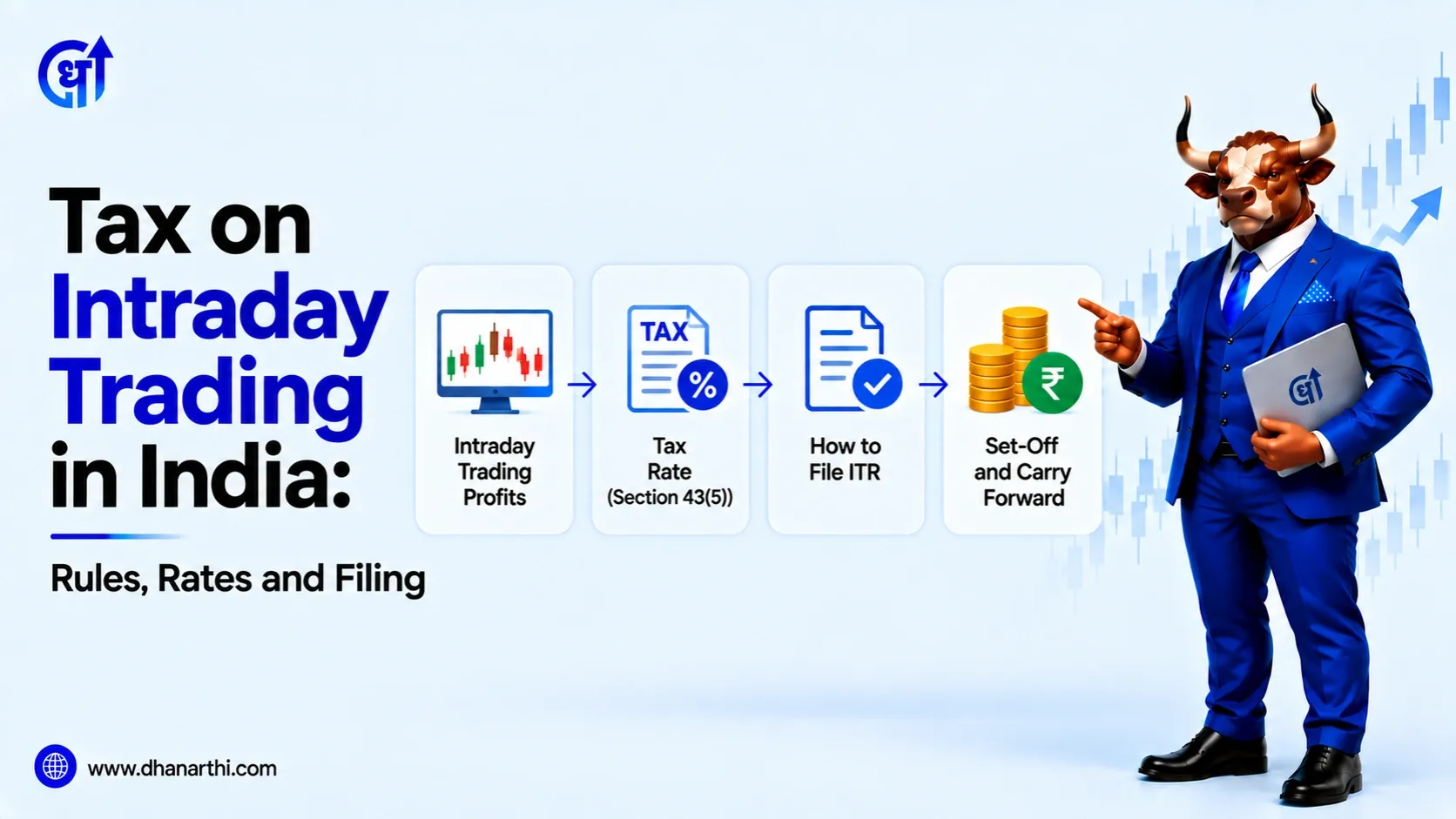
Tax on intraday trading in India is calculated differently from delivery-based equity investing. Intraday trading profit is classified as speculative business income under Section 43(5) of the Income Tax Act, added to total income, and taxed at the trader's applicable slab rate, ranging from 5% to 30%, with no flat or concessional rate available.
Intraday trading involves buying and selling shares within the same trading day without taking delivery into a demat account, all positions are squared off before the market closes. Because no actual transfer of ownership occurs, the Income Tax Act does not treat this activity as a capital asset transaction under Section 45, instead classifying it as speculative business income under Section 43(5).
This classification matters significantly for tax purposes. Unlike capital gains, which enjoy specific rates and exemptions, speculative business income is added directly to a taxpayer's total income and reported under the head "Profits and Gains of Business or Profession" (PGBP), taxed at whatever slab rate applies to that total income, with no separate concessional treatment.
Example: A salaried individual earns Rs 8,00,000 annually from their job and additionally earns Rs 1,50,000 in net intraday trading profit during the same financial year. This intraday profit is added to their total income, bringing it to Rs 9,50,000, and taxed according to the slab rates applicable at that total income level, not at a separate or reduced rate for the trading portion specifically.
This is an important distinction from delivery-based equity, where short-term capital gains are taxed at a flat 20% regardless of the investor's overall income level. Intraday profit has no such flat rate, a trader in a higher income bracket pays a higher effective rate on their intraday gains simply because those gains stack on top of their other income within the same progressive slab structure.
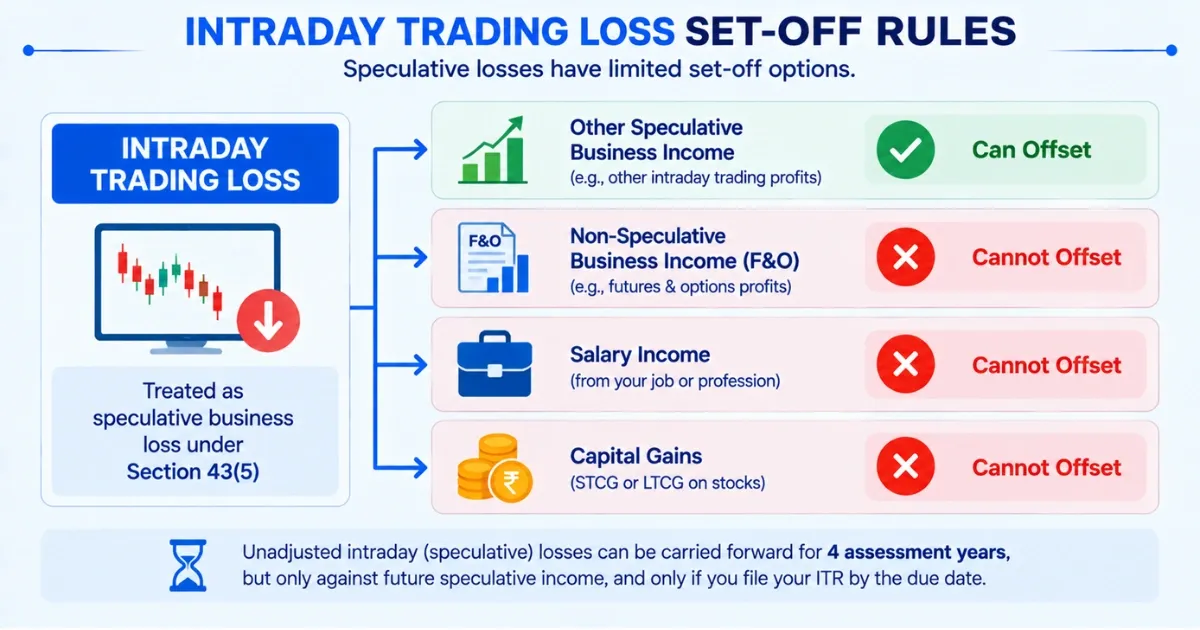
This is a commonly misunderstood rule among active traders working across multiple instruments. Losses from intraday trading are classified as speculative business losses, and speculative losses can only be set off against other speculative business income, they cannot be adjusted against salary, capital gains, or, importantly, against profits from F&O trading.
This last point trips up many traders who assume all their "trading losses" sit in one bucket. F&O trading is classified as non-speculative business income, a separate category from intraday equity's speculative classification. A trader who loses money on intraday equity trades but profits from F&O in the same year cannot use the intraday loss to reduce their taxable F&O profit, the two income types are kept in entirely separate compartments for set-off purposes, even though both fall under the same overall "trading" activity in everyday language.
| Loss Type | Can Offset Speculative Income? | Can Offset Non-Speculative Business Income (F&O)? | Can Offset Salary/Capital Gains? |
|---|---|---|---|
| Speculative loss (intraday) | Yes | No | No |
Unused speculative losses can be carried forward for up to 4 assessment years, but strictly against future speculative income only, and only if the ITR is filed by the original due date for the year the loss occurred.
Determining whether a tax audit applies to intraday trading activity depends on a turnover calculation that works differently from how turnover is understood in most other contexts. For speculative transactions, turnover is calculated as the absolute sum of all positive and negative differences from each trade, added together, not the total value of shares bought and sold.
Worked example: Suppose a trader made 3 intraday trades in a year: a profit of Rs 20,000 on the first, a loss of Rs 8,000 on the second, and a profit of Rs 15,000 on the third. Turnover for tax purposes is calculated as the sum of the absolute values of each trade's outcome: Rs 20,000 + Rs 8,000 + Rs 15,000 = Rs 43,000, regardless of how much total share value was actually bought and sold to generate those results.
A tax audit under Section 44AB generally becomes mandatory once this calculated turnover exceeds Rs 10 crore, provided cash transactions remain within 5% of total transactions, or Rs 1 crore if this cash-transaction condition isn't met, unless the trader's profit meets the presumptive taxation threshold under applicable provisions and they opt for that route instead. Given that speculative business income under Section 43(5) does not qualify for Section 44AD presumptive taxation, active intraday traders with substantial trade volume should track this turnover figure carefully well before year-end, rather than discovering an audit requirement only at filing time.
A compliance requirement many beginner traders overlook entirely: if an individual's total estimated tax liability for a financial year exceeds Rs 10,000, advance tax must be paid in quarterly installments throughout the year, rather than as a single lump sum at the time of filing the return. This obligation applies regardless of whether the tax arises from salary, business income, or speculative intraday trading profit.
Failing to pay adequate advance tax on time attracts interest under Sections 234B and 234C of the Income Tax Act, calculated on the shortfall between tax actually paid and tax that should have been paid by each quarterly deadline. Since intraday trading profits can be irregular and difficult to predict quarter to quarter, active traders should estimate their likely annual trading income periodically through the year rather than waiting until March to calculate their full tax position for the first time.
Research Stocks Smarter with Dhanarthi AI Screener
Analyze 5,000+ NSE & BSE stocks with 150+ custom filters, real-time volume breakout scans, and transparent fundamental data.
Use Dhanarthi Screener
Since intraday trading profit falls under "Profits and Gains of Business or Profession," it must be reported using ITR-3, the form applicable to individuals with business or professional income, rather than the simpler ITR-1 or ITR-2 forms used for salary income or capital gains alone. This applies even to traders whose primary income comes from salaried employment, if intraday trading activity exists during the year, ITR-3 becomes the correct filing form for that year.
Maintaining a detailed, trade-by-trade record throughout the year, including dates, quantities, buy and sell prices, and resulting profit or loss on each transaction, makes accurate turnover calculation and audit-readiness considerably more manageable than attempting to reconstruct this information at filing time from broker statements alone.
The tax treatment of intraday trading differs substantially from delivery-based equity investing, and understanding this distinction clearly helps traders and investors classify their activity correctly from the outset.
| Factor | Intraday Trading | Delivery-Based Equity |
|---|---|---|
| Income classification | Speculative business income | Capital gains (STCG/LTCG) |
| Tax rate | Slab rate (5% to 30%) | Flat 20% (STCG) or 12.5% (LTCG) |
| ITR form | ITR-3 | ITR-2 or ITR-3 |
| Loss set-off | Only against speculative income | STCL against STCG/LTCG, LTCL only against LTCG |
| Loss carry forward | 4 assessment years | 8 assessment years |

Confused about chart patterns & stock analysis?
Use
Dhanarthi Stock Guru
to chat, analyze price patterns, and ask questions directly.
Tax on intraday trading in India operates under a meaningfully different framework than most beginner traders initially expect, speculative business income taxed at slab rates rather than a flat capital gains rate, losses confined strictly to offsetting other speculative income, and a turnover calculation method specific to trading activity that determines audit obligations. Understanding these mechanics, filing ITR-3 correctly, tracking turnover using the right formula, and meeting advance tax deadlines, matters as much for compliance as understanding the trading strategy itself.
1. How is intraday trading profit taxed in India?
Intraday trading profit is classified as speculative business income under Section 43(5) of the Income Tax Act, added to total income, and taxed at the trader's applicable slab rate rather than a flat capital gains rate.
2. What is the tax rate on intraday trading income?
There is no separate flat rate, intraday trading income is added to total income and taxed according to the applicable income tax slab, which can range from 5% to 30% depending on total income.
3. Can intraday trading losses be set off against salary income?
No, intraday trading losses are speculative business losses and can only be set off against other speculative business income, not against salary, capital gains, or non-speculative business income.
4. Can intraday losses be set off against F&O profits?
No, intraday trading losses are speculative in nature, while F&O trading is classified as non-speculative business income, so intraday losses cannot be used to offset F&O profits.
5. How is turnover calculated for intraday trading tax audit purposes?
Turnover for speculative transactions is calculated as the absolute sum of all positive and negative differences from each trade, not the total value of shares bought and sold.
6. When is a tax audit required for intraday traders?
A tax audit under Section 44AB is generally required once calculated turnover exceeds Rs 10 crore with limited cash transactions, or Rs 1 crore otherwise, unless presumptive taxation provisions apply and are opted for.
7. Which ITR form should intraday traders use?
Intraday traders must file ITR-3, since intraday trading profit falls under "Profits and Gains of Business or Profession" rather than capital gains or simple salary income.
8. Do intraday traders need to pay advance tax?
Yes, if total estimated tax liability for the year exceeds Rs 10,000, advance tax must be paid in quarterly installments, otherwise interest under Sections 234B and 234C applies on the shortfall.
9. How long can intraday trading losses be carried forward?
Speculative losses from intraday trading can be carried forward for up to 4 assessment years, but only against future speculative income, and only if the ITR is filed by the due date.
10. Is intraday trading profit taxed the same as short-term capital gains?
No, short-term capital gains on delivery-based equity are taxed at a flat 20%, while intraday trading profit is added to total income and taxed at the applicable slab rate, which can be higher or lower depending on total income.
11. Do I need to maintain trade records for intraday trading tax filing?
Yes, maintaining detailed, trade-by-trade records of dates, quantities, and prices is important for accurate turnover calculation, audit readiness, and correct ITR filing.
12. What happens if I miss the ITR deadline after an intraday trading loss?
Missing the ITR filing deadline in the year a speculative loss occurs forfeits the ability to carry that loss forward to offset future speculative income, regardless of the loss amount.
Share Market
IPO
Artificial Intelligence
Semi Conductor