RBI Hikes Repo Rate to 5.50%, Crude Surges Past $102 Amid Market Sell-Off
TABLE OF CONTENTS
- Reading Overview

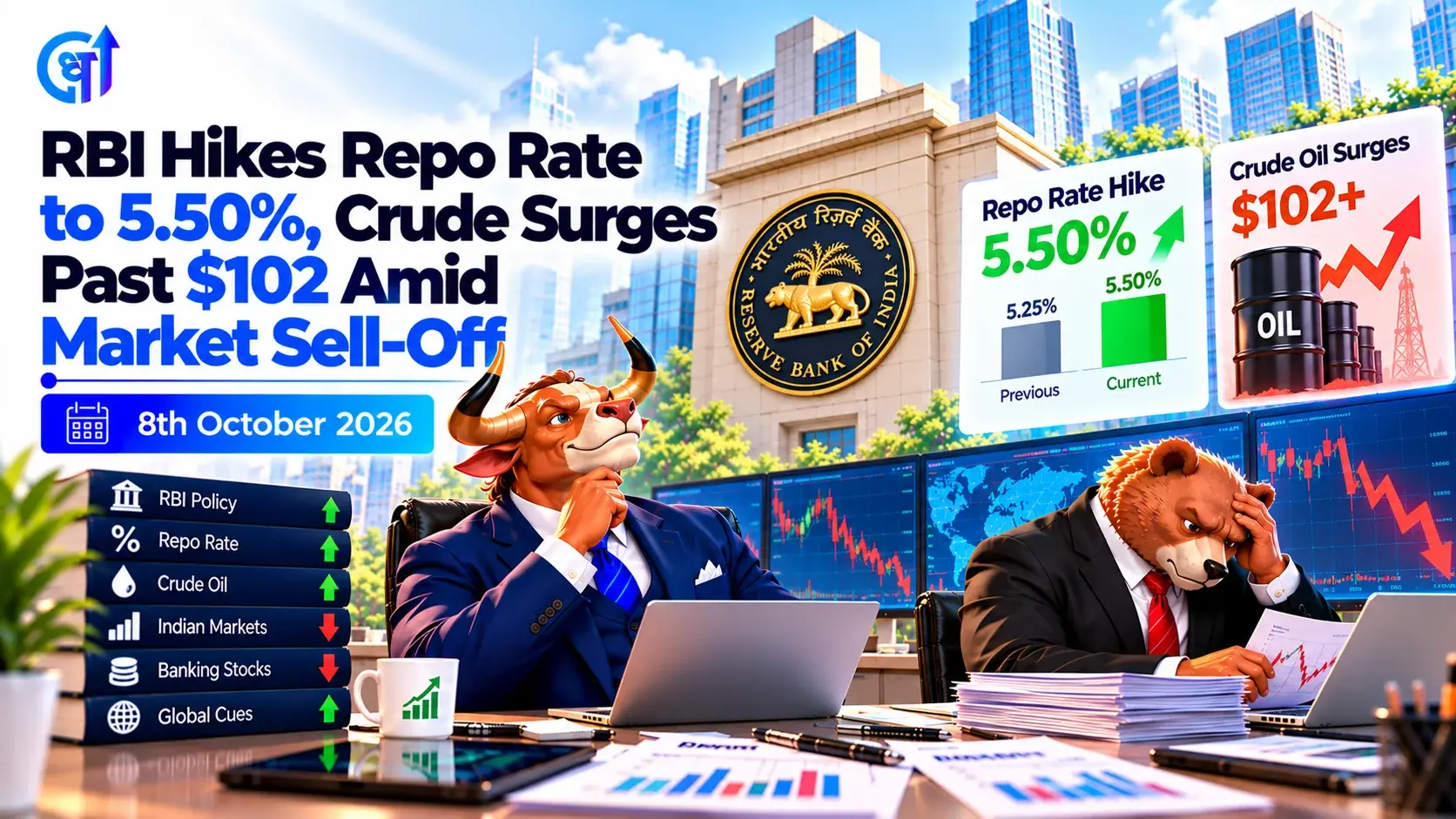
The Reserve Bank of India (RBI) has raised its benchmark repo rate by 25 basis points to 5.50% and shifted its monetary policy stance to "calibrated tightening," signaling a firm approach to inflation control. This move, coupled with Brent crude oil prices surging past $102 a barrel due to escalating Middle East tensions, has weighed heavily on Indian equities, with both the Sensex and Nifty trading significantly lower in today's session. The market is also reacting to the RBI's cancellation of Paytm Payments Bank's license and anticipating TCS's Q2 earnings.
Key highlights
- RBI Repo Rate: The Monetary Policy Committee (MPC) hiked the repo rate by 25 basis points to 5.50%, marking its first increase in nearly four years.
- Monetary Stance: The RBI shifted its stance to "calibrated tightening," indicating a hawkish outlook on inflation.
- Crude Oil Prices: Brent crude futures surged past $102 a barrel, up over 2%, driven by heightened Middle East geopolitical tensions and supply concerns.
- Indian Equities: The Sensex plunged over 750 points, and the Nifty fell below the 22,400 mark in late morning trade, extending losses.
- Paytm Payments Bank: The Reserve Bank of India cancelled Paytm Payments Bank Limited's banking license, impacting the fintech sector.
RBI Hikes Repo Rate to 5.50%, Shifts Stance to Calibrated Tightening
The Reserve Bank of India's Monetary Policy Committee (MPC), led by Governor Sanjay Malhotra, announced a significant policy shift yesterday, raising the benchmark repo rate by 25 basis points to 5.50%. This marks the first rate hike by the central bank in nearly four years, signaling a decisive move to combat persistent inflationary pressures. Accompanying the rate hike, the MPC also changed its monetary policy stance to "calibrated tightening," moving away from its previous "neutral" position.
What the announcement means
The decision to increase the repo rate was unanimous among the MPC members, reflecting growing concerns over inflation, particularly with global energy supply issues and geopolitical tensions in West Asia. Governor Malhotra emphasized that "rate cuts are off the table in the near term," and future policy actions would either be a hike or a pause, depending on evolving economic conditions. The RBI also revised its GDP growth forecast for FY27 upwards to 7.1%, while projecting CPI inflation to average around 5.8% in the next three quarters.
Market reaction and implications
Indian equity markets reacted negatively to the hawkish stance, extending losses from the previous session. The Sensex and Nifty opened lower today, with real estate and banking sectors facing pressure due to the anticipated rise in borrowing costs. Home loan EMIs are expected to increase, which could impact housing sales, according to realtors' industry bodies CREDAI and NAREDCO. Economists from SBI have suggested that the RBI might consider a steeper 0.50% rate hike in the December review if inflation remains elevated. The move also comes amidst a backdrop of rising US Treasury yields and a weaker rupee, making a narrower interest-rate differential crucial to maintain the appeal of rupee-denominated assets.
Crude Oil Surges Past $102 Amid Middle East Tensions, Pressuring India
Global crude oil prices have surged significantly, with Brent crude futures climbing past $102 a barrel today, marking an increase of over 2%. This sharp rise is primarily attributed to escalating geopolitical tensions in the Middle East and concerns over potential disruptions to Gulf oil shipments. Reports of attacks on shipping in and around the Strait of Hormuz, a critical waterway for global oil and fuel shipments, have intensified fears of supply shortages.
Impact on India
The elevated crude oil prices pose a substantial challenge for India, a major oil importer. A sustained rise in international crude rates will inevitably increase India's oil import bill, putting pressure on the country's current account deficit and potentially exacerbating domestic inflation. While petrol and diesel prices in India have remained steady across major cities, with state-run oil marketing companies (OMCs) absorbing the volatility, prolonged high crude prices could strain their marketing margins. Analysts warn that continued disruptions could push oil prices even higher, potentially towards $120 a barrel, further complicating India's economic outlook. The rupee also traded in a narrow range against the US dollar, with elevated Brent crude prices contributing to macroeconomic headwinds.
More stocks and market news
Paytm Payments Bank Loses License: RBI Action Impacts Fintech Sector
The Reserve Bank of India (RBI) has cancelled the banking license of Paytm Payments Bank Limited (PPBL). The central bank had issued a statement regarding this on Wednesday, October 7, 2026, following a notification published in July and the Gazette in September. This regulatory action comes after PPBL faced scrutiny for "material supervisory concerns" and was previously barred from onboarding new customers. The Delhi High Court has ordered the winding up of PPBL. This development is expected to have significant implications for the fintech sector and Paytm's operations, highlighting the RBI's stringent regulatory oversight.
TCS Q2 Earnings Eyed Today: IT Major Kicks Off Results Season
Tata Consultancy Services (TCS), India's largest IT services company, is set to announce its second-quarter results today, October 8, 2026. Analysts are closely watching the earnings, with expectations of modest sequential revenue growth but improved year-on-year figures, supported by a lower base and margin improvements. Brokerage firms anticipate constant-currency revenue growth of around 0.5% to 0.6%, driven by steady execution in segments like BFSI and technology services, though softness in the consumer vertical might be a drag. The IT major's board is also expected to consider a second interim dividend. The results will set the tone for the broader IT sector's performance in the current earnings season.
Fino Payments Bank Shares Jump 13% on Strong September Business Update
Shares of Fino Payments Bank surged by 13% today following the release of its robust September 2026 business update. The company reported strong growth across several key metrics, with loan disbursals witnessing a significant year-on-year increase of 223% to ₹278 crore. Deposit accounts also grew by 9% year-on-year to 2.44 lakh, and the average total deposits increased by 13% year-on-year to ₹2,794 crore. This positive business performance has instilled investor confidence, leading to a notable uptick in the stock's trading today.
Market context
Indian equity benchmarks are trading lower today, extending losses from the previous session. The Sensex is down over 750 points at 71,887.01, while the Nifty 50 has fallen more than 245 points to 22,357.10 as of late morning trade. The broader market sentiment is cautious, influenced by the RBI's hawkish rate hike and elevated global crude oil prices. The India VIX, a measure of market volatility, is likely to reflect increased investor anxiety. Global markets are also showing weakness, with Asian indices trading lower amid rising US Treasury yields. Brent crude is trading above $102 a barrel, while the Indian rupee is under pressure against the US dollar.
Why these stories matter
The RBI's rate hike and shift to "calibrated tightening" directly impact the cost of capital, influencing corporate borrowing, consumer spending, and the profitability of interest-rate sensitive sectors like banking and real estate. This signals the central bank's priority on inflation control, even at the cost of growth momentum. The surge in crude oil prices is a critical macro headwind, threatening to inflate India's import bill and domestic fuel prices, potentially leading to broader inflationary pressures and impacting corporate margins. The regulatory action against Paytm Payments Bank underscores the increasing scrutiny on the fintech sector, while TCS's Q2 results will provide crucial insights into the health of India's vital IT services industry amidst global economic uncertainties. Fino Payments Bank's strong performance highlights pockets of growth within the financial services space despite broader challenges.
What to watch next
- Further commentary from RBI officials on the monetary policy outlook.
- Evolution of geopolitical tensions in the Middle East and their impact on crude oil prices.
- TCS's detailed Q2 earnings report and management commentary on future guidance.
- Performance of other major IT companies as the earnings season progresses.
- Any further regulatory actions or developments concerning Paytm Payments Bank.
Sources
- The Hindu: Paytm distances itself from Payments Bank after RBI cancels PPBL's banking licence
- Indian Express: RBI repo rate news HIGHLIGHTS: RBI raises GDP growth forecast to 7.1 per cent for FY27
- Economic Times: Oil Price Today (October 8): Crude oil jumps 2% to $102 amid rising attacks on ships in Middle East. What lies ahead?
- Economic Times: TCS Q2 Results Live Updates: Tata Consultancy Services may open the September-quarter earnings
- NDTV Profit: Fino Payments Bank: September business update — Deposits accounts up 9% YoY to 2.44 lakh; loan disbursals up 223% YoY to Rs 278 crore versus Rs 60 crore; throughput transaction business up 10% YoY to Rs 6,918 crore; average total deposits up 13% YoY to Rs 2,794 crore.
FAQ
1. Why did the RBI hike the repo rate today?
The RBI hiked the repo rate by 25 basis points to 5.50% primarily to combat persistent inflationary pressures and address global economic uncertainties, including rising energy prices and geopolitical tensions. The central bank aims to anchor inflation expectations and maintain financial stability.
2. How will the RBI's rate hike affect my EMIs?
The RBI's repo rate hike is likely to lead to an increase in lending rates by banks, which could result in higher Equated Monthly Installments (EMIs) for various loans, including home loans, auto loans, and personal loans.
3. Why are crude oil prices rising, and what is its impact on India?
Crude oil prices are surging due to escalating geopolitical tensions in the Middle East and concerns over potential disruptions to oil shipments, particularly through the Strait of Hormuz. For India, this means a higher import bill, increased inflationary pressures, and potential strain on oil marketing companies' margins.
4. What happened with Paytm Payments Bank?
The Reserve Bank of India (RBI) has cancelled the banking license of Paytm Payments Bank Limited (PPBL) due to "material supervisory concerns." The Delhi High Court has also ordered the winding up of the bank.
5. What are the expectations for TCS Q2 results?
Analysts expect Tata Consultancy Services (TCS) to report modest sequential revenue growth but better year-on-year numbers for its Q2 earnings, which are being announced today. Key areas of focus include performance in BFSI and technology services, and any commentary on future guidance.
Disclaimer
Disclaimer: This article is for educational purposes only. It does not constitute investment advice. Please consult a SEBI-registered financial advisor before making investment decisions.