
Top 10 Financial Metrics Every Investor Must Track
June 18, 2026




TABLE OF CONTENTS
Get an AI Summary of This Post Using The Tools Below.





The 10 financial metrics every investor must track are P/E Ratio, EPS, ROE, ROCE, EBITDA Margin, Debt-to-Equity Ratio, Free Cash Flow, Current Ratio, Dividend Yield, and PEG Ratio. Together they cover valuation, profitability, efficiency, leverage, liquidity, and growth. No single metric tells the full story, strong investors use all ten in combination.
Stock prices move every day, but the financial strength of the business behind a stock changes far more slowly. Before buying any stock on NSE or BSE, checking a core set of financial metrics for investors separates an informed decision from a guess. These numbers come straight from the financial statements every listed company files with NSE and BSE under SEBI rules. Our guide on financial statement analysis explains where to find each statement. This article walks through the 10 metrics worth pulling from those statements and what to do with each one.
| Metric | Formula | What It Measures | Typical Range (Indian Context) | |
|---|---|---|---|---|
| 1 | P/E Ratio | Price / EPS | Valuation versus earnings | 35-45x for FMCG; 8-12x for PSU banks |
| 2 | EPS | Net Profit / Shares Outstanding | Profit per share | Growing year on year |
| 3 | ROE | Net Profit / Shareholders' Equity | Return on equity capital | Above 15% preferred |
| 4 | ROCE | EBIT / Capital Employed | Return on total capital | Above 15%; ROCE above ROE is a positive sign |
| 5 | EBITDA Margin | EBITDA / Revenue x 100 | Core operating profitability | Varies by sector; higher is better |
| 6 | Debt-to-Equity | Total Debt / Total Equity | Financial leverage and risk | Below 1.0 for non-financial companies |
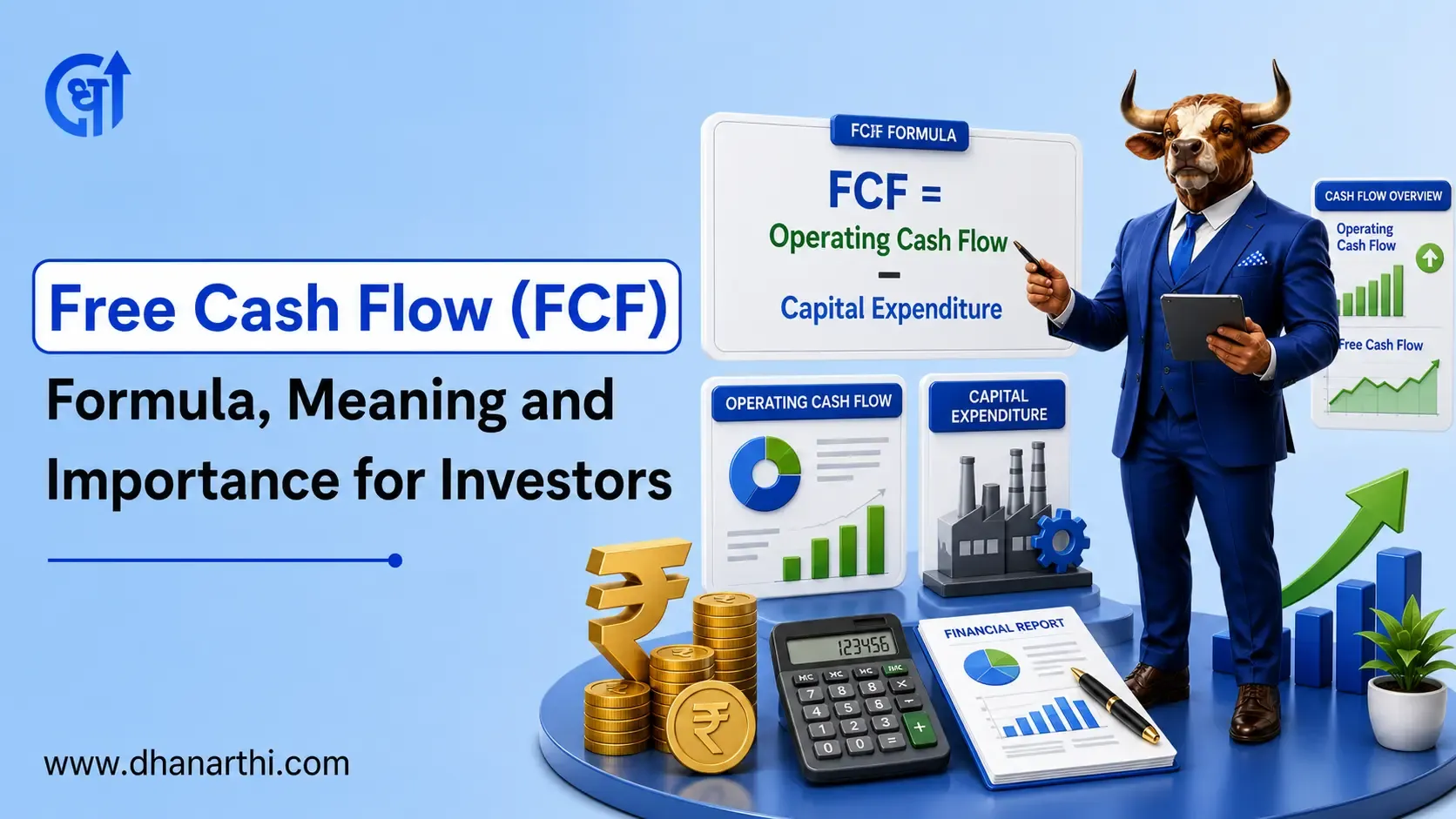
| 7 | Free Cash Flow | Operating Cash Flow minus CapEx | Actual cash generation | Positive and growing |
| 8 | Current Ratio | Current Assets / Current Liabilities | Short-term liquidity | 1.5 to 2.5 |
| 9 | Dividend Yield | Annual Dividend / Share Price x 100 | Income return | 1-4% for quality dividend stocks |
| 10 | PEG Ratio | P/E / EPS Growth Rate | Valuation versus growth | Below 1.0 often indicates value |
Data sourced from NSE and BSE company disclosures and SEBI-mandated financial reporting standards. Last updated: June 2026.
P/E Ratio is the most widely tracked valuation metric. Formula: Share Price divided by EPS. It tells you how much you are paying for each rupee of annual profit. The Nifty 50 traded at a P/E of around 20-21x in June 2026, close to its 10-year average of roughly 23x (Source: NSE Nifty 50 index data, June 2026).
A high P/E usually means the market expects strong future growth. A low P/E can mean the stock is cheap, or that the business faces real concerns. Sector matters too: FMCG companies have historically commanded richer multiples than PSU banks, sometimes 35x-45x against single digits to low teens. P/E breaks down for loss-making companies since there is no positive EPS to divide by.
EPS equals Net Profit divided by Total Shares Outstanding. It is the most direct measure of the profit attributable to each share you hold. Track EPS over five years, not just one year, since a single quarter can be distorted by one-off items.
Infosys reported a Basic EPS of Rs 64.50 for FY25, up 1.8% year on year (Source: Infosys FY25 Annual Results, NSE filing, April 17, 2025). A company compounding EPS at 15% or more consistently is building real shareholder value. Always prefer diluted EPS over basic EPS, since diluted EPS accounts for stock options and convertible instruments that could increase the share count later.
ROE equals Net Profit divided by Shareholders' Equity, multiplied by 100. It shows how efficiently a company turns shareholder money into profit. A consistently high ROE, generally above 15%, signals quality management and pricing power.
HDFC Bank's ROE stood at 14.6% in FY25 (Source: HDFC Bank Integrated Annual Report 2024-25), down from levels above 16% in earlier years. The decline traces back to the 2023 merger with HDFC Limited, which enlarged the equity base faster than profits could catch up. This is a useful lesson: a falling ROE after a large merger does not always signal weaker operations, it can simply reflect a bigger equity denominator. High ROE built on heavy debt is also misleading, which is exactly where ROCE adds value.
ROCE equals EBIT divided by Capital Employed, where Capital Employed is Total Assets minus Current Liabilities. Unlike ROE, which only looks at equity, ROCE measures returns on every rupee of capital in the business, both equity and debt.
This makes ROCE the better tool for comparing companies that carry different debt loads. A business generating ROCE consistently above 15%, and above its own cost of borrowing, is creating real value rather than just growing on borrowed money. A falling ROCE that drops below the company's average borrowing rate is a warning sign worth investigating further. Indian retail investors run into ROCE constantly while screening stocks. Use the dhanarthi stock screener to compare ROE and ROCE side by side for any NSE or BSE listed company.
EBITDA Margin strips out interest, tax, depreciation, and amortisation to isolate core operating profitability. Formula: EBITDA divided by Revenue, multiplied by 100. It is useful for comparing companies across sectors that depreciate assets differently.
TCS posted an operating margin of 24.2% for Q4 FY25, with full-year operating margin running close to 24% (Source: TCS Q4 FY25 Financial Results, April 10, 2025). EBITDA margin sits a few percentage points above operating margin for asset-light IT companies like TCS, since depreciation and amortisation are added back. IT services companies typically post EBITDA margins in the 22-28% band, FMCG companies sit around 18-24%, and steel or metals names run lower at 12-18% due to heavier capital intensity.
Debt-to-Equity (D/E) equals Total Debt divided by Total Shareholders' Equity. It measures how dependent a company is on borrowed money. A D/E above 1.0 means a company carries more debt than equity on its books.
For non-financial companies, a D/E below 1.0 is generally preferred, and zero or near-zero debt commands a valuation premium in sectors like IT and FMCG. Banks and NBFCs are the clear exception: leverage is built into how lending businesses work, so D/E is not the right lens for them. Use the Net NPA ratio and Capital Adequacy Ratio for banks instead.
Free Cash Flow equals Operating Cash Flow minus Capital Expenditure. It is the actual cash a company keeps after running and growing the business, and it cannot be manipulated by accounting choices the way reported profit sometimes can.
Infosys generated Rs 34,549 crore in free cash flow for FY25, its highest ever, with FCF conversion at 129.2% of net profit (Source: Infosys FY25 Annual Results, NSE filing, April 17, 2025). A company converting more than 100% of profit into cash is collecting receivables efficiently and keeping capital spending under control. Consistently positive and growing FCF is one of the strongest quality signals an investor can check.
Current Ratio equals Current Assets divided by Current Liabilities. It tells you whether a company can pay its near-term bills using assets it can convert to cash within a year. A ratio below 1.0 is a liquidity warning, since the company owes more in the short term than it currently holds in liquid assets.
A range of 1.5 to 2.5 is generally considered healthy. A ratio above 3.0 can mean a company is sitting on excess idle cash or inventory instead of deploying it productively. The Quick Ratio, which excludes inventory from current assets, gives a more conservative view for manufacturing companies holding large stockpiles.
Dividend Yield equals Annual Dividend Per Share divided by Share Price, multiplied by 100. It shows the cash return an income investor receives each year, separate from any change in share price.
Infosys raised its total dividend for FY25 to Rs 39 per share, a 13.2% increase over FY24 (Source: Infosys FY25 Annual Results, NSE filing, April 17, 2025). A yield of 1-4% is typical for quality dividend payers in India. A yield above 6-7% deserves a closer look, since it often signals a falling share price rather than rising dividends. Track the Dividend Payout Ratio (Dividend divided by EPS) alongside yield to confirm the dividend is actually sustainable from earnings.
PEG Ratio equals P/E Ratio divided by EPS Growth Rate. P/E alone says nothing about growth, so PEG adjusts for it. A stock at P/E 40 can be cheap if EPS is growing 50% a year. A stock at P/E 15 can be expensive if EPS growth is stuck at 5%.
A PEG below 1.0 often points to an undervalued stock relative to its growth rate, while a PEG near 1.0 suggests fair value. A PEG above 2.0 suggests the market may be pricing in growth that does not show up later. The main limitation is that PEG depends on projected future EPS growth, and projections can be wrong. Use the AI Financial Research Assistant to calculate PEG ratios and compare growth-adjusted valuations across Indian stocks.
No single metric works the same way across every sector. The table below shows where to focus depending on the business you are analysing.
| Sector | Primary Metrics | Why |
|---|---|---|
| IT and Software | ROE, ROCE, FCF, EPS Growth | Low capital spending and high margins make cash generation the real test |
| FMCG | EBITDA Margin, ROCE, D/E | Brand strength shows up directly in margins; low debt is the norm |
| Banking and NBFC | ROE, Net Interest Margin, Gross NPA Ratio | D/E does not apply; leverage is structural to lending |
| Capital Goods and Infra | D/E, Order Book, FCF | Heavy capex cycles make debt load and cash visibility critical |
| Pharma | EBITDA Margin, R&D Spend, FCF | Pipeline strength is not captured by standard ratios alone |
| Steel and Metals | D/E, EV/EBITDA, Capacity Utilisation | Commodity price cycles swing valuations sharply |
Benchmarks based on company filings on NSE and BSE as of FY25.
No single metric defines a great stock. The ten covered here address what you pay (P/E, PEG), what the company earns (EPS, ROE, ROCE), how efficiently the business runs (EBITDA Margin, FCF), how safe the balance sheet is (D/E, Current Ratio), and what income you receive (Dividend Yield). Use the dhanarthi stock screener to filter Indian stocks by any combination of these ten metrics and build a shortlist of fundamentally strong companies without reading every annual report by hand.
Disclaimer: This article is for educational purposes only. It does not constitute investment advice. Please consult a SEBI-registered financial advisor before making investment decisions.
1. What are the most important financial metrics for investors?
The ten that matter most are P/E Ratio, EPS, ROE, ROCE, EBITDA Margin, Debt-to-Equity Ratio, Free Cash Flow, Current Ratio, Dividend Yield, and PEG Ratio. They cover valuation, profitability, leverage, liquidity, and growth together.
2. What is the difference between ROE and ROCE?
ROE measures return on shareholders' equity alone. ROCE measures return on total capital, equity plus debt. A company with high ROE but low ROCE may be relying on debt to inflate equity returns.
3. What is a good P/E ratio for Indian stocks?
It depends on the sector. The Nifty 50 traded around 20-21x in June 2026. FMCG stocks often trade 35x-45x, while PSU banks trade in single digits to low teens.
4. How do I use EPS to evaluate a stock?
Track EPS growth over five years rather than a single year. Consistent EPS growth of 15% or more signals compounding shareholder value. Always check diluted EPS, not just basic EPS.
5. What financial ratios should I check before buying a stock?
Start with P/E for valuation, ROE and ROCE for profitability, Debt-to-Equity for leverage, Current Ratio for liquidity, and Free Cash Flow to confirm the profit shows up as real cash.
6. What is EBITDA margin and why does it matter?
EBITDA margin shows core operating profitability before interest, tax, depreciation, and amortisation. It lets you compare companies across sectors that depreciate assets at different rates.
7. What is a good debt-to-equity ratio?
Below 1.0 is generally preferred for non-financial companies. Banks and NBFCs naturally run higher leverage, so D/E is not the right metric for them.
8. What does current ratio tell investors?
It shows whether a company can cover its short-term liabilities using short-term assets. A ratio of 1.5 to 2.5 is considered healthy; below 1.0 is a liquidity warning.
9. How do dividend yield and payout ratio differ?
Dividend yield compares the dividend to the current share price. Payout ratio compares the dividend to EPS, showing what portion of profit is actually being distributed.
10. What is the PEG ratio and how is it used?
PEG divides the P/E ratio by the EPS growth rate. A PEG below 1.0 often suggests a stock is undervalued relative to its growth, while above 2.0 suggests growth expectations may be too optimistic.
Share Market
IPO
Artificial Intelligence
Semi Conductor