





Best Banking Stocks in India 2026
October 26, 2026



TABLE OF CONTENTS
Get AI Summary





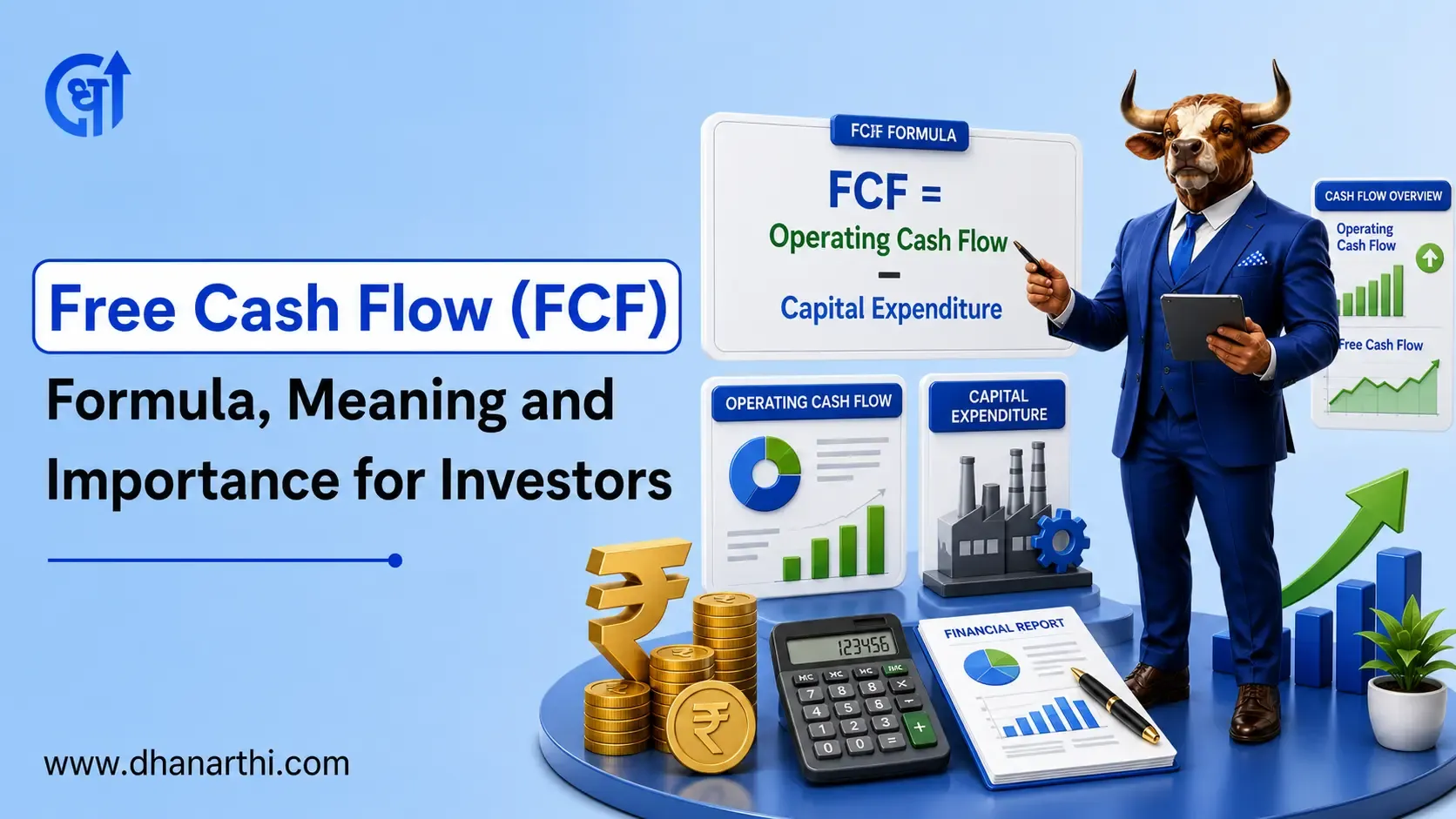
Free cash flow (FCF) is the cash a company generates after paying for its operating costs and capital expenditures. The formula is: FCF = Operating Cash Flow minus Capital Expenditure. A positive FCF means the business produces surplus cash it can use to pay dividends, repay debt, or reinvest. Investors use FCF to judge a company's true financial health beyond what net profit alone reveals.
Many investors check net profit when evaluating a stock. But profit can be shaped by accounting choices - revenue can be recorded before cash actually arrives, and depreciation adjusts profit without any cash changing hands. Free cash flow cuts through that. It shows how much actual cash the business generated after all real expenses and investments.
For a deeper understanding of where FCF appears alongside other financial data, our guide on financial statement analysis walks you through balance sheets, P&L statements, and cash flow statements. This article covers the FCF formula, how to read it from an Indian company's filings, and how to use it when evaluating stocks.
Free cash flow is the cash left with a company after it pays for day-to-day operations and spends on maintaining or growing its physical assets.
Think of it this way: a shop owner earns Rs 10 lakh in revenue. After paying rent, salaries, and buying new shelving, he has Rs 2 lakh left in hand. That Rs 2 lakh is his free cash flow - actual money he can use as he chooses.
FCF differs from net profit in one important way. Net profit includes non-cash items like depreciation. It also recognizes revenue even when payment has not been received. Free cash flow counts only cash that actually moved - in or out.
You will find FCF data in the Cash Flow Statement filed by every listed company with NSE and BSE, not in the Profit and Loss statement.
The standard formula used by analysts and investors:
FCF = Operating Cash Flow (OCF) - Capital Expenditure (CapEx)
Both figures appear in the Cash Flow Statement of every NSE/BSE-listed company.
| Term | What It Means | Where to Find It |
|---|---|---|
| Operating Cash Flow (OCF) | Cash generated from core business operations | Section 1 of the Cash Flow Statement |
| Capital Expenditure (CapEx) | Cash spent on buying or upgrading fixed assets (plant, machinery, equipment) | Section 2 of the Cash Flow Statement (Investing Activities) |
| Free Cash Flow (FCF) | OCF minus CapEx | Calculated; some platforms show it directly |
Data sourced from SEBI-mandated disclosure format for listed companies. Last updated: June 2026.
A company with OCF of Rs 500 crore and CapEx of Rs 150 crore has FCF of Rs 350 crore. That Rs 350 crore is available for dividends, debt repayment, buybacks, or reinvestment into growth.
Infosys (NSE: INFY) reported its highest-ever free cash flow in FY25, making it a strong real-world example for understanding this metric.
| Line Item | Where to Find | FY25 Value |
|---|---|---|
| Net Cash from Operating Activities (OCF) | Cash Flow Statement - Section 1 | Rs 38,003 crore |
| Capital Expenditure (CapEx) | Cash Flow Statement - Section 2 | Rs 3,454 crore |
| Free Cash Flow (FCF) | OCF minus CapEx | Rs 34,549 crore |
Data sourced from Infosys FY25 Annual Results filed with NSE on April 17, 2025. FCF conversion was 129.2% of net profit for FY25.
Infosys CFO Jayesh Sanghrajka stated in the April 2025 earnings release: this was the highest-ever free cash flow in the company's history, driven by operating margin expansion and disciplined capital allocation.
How to read this: Infosys generated Rs 34,549 crore in FCF in FY25. With a market cap of approximately Rs 6.5 lakh crore at the time of reporting, its FCF yield works out to roughly 5.3%. For a large-cap IT company, that is a strong cash generation profile.
Step-by-step calculation:
Find Net Cash from Operating Activities in the Cash Flow Statement
Find "Purchase of property, plant and equipment" in the Investing Activities section
Subtract Step 2 from Step 1
The result is Free Cash Flow
This is where most beginner investors get stuck. FCF does not have its own dedicated line in standard financial statements - you calculate it from two specific line items.
Using Screener.in (free):
Visit screener.in and search the company name
Scroll to the "Cash Flows" table on the company page
Look for "Cash from Operating Activity" - this is OCF
Look for "Capital Expenditures" - this is CapEx
Screener.in often shows FCF directly in the summary section
Using NSE India (nse india.com):
Go to the company page and select "Financial Results"
Open the Cash Flow Statement from the quarterly or annual filing
Section A: "Cash flows from operating activities" - note the net figure
Section B: "Cash flows from investing activities" - find "Purchase of property, plant and equipment"
Subtract the CapEx from OCF
You can also use the Dhanarthi stock screener to filter Indian stocks by cash flow metrics and compare FCF across companies in the same sector without manually reading each annual report.
Two variations of FCF are commonly used in financial analysis:
| Type | Full Form | What It Measures | Who Uses It |
|---|---|---|---|
| FCFF | Free Cash Flow to Firm | Cash available to all capital providers - both debt holders and equity shareholders | Analysts valuing entire businesses, lenders assessing repayment |
| FCFE | Free Cash Flow to Equity | Cash available specifically to equity shareholders after debt repayment | Equity investors, dividend analysis |
FCFF formula: Operating Cash Flow minus Capital Expenditure
FCFE formula: FCFF + Net Borrowing minus Interest × (1 minus Tax Rate)
For most retail investors evaluating stocks on NSE/BSE, FCFF (the standard FCF formula) is what you will encounter in screeners and research reports. FCFE becomes relevant when you are specifically assessing dividend sustainability or a company's capacity to run buybacks.
There is no single number that defines "good" FCF. The right benchmark depends on the sector, company size, and stage of growth.
| Sector | Typical FCF Profile | Reason |
|---|---|---|
| IT / Software (Infosys, TCS, HCL Tech) | High and consistent | Low physical asset requirements, strong margins, short cash cycles |
| FMCG (HUL, Nestle, Marico) | High and stable | Low CapEx needs, strong brand cash generation |
| Pharma (Sun Pharma, Dr. Reddy's) | Moderate to high | Some R&D CapEx, but asset-light model for generics |
| Telecom (Airtel, Jio) | Low to moderate | Continuous network investment required |
| Capital Goods / Infrastructure (L&T, BHEL) | Often low or negative | Project-based payment cycles, high working capital needs |
| Steel / Cement (JSW Steel, UltraTech) | Cyclical - swings widely | Heavy plant and equipment CapEx, commodity pricing exposure |
| Early-stage consumer / QSR | Negative | Expanding store network requires upfront CapEx |
Analysis based on company filings on NSE/BSE. Sector data as of FY25.
The key takeaway: A large IT company with negative FCF is a serious red flag. A QSR chain or hospital network with negative FCF during an expansion phase may be entirely normal.
No. Negative FCF needs context before you draw any conclusion.
When negative FCF signals a problem:
Revenue is stagnant or declining while CapEx continues to rise
The company is borrowing to fund day-to-day operations
Negative FCF has persisted for 5+ years with no clear asset build-up
When negative FCF may be justified:
A hospital chain opening new facilities - each hospital takes 3-4 years to become FCF positive
A telecom company rolling out 5G infrastructure across the country
A manufacturing company building new capacity to meet rising demand
A real example: several investors avoided JSW Steel during its heavy capex expansion phases because FCF was negative. Those who understood the context - that new blast furnace capacity was being built with a clear payback timeline - and held through the investment cycle were rewarded as FCF turned sharply positive once capacity came online.
The discipline is to ask: Why is FCF negative, and is the CapEx building something that will generate returns?
This is one of the most common points of confusion for new investors.
| Parameter | Net Profit | Free Cash Flow |
|---|---|---|
| Includes depreciation | Yes (reduces profit without cash going out) | No (non-cash items excluded) |
| Counts revenue when earned | Yes (even if payment not received) | No (only counts actual cash received) |
| Can be affected by accounting choices | More easily, through accrual methods | Harder to manipulate |
| Best used for | Profitability assessment | Actual cash generation, valuation |
| Common ratio | P/E ratio | P/FCF ratio, DCF valuation |
Practical example: A B2B manufacturer supplies goods worth Rs 200 crore to a large buyer but receives payment only after 180 days. The P&L shows Rs 200 crore in revenue. The Cash Flow Statement shows nothing - because the cash has not arrived yet. FCF reflects this reality; net profit does not.
This is why analysts trust FCF more than PAT when evaluating financial strength, especially for companies with long receivable cycles.
FCF Yield tells you how much cash return you get relative to what you pay for a stock. It is a direct way to compare whether a stock is expensive or cheap based on actual cash generation.
Formula: FCF Yield = (Free Cash Flow / Market Capitalization) × 100
Example using Infosys FY25:
FCF: Rs 34,549 crore
Market Cap at time of reporting: approximately Rs 6.5 lakh crore
FCF Yield: 34,549 / 6,50,000 × 100 = approximately 5.3%
How to interpret FCF Yield:
| FCF Yield | What It Suggests |
|---|---|
| Above 7-8% | Potentially undervalued; strong cash generation relative to price |
| 4% to 7% | Fair value range for quality companies |
| Below 2-3% | Premium valuation; market is pricing in strong future growth |
| Negative | Company burning cash; high risk unless growth-phase justified |
Use the AI Financial Research Assistant to quickly pull FCF and market cap data for any Indian listed company and calculate FCF yield without manually reading each filing.
A high FCF yield in a quality business often signals that the market is underpricing the stock. A low FCF yield does not automatically mean avoid - it may simply reflect the premium investors pay for consistent compounders like TCS or HUL.
Three practical uses that directly improve investment decisions:
1. Dividend sustainability check A company paying a Rs 10 dividend per share is only truly sustainable if FCF per share comfortably covers it. If FCF is lower than dividends being paid, the company is funding payouts from debt or asset sales - a warning sign.
2. DCF (Discounted Cash Flow) valuation FCF is the primary input in DCF models. Future FCF is projected and discounted back to today's value to estimate intrinsic value. This is the method widely used by institutional investors and fund managers to evaluate whether a stock is trading above or below its true worth.
3. Quality screening Filter for companies with 5 consecutive years of positive and growing FCF. These businesses are generating real cash, not just accounting profits. Combined with low debt and consistent ROE, consistently positive FCF is one of the strongest indicators of business quality.
Use the Dhanarthi stock screener to filter Indian stocks by cash flow strength and track companies with consistently positive free cash flow across sectors.
FCF is powerful, but it is not a standalone metric.
CapEx definition varies: Different companies classify certain expenses as CapEx or operating costs differently. This makes direct cross-company FCF comparisons unreliable without reading footnotes.
High FCF can mean underinvestment: A company showing very high FCF may simply be cutting back on growth spending. That is not always a positive signal.
Cyclical distortion: For capital-intensive businesses, FCF can swing dramatically year to year based on when large projects are built. A single bad FCF year means little; track 3-5 years.
Working capital timing: Delay in collecting receivables can depress FCF in one year and inflate it the next. Always check receivable days alongside FCF.
FCF works best when combined with ROE, ROCE, debt levels, and revenue growth - not as a single filter.
Free cash flow is the closest thing to a company's true earning power. It strips out accounting adjustments and shows what the business actually generated and kept. For Indian retail investors, FCF answers three questions that net profit cannot: Can this company sustain its dividend? Is it genuinely profitable or just profitable on paper? And relative to its price, does the stock offer good value?
Learning to read FCF from NSE/BSE filings - and track it over multiple years - puts you ahead of investors who rely only on headline numbers.
Disclaimer: This article is for educational purposes only. It does not constitute investment advice. Please consult a SEBI-registered financial advisor before making investment decisions.
1. What is free cash flow in simple terms?
Free cash flow is the cash a company has left after paying for its daily operations and spending on assets like machinery or equipment. If a company earns Rs 500 crore from operations and spends Rs 150 crore on CapEx, its FCF is Rs 350 crore - the actual cash it can use freely.
2. What is the formula for free cash flow?
FCF = Operating Cash Flow minus Capital Expenditure. Operating Cash Flow is found in Section A of the Cash Flow Statement. Capital Expenditure is found in Section B under Investing Activities, typically labeled "Purchase of property, plant and equipment." Subtract the second from the first to get FCF.
3. What is the difference between free cash flow and net profit?
Net profit includes non-cash items like depreciation and counts revenue even when payment has not been received. Free cash flow counts only actual cash that entered or left the company. This makes FCF a more reliable measure of whether a business is truly generating money, not just reporting it.
4. What is FCFF and FCFE?
FCFF (Free Cash Flow to Firm) measures cash available to all capital providers - both lenders and equity shareholders. FCFE (Free Cash Flow to Equity) measures cash available only to equity shareholders after debt repayment. Most retail investors use FCFF when screening stocks; FCFE is more relevant for dividend analysis.
5. Is negative free cash flow always a bad sign?
No. Context matters. A hospital chain expanding into 10 new cities, a telecom company rolling out 5G, or a manufacturing company building new capacity will often show negative FCF during the investment phase. The key question is whether the CapEx is building productive assets with a clear payback timeline. Negative FCF with declining revenue and rising debt is a genuine red flag.
6. What is a good free cash flow for an Indian company?
There is no universal number. IT companies like Infosys and TCS consistently generate high FCF due to their low CapEx requirements. Capital-intensive sectors like steel and infrastructure have lower or negative FCF during expansion cycles. Compare FCF within the same sector over 3-5 years. As a starting point, positive and growing FCF across multiple years is the signal to look for.
7. Where can I find free cash flow in an annual report?
FCF is not a separate line item - you calculate it from the Cash Flow Statement. Look for "Net Cash from Operating Activities" (OCF) in Section A and "Purchase of property, plant and equipment" (CapEx) in Section B. Subtract CapEx from OCF. Screener.in shows this calculation directly on each company's summary page.
8. What is free cash flow yield and how is it calculated?
FCF Yield = (Free Cash Flow / Market Capitalization) × 100. It tells you how much cash return the company generates relative to its current market value. A FCF yield above 5% in a quality company generally indicates good value. Below 2% suggests the market is pricing in strong future growth.
9. How do investors use free cash flow to value stocks?
Investors use FCF in three main ways: checking dividend sustainability (can FCF cover the dividend?), running DCF models (projecting future FCF and discounting to present value for intrinsic price), and quality screening (filtering for companies with consistently positive and growing FCF over 5 years). FCF-based screening helps identify businesses with genuine cash generation versus those with inflated accounting profits.
10. Why do investors prefer free cash flow over net income?
Net income can be influenced by accounting choices - depreciation methods, revenue recognition timing, and provisions. Free cash flow is harder to manipulate because it tracks actual cash. A company can report high net income while running out of cash. FCF reveals whether the profitability is real. This is why Warren Buffett's concept of "owner earnings" closely mirrors free cash flow - it reflects what the business actually earns for its owners.
Share Market
IPO
Artificial Intelligence
Semi Conductor