





Best Banking Stocks in India 2026
October 26, 2026



TABLE OF CONTENTS
Get AI Summary





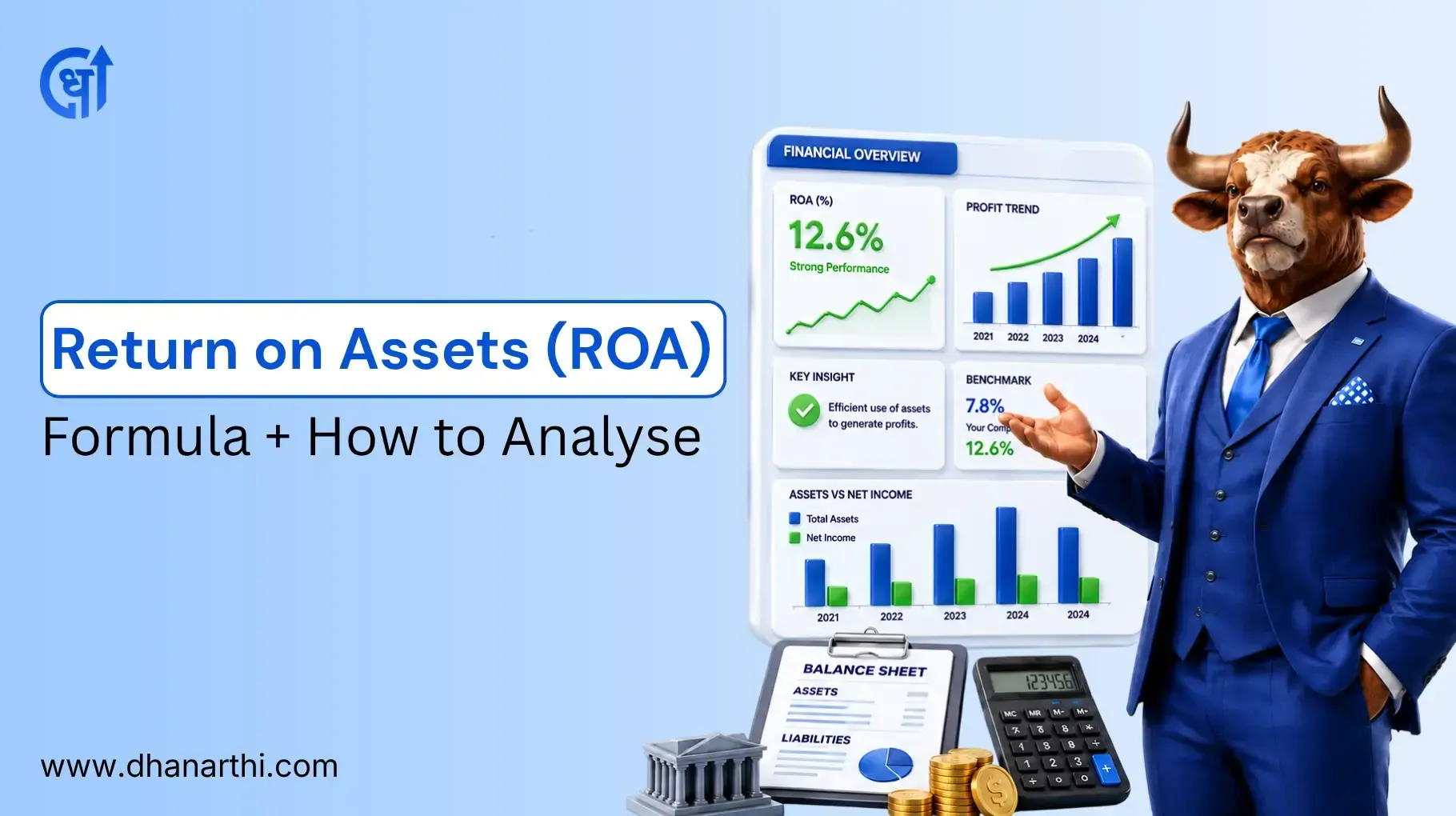
Return on Assets defines how efficiently a company converts its assets into profit. It is calculated as Net Income divided by Average Total Assets, which is expressed as a percentage. A higher ROA indicates stronger asset utilisation, but ROA should always be compared within the same sector, since asset-heavy and asset-light businesses may differ widely.
ROA = Net Income ÷ Average Total Assets, shown as a percentage
It measures how efficiently a company turns its assets into profit
A higher ROA generally signals better asset utilisation, but only within the same sector
Asset-heavy sectors like manufacturing and infrastructure run lower ROA than asset-light sectors like IT and FMCG
ROA works best alongside ROE and ROCE for a full profitability picture
For a complete view of a company's balance sheet and earnings before checking its ROA, start with financial statement analysis
ROA defines how much profit a company makes for every rupee of assets that it owns. It is a profitability ratio, not a valuation ratio, and it says nothing about whether a stock is cheap or expensive.
For Example, A company with Rs 100 crore in assets has an ROA of 8%, with Rs 8 crore in net profit for a specific set of assets. Management tams which also extract more profit from the same assets are considered more efficient operators. This is because ROA is widely used to compare companies within the same Industry with various across Industries.
The standard return on assets formula is:
ROA = Net Income / Average Total Assets × 100
Average Total Assets = (Opening Total Assets + Closing Total Assets) / 2
Analysts often stick with the average rather than only the closing balance, because the asset base can move pretty meaningfully during the year, due to capital expenditure, inventory build-up, or even acquisitions.
Using the average kinda levels out that timing mismatch where the income statement runs across a whole year, but the balance sheet is just one single snapshot in time.
Some platforms then compute ROA by using the closing total assets straightaway, mainly for simplicity. Either version works, as long as you keep the approach consistent when you compare one company to another.
Bajaj Auto reported net income of Rs 3,828 crore against total assets of Rs 20,815 crore in its FY2024 financial statements (Source: company BSE filing, FY2024).
ROA = 3,828 / 20,815 × 100 = 18.4%
This means Bajaj Auto generated Rs 18.40 in profit for every Rs 100 of assets on its books, a strong figure for an auto manufacturing company where global peers typically run in single digits.
| Step | Figure |
|---|---|
| Net Income (FY2024) | Rs 3,828 crore |
| Total Assets | Rs 20,815 crore |
| ROA | 18.4% |
Data sourced from BSE company filings. Last updated: June 2026.
To screen for companies with strong ROA alongside other profitability ratios, the stock screener lets you filter Indian stocks by financial ratios in one place.
There is no single “good” ROA really. It depends a lot on how asset-heavy the whole sector is, kind of. Banks and NBFCs end up carrying big loan books as assets, so that mechanically drags ROA down even if the business itself is healthy, in a way. In India, private sector banks usually end up reporting ROA somewhere around 1.5% to 2.2%, and people treat that as solid for the category. (Source: RBI Financial Stability Report).
| Sector | Typical ROA Range | Why |
|---|---|---|
| Banking and NBFC | 1% to 2.5% | Large loan books inflate the asset base |
| Manufacturing | 4% to 10% | Heavy plant, machinery, and inventory |
| FMCG | 10% to 20% | Asset-light, high margin |
| IT services | 15% to 25% | Minimal physical assets, people-driven |
Data sourced from NSE/BSE company filings and RBI Financial Stability Report. Last updated June 2026.
Trying to line up an IT company's ROA with a bank's ROA is basically a dead end, because it won’t show anything that is actually useful. A better thing is to compare ROA only inside the same sector, so the story is at least relatable.
ROA and ROE both kind of measure profitability, but they are kind of asking different things. ROA shows just how well the company can use its whole asset pool efficiently. ROE, meanwhile, shows how effectively it uses shareholder equity, but it sort of ignores the question of how much of the asset base is backed by debt.
| Metric | Formula | What It Measures |
|---|---|---|
| ROA | Net Income / Average Total Assets | Efficiency of total assets |
| ROE | Net Income / Average Shareholder Equity | Returns to shareholders |
A company with high debt will show a much higher ROE than ROA, since debt inflates equity returns without changing the asset base. For companies with low debt, ROA and ROE stay close to each other. Reading both together gives a clearer view of whether strong returns come from genuine efficiency or from leverage.
ROA can be split into two components using a simplified DuPont approach:
ROA = Net Profit Margin × Asset Turnover
Net Income / Revenue. Shows how much of every rupee in sales becomes profit.
Revenue / Average Total Assets. Shows how many rupees of sales a company generates from each rupee of assets.
Take the example: a company with a 10% profit margin, plus an asset turnover of 1, shows an ROA of 15%.
Now consider that another company can still land at that same 15% ROA in two different ways, like by keeping margins kinda thin while pushing big sales volume, or by having fatter margins even though volume is lower.
When you split ROA into those two pieces, you can actually see what lever the company is using, and that’s what matters for whether the current ROA can last.
ROA has real blind spots that beginner investors often miss, or at least they think they understand it. A thing people do is compare ROA across sectors that really don't match, like using a steel company as the benchmark and then weighing it against a software company on the same chart. It sounds “fair” at first, but it totally ignores how differently capital intensive those two businesses are, and then the whole reading gets shaky.
Depreciation policy differences also mess with the comparison. If one company uses accelerated depreciation, its net asset base shrinks faster over time, which can make ROA look stronger than a peer that uses straight-line depreciation.
And that effect can show up even when both companies are equally efficient, so you end up crediting the accounting method instead of the business.
Then there’s the holding company situation, which is kinda its own lane. Their balance sheets often include big investment assets in subsidiaries. That can dilute ROA and make the metric look weaker versus operating companies inside the same group, even when the underlying operations are doing fine.
Dhanarthi's screener lets investors filter companies by ROA alongside other ratios like ROE and debt-to-equity, directly from the balance sheet data of NSE- and BSE-listed companies. This helps shortlist efficient companies within a chosen sector rather than across unrelated industries, avoiding the cross-sector comparison trap.
While Return on Assets defines how well a company turns it assets base into profit, it only means something when read in sector context. Also, pair it with ROE and a quick DuPon breakdown before concluding; always check the trend, not just one year’s figure.
Disclaimer: This article is for educational purposes only. It does not constitute investment advice. Please consult a SEBI-registered financial advisor before making investment decisions.
1. What is Return on Assets (ROA)?
Return on Assets measures how efficiently a company converts its total assets into profit. It is calculated as Net Income divided by Average Total Assets, shown as a percentage.
2. What is the ROA formula?
ROA = Net Income / Average Total Assets × 100. Average Total Assets is the sum of opening and closing total assets divided by two.
3. What is the ROA full form?
ROA stands for Return on Assets, a core profitability ratio used in financial statement analysis.
4. What is a good ROA in India?
It depends on the sector. Banks typically run 1% to 2.5%, manufacturing runs 4% to 10%, and IT or FMCG companies often exceed 15%, since they need fewer physical assets to generate revenue.
5. What is the difference between ROA and ROE?
ROA measures returns on total assets, while ROE measures returns on shareholder equity. Companies with high debt show a much higher ROE than ROA, since leverage inflates equity returns.
6. Why is ROA lower for banks than for IT companies?
Banks hold large loan books as assets on their balance sheet, which expands the denominator of the ROA formula. IT companies need minimal physical assets, so their ROA naturally runs higher.
7. Can ROA be negative?
Yes. If a company reports a net loss, ROA turns negative, signalling that the business is destroying value from its asset base rather than generating profit from it.
8. Should I use closing assets or average assets in the ROA formula?
Average total assets is more accurate since it accounts for changes during the year. Closing assets alone work for quick checks but can distort the ratio if the asset base shifted sharply.
9. How does ROA relate to ROCE?
ROCE measures returns on total capital employed, including both debt and equity, while ROA measures returns purely on total assets. ROCE is more useful for capital-intensive businesses with significant borrowings.
10. Is a higher ROA always better?
Generally yes within the same sector, but a sudden spike in ROA can come from a one-time asset sale or accounting change rather than genuine operating improvement. Always check the trend before concluding.
Share Market
IPO
Artificial Intelligence
Semi Conductor