

Types of Bonds in India: Features, Risks & How to Choose
September 29, 2026



TABLE OF CONTENTS
Get AI Summary





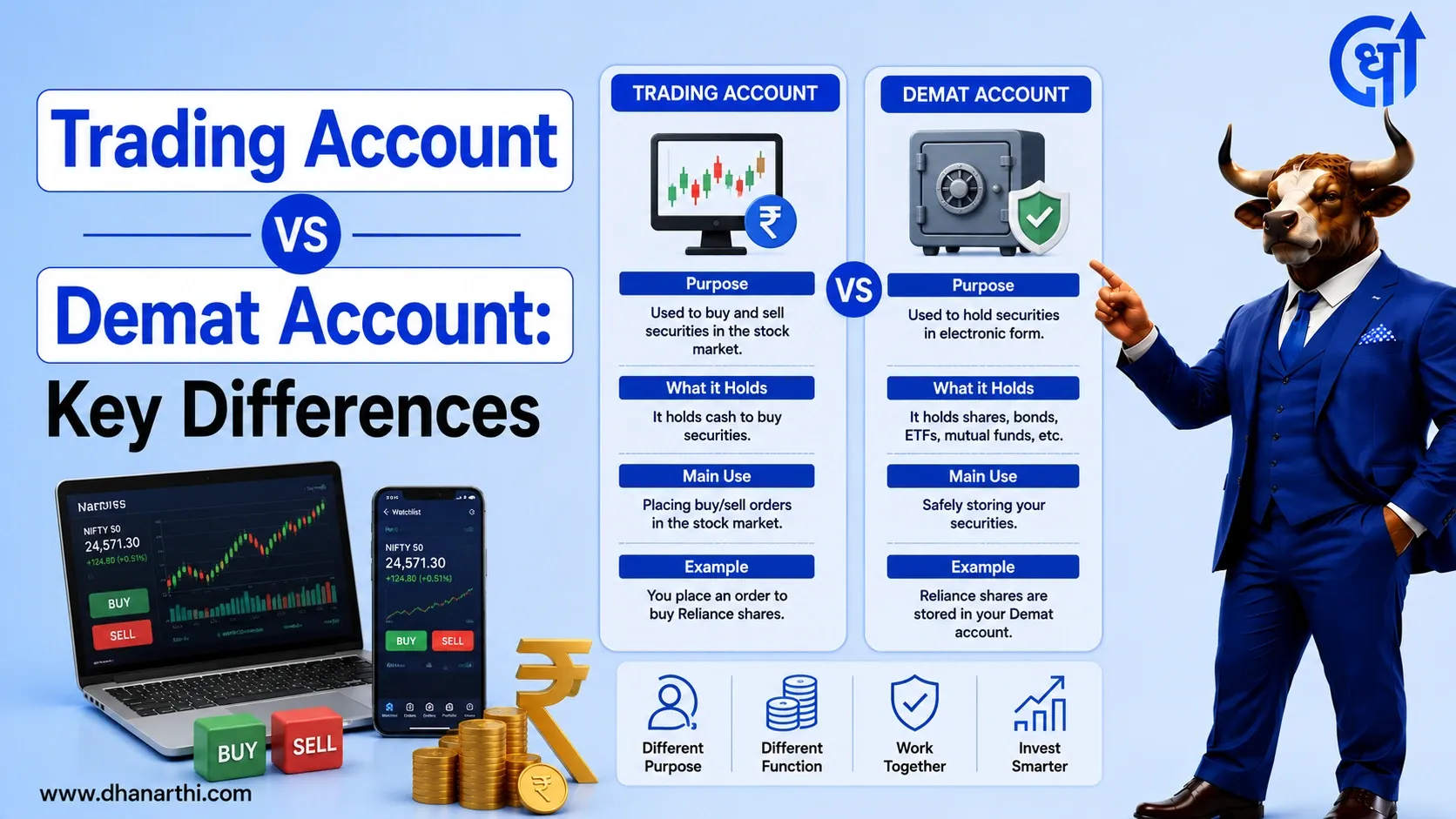
A demat account holds your shares and securities in electronic form, while a trading account is used to place buy and sell orders on the stock exchange. You need both to invest in the Indian stock market. The trading account executes the order, and the demat account stores what you own.
A demat account stores securities electronically. A trading account executes buy and sell orders.
You need both accounts to invest in equity delivery. Only a trading account is needed for cash-settled derivatives.
Most brokers now offer 2-in-1 or 3-in-1 accounts that bundle trading, demat, and banking.
India had close to 22.9 crore demat accounts as of May 2026, split between NSDL and CDSL (Source: NSDL, CDSL).
Charges differ by account type: demat carries an annual maintenance charge, trading carries brokerage per order.
A demat account is an electronic account that holds your shares, bonds, ETFs, and mutual fund units in digital form. Dematerialisation converted paper share certificates into electronic records, removing the risk of loss, theft, or damage to physical certificates. If you are new to investing, it helps to first get comfortable with the basics of stock analysis before you start tracking holdings in this account.
Every demat account is opened through a Depository Participant (DP) linked to one of India's two depositories, NSDL or CDSL. As of May 2026, CDSL served 18.38 crore demat accounts and NSDL served 4.51 crore, taking the industry total to roughly 22.9 crore accounts (Source: NSDL, CDSL, May 2026 data). Each account gets a unique Beneficiary Owner (BO) ID used to identify holdings.
A demat account is where your ownership record lives. After you buy shares through a broker, they get credited to this account following settlement.
Holds equities, ETFs, government securities, and mutual fund units in one place
Removes paperwork and the risk tied to physical certificates
Lets you track your holdings and portfolio value at any time
Required by SEBI for holding and selling shares in electronic form
A trading account is the account you use to place buy and sell orders in the stock market. It connects your bank account to the stock exchange through your broker, so orders placed through it get routed to NSE or BSE for execution.
Once an order is executed, funds move from your bank account and shares move into your demat account. The trading account itself does not store anything; it only carries out transactions.
Without a trading account, you cannot buy or sell securities on an exchange, even if you already hold shares in a demat account.
Routes your buy and sell orders to NSE, BSE, MCX, or NCDEX
Links your bank account and demat account for settlement
Gives access to segments like equity, F&O, currency, and commodities
Provides order history, contract notes, and margin details
The trading account vs demat account comparison comes down to one line: one executes transactions, the other stores what you own after the transaction settles.
| Particulars | Demat Account | Trading Account |
|---|---|---|
| Primary function | Holds securities electronically | Places buy and sell orders |
| Nature | Works like a locker for your holdings | Works like a gateway to the exchange |
| Linked to | Depository (NSDL or CDSL) via a DP | Broker registered with NSE/BSE |
| What moves through it | Shares, bonds, ETFs, mutual fund units | Buy/sell orders, funds settlement |
| Charges | Annual maintenance charge (AMC) | Brokerage per executed order |
| Regulator | SEBI, through depositories | SEBI, through stock exchanges |
Data sourced from SEBI and NSDL/CDSL public disclosures. Last updated: July 2026.
Most brokers no longer make you open a demat account and a trading account separately. They bundle both into a single application.
2-in-1 account: Combines trading and demat accounts under one broker, opened with a single KYC process.
3-in-1 account: Adds a linked bank account on top of trading and demat, typically offered by bank-backed brokers such as ICICI Direct or HDFC Securities.
A 3-in-1 setup automates fund transfers between your bank, trading, and demat accounts, which reduces manual steps during settlement. If you want to compare brokers before opening either type, Dhanarthi's stock screener can help you check broker-listed stocks and filter options once your account is active.
Yes, but only in specific cases. SEBI does not legally require you to open both accounts together.
You can hold a demat account without a trading account if you only want to store securities received through an IPO allotment, gift, or transfer, without actively trading. You can also have a trading account without a demat account if you trade only in cash-settled derivatives like index futures and options, since these do not involve delivery of shares. However, for equity delivery, intraday equity trading, and IPO applications, SEBI has made a demat account mandatory alongside a trading account.
The right combination depends on what kind of investor you are.
Beginners: Open a 2-in-1 account directly. It saves you a second KYC process and gets you ready to invest in both stocks and mutual funds.
Long-term investors: A demat account carries more weight here, since your shares sit in it for years. Pick a DP with a low AMC and reliable customer support.
Intraday and F&O traders: The trading account matters more, since order execution speed, margin funding, and brokerage per trade directly affect returns. A demat account is still required if you also hold delivery positions.
If you are unsure which stocks fit your investing style once your accounts are active, Dhanarthi's AI Financial Research Assistant can help you research fundamentals before you place your first order.
Opening both accounts online usually takes under a day with most SEBI-registered brokers.
Choose a SEBI-registered broker or Depository Participant.
Fill the online account opening form with personal and bank details.
Upload PAN card, Aadhaar or address proof, and a passport-size photo.
Complete KYC through video verification, Aadhaar OTP, or in-person verification.
E-sign the account opening agreement digitally.
Receive your demat account number (BO ID) and trading account credentials, typically within 24 to 48 hours.
Types of demat accounts include a regular demat account for resident Indians, a repatriable demat account for NRIs (linked to an NRE bank account), and a non-repatriable demat account for NRIs (linked to an NRO bank account).
Demat and trading accounts carry different cost structures, and both add up over a year of active investing.
Demat account charges:
Account opening: free at most discount brokers
Annual Maintenance Charge (AMC): typically Rs 300 to Rs 500 a year, though some brokers waive it for holdings under Rs 50,000 (Basic Services Demat Account)
Demat/Remat charges: applicable only if converting physical certificates to electronic form or vice versa
Off-market transfer charges: levied when moving shares between demat accounts of different brokers
Trading account charges:
Brokerage: flat fee per order or a percentage of trade value, depending on the broker
Transaction charges: levied by the exchange (NSE/BSE) on every trade
DP charges: charged when you sell shares from your demat account, separate from brokerage
As an example of real market pricing, Zerodha charges zero brokerage on equity delivery trades, Rs 20 per executed order for intraday and F&O trades, and an annual demat AMC of Rs 300 plus GST, billed quarterly (Source: Zerodha pricing page, July 2026). CDSL, the depository that services the AMC and settlement infrastructure behind such accounts, added 75 lakh new demat accounts in the quarter ending September 2025, taking its base to 17.27 crore (Source: CDSL Q3 FY26 investor call, November 2025).
Myth 1: A demat account and a trading account are the same thing. They serve different functions. One stores securities, the other executes transactions.
Myth 2: You need a large amount of money to open either account. Most brokers offer free account opening, and some waive AMC entirely for small holdings under the BSDA category.
Myth 3: Keeping shares in electronic form is riskier than holding physical certificates. The opposite is true. Physical certificates carry risks of theft, forgery, and damage that dematerialised holdings do not.
Myth 4: You can trade stocks the moment your demat account is approved. You still need an active, funded trading account linked to it before you can place an order.
A trading account and a demat account solve two different problems: one lets you act in the market, the other lets you hold what you have bought. For most investors, a 2-in-1 account removes the need to choose between them. What matters more than which one you open first is picking a broker whose charges, platform, and support fit how you plan to invest, whether that is long-term holding or active trading.
Disclaimer: This article is for educational purposes only. It does not constitute investment advice. Please consult a SEBI-registered financial advisor before making investment decisions.
1. What is the main difference between a demat account and a trading account?
A demat account stores your securities electronically after settlement. A trading account is used to place the buy or sell order that leads to that settlement.
2. Can I open a demat account without a trading account?
Yes, if you only want to hold securities received through an IPO allotment, gift, or transfer without actively buying or selling.
3. Can I open a trading account without a demat account?
Yes, but only for cash-settled derivatives like index futures and options, where no shares change hands.
4. Is a demat account mandatory for stock market investing in India?
Yes, SEBI requires a demat account for equity delivery trades and IPO applications, alongside a trading account.
5. What are 2-in-1 and 3-in-1 accounts?
A 2-in-1 account bundles trading and demat under one broker. A 3-in-1 account adds a linked bank account, common with bank-backed brokers.
6. Are demat and trading accounts free to open?
Account opening is free at most discount brokers, but annual maintenance charges and brokerage still apply based on your broker's pricing.
7. Can I have multiple demat accounts?
Yes, an investor can hold multiple demat accounts across different brokers using the same PAN card.
8. Which types of demat accounts are available for NRIs?
NRIs can open a repatriable demat account linked to an NRE bank account, or a non-repatriable demat account linked to an NRO bank account.
9. How long does it take to open a demat and trading account online?
Most SEBI-registered brokers complete the process within 24 to 48 hours after KYC verification is done.
10. Which account should a beginner focus on first?
Beginners should open a 2-in-1 account, since most brokers no longer allow opening one without the other for full-service investing.
Share Market
IPO
Artificial Intelligence
Semi Conductor