



Types of Bonds in India: Features, Risks & How to Choose
September 29, 2026



TABLE OF CONTENTS
Get AI Summary





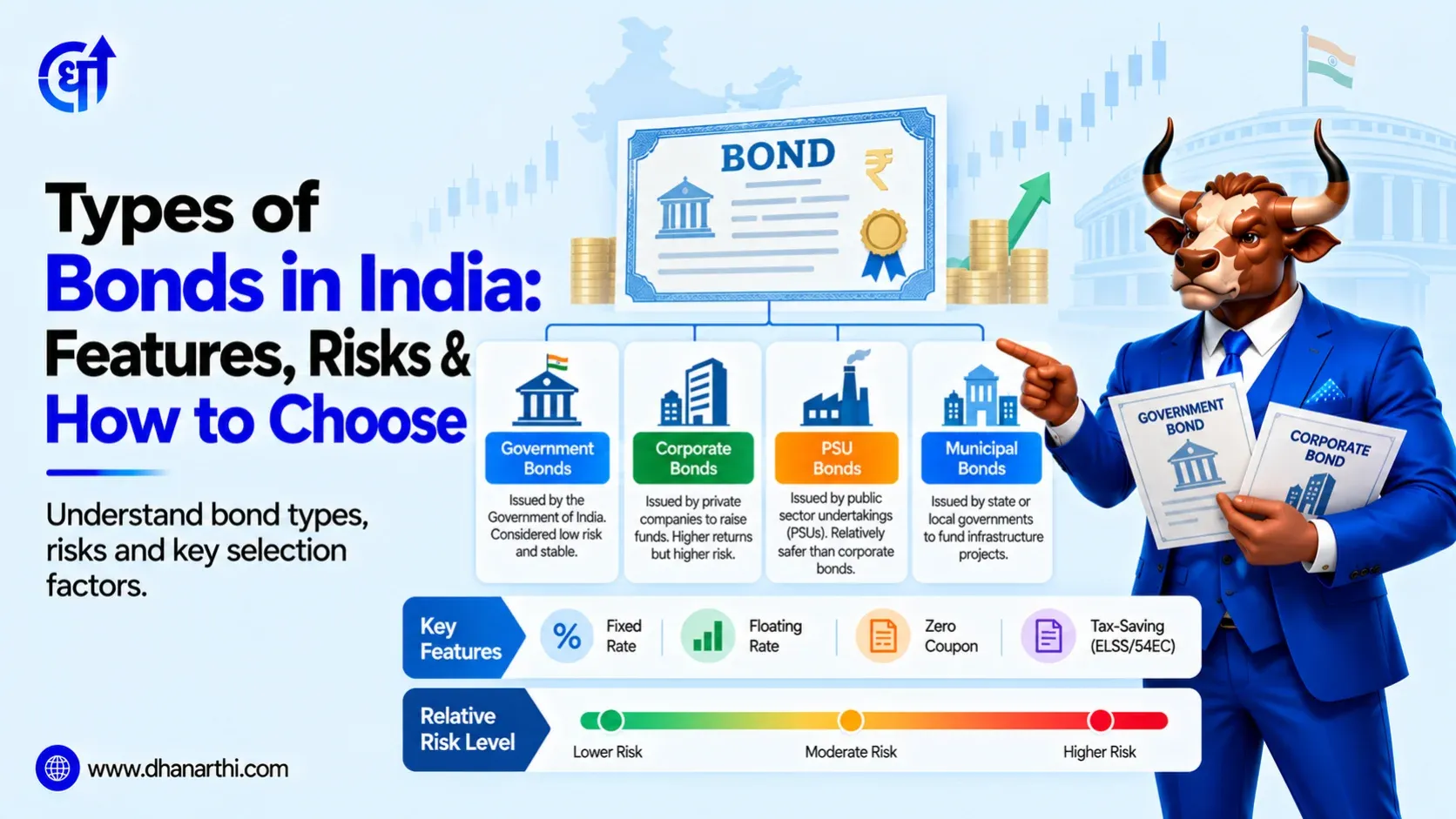
Bonds in India are a handful of core types based on who issues them (government, PSU, or corporate). Also understand how they pay interest (fixed, floating, or zero-coupon) and what special features they carry. The right type depends on your investment horizon, tax bracket, and how much credit and interest rate risk you’re willing to accept, or which bond currently advertises the highest coupon.
Bonds are classified in four ways, which are demonstrated as by issuer, by interest structure, by special features, and by tax treatment; also, a single bond often sits in more than one category.
Government securities and T-bills carry the lowest credit risk in India, while corporate bonds and perpetual bonds carry meaningfully more.
India’s 10-year G-sec yield stood at 7.11% as of 25 September 2026; that gives a live India benchmark against which every other bond's coupon should be compared.
Prices of bonds are generally related to the level of interest rates, but in the opposite direction. The longer the term of the bond, the more it falls in price with a rise in rates. A bond with a 20-year maturity, for instance, will drop almost 10% in price if rates rise 1 percent. But a 3-year bond will only lose about 2.6%.
Perpetual bonds, also known as AT1 bonds, carry a real risk of losing your entire investment. This risk was seen in March 2020 when Yes Bank's ₹8,415 crore AT1 bonds were written down to zero. The legal dispute over this write-off was still before the Supreme Court as of mid-2026.
Bond taxation depends on several factors, not simply on the bond's name. The tax treatment can vary based on whether the bond is listed, how long you hold it, and whether your return comes from interest income or a capital gain.
To judge whether a bond offers an attractive return, compare its coupon with the current risk-free G-Sec yield. Using a fixed benchmark from a different interest-rate cycle can give you a misleading picture of how attractive the bond really is.
Research Stocks Smarter with Dhanarthi AI Screener
Analyze 5,000+ NSE & BSE stocks with 150+ custom filters, real-time volume breakout scans, and transparent fundamental data.
Use Dhanarthi Screener
A bond is a debt instrument issued by a government, PSU, or corporation to raise funds. It offers a fixed rate of interest and repayment of the borrowed amount on maturity.
The face value of a bond is the amount that is returned to the bondholder on maturity. The coupon rate is the rate at which the bond issuer pays interest to the bondholder on the face value of the bond. Yield to maturity is the total return anticipated by an investor of a bond if the bond is held until it matures.
The yield to maturity may turn out to be different from the coupon rate if the bond is bought at a discount or premium.
The types of bonds can be classified in various ways depending upon who has issued them, how they pay interest, any special features or risks attached, and their taxability.
There are certain bonds that fall under more than one category. For example, a tax-free bond issued by a public sector undertaking (PSU) has elements of both types of issuer and taxability.
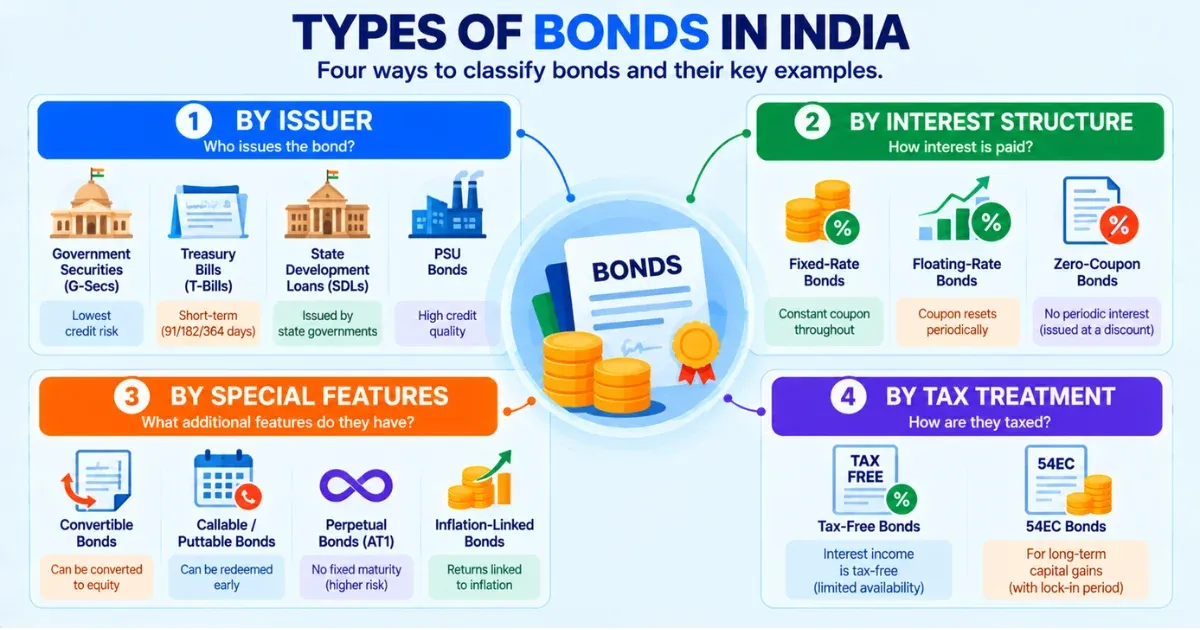
There is no right or wrong in terms of the count, as it depends on the lens through which you look at it. The table below attempts to list the different types across various lenses and has a practical take on whether individual retail investors in India can buy them today or not.
| Classification | Examples | Can a Retail Investor Buy This? |
|---|---|---|
| By issuer | G-Secs, T-bills, SDLs, PSU bonds, corporate bonds, municipal bonds | Yes, for most; municipal bonds have limited retail availability |
| By interest structure | Fixed-rate, floating-rate, zero-coupon | Yes |
| By special feature | Convertible, callable/puttable, perpetual (AT1), inflation-linked | Yes, though perpetual bonds are aimed at more risk-tolerant investors |
| By tax treatment | Tax-free bonds, 54EC capital gains bonds | Only in the secondary market for tax-free bonds; 54EC bonds require a qualifying capital gain |
Government Securities (G-Secs) are the medium- and long-term bonds issued by the government and are considered to have the least credit risk as they are backed by the government, which reduces default risk.
Treasury Bills (T-Bills) are the short-term government securities that mature within 91, 182, or 364 days, and do not pay periodic coupons but are instead issued at a discount to the face value. State Development Loans (SDLs) are similar to G-Secs but are issued by individual states and carry a yield slightly higher than government securities on account of increased risk.
PSU Bonds are issued by public sector undertakings like REC, PFC, NHAI, IRFC, etc., which usually have an implicit government guarantee, thus having good credit ratings but providing only a small excess return over purely government-issued G-Secs.
Corporate Bonds are issued by private entities and have a very wide credit spectrum ranging from AAA-rated entities to highly risky issues with low credit ratings; yields vary according to the creditworthiness of the issuer.
Municipal Bonds are issued by municipal authorities to raise money for infrastructure development within urban areas. This category comprises a small segment of the overall bond market in India and also has a very limited retail presence as compared to the other bond categories mentioned above.
Understanding where bonds sit relative to other financial instruments is easier alongside a broader view of how the money market compares to the capital market, since T-bills and G-Secs technically straddle both, depending on their maturity.
Fixed-rate bonds provide a fixed coupon for their lifetime, which makes the payment stable but leaves the holder exposed to interest rate risks.
Meanwhile, floating-rate bonds change the coupon rate on a regular basis, which negates the interest rate risks but makes the payments unstable. For example, RBI’s very own Floating Rate Savings Bond 2020 (Taxable) has a coupon that resets every 6 months based on the National Savings Certificate rate.
This means the coupon is not fixed at any point and moves along with the broader interest rates while still having a 7-year lock-in period and no liquidity until then.
Zero-coupon bonds do not pay any coupons throughout their life. Instead, these bonds offer a discount on the par value and pay the holder the full amount upon maturity. These bonds are suitable for individuals who want to receive a lump-sum payout after a certain period rather than receiving income during the period.
Convertible bonds are generally issued by corporates and give the option to the holder to convert the bond into a specified number of equity shares which in turn offer upside if the issuer's stock performs well, while paying interest in the meantime
Callable bonds, on the other hand, allow the issuer to redeem the bonds early, especially when the prevailing interest rates drop, allowing the issuer to refinance by issuing new bonds with the lower interest rate, which is a negative aspect from the bondholders' point of view.
Perpetual bonds are most commonly issued by India’s banking sector as additional Tier 1 (AT1) bonds and have no maturity date, typically containing loss-absorption terms that can be triggered if the issuing bank reaches a certain capital threshold.
Inflation-linked bonds, such as the government’s occasionally issued Capital Indexed Bonds, have a variable coupon or principal dependent on a specified inflation index, which serves to protect the value of the investment over time against inflation, unlike regular bonds.
Tax-free bonds issued in the past by entities like NHAI, PFC and IRFC offer interest, which is exempt from income tax in the hands of the investor. There have been no fresh tax-free bonds issued in recent times, and hence one can only invest in the secondary market for tax-free bonds and not through a public issue.
The capital gains bonds have been substituted with the new Section 54EC in the I-T Act with effect from April 1, 2026. These bonds allow an investor to claim exemption from long-term capital gains tax on the sale of his residential property by investing the gains in bonds issued by REC, PFC and IRFC, which would have a maximum maturity period of 5 years and a lock-in period of 6 months.
The bonds on average offer a coupon of around 5.0-5.25%, which is lower compared to the yields on Government securities since the main attraction of these bonds is the tax benefit, which is available under section 54EC. However, it may be noted that the interest income from these bonds would be taxed at the applicable slab rates.
Bond selection is not a singular exercise, but rather a choice at different points in the rate cycle depending on where rates are and where they are potentially headed. On 25 September 2026, India's 10-year G-Sec yield was at 7.11% or 0.6 percentage points above the level a year ago, after the rate-cutting cycle of the RBI in 2025 that saw the repo rate cut from 6.50% to 5.25%.
With retail inflation at 4.82% in August 2026, a rate increase at the early-October Monetary Policy Committee meeting was a possibility, an upside risk for bond investors.
A portfolio that is expected to perform best when rates are rising should have maximum exposure to shorter maturities and floating rate bonds.
On the other hand, when rates are expected to fall (as at the end of 2025), longer maturity fixed-rate bonds should have a larger allocation as their price appreciation potential is higher for a given decline in yields.
The table below shows the sensitivity to price changes for a bond priced at par with a 7% coupon (for illustration only)
| Bond Maturity | Price Change if Yields Rise 1 Point | Price Change if Yields Fall 1 Point |
|---|---|---|
| 3 years | Approximately -2.6% | Approximately +2.7% |
| 5 years | Approximately -4.0% | Approximately +4.2% |
| 10 years | Approximately -6.7% | Approximately +7.4% |
| 20 years | Approximately -9.8% | Approximately +11.5% |
The pattern is the same, regardless of which particular coupon you examine: longer maturities mean greater price sensitivity to changes in rates in either direction, which is precisely why in this current climate of uncertainty, maturity selection (and not just credit quality) can be an active decision rather than an afterthought.
Interest rate risk is the price sensitivity of a bond reflected in the given figure below. Bonds with a longer period till maturity are more sensitive to changes in yield. The price of bonds changes when there is a change in yields; it drops when yields increase and increases when yields decrease.
Credit risk arises when the issuing company defaults on its obligations to pay back the bondholders. Credit rating agencies like CRISIL, ICRA, CARE, and others give credit ratings to bonds based on their risk profile. These ratings range from AAA, indicating bonds with the highest degree of safety, down to lower grades.
Liquidity risk is the risk of holding onto a bond before maturity because the holder would have to sell the bond at a greatly discounted price. Government securities and large corporate issues have better liquidity than ordinary corporate bonds.
Structural risk is particular to specific bond features and can be understood using a real, unresolved example.
In March 2020, Yes Bank wrote off the entire Rs 8,415 crore of its Additional Tier 1 (AT1) bonds as part of its RBI-led reconstruction. Its own equity shareholders were left with something, even as the bank continued to exist, while bondholders were wiped out, an outcome surprising to many investors who thought of AT1 bonds as a safer alternative to pure equity.
The Bombay High Court annulled this write-off in January 2023, but the issue was referred to the Supreme Court, which had reserved its verdict as of May 2026 so the fate of the affected bondholders was still legally uncertain more than six years after the write-off. Given that Indian banks have issued well over Rs 1 trillion in ATI bonds since then, this is a real-world illustration of the structural risk embedded in perpetual, loss-absorbing bonds, which are different to a vanilla government/PSU bond, attractive coupon notwithstanding.
| Credit Rating Band | General Meaning |
|---|---|
| AAA | Highest safety, lowest credit risk |
| AA | High safety, very low credit risk |
| A | Adequate safety, low credit risk |
| BBB | Moderate safety, moderate credit risk |
| Below BBB | Speculative to high credit risk |
Bond taxation is determined by three factors: whether the bond is listed, the length of time held by the investor, and whether the taxpayer is reporting interest income or realizing a capital gain from sale before maturity.
For listed bonds, a sale after more than one year of holding is subject to long-term capital gains tax of 12.5% (no indexation), while a sale within one year is taxed as a short-term capital gain at the investor's slab rate. This mirrors the broader STCG and LTCG framework that applies across most listed securities in India.
Unlisted bonds & debentures are taxed differently since the Finance (No. 2) Act, 2024 introduced Section 50AA with effect from 23 July 2024. Gains from unlisted bonds & debentures are now considered as short-term capital gains and taxed at the investor's slab rate, regardless of the period of holding. This eliminates the long-term capital gains tax advantage for unlisted bonds & debentures.
The income in the form of interest received from any bond (listed or unlisted) shall be added to the total income of the investor and taxed at applicable slab rates, except tax-free bonds, which are exempt from tax on interest.
| Bond Category | Interest Taxation | Capital Gains Taxation |
|---|---|---|
| Listed bonds (held over 12 months) | Slab rate | 12.5% LTCG, no indexation |
| Listed bonds (held 12 months or less) | Slab rate | Slab rate (STCG) |
| Unlisted bonds/debentures | Slab rate | Slab rate, deemed short-term regardless of holding period (Section 50AA) |
| Tax-free bonds | Exempt | Follows listed bond capital gains rule above |
The right bond depends on your time horizon, your tolerance for credit risk, your tax situation, and your outlook on interest rates.
An investor in a high tax bracket who has existing tax-free bonds in the secondary market will benefit from the tax exemption more than an investor in a low tax bracket.
An investor who is unsure about the direction of rates, as most investors are in the current market environment, will be inclined to favor shorter maturity or floating rate bonds over fixed-rate bonds.
An investor who needs to defer capital gains taxes when selling property has only one viable option: the 54EC bonds, regardless of their yield.
| Investor Goal | Bond Type to Consider |
|---|---|
| Maximum safety, short horizon | T-bills, short-term G-Secs |
| Steady income, moderate risk | PSU bonds, high-rated corporate bonds |
| Protection from rising rates | Floating-rate bonds, RBI Floating Rate Savings Bond |
| Tax-efficient income (existing holdings) | Tax-free bonds (secondary market) |
| Capital gains deferral after property sale | 54EC-eligible bonds (REC, PFC, IRFC) |
| Higher yield, higher risk tolerance | Lower-rated corporate bonds, AT1/perpetual bonds |
Retail investors can directly and freely access government securities through the RBI Retail Direct scheme. The scheme allows retail investors to open a Retail Direct Gilt Account and trade Government Securities, Treasury Bills (T-Bills), and State Development Loans (SDLs) in both the primary and secondary markets.
Listed corporate and PSU bonds can be bought through a regular demat and trading account on the exchange, the same account used for buying stocks. The RBI Floating Rate Savings Bond, by contrast, is bought directly through specified banks and cannot be traded on an exchange once purchased, reflecting its non-tradable, buy-and-hold structure.
Comparing a bond's coupon to an outdated benchmark: Judging a bond's yield against a rate environment from years ago rather than today's actual G-Sec curve.
Treating perpetual bonds as equivalent to fixed-maturity bonds: Overlooking the structural loss-absorption risk perpetual AT1 bonds carry, as demonstrated by the Yes Bank case.
Ignoring the unlisted bond tax trap: Assuming a long holding period automatically earns favourable LTCG treatment, when unlisted bonds and debentures are taxed as deemed short-term gains regardless of holding period under Section 50AA.
Chasing yield without checking credit rating: Being drawn to a high coupon on a lower-rated corporate bond without weighing the meaningfully higher credit risk behind that yield.
Locking into long-duration fixed-rate bonds during rate uncertainty: Committing to a long-dated bond without considering how much its price could fall if rates move higher than expected.

Confused about chart patterns & stock analysis?
Use
Dhanarthi Stock Guru
to chat, analyze price patterns, and ask questions directly.
India's bond market offers a range of types to choose from, from government securities and PSU and corporate bonds, to floating and zero-coupon structures, and convertible and perpetual varieties, and even tax-saving 54EC bonds, to suit differing needs of risk, time-horizon and tax-slabs.
With India's 10-yr G-Sec yield at 7.11% and a truly uncertain rate cycle ahead going into the RBI's early October review, it's as important to look at a bond's maturity-based price sensitivity and the issuer's credit rating as its coupon.
The unresolved Yes Bank AT1 issue serves as a sobering reminder that not all bonds carry the same risks, and picking the right type begins with understanding which risks you are compensated for taking on.
India 10 Year Bond Yield. Trading Economics, citing government bond market data, September 2026.
Yes Bank AT-1 bonds case: Supreme Court reserves verdict. Moneycontrol, May 2026.
Income-tax Act, 2025. Government of India, effective 1 April 2026.
Disclaimer: This article is for educational purposes only. It does not constitute investment advice. Please consult a SEBI-registered financial advisor before making investment decisions.
1. What are the main types of bonds in India?
The main types include government securities, treasury bills, state development loans, PSU bonds, corporate bonds, and municipal bonds by issuer, plus fixed-rate, floating-rate, and zero-coupon bonds by interest structure.
2. How many types of bonds are there?
There is no single fixed count, bonds can be classified by issuer, interest structure, special features, or tax treatment, and a single bond often falls into more than one category at once.
3. Which bond is safest in India?
Government securities and treasury bills are generally considered the safest, since they carry sovereign backing and the lowest credit risk compared to PSU, corporate, or perpetual bonds.
4. What is the difference between G-Secs and T-bills?
G-Secs are medium- to long-term government bonds paying periodic interest, while T-bills are short-term instruments with maturities up to 364 days, sold at a discount to face value with no periodic coupon.
5. How are bonds taxed in India?
Interest income from bonds is taxed at the investor's slab rate. Listed bonds held over 12 months attract 12.5% LTCG tax without indexation, while unlisted bonds and debentures are taxed as deemed short-term gains at slab rate regardless of holding period.
6. What happened to Yes Bank's AT1 bonds?
Yes Bank wrote down Rs 8,415 crore of AT1 bonds to zero in March 2020 during its reconstruction. The Bombay High Court quashed this write-off in 2023, and the matter remained before the Supreme Court as of mid-2026.
7. What happens to bond prices when interest rates rise?
Bond prices fall when interest rates rise, and the fall is larger for longer-maturity bonds, a 20-year bond can lose close to 10% in price for a 1-percentage-point rise in yields, compared to roughly 2.6% for a 3-year bond.
8. How do I buy government bonds in India?
Retail investors can buy government securities directly and free of charge through the RBI Retail Direct scheme, or access listed corporate and PSU bonds through a regular demat and trading account.
9. What is a perpetual bond?
A perpetual bond has no fixed maturity date and, in the Indian context, most commonly refers to bank-issued Additional Tier 1 (AT1) bonds, which carry loss-absorption features that can be triggered if the issuing bank's capital position weakens.
10. Are tax-free bonds still available in India?
No fresh tax-free bonds have been issued in recent years, so exposure to this category today generally comes through buying existing issues in the secondary market rather than a new public offer.
11. What is a 54EC bond used for?
54EC-eligible bonds, issued by REC, PFC, and IRFC, let an investor defer long-term capital gains tax from a property sale by reinvesting up to Rs 50 lakh within six months, subject to a 5-year lock-in, though the interest earned remains fully taxable.
12. Should I choose a fixed-rate or floating-rate bond right now?
This depends on your view of interest rates, floating-rate bonds carry less price risk if rates are expected to rise, while long-dated fixed-rate bonds benefit more if rates are expected to fall, making the choice genuinely dependent on the current rate outlook.
Share Market
IPO
Artificial Intelligence
Semi Conductor