




CAGR: Meaning, Formula, Calculator and Examples
June 16, 2026

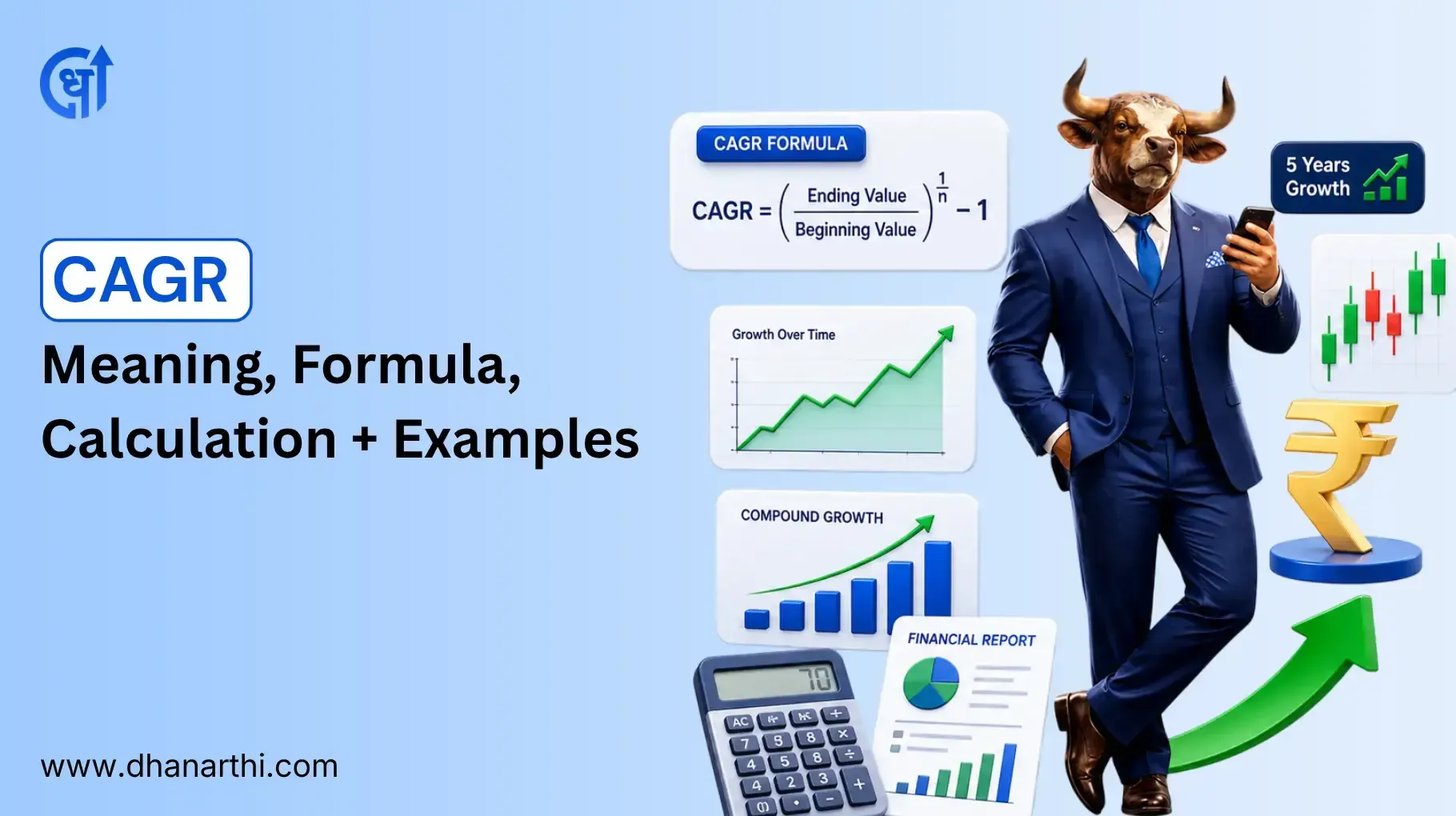
TABLE OF CONTENTS
Get an AI Summary of This Post Using The Tools Below.





CAGR (Compound Annual Growth Rate) is the annual rate at which an investment grows from its starting value to its ending value, assuming profits compound every year. It is calculated as (Ending Value / Beginning Value) raised to the power of (1 / number of years), minus 1. CAGR smooths out yearly ups and downs into one number.
Most investors confuse CAGR with simple average return. They are not the same. Many beginners search "what is CAGR growth rate" expecting a simple percentage, but it is really a smoothed annual rate that strips out year-to-year noise. If you want to know how fast your money actually grew each year, on a compounding basis, CAGR is the metric you need. This guide covers the CAGR formula, a step-by-step calculation example, how to compute CAGR in Excel, and the most common mistakes Indian investors make while using it. For a wider view of how CAGR fits with other metrics, see this guide on financial ratio analysis.
CAGR stands for Compound Annual Growth Rate. The simplest CAGR definition: it tells you the constant annual rate at which an investment would have grown, year after year, to move from its starting value to its ending value.
Real investments rarely grow at a fixed rate every year. One year a stock might rise 30%, the next year it might fall 10%. CAGR ignores these swings and gives you a single smoothed-out annual rate.
This makes CAGR useful for:
Comparing two stocks or mutual funds over the same time period
Measuring a company's revenue or profit growth across multiple years
Setting realistic return expectations for long-term goals
The compound annual growth rate formula is:
CAGR = (Ending Value / Beginning Value) ^ (1 / Number of Years) − 1
Each term in the formula has a specific meaning:
| Term | Meaning |
|---|---|
| Ending Value | Value of the investment at the end of the period |
| Beginning Value | Value of the investment at the start of the period |
| Number of Years | Total duration over which growth is measured |
Divide the ending value by the beginning value. Raise that result to the power of one divided by the number of years. Subtract one from the final figure. Multiply by 100 to express it as a percentage.
CAGR calculation needs only three inputs: beginning value, ending value, and number of years. Here is the process:
Divide the ending value by the beginning value
Raise the result to the power of (1 ÷ number of years)
Subtract 1 and multiply by 100 to get the percentage
Worked example: Suppose you invested Rs 1,00,000 in a stock, and it grew to Rs 1,44,000 in 3 years.
CAGR = (1,44,000 / 1,00,000) ^ (1/3) − 1 CAGR = (1.44) ^ (0.333) − 1 CAGR ≈ 0.1299, or 12.99%
This means your investment grew at an average annual rate of roughly 13% over the 3-year period, even though the actual year-to-year growth may have varied.
Real index example: Over the past 10 years through 2025, the Nifty 50 has delivered roughly 12% CAGR, while the broader Nifty Next 50 index has historically delivered a higher CAGR with greater volatility (Source: NSE-linked index data, 2025). This is the kind of comparison CAGR is built for: stripping out yearly noise to show the real annualized growth rate.
If you have searched "what is CAGR formula in Excel," the short answer is that Excel does not have a built-in "CAGR" function, but you can calculate it using the POWER function or the RRI function.
Using POWER function:
=(Ending Value/Beginning Value)^(1/Number of Years)-1
Using RRI function (simpler):
=RRI(Number of Years, Beginning Value, Ending Value)
For example, if Rs 10,000 grew to Rs 18,000 in 5 years, entering =RRI(5,10000,18000) returns the CAGR directly as a decimal, which you then format as a percentage.
The RRI function is faster because it needs no manual exponent calculation. If you prefer not to build formulas yourself, the CAGR calculator on Dhanarthi gives you the same result instantly by entering just the beginning value, ending value, and number of years.
Numbers from an actual company filing make CAGR easier to understand than a generic example.
Infosys reported a net profit of Rs 6,806 crore in Q3 FY25 (Source: BSE filing, Q3 FY25). Looking at full-year net profit, Infosys posted Rs 24,108 crore in FY22 and Rs 26,233 crore in FY25 (Source: Infosys annual financial statements, BSE filings).
Applying the CAGR formula over this 3-year period:
CAGR = (26,233 / 24,108) ^ (1/3) − 1 ≈ 2.85%
This shows Infosys's net profit grew at an annualized rate of roughly 2.85% between FY22 and FY25, far slower than its revenue growth in earlier years. A single year's profit jump or dip would not reveal this trend. CAGR does, because it smooths the entire period into one annualized figure.
A "good" CAGR depends entirely on what you are comparing it to. A 12% CAGR sounds attractive for a fixed deposit but average for a small-cap fund.
| Asset Class | Approx. CAGR (Long-Term) | Period | Source |
|---|---|---|---|
| Nifty 50 (TRI) | 12% to 13% | 20 to 25 years | NSE Nifty 50 data, as of Feb 2026 |
| Gold | 11% to 14% | 20 years | AMFI-linked commodity data |
| Bank Fixed Deposits | 6% to 7% | 20 years | RBI deposit rate trends |
| Nifty Next 50 | 14% to 15% | 10 years (through 2025) | NSE-linked index data |
Data sourced from NSE, AMFI, RBI. Last updated: June 2026.
Mature, large companies typically deliver 3% to 5% CAGR in revenue over five years. Growth-stage companies often target 10% to 20% CAGR, while early-stage businesses may aim for 50% or higher. The right benchmark always depends on the company's size, sector, and stage.
These three metrics answer different questions, and using the wrong one gives a misleading picture of returns.
| Metric | Best Used For | Accounts for Time? | Accounts for Multiple Cash Flows? |
|---|---|---|---|
| Absolute Return | Investments under 1 year | No | No |
| CAGR | Lump-sum investments over multiple years | Yes | No |
| XIRR | SIPs and investments with multiple inflows/outflows | Yes | Yes |
If you invested a lump sum and want one number to describe its annual growth, CAGR is correct. If you invest through monthly contributions, like a SIP vs lumpsum comparison would show, CAGR understates the real picture because it assumes a single investment date. XIRR is the right tool for staggered investments since it accounts for the exact date and amount of every instalment.
Quick rule: Absolute return for under 1 year. CAGR for a single lump-sum investment held for multiple years. XIRR for SIPs or any investment with multiple transaction dates.
Most calculation errors come from applying CAGR where it does not belong.
Using CAGR for SIP returns. SIPs involve monthly cash flows at different dates. CAGR assumes one lump-sum entry, so it gives a distorted figure. Use XIRR instead.
Ignoring fractional years. Calculating CAGR using whole years only, when the actual holding period is 2.5 or 3.7 years, skews the result. Always use the precise time period.
Treating CAGR as a guaranteed future return. A stock's past 5-year CAGR of 18% does not mean it will repeat that rate going forward. CAGR is historical, not predictive.
Confusing CAGR with year-on-year growth. CAGR is a smoothed average. The actual year-to-year growth could have been wildly different even with the same starting and ending values.
CAGR is useful, but it hides important details about how an investment actually behaved.
It assumes growth happened at a constant rate every year, when in reality returns fluctuate. It also ignores volatility entirely. CAGR ignores volatility and implies that growth was steady and evenly split among all years, which can understate the actual risk an investor took on.
CAGR can also be negative. If a stock falls from Rs 100 to Rs 60 over 3 years, the CAGR works out to roughly -15.9%, signaling an average annual decline rather than growth. A negative CAGR is harder to recover from than a same-sized positive CAGR is to achieve, since losses shrink the base that future gains need to compound from.
CAGR becomes far more useful when you can screen entire markets by it instead of calculating it stock by stock.
Use the dhanarthi stock screener to filter all NSE-listed stocks by 5-year CAGR above 15% and cross-check the result against the company's P/E ratio to avoid overpaying for that growth.
CAGR remains the most reliable way to compare lump-sum investments across different time periods. It strips out yearly noise and gives you one annualized number, whether you are checking a stock's growth, a mutual fund's performance, or a company's profit trend. Just remember its limits: use XIRR for SIPs, and never treat a past CAGR as a guaranteed future return.
Disclaimer: This article is for educational purposes only. It does not constitute investment advice. Please consult a SEBI-registered financial advisor before making investment decisions.
1. What is CAGR in simple words?
CAGR is the average annual rate at which an investment grows, assuming the growth compounds every year. It smooths out year-to-year ups and downs into one consistent number, making it easier to compare two different investments.
2. What is the formula for CAGR?
CAGR = (Ending Value / Beginning Value) ^ (1 / Number of Years) − 1. You divide the ending value by the beginning value, raise it to the power of 1 divided by the number of years, then subtract 1.
3. How do you calculate CAGR in Excel?
Use the RRI function: =RRI(Number of Years, Beginning Value, Ending Value). Alternatively, use the POWER function: =(Ending Value/Beginning Value)^(1/Number of Years)-1. Both return the same result.
4. What is CAGR full form?
CAGR full form is Compound Annual Growth Rate. It measures the annualized growth of an investment, business metric, or financial figure over a specific multi-year period.
5. What is a good CAGR percentage?
For large, mature companies, 3% to 5% CAGR over 5 years is considered solid. Growth-stage companies often deliver 10% to 20% CAGR. For Indian equity indices like the Nifty 50, a long-term CAGR of 12% to 13% is the historical benchmark.
6. Is CAGR the same as average annual return?
No. A simple average adds up each year's percentage return and divides by the number of years. CAGR accounts for compounding, which gives a more accurate picture, especially when returns vary significantly from year to year.
7. Can CAGR be negative?
Yes. A negative CAGR means the investment's ending value is lower than its beginning value. For example, a stock falling from Rs 100 to Rs 60 over 3 years has a CAGR of roughly -15.9%, reflecting an average annual decline.
8. What is the difference between CAGR and XIRR?
CAGR assumes a single lump-sum investment made at one point in time. XIRR accounts for multiple cash flows at different dates, such as SIP instalments. Use CAGR for lump sums and XIRR for SIPs or staggered investments.
9. What is CAGR used for in the stock market?
CAGR is used to compare the annualized growth of two or more stocks, evaluate a company's revenue or profit trend over multiple years, and assess mutual fund performance over a fixed holding period.
10. Does CAGR account for risk or volatility?
No. CAGR only uses the beginning value, ending value, and number of years. It ignores how much the investment fluctuated in between, so two investments with the same CAGR can carry very different levels of risk.
Share Market
IPO
Artificial Intelligence
Semi Conductor