





Best Banking Stocks in India 2026
October 26, 2026



TABLE OF CONTENTS
Get AI Summary





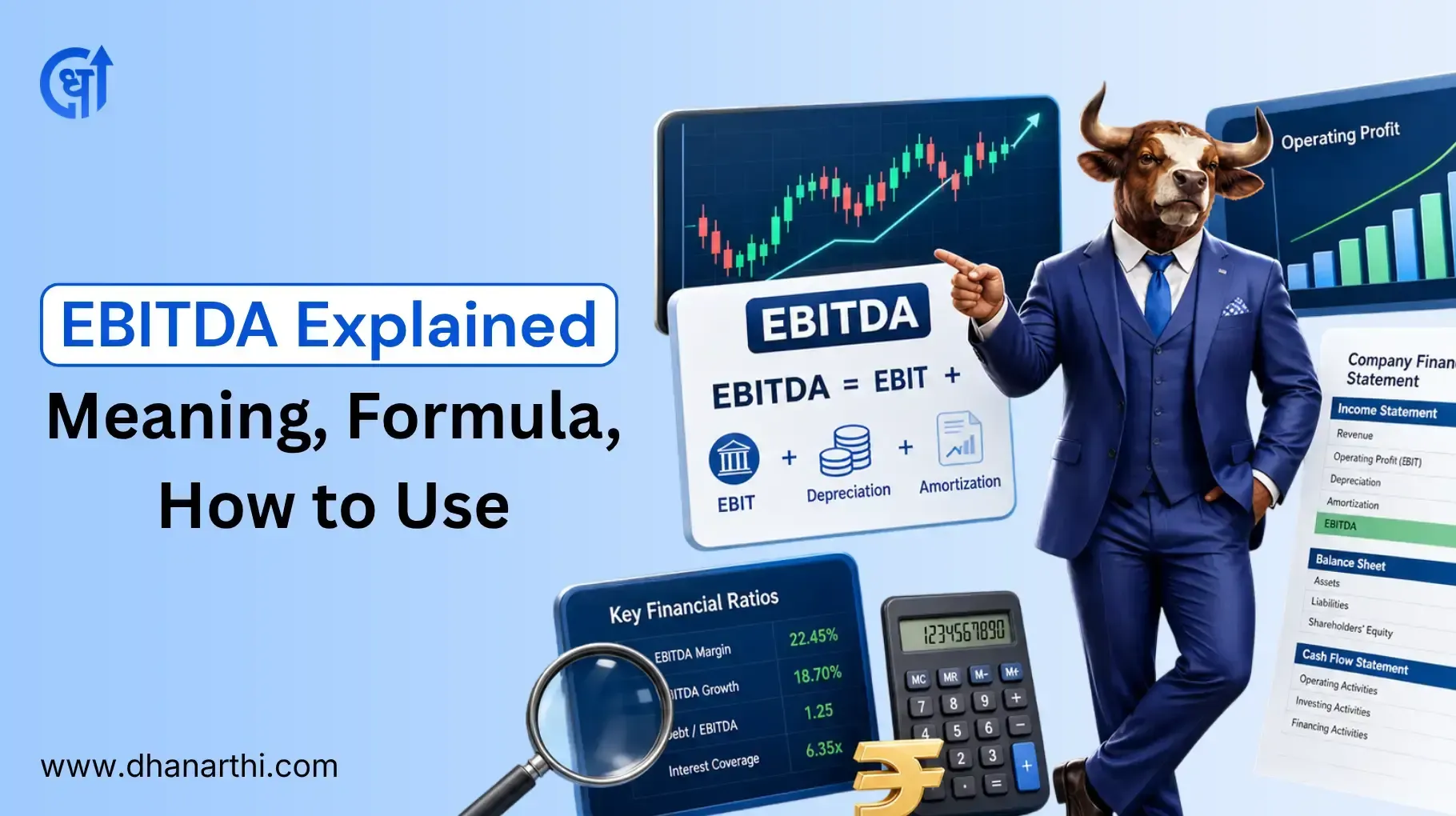
EBITDA stands for Earnings Before Interest, Taxes, Depreciation, and Amortization. It measures how much profit a company generates from its core operations, before accounting for financing costs, tax, and non-cash charges. Indian investors use EBITDA to compare operational profitability across companies in the same sector, without distortions from debt levels or accounting policies.
When analyzing Indian stocks, reading only net profit gives an incomplete picture. Two companies can show the same net profit but have very different business strengths. EBITDA strips away the noise of interest costs, taxes, and non-cash charges to show what the core business actually earns. This article explains EBITDA's full form, both calculation formulas, how to read it in a real Indian company's financial statement, and when not to use it. For a broader view of how EBITDA fits into financial ratio analysis, see Dhanarthi's complete guide on the topic.
Each letter in EBITDA represents a specific item from the income statement:
E: Earnings (net profit before adjustments)
B: Before
I: Interest (finance costs on loans and borrowings)
T: Taxes (income tax paid to the government)
D: Depreciation (annual reduction in value of physical assets like machinery, buildings)
A: Amortization (annual reduction in value of intangible assets like patents, software licenses)
By adding back these four items to net profit, EBITDA isolates what the business earns purely from its operations.
Formula 1: Starting from Net Profit:
EBITDA = Net Profit + Interest Expense + Taxes + Depreciation + Amortization
Formula 2: Starting from Operating Profit (EBIT):
EBITDA = Operating Profit (EBIT) + Depreciation + Amortization
Formula 2 is faster. Indian company income statements (prepared under Ind-AS) show "Operating Profit" or "Profit Before Interest and Tax" directly. Add depreciation and amortization from the notes to accounts, and you have EBITDA.
Both formulas produce the same result. Use Formula 1 when working from the bottom of the P&L. Use Formula 2 when the company clearly discloses operating profit.
Here is how to calculate EBITDA using Infosys's FY25 consolidated income statement (Source: Infosys Investor Relations, IFRS P&L Data, FY25).
Infosys reported an operating profit of Rs 34,424 crore for FY25, on revenue of Rs 1,62,990 crore. The finance cost for FY25 was Rs 416 crore. Depreciation and amortization for FY25, as reported separately in the company's financial disclosures, were approximately Rs 3,200 crore (derived from cash flow and operating margin data; Infosys IFRS operating margin 21.1% on Rs 1,62,990 crore revenue = Rs 34,391 crore operating profit; D&A is added to arrive at EBITDA).
For a clean illustration using the published figures:
| Financial Item | FY25 Amount (Rs Crore) |
|---|---|
| Revenue from Operations | 1,62,990 |
| Operating Profit (EBIT) | 34,424 |
| Add: Depreciation and Amortization | ~3,200 |
| EBITDA | ~37,624 |
| EBITDA Margin | ~23.1% |
Source: Infosys Consolidated P&L, Infosys Investor Relations (IFRS basis), FY25. D&A is approximate based on disclosed cash flow data.
This means that for every Rs 100 of revenue Infosys earned in FY25, approximately Rs 23 was operating profit before interest, taxes, and non-cash charges.
EBITDA Margin = (EBITDA / Revenue) x 100
It tells you what percentage of revenue a company keeps as operating profit before financing and accounting items.
Example: If Company A has Rs 500 crore revenue and Rs 100 crore EBITDA, its EBITDA margin is 20%. If Company B has Rs 500 crore revenue but Rs 60 crore EBITDA, its margin is 12%. Company A keeps more from each rupee of sales.
A rising EBITDA margin over time shows the company is controlling costs better as it scales. A falling margin, even with growing revenue, signals rising operating expenses or pricing pressure.
This is where EBITDA becomes most useful. A 15% EBITDA margin is excellent in one sector and mediocre in another. Always compare within the same industry.
| Sector | Typical EBITDA Margin (India) | Representative Companies |
|---|---|---|
| IT Services | 22% to 27% | TCS, Infosys, Wipro |
| FMCG | 18% to 28% | HUL, ITC, Nestle India |
| Pharma | 20% to 30% | Sun Pharma, Dr. Reddy's |
| Cement / Infrastructure | 18% to 24% | UltraTech, ACC, L&T |
| Telecom | 35% to 50% | Bharti Airtel (high D&A inflates this) |
| Auto / Auto Ancillaries | 10% to 16% | Maruti Suzuki, M&M, Bosch India |
| Banking / NBFCs | Not applicable | EBITDA is not used for financials |
Data reference: CRISIL Research sector reports; company BSE filings, FY24-25.
Key investor insight: Telecom companies show high EBITDA margins because telecom infrastructure requires massive depreciation. The high EBITDA simply means depreciation is being added back. But the actual cash being spent on towers, spectrum, and fiber remains enormous. Bharti Airtel's net debt exceeded Rs 2 lakh crore in recent years. High EBITDA margin does not equal low risk here.
Banking and NBFCs are exceptions. EBITDA is not a meaningful metric for financial companies because interest income is their core revenue, not a financing cost. Use NIM (Net Interest Margin) and return on assets instead.
EBIT vs EBITDA is one of the most common points of confusion for beginner investors. EBITDA vs PAT is another. Here is how all three differ:
| Metric | Includes | Excludes | Best Used For |
|---|---|---|---|
| EBITDA | Revenue minus operating costs | Interest, Tax, Depreciation, Amortization | Comparing operational efficiency across companies |
| EBIT (Operating Profit) | Revenue minus operating costs and D&A | Interest, Tax | Profitability after accounting for asset wear |
| PAT (Net Profit) | All revenues minus all costs | Nothing | Final profit available to shareholders |
EBITDA is best when comparing two companies in the same sector with different debt levels or asset bases. It levels the playing field.
EBIT is better than EBITDA for asset-heavy businesses where depreciation is a real economic cost, not just an accounting entry.
PAT is what matters to shareholders ultimately. It reflects full financial reality, including debt costs and taxes.
A company can show strong EBITDA growth but declining PAT if interest costs are rising. Always check both.
EBITA meaning: Earnings Before Interest, Taxes, and Amortization. EBITA excludes amortization but keeps depreciation, unlike EBITDA, which removes both. Analysts use EBITA for asset-light businesses where depreciation is minimal, but intangible amortization (from acquisitions) distorts the picture.
EV/EBITDA is one of the most common valuation ratios used by professional investors and analysts.
Formula: EV/EBITDA = Enterprise Value / EBITDA
Enterprise Value (EV) = Market Capitalization + Total Debt minus Cash
It tells you how many rupees an investor pays for each rupee of a company's operational earnings.
A low EV/EBITDA relative to sector peers suggests potential undervaluation.
A high EV/EBITDA may reflect premium pricing or high growth expectations.
Sector-wise EV/EBITDA multiples vary widely. IT companies typically trade at 15x to 25x. Infrastructure companies may trade at 8x to 12x. Comparing across sectors using this ratio is not meaningful.
EV/EBITDA is widely used in M&A deals, private equity valuations, and by institutional investors on BSE/NSE to identify undervalued stocks.
No competitor explains this step clearly. Here is exactly how to do it using a BSE/NSE-listed company's filing.
Step 1: Go to the company's page on BSE (bseindia.com) or NSE (nseindia.com) and open the latest Annual Report or Quarterly Results PDF.
Step 2: Open the Standalone or Consolidated Statement of Profit and Loss (P&L).
Step 3: Find the line labeled "Profit Before Tax" (PBT) or "Profit Before Interest and Tax" (PBIT).
Step 4: Add back "Finance Costs" (interest on borrowings). This appears as a separate line item in Ind-AS format P&Ls.
Step 5: Add back "Depreciation and Amortization Expense." In Ind-AS P&Ls, this is a separate line in operating expenses or detailed in the Notes to Accounts.
Step 6: The result is EBITDA.
Most stock analysis tools display EBITDA directly, so you do not need to calculate it manually each time. Use the Dhanarthi stock screener to filter NSE-listed companies by EBITDA margin and compare sector peers in under 60 seconds. You can also use the Dhanarthi EBITDA Calculator to compute EBITDA from any company's reported figures.
EBITDA is useful but has real blind spots. Here are the specific situations where relying on EBITDA alone will mislead you:
EBITDA margins above 40% look impressive. But telecom requires constant capital expenditure on spectrum, towers, and fiber. EBITDA does not capture capex. Airtel's reported EBITDA margin was above 50% in recent quarters even as it carried over Rs 2 lakh crore in net debt. Always check free cash flow and net debt/EBITDA ratio alongside.
These companies run on project debt. Interest costs can be 8 to 12% of revenue. EBITDA ignores this entirely. A real estate company with Rs 500 crore EBITDA and Rs 600 crore in annual interest expense is not profitable at all. Check PAT and interest coverage ratio here.
Depreciation on large plants and machinery is a genuine economic cost, not just an accounting entry. A steel company replacing blast furnace equipment every 10 to 15 years faces real capex. EBITDA adds back depreciation, which can make a heavy maintenance-burden business look healthier than it is.
Some promoter-driven companies capitalize routine expenses as assets to inflate EBITDA. If a company's EBITDA grows but free cash flow does not follow, that is a warning sign.
The complete picture requires: EBITDA + Debt/EBITDA ratio + Free Cash Flow + PAT. No single metric is enough.
Adjusted EBITDA removes one-time, non-recurring items from standard EBITDA things like restructuring charges, legal settlements, or exceptional write-offs.
Companies report adjusted EBITDA to show a cleaner view of recurring operational For example, if Infosys books a one-time Rs 500 crore legal expense In FY25, adjusted EBITDA adds it back to reflect the underlying business trend.
Investor caution: Always check what has been adjusted. Some companies remove Expenses that recur every year under different labels are a red flag.
EBITDA answers one focused question: how efficiently does this company run its core operations? It is not a measure of final profitability, and it does not replace net profit or cash flow analysis. For Indian retail investors, EBITDA works best as a starting filter to compare companies within the same sector, track whether operational efficiency is improving or declining over time, and assess companies for EV/EBITDA-based valuation.
Use EBITDA with a sector benchmark in mind. Combine it with PAT, free cash flow, and debt levels before making any investment decision.
Disclaimer: This article is for educational purposes only. It does not constitute investment advice. Please consult a SEBI-registered financial advisor before making investment decisions.
1. What is EBITDA in simple terms?
EBITDA is the profit a company earns from its core business operations, before deducting interest on loans, income tax, and non-cash charges like depreciation and amortization. It shows whether the business itself is profitable, regardless of how it is financed or taxed.
2. What is the full form of EBITDA?
EBITDA stands for Earnings Before Interest, Taxes, Depreciation, and Amortization. Each component that is excluded is either a financing cost (interest, taxes) or a non-cash accounting charge (depreciation, amortization), not an operating cost.
3. How do you calculate EBITDA from an income statement?
Add back four items to net profit: interest expense, income tax, depreciation, and amortization. The formula is: EBITDA = Net Profit + Interest + Taxes + Depreciation + Amortization. You can also start from operating profit and add only depreciation and amortization.
4. What is a good EBITDA margin in India?
It depends on the sector. IT companies like TCS and Infosys typically post 22% to 27%. FMCG companies like HUL target 18% to 28%. Auto companies operate at 10% to 16%. A margin higher than the sector average generally signals better cost efficiency. Always compare within the same industry.
5. What is the difference between EBITDA and net profit (PAT)?
EBITDA excludes interest, taxes, depreciation, and amortization. Net profit (PAT) includes all four. EBITDA measures operational strength. PAT reflects what actually belongs to shareholders after all costs are paid. A company can have strong EBITDA but poor PAT if it carries heavy debt.
6. Is EBITDA the same as operating profit?
No. Operating profit (EBIT) deducts depreciation and amortization from revenue. EBITDA adds them back. EBITDA is always higher than EBIT. For asset-heavy businesses, the gap between the two is significant and matters for accurate valuation.
7. What does the EV/EBITDA ratio tell investors?
EV/EBITDA shows how many rupees investors pay for each rupee of a company's operational earnings. A lower ratio compared to sector peers may signal undervaluation. It is commonly used in mergers, acquisitions, and stock comparison within the same industry.
8. What are the limitations of EBITDA?
EBITDA ignores capital expenditure, so companies with heavy asset replacement needs look better than they are. It also excludes interest costs, hiding the burden of highly leveraged companies. It is not a GAAP-mandated metric, so companies can define it differently, making comparisons tricky.
9. What is adjusted EBITDA?
Adjusted EBITDA is EBITDA after removing one-time or non-recurring items such as restructuring costs, legal settlements, or exceptional gains. Companies report it to show a cleaner view of recurring operational performance. Investors should verify what has been adjusted and whether those adjustments are genuinely non-recurring.
10. Which Indian sectors have the highest EBITDA margins?
Telecom consistently reports the highest EBITDA margins (35% to 50%), but this is partly because of high depreciation being added back on expensive infrastructure. After telecom, pharma (20% to 30%) and FMCG (18% to 28%) typically report the strongest margins. IT services also remain above 22% for large players.
Share Market
IPO
Artificial Intelligence
Semi Conductor