


What Is ROCE? Meaning, Formula and Examples
October 2, 2026



TABLE OF CONTENTS
Get AI Summary






Fundamental analysis is a method of evaluating a stock by examining a company's financial statements, key ratios, and business fundamentals to estimate its true worth, called intrinsic value. Investors use it to decide whether a stock is undervalued or overpriced at its current market price. The three core documents used are the balance sheet, profit and loss statement, and cash flow statement.
As of 2025, India had 19.4 crore demat accounts, up from just 3.6 crore in 2019, according to SEBI. That is a fivefold increase in six years. Most of these investors are buying stocks for the first time, often based on tips, social media posts, or short-term price movements rather than the underlying financial health of a business.
Fundamental analysis changes that. It gives you a structured way to look at what a company actually earns, owes, and generates in cash before you put your money in. This article explains what fundamental analysis is, why it matters for Indian investors specifically, the key ratios and financial statements you need to understand, a step-by-step process to follow, and a real worked example using actual FY25 data. For a broader overview of the field, see this guide on financial analysis.
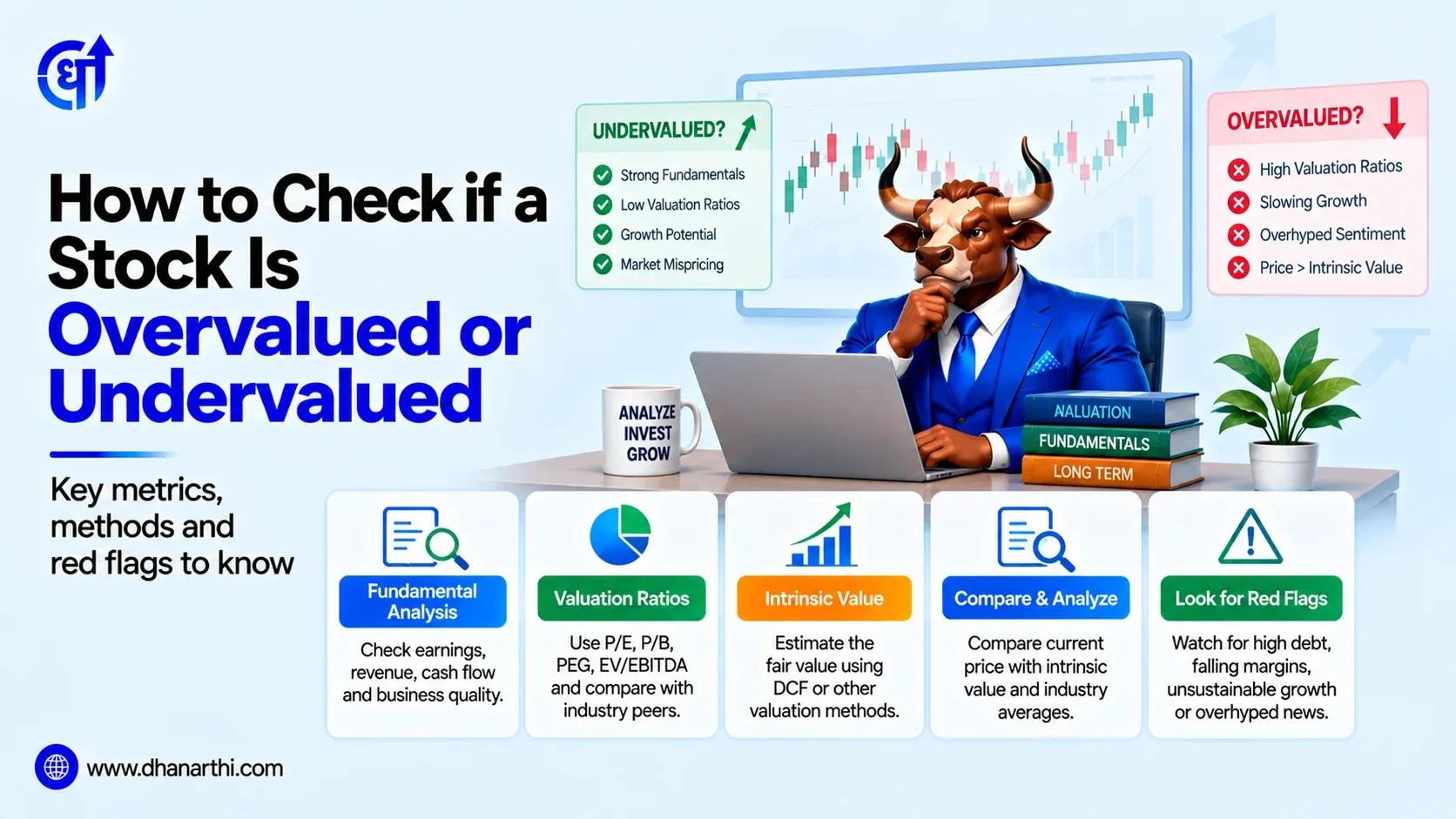
Fundamental analysis is the process of determining the true or intrinsic value of a stock by studying the underlying business, its revenues, profits, debts, competitive position, and growth potential. The core question it answers is: at today's price, is this stock worth buying?
A stock trades at a price set by market sentiment on any given day. That price can be higher or lower than what the company is actually worth based on its financials. Fundamental analysis is the tool that helps you figure out the difference. Legendary investors from Warren Buffett to the late Rakesh Jhunjhunwala built their fortunes by buying stocks that were priced below their intrinsic value and holding them as the market eventually corrected to reflect the business's real worth. This approach is suited to investors with a time horizon of three years or more, where business performance drives price rather than daily market noise.
India's NSE alone lists over 2,200 companies in its capital market segment. Combined with BSE listings, Indian investors have access to more than 5,000 publicly traded companies. Without a structured evaluation method, picking from this pool based on price alone is guesswork.
The numbers show why this matters. SEBI's data from 2025 confirms 19.4 crore demat accounts in India, with the registered investor base at NSE growing nearly threefold between March 2020 and early 2024. NSE data further shows retail investors consistently contribute upwards of 45% of daily cash market turnover. Yet a significant portion of this participation is driven by short-term momentum rather than business analysis.
Fundamental analysis is the filter that separates investing from speculating. It tells you whether a company's revenue is actually growing, whether profits are real or driven by one-off items, and whether the management is building value or destroying it. For a beginner in India, learning fundamental analysis is the single most important step toward making informed long-term investment decisions.
Fundamental analysis rests on two types of inputs. Most beginners focus only on the second. Both are necessary.
Qualitative analysis examines factors that cannot be captured in a number. This includes the quality of the business model: does the company sell something people will keep needing? It includes the promoter's track record, whether the founders have been consistent and transparent, and whether they have avoided regulatory trouble. It includes competitive positioning: Does the company have a moat, such as a strong brand, a cost advantage, or a technology barrier that competitors cannot easily cross?
One specific qualitative check that Indian retail investors often skip is promoter pledge data. SEBI mandates that promoters of listed companies disclose the percentage of their shareholding pledged as collateral for loans. High promoter pledging is a warning sign; it means the promoters have borrowed heavily against their own shares, and if the stock price falls, lenders can force-sell those shares into the market, pushing the price down further. This data is available on the NSE and BSE stock pages and is not reflected in any financial ratio.
Quantitative analysis works with the numbers from a company's financial statements, including revenue, net profit, earnings per share, return on equity, debt levels, and cash generation. This is where most of the ratio-based work happens. Quantitative analysis gives you a comparable, measurable basis for evaluating a company and comparing it against its peers.
A complete fundamental analysis uses both. A company with excellent ratios but a promoter pledging 70% of holdings carries significant hidden risk. A company with a strong promoter and clean governance but deteriorating margins is equally worth caution.
Every listed company in India is required by SEBI to file quarterly and annual financial results on the exchanges. These results are freely available on the NSE and BSE websites. Three documents form the foundation of any fundamental analysis.
The balance sheet is a snapshot of a company's financial position on a specific date. It shows what the company owns (assets), what it owes (liabilities), and the net worth left for shareholders (equity). For an investor, the most important things to check on the balance sheet are the total debt, the debt-to-equity ratio, and whether assets are growing alongside the business. A company carrying debt equal to three times its equity in a capital-light industry is a concern. A company with zero debt and growing reserves is a positive signal.
The profit and loss statement, also called the income statement, covers a specific period, a quarter, or a full financial year. It shows revenue at the top, then subtracts costs to arrive at net profit at the bottom. The key things to track here are whether revenue is growing consistently, whether net profit margins are stable or expanding, and whether the operating profit (EBITDA) is healthy. A company can show revenue growth while seeing profits shrink; this matters. Margins tell you the quality of the business's earnings.
The cash flow statement shows the actual cash moving in and out of a business from operations, investments, and financing. This is the document many beginner investors ignore, and it is the one that catches the most fraud and accounting manipulation. A company can report accounting profits while its operating cash flow is negative. When a company consistently earns profits on paper but generates weak or negative cash from operations, that is a red flag. Strong businesses generate cash, and that cash is what funds dividends, buybacks, and expansion.
Once you have read the financial statements, the next step is to calculate and compare key ratios. The table below covers the most important ratios used in fundamental analysis, with benchmark ranges relevant to Indian stock market conditions.
| Ratio | What it Measures | Formula | Benchmark for Indian Stocks |
|---|---|---|---|
| PE Ratio | How much do investors pay per rupee of earnings | Market Price / EPS | Below 20 = reasonably valued; above 40 = expensive (sector-dependent) |
| Price-to-Book (PB) | Stock price vs net asset value per share | Market Price / Book Value per Share | Below 3 = fair value zone; above 5 = premium pricing |
| Return on Equity (ROE) | Profit generated on shareholders' capital | Net Profit / Shareholders' Equity × 100 | Above 15% = good; above 20% = strong management efficiency |
| Debt-to-Equity (D/E) | How much debt the company uses vs its equity | Total Debt / Total Shareholders' Equity | Below 1 = conservative; above 2 = elevated risk (varies by sector) |
| Current Ratio | Short-term liquidity: ability to pay near-term obligations | Current Assets / Current Liabilities | Above 1.5 = healthy; below 1 = potential liquidity concern |
| EPS Growth (3-year CAGR) | Earnings growth trend over time | (Latest EPS / EPS 3 Years Ago)^(1/3) - 1 | Above 10% CAGR = positive growth signal |
Data sourced from NSE and BSE filings. Benchmark ranges are general guidelines; sector norms vary. Last updated: June 2026.
For a deeper understanding of how these ratios are calculated and interpreted, see this detailed guide on financial ratio analysis.
Important note on PE ratios across sectors: A PE of 30 may be reasonable for an IT company growing at 15% annually and may be expensive for a steel company growing at 5%. Never compare PE ratios across sectors. Compare only within the same sector and against the company's own historical PE range.
Here is a practical process a beginner in India can follow to evaluate any listed stock.
Step 1: Understand what the company does Read the company's website, its latest annual report, and the management discussion section. Understand the business model: how does this company make money? Who are its main customers? Is the sector it operates in growing or declining? A company in a shrinking sector requires stronger individual performance to compensate.
Step 2: Check the promoter and management Go to the NSE or BSE company page. Ack promoter holding percentage above 50% typically indicates confidence in the business. Check whether promoter shares are pledged. Look at management's track record over five years: have they delivered on stated targets? Have there been any SEBI penalties or regulatory issues?
Step 3: Read five years of financial statements One year of data is not enough. A company can have an exceptional single year due to a one-off contract or tax benefit. Look at five years of the balance sheet, P&L, and cash flow statement. Check if revenue has grown consistently, if net profit margins have been stable or improving, and if operating cash flow has tracked net profit closely.
Step 4: Calculate and compare the key ratios Use the ratios from the table above. Compare each ratio against the sector average and against the company's own five-year history. An ROE of 18% looks different if the company's five-year average was 25%; it may signal a deteriorating trend.
Step 5: Estimate intrinsic value A simple method for beginners is PE-based valuation. Take the company's expected earnings per share for the next year and multiply by a fair PE for the sector. If the result is higher than the current market price, the stock may be undervalued. This is a rough proxy; a detailed discounted cash flow analysis is more precise but requires more inputs.
Step 6: Compare intrinsic value with current market price If your estimated intrinsic value is significantly above the current price, the stock may offer a margin of safety. If the stock is already trading at a premium to your estimated value, patience is the discipline to wait for a better entry point rather than overpaying.
Infosys Limited is one of India's largest IT services companies, listed on both the NSE and the BSE. Here is how a beginner would apply the fundamental analysis framework to Infosys using its FY25 annual results.
Revenue: Rs 1,61,376 crore in FY25, up from Rs 1,53,670 crore in FY24, a growth of approximately 5% (Source: BSE filing, FY25 Annual Report).
Net Profit: Rs 26,248 crore in FY25 (Source: Equitymaster FY25 Annual Report Analysis / BSE filing).
Net Profit Margin: 16.4% in FY25, compared to 17.1% in FY24, a marginal decline, worth monitoring.
Return on Equity (ROE): 28.2% in FY25 (Source: Equitymaster FY25 analysis). Against the benchmark of 15% minimum, Infosys is well above. This means that for every Rs 100 of shareholders' money, Infosys generated Rs 28.2 in profit.
Debt-to-Equity Ratio: 0.00 Infosys carries zero long-term debt. This is a strong balance sheet signal.
PE Ratio: Approximately 22–24x at a share price of Rs 1,420–1,430 (BSE, April–May 2025 range). Within the IT sector's historical norm of 20–30x, this sits in a fair value range.
Qualitative check: Promoter (the Murthy family and public float)has no pledge data concerns in FY25. Management delivered on cost-efficiency guidance. Operating margins were maintained at 23.9%.
What this tells a beginner: Infosys passes most fundamental checks, has strong ROE, zero debt, consistent cash generation, and a fair valuation relative to sector peers. The slight margin compression and muted FY26 revenue guidance of 0–3% constant currency growth are areas to watch.
This example is for educational purposes only and does not constitute a buy or sell recommendation.
Learning what to look for is half the work. Understanding what goes wrong in practice is equally important.
Mistake 1: Comparing PE ratios across different sectors. A banking stock with a PE of 12 and an IT stock with a PE of 28 cannot be directly compared. Banking companies carry structural leverage that compresses PE multiples. Sector context is not optional; it is essential.
Mistake 2: Ignoring promoter pledge data. No financial ratio captures this risk. A company with strong revenue growth and healthy ROE can still be a dangerous investment if promoters have pledged 60–70% of their holdings. When stock prices fall, forced selling by lenders accelerates the decline. This data is available for free on the NSE and BSE stock pages under shareholding patterns.
Mistake 3: Looking at only one year of data. A company can have an exceptional year due to a one-off asset sale, a favourable currency move, or a large government contract. Basing a fundamental view on a single year's results produces misleading conclusions. Always look at a minimum of five years of data to identify genuine trends.
Mistake 4: Confusing revenue growth with profit growth. Revenue growing at 20% while net profit margins fall from 15% to 10% means the company is growing expenses faster than income. This is not wealth creation. Always check both top-line growth and bottom-line margin trends together.
Mistake 5: Buying "cheap" stocks by PE without checking debt. A low PE can indicate undervaluation, or it can indicate a company carrying dangerous levels of debt that the market is correctly discounting. Always check the debt-to-equity ratio alongside PE. A stock with a PE of 8 and a D/E ratio of 4 is not a bargain; it is a risk.
Manually calculating PE ratios, ROE, debt-to-equity, and promoter pledge data for even 20 stocks takes hours. For 5,000-plus NSE and BSE-listed companies, it is not practical.
The Dhanarthi Stock Screener aggregates these key fundamental ratios in one place. You can filter NSE-listed stocks by PE ratio, return on equity, debt-to-equity, earnings growth, and other parameters simultaneously. Instead of pulling data from multiple exchange filings, the screener gives you a filtered list of stocks that match your fundamental criteria in seconds.
A practical starting filter for a beginner applying the concepts from this article: PE below 25, ROE above 15%, debt-to-equity below 1, and EPS growth positive over three years. This combination filters for reasonably valued, profitable, low-debt companies with a track record of earnings growth.
Use the Dhanarthi Stock Screener to filter NSE-listed stocks by PE ratio, ROE, and debt-to-equity ratio in one place no spreadsheet needed.
Fundamental analysis is the process of evaluating a stock by studying the company's financial statements, key ratios, and business fundamentals to estimate its intrinsic value.
The three financial statements at the core of any fundamental analysis are the balance sheet, the profit and loss statement, and the cash flow statement, all freely available on the NSE and BSE.
Key ratios to check include PE ratio, price-to-book, return on equity, debt-to-equity, current ratio, and EPS growth, always compared within the same sector, never across sectors.
A complete fundamental analysis covers both qualitative factors (management quality, promoter pledge data, competitive position) and quantitative factors (ratios and financial statement trends).
The five most common mistakes Indian retail investors make are comparing PE ratios across sectors, ignoring promoter pledging, using only one year of data, confusing revenue with profit, and buying low-PE stocks without checking debt levels.
Fundamental analysis is not a technique reserved for chartered accountants or institutional fund managers. With 21.6 crore demat accounts and counting in India, the gap between those who invest with data and those who invest on instinct is growing. The investors who understand what a balance sheet shows, how to read a five-year profit trend, and what a debt-to-equity ratio of 0.5 versus 3.0 actually means will make consistently better decisions over a market cycle.
The process is learnable. It takes time, not talent. Starting with the three financial statements and six ratios covered in this article puts any beginner ahead of most retail investors currently active in Indian markets. Apply the framework consistently, check the data before you invest, and let fundamentals guide your long-term decisions.
Disclaimer: This article is for educational purposes only. It does not constitute investment advice. Please consult a SEBI-registered financial advisor before making investment decisions.
1. What is fundamental analysis with an example?
Fundamental analysis is the evaluation of a stock by studying its financial statements, key ratios, and business quality to determine intrinsic value. For example, Infosys in FY25 had an ROE of 28.2%, zero debt, and a PE of approximately 22–24x data points a fundamental analyst would use to assess whether the stock is fairly valued.
2. What are the 3 types of fundamental analysis?
The three types are economic analysis (assessing GDP growth, inflation, interest rates, and how they affect the sector), industry analysis (evaluating the competitive landscape and sector growth outlook), and company analysis (studying financial statements, ratios, management quality, and intrinsic value of a specific stock).
3. How do I start fundamental analysis of a stock in India?
Start by reading the company's last five years of annual reports, available free on BSE and NSE. Calculate six ratios: PE, price-to-book, ROE, debt-to-equity, current ratio, and EPS growth. Compare these against the sector average. Then check qualitative factors: promoter holding, pledge data, and management track record.
4. What is the difference between fundamental and technical analysis?
Fundamental analysis evaluates a company's financial health and intrinsic value to decide whether to invest for the long term. Technical analysis studies price charts, trading volumes, and patterns to identify short-term buy and sell signals. Fundamental analysis asks whether a stock is worth buying; technical analysis asks when to buy or sell.
5. What are the key ratios used in fundamental analysis?
The six most widely used ratios are PE ratio (valuation), price-to-book ratio (asset valuation), return on equity (management efficiency), debt-to-equity ratio (financial risk), current ratio (short-term liquidity), and EPS growth over three years (earnings trend). Each ratio should be compared within the same sector, not across industries.
6. Is fundamental analysis enough to pick stocks?
Fundamental analysis is the primary tool for long-term stock selection but works best when combined with qualitative checks: promoter credibility, sector tailwinds, and governance quality. Many analysts also use basic technical analysis to time entry points once a fundamentally strong stock is identified. FA alone is a powerful filter; combined with quality checks, it is more complete.
7. What is intrinsic value in fundamental analysis?
Intrinsic value is the true worth of a stock based on its future earnings potential, discounted to today's value. If a stock's intrinsic value is Rs 800 and it is currently trading at Rs 600, it may be undervalued, offering a margin of safety. Intrinsic value is estimated using methods like discounted cash flow analysis or PE-based valuation.
8. How long does it take to learn fundamental analysis?
A beginner can learn the basics of reading three financial statements and calculating six key ratios within four to six weeks of consistent study and practice. Applying it confidently to real stocks takes three to six months of hands-on analysis. Mastery deepens over the years as more business cycles and industries are studied.
9. Can a beginner do fundamental analysis?
Yes. Fundamental analysis does not require a finance degree. It requires basic arithmetic, access to NSE or BSE filings (free), and a structured process. Starting with large-cap companies like Infosys, HDFC Bank, or ITC, where data is clean, abundant, and widely reported, is the best way for a beginner to develop the skill.
10. What financial statements are used in fundamental analysis?
The three financial statements used are the balance sheet (shows assets, liabilities, and equity on a specific date), the profit and loss statement or income statement (shows revenue, expenses, and net profit for a period), and the cash flow statement (shows actual cash generated from operations, investment, and financing activities).
Share Market
IPO
Artificial Intelligence
Semi Conductor