How to Use a Stock Screener in India for Beginners
June 5, 2026

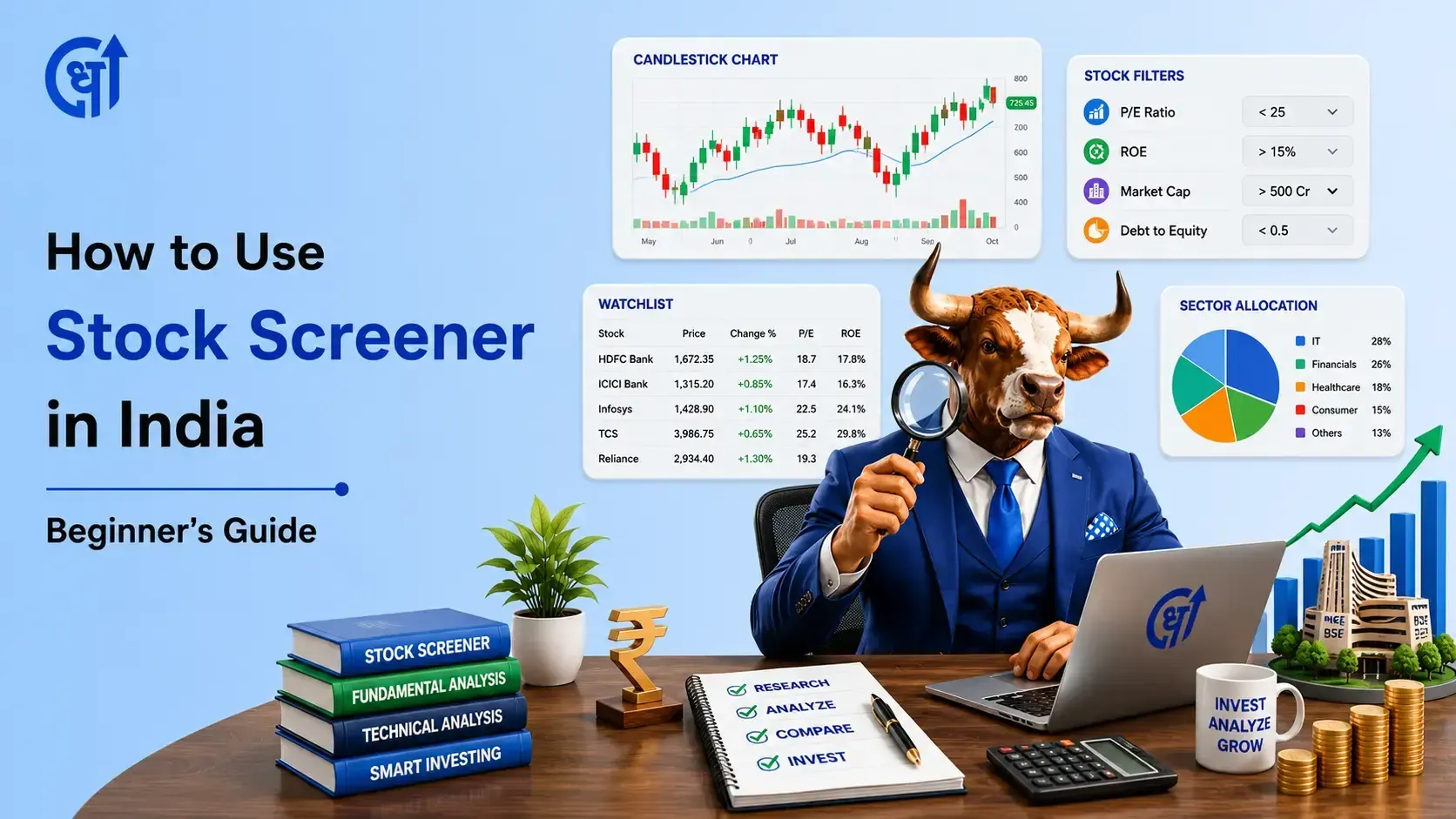
TABLE OF CONTENTS
Get an AI Summary of This Post Using The Tools Below.





A stock screener is a filtering tool that lets you search through thousands of NSE and BSE-listed stocks using specific criteria such as PE ratio, return on equity, and debt levels to build a shortlist of stocks worth researching further. It does not pick stocks for you; it narrows a universe of 5,000-plus companies down to a manageable candidate list.
BSE lists over 5,000 companies. NSE's main equity board has 2,200-plus stocks as of April 2026 (Source: NSE India). With 21.6 crore demat accounts open in India, more retail investors are entering the market than at any point in history, yet most still select stocks based on tips, social media posts, or television recommendations rather than financial data.
A stock screener changes that. It gives you a structured, repeatable method to filter thousands of companies down to a shortlist that actually matches your investment criteria. This article covers what a screener does, which financial ratios to use as a beginner, a step-by-step first screening session, a real NSE stock example, and the five mistakes to avoid when you start.
A stock screener is a query engine over a stock universe. You define the conditions PE below 25, ROE above 15%, debt-to-equity below 1, and the screener returns every listed stock that currently meets all those conditions simultaneously.
Most screeners pull data from company filings submitted to the NSE and BSE. Free tools typically update end-of-day pricing and fundamentals within 21 to 60 days after each quarterly filing, in line with SEBI's disclosure requirements. The two main types of screens are pre-built screens, ready-made filter combinations designed for value investing, dividend strategies, or growth plays, and custom screens, where you define every parameter yourself.
For a beginner, starting with a pre-built screen is the faster path. You see how professional filters are combined before building your own. Once you understand why each filter is included, customising from there takes minutes.
Manually researching even 50 stocks takes weeks. Researching 5,000 is impossible. This is the core problem a screener solves.
As of April 2026, NSE's daily equity turnover exceeds Rs 70,000 crore (Source: NSE India, April 2026). Retail investors now account for upwards of 45% of cash market turnover on the exchange. The number of demat accounts reached 19.4 crore as of 2025, up from just 3.6 crore in 2019, according to SEBI's Executive Director Ruchi Chojer at a capital markets event in July 2025.
This scale of participation means more money is chasing the same universe of stocks, which makes stock selection more important, not less. A screener does not guarantee returns. What it does is replace a random, tip-driven selection process with one based on measurable financial criteria. That is a structural improvement in how you invest, regardless of what the market does on any given day.
Five filters are enough to build a meaningful first screen. Adding more restrictions without understanding the basics produces either zero results or a false sense of precision.
| Filter | What it Measures | Beginner Starting Threshold | Why This Threshold |
|---|---|---|---|
| PE Ratio | Price vs earnings is the stock expensive? | Below 25 | Avoids overpaying; reasonable for most large and mid-cap Indian stocks |
| Return on Equity (ROE) | How efficiently the company uses shareholders' capital | Above 15% | Separates genuinely profitable businesses from low-quality earners |
| Debt-to-Equity (D/E) | How much the company has borrowed vs its own equity | Below 1 | Keeps you away from heavily leveraged companies, especially relevant in rising rate environments |
| Market Cap | Company size and liquidity | Above Rs 500 crore | Filters out illiquid micro-cap and penny stocks with poor data quality |
| 3-Year EPS Growth | Whether earnings are growing or declining | Positive (above 0%) | Confirms the company is not stagnating; earnings trend matters more than a single year |
Data sourced from NSE and BSE company filings. Benchmark ranges are general guidelines; sector norms vary. Last updated: June 2026.
One important note on PE ratio across sectors: A PE of 28 in IT is reasonable for a company growing revenue at 12–15% annually. A PE of 28 in a steel company growing at 4% is expensive. The PE filter should always be applied within a sector, not across the full market. To use PE meaningfully as a beginner, either add a sector filter when screening or compare each result against its sector average before proceeding.
Here is a complete first screening session for a beginner, from opening the tool to having a candidate shortlist ready for further research.
Step 1: Open a Dhanarthi and create a free account. Go to the Dhanarthi Stock Screener. An account lets you save your screens so you do not have to rebuild the same filters every session. Without an account, your screen resets each time.
Step 2: Start with a pre-built screen. Before building a custom screen, spend five minutes with a pre-built one. Select a template labelled "Value Stocks," "Low Debt Compounders," or "High ROE Stocks." Run it and study the output. Pre-built screens show you how experienced investors combine filters. Look at which parameters are set and at what thresholds this accelerates your understanding of custom screening.
Step 3: Build your custom beginner screen using the 5 core filters. Add each of the five filters from the table above, one at a time. Start witha market cap above Rs 500 crore to clean up your universe first. Then add ROE above 15%, debt-to-equity below 1, PE below 25, and three-year EPS growth positive. Add them in this order so you can see how each filter progressively narrows the results.
Step 4: Add a sector or index filter to keep comparisons meaningful. Limit your results to the NSE 500 index or to a specific sector you understand: banking, FMCG, IT, pharma, or auto. This step ensures the PE ratios you are comparing are within a comparable group of companies. A screen across all sectors without a sector filter mixes companies with completely different valuation norms.
Step 5: Run the screen and check the result count.t A well-calibrated beginner screen returns between 15 and 50 stocks. If you get more than 100, your filters are too loose; tighten one or two thresholds. If you get fewer than 5, one filter is too restrictive; relax the least important one first (usually the PE threshold, which you can raise slightly). Aim for a shortlist you can actually read through in an evening.
Step 6: Sort results and identify your top candidates. Sort the output by market cap (descending) or by ROE (descending) to bring the strongest candidates to the top. Identify 5 to 10 stocks that pass all filters and rank well across multiple metrics. These are your research candidates, not your buy list. The screen has done its job. The next step is human research on each candidate.
To understand what to look for once you have your shortlist, read this guide on how to pick stocks in India.
Applying the five beginner filters to the NSE universe using FY25 data, Tata Consultancy Services (TCS) passes all criteria.
TCS FY25 Actual Data:
PE Ratio: approximately 24x at a share price in the Rs 3,400–3,500 range (NSE, FY25 period). Passes the below-25 threshold.
Return on Equity (ROE): 53.4% in FY25 (Source: BSE filing, FY25 Annual Report). Passes the above-15% threshold with a significant margin.
Debt-to-Equity Ratio: 0.00 in FY25, TCS carries zero long-term debt. Passes the below-1 threshold.
Market Cap: Over Rs 12 lakh crore. Passes the above-Rs-500-crore threshold.
3-Year EPS Growth: Positive across FY23, FY24, and FY25. Passes the positive-growth threshold.
TCS passes every filter in the beginner screen. This places it in the research candidate pool, meaning a beginner would now move to Step 6 and examine the annual report, management commentary, sector outlook, and peer comparison before drawing any investment conclusion.
This is precisely the correct use of a screener: it told you TCS is worth investigating further. It did not tell you to buy.
This example is for educational purposes only and does not constitute a buy or sell recommendation.
The screener shortlists. It does not select. After running the beginner screen and getting 15 to 40 results, the real research begins on your top 5 to 10 candidates.
Check promoter holding and pledge data. Go to the NSE or BSE company page for each candidate. Under the shareholding pattern section, check what percentage of shares the promoters hold and whether any are pledged. SEBI mandates disclosure of promoter pledge data under Regulation 31 of the SAST Regulations. A promoter holding above 50% with zero pledge is a positive signal. Pledging above 20% of promoter holdings warrants deeper scrutiny.
Read the management discussion section of the latest annual report. The screener shows you what has happened financially. The management discussion section shows you what the company expects to happen. It covers risks, growth plans, and sector-specific challenges. A company with strong ratios but a declining order book or margin guidance deserves caution.
Compare with 2 to 3 sector peers. A PE of 22 looks different if the sector average is 18 versus 35. Pull two or three competitors from the same screener and compare all five metrics side by side. The company that leads its peers across most metrics is worth the deepest research.
Check the last four quarters of revenue and profit trends. A company can pass a screener using trailing twelve-month data while showing quarter-on-quarter deterioration in margins. Quarterly result filings are available free on the NSE and BSE. SEBI requires listed companies to publish quarterly results within 45 days of each quarter's end.
Mistake 1: Using too many filters from the start. Adding 12 to 15 filters as a beginner typically returns zero to five stocks. When the result count is that low, the filters are doing guesswork, not analysis. Start with five filters. Understand each one. Add complexity only after you understand why a filter belongs in your screen.
Mistake 2: Treating screener output as a buy list. A screener result is a research shortlist. Every stock in the output still requires qualitative research, promoter track record, sector position, annual report review, and competitive comparison. Skipping this step and buying directly from the screener output is the single most common error retail investors make with these tools.
Mistake 3: Comparing PE ratios across different sectors, IT companies trade at 22 to 30x PE. Banking stocks trade at 10 to 18x PE. FMCG companies trade at 30 to 50x PE. Comparing these numbers across sectors leads to incorrect conclusions. A bank with a PE of 14 is not "cheap" compared to an FMCG company at 40. Always filter within a sector before drawing valuation conclusions.
Mistake 4: Running a screen once and forgetting to update it. Screener results change with every quarterly filing. A company that passed your screen in December FY25 may have missed its Q4 FY25 profit target and no longer qualifies after the April filing. Set a reminder to re-run your screen after each quarterly result cycle, broadly March, June, September, and December.
Mistake 5: Ignoring the market cap filter. A PE of 8 with an ROE of 22% and D/E of 0.3 sounds like a perfect stock until the market cap is Rs 18 crore, daily trading volume averages 500 shares, and the company has not filed an annual report in two years. The market cap filter above Rs 500 crore is not optional for beginners. It removes a large category of low-quality, illiquid, and potentially manipulated stocks from your results before you waste time on them.
For a beginner running their first screen, the fastest path is a platform that removes the setup friction. The Dhanarthi Stock Screener offers 50 ready-made screens and 150-plus customisable parameters built specifically for Indian equity research.
A beginner can open Dhanarthi's screener, select a pre-built template value stocks, low debt compounders, high ROE growth plays, or dividend payers, and immediately see a filtered list with real NSE and BSE data. No manual filter setup is needed to get started. For investors who want to build their own screen, the 150-plus parameter library covers PE ratio, PB ratio, EBITDA margin, debt ratio, promoter holding, technical indicators, and sector classifications, everything from the beginner table above and considerably more.
The AI layer in the Dhanarthi screener reads financial reports and delivers plain-language summaries for each screened stock, reducing the time between "screener output" and "research insight" from hours to minutes.
Use the Dhanarthi Stock Screener to filter NSE and BSE stocks by PE ratio, ROE, debt-to-equity, and 150-plus other parameters with 50 ready-made screens built for Indian investors- no setup needed.
A stock screener filters a universe of 5,000-plus NSE and BSE-listed companies down to a shortlist of 15 to 50 stocks that match your specific financial criteria.
The five core beginner filters are PE below 25, ROE above 15%, debt-to-equity below 1, market cap above Rs 500 crore, and positive three-year EPS growth.
Always apply PE ratio comparisons within the same sector; comparing PE across IT, banking, and FMCG produces misleading conclusions.
A screener shortlists research candidates; it does not make investment decisions. Every result requires qualitative checks promoter pledge data, annual report review, and peer comparison.
After each quarterly result cycle, re-run your screen screener results change as companies file new financial data with NSE and BSE.
A stock screener is the most practical tool a beginner Indian investor can learn to use. With BSE listing over 5,000 companies and 21.6 crore demat accounts active in India, the challenge is not access to stocks it is knowing which ones deserve your research time. Five filters, a 30-minute first screening session, and a shortlist of 15 to 40 candidates is a better starting point than any tip from any source. The screener does the filtering. You do the research. That division of labour is how to use a stock screener in India for beginners effectively.
Disclaimer: This article is for educational purposes only. It does not constitute investment advice. Please consult a SEBI-registered financial advisor before making investment decisions.
1. What is a stock screener and how does it work?
A stock screener is a filtering tool that searches through thousands of NSE and BSE-listed stocks based on criteria you define, such as PE ratio, ROE, and debt levels. You set the conditions, and the screener returns every stock that currently meets all your criteria simultaneously. Data comes from company filings submitted to the exchanges.
2. How do I use a stock screener in India?
Open a screener like Dhanarthi, Screener.in, or Tickertape. Set five core filters: PE below 25, ROE above 15%, debt-to-equity below 1, market cap above Rs 500 crore, and positive EPS growth. Add a sector filter to keep comparisons meaningful. Run the screen and aim for a shortlist of 15 to 50 stocks for further manual research.
3. Which is the best free stock screener in India?
Several strong free options exist for Indian investors in 2026: Dhanarthi (50 ready-made screens, 150-plus parameters, AI-powered summaries), Screener.in (deep fundamental custom queries, 5 million users), and Tickertape (200-plus filters, investment checklist). The best choice depends on whether you prefer pre-built templates for quick starts or custom query building for advanced research.
4. What filters should I use in a stock screener as a beginner?
Start with five filters: PE below 25, return on equity above 15%, debt-to-equity below 1, market cap above Rs 500 crore, and three-year EPS growth positive. These five filters together identify reasonably valued, profitable, low-debt, liquid companies with a consistent earnings track record, a solid starting point for any long-term investor.
5. Can a stock screener help me find undervalued stocks?
Yes, but with an important caveat. A screener with PE below 20, ROE above 15%, and low debt can surface potentially undervalued stocks, but a low PE alone does not mean undervalued. Always check whether a low PE reflects genuine value or a business problem. The screener flags candidates; manual research on annual reports and management commentary confirms or rejects the thesis.
6. What is the difference between a stock screener and a stock scanner?
A screener is a static filtering tool where you set criteria, and it returns a list of stocks that currently match. A scanner is a real-time monitoring tool that continuously watches the market and alerts you the instant a stock meets your criteria. Screeners suit fundamental, long-term investors. Scanners suit active intraday traders who need live signals.
7. Is Screener.in free to use in India?
Screener.in offers a free plan that covers most core features: company pages, basic financial data, custom screens, and community-shared screens. A paid premium plan at Rs 4,999 per year adds unlimited company tracking, 800 stock alerts, peer comparison tools, and Excel automation. For most beginner and intermediate investors, the free plan is sufficient to get started.
8. How do I filter stocks by PE ratio and ROE in India?
On any Indian screener, add PE ratio as a filter and set the maximum to 25. Then add ROE and set the minimum to 15%. Run both filters together on NSE 500 or a specific sector. This combination narrows 5,000-plus listed companies to a smaller group of reasonably priced, efficiently managed businesses, typically 50 to 150 stocks depending on market conditions.
9. Can complete beginners use a stock screener?
Yes. Screeners are built to simplify research, not complicate it. A beginner with no finance background can open Dhanarthi's screener, select a pre-built template, and see filtered results in under five minutes. Starting with pre-built screens before building custom ones is the recommended path it shows how professional investors combine filters before you construct your own.
10. What should I do after a stock screener gives me results?
The screener output is a research shortlist, not a buy list. For each of your top 5 to 10 candidates, check the promoter holding and pledge data on NSE or BSE, read the management discussion section of the latest annual report, compare with 2 to 3 sector peers, and review the last four quarters of revenue and profit trends. Only after these checks should any investment decision be considered.
Share Market
IPO
Artificial Intelligence
Semi Conductor