





Best Nifty Next 50 Index Fund India 2026
October 20, 2026



TABLE OF CONTENTS
Get AI Summary






Bullish describes an optimistic outlook where investors expect prices to rise, leading to buying activity. **Bearish** describes a pessimistic outlook where investors expect prices to fall, leading to selling activity. A bull market is defined by a rise of 20% or more from recent lows, while a bear market is defined by a fall of 20% or more from recent highs.
People who check the stock market regularly easily recognize a bull market and a bear market. These terms get used constantly, but understanding what they actually mean, and how to act on them, matters more than just knowing the definitions.
Every investor benefits from understanding bullish market vs bearish market conditions. Whether beginner or experienced, knowing which phase the market is in supports better decision-making.
A bull market occurs when there is a price increase of at least 20% from recent lows, with that upward trend holding for an extended period.
Historical cycles show bull markets outlasting bear markets by a wide margin, averaging around 42 months compared to just 19 months for bears. In practical terms, markets spend considerably more time rising than falling, which is part of why long-term investors tend to come out ahead over full market cycles.
"Bullish" describes an optimistic view of a market, sector, or specific stock. A bullish investor expects prices to rise and behaves accordingly, buying shares and holding them until the price appreciates enough to lock in a profit.
For example, someone bullish on tech stocks expects tech companies to grow and their share prices to climb. This optimism is often self-reinforcing: as more people buy based on a bullish view, prices tend to rise further, reinforcing the upward trend.
"Bearish" describes the opposite stance. A bearish investor expects prices to decline and adopts a more defensive posture to limit potential losses.
Where bulls buy and hold, bears sell and preserve capital. A bearish investor might sell part of a portfolio, shift funds into lower-risk assets like bonds, or hold cash while waiting for better entry points. More advanced traders sometimes use strategies like short selling to profit directly from falling prices during bearish periods.
This is a heavily searched question on this topic, so it deserves a direct answer.
Bullish means buy: A bullish outlook reflects an expectation that prices will rise, so bullish investors buy shares, expecting to sell later at a higher price.
Bearish means sell (or avoid buying): A bearish outlook reflects an expectation that prices will fall, so bearish investors sell existing holdings, avoid new purchases, or move capital into safer assets like bonds or cash until conditions improve.
These aren't rigid rules for every situation, since short sellers effectively profit from a bearish view by selling first, but for the vast majority of retail investors, bullish maps to buying and bearish maps to selling or holding off.
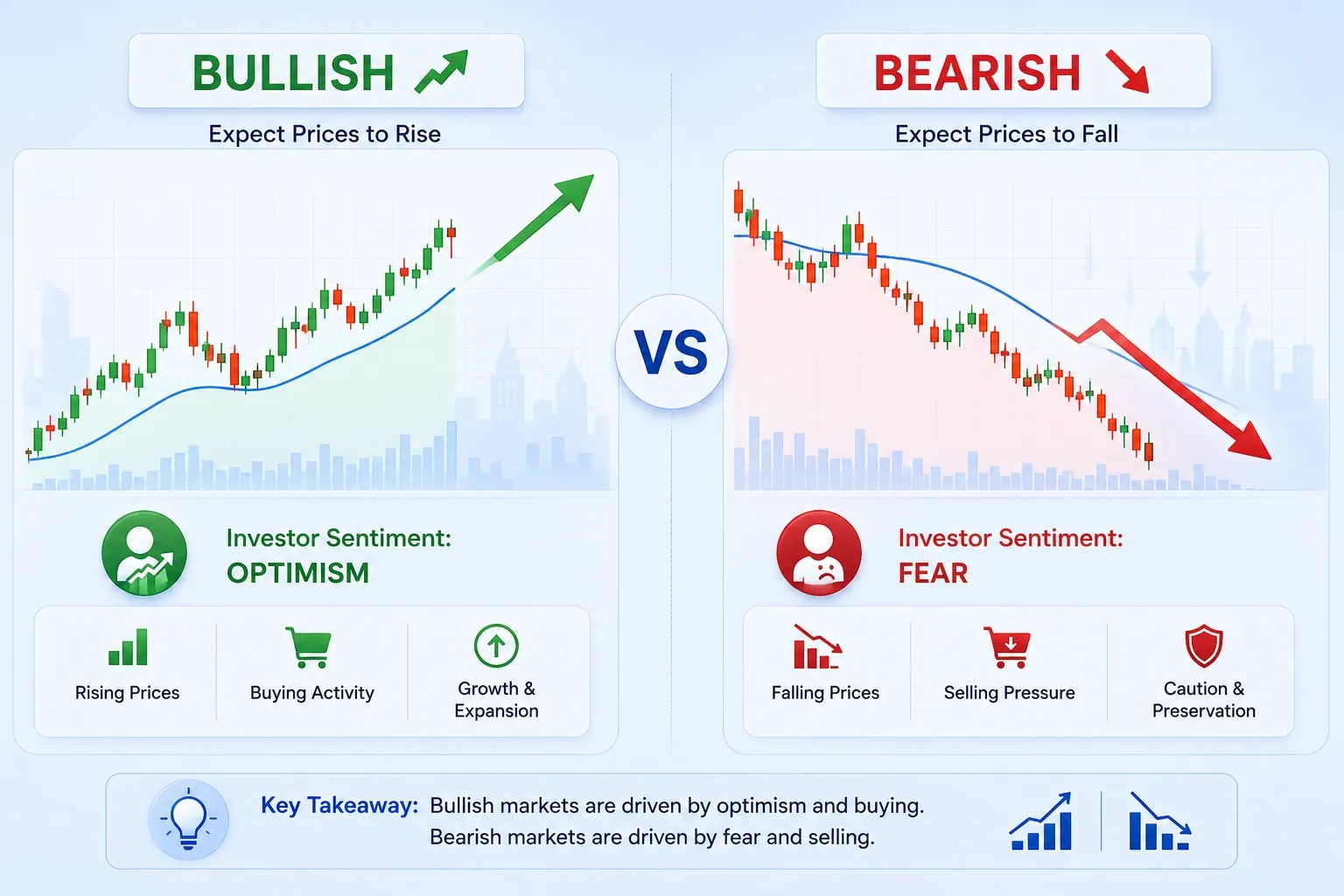
Understanding these differences helps investors adjust strategy appropriately as conditions shift.
Market Direction and Momentum: In a bull market, prices trend consistently upward with small, infrequent dips. In a bear market, the decline is often sharper and faster.
Investor Psychology: Bullish markets are driven by optimism, confidence, and at times excessive greed, since rising prices tend to make most participants feel like skilled investors. Bearish markets bring fear, doubt, and uncertainty, prompting investors to question decisions they were confident about only months earlier.
Economic Backdrop: Bull markets typically coincide with economic expansion: rising GDP, active hiring, low unemployment, and confident consumer spending. Bear markets typically align with economic slowdowns: job losses, reduced spending, and general uncertainty.
Duration Patterns: Bull markets significantly outlast bear markets, with a median duration around 3.5 years versus roughly 1.6 years for bears, a pattern that has held remarkably consistent across market history.
Investor Actions: Bull markets bring aggressive buying as investors chase gains and take on more risk. Bear markets bring selling pressure as investors exit positions, accept losses, and prioritize capital preservation over growth.
| Aspect | Bull Market | Bear Market |
|---|---|---|
| Price Direction | Rising 20%+ from lows | Falling 20%+ from highs |
| Duration | Median 42 months | Median 19 months |
| Sentiment | Optimism, confidence | Fear, pessimism |
| Economy | Strong growth, low unemployment | Recession, high unemployment |
| Trading Volume | High buying demand | High selling pressure |
| Risk Appetite | Aggressive, growth-focused | Defensive, preservation-focused |
A few consistent signs tend to appear together during genuinely bullish phases.
1. Price and Volume Signals: A sustained price increase of 20% or more from recent lows marks the formal start. Rising trading volumes alongside this move confirm strong, convicted buying interest rather than a weak, unsupported rally.
2. Economic Strength: Strong GDP growth, expanding business activity, and low unemployment create favorable conditions for stock prices, since stronger economic conditions typically translate into higher corporate profits.
3. Corporate Performance and Sentiment: Companies report growing profits and sales, and management commentary turns notably more optimistic about future prospects.
IPO activity tends to pick up as more companies rush to list while investor enthusiasm for new offerings runs high. The India VIX (volatility index) tends to stay low, reflecting calm, confident market participants.
Together, these factors typically reinforce and sustain bullish market conditions.
Recognizing bearish warning signs early supports more deliberate, strategic decision-making rather than reactive panic.
1. Price Declines and Volume Changes: The formal start of a bear market is a 20% drop in major indexes from recent highs, though warning signs often appear earlier: persistent selling pressure, breaking support levels, and declining trading volumes. Understanding these patterns through technical analysis helps identify bearish trends earlier and adjust strategy accordingly.
2. Economic Deterioration: GDP growth slows or contracts, companies cut jobs and hiring, unemployment rises, and consumer confidence declines as people grow concerned about their financial security.
3. Corporate Struggles: Earnings disappoint, revenue growth flattens or reverses, and management issues cautious or negative guidance, all of which pressure stock prices lower.
4. Market Behavior Changes: News coverage turns predominantly negative, the VIX spikes as volatility rises sharply, and investors rotate into safe-haven assets like government bonds and gold.
Despite their clear differences, both phases share important traits every investor should understand.
Both operate under the same fundamental market principle: no phase lasts forever. Over a century of market history, cycles of bulls and bears have consistently followed one another; every bull market eventually ends, and every bear market eventually recovers.
Both phases also carry genuine opportunity. Bull markets reward investors who stay invested through the cycle. Bear markets reward those willing to buy quality assets while others panic and sell.
Recognizing the current market phase is only useful if it actually shapes strategy. Here are practical approaches for each condition.
Staying invested matters during a bull run; many investors sell too early out of fear of a correction, missing out on substantial further gains as a result.
At the same time, buying overpriced stocks purely because prices are rising is a common trap. Setting a disciplined plan for taking profits as valuations stretch helps manage this. Bull markets are also good windows to research potential multibagger stocks capable of delivering outsized long-term returns. The most common mistake in this phase is overconfidence, taking on excessive risk right as the market nears a peak.
The most important rule: avoid panic selling. Markets have historically recovered from every bear phase, eventually reaching new highs.
Defensive sectors like utilities, consumer staples, and healthcare tend to hold up better, since these companies sell non-discretionary products even during economic stress. Understanding market cap categories helps in favoring stable large-cap names during bear phases while reserving more aggressive small-cap bets for bull markets. Dividend-paying stocks also provide some income cushion even while share prices are under pressure.
Both bull and bear cycles eventually pass. Viewing corrections as opportunities rather than crises tends to serve long-term investors better than reactive decision-making.
Regardless of market phase, diversification remains a reliable way to manage portfolio risk, spreading capital across asset classes, sectors, and regions. Mutual funds or index funds offer a straightforward way to achieve broad exposure with lower single-stock risk.
Combining fundamental and technical analysis supports more well-rounded decisions in any market condition. A stock screener like the Dhanarthi Screener speeds up filtering companies by fundamental criteria, making it considerably faster to compare financial metrics across multiple stocks.
For anyone uncertain about their overall strategy, working with a qualified financial advisor can help avoid the emotional decision-making that tends to be most costly during periods of high market volatility.
The core distinction between a bullish and bearish market comes down to participant sentiment. Bullish sentiment is positive, with investors generally expecting continued price appreciation and growth over time. Bearish sentiment is negative, with declining prices and reduced investor confidence typically leading to earlier exits from positions.
Rather than trying to predict the exact top or bottom of any particular security, an honest assessment of individual financial goals, risk tolerance, and time horizon offers a more reliable foundation for decision-making in either market phase. Checking current market data and stock fundamentals directly on Dhanarthi, including through Dhanarthi's financial analysis tools, helps ground these decisions in current information rather than assumption.
Disclaimer: This article is for educational purposes only and should not be considered as financial or tax advice. Tax laws are subject to change, and individual circumstances vary. Please consult with a qualified chartered accountant or tax advisor for personalized guidance based on your specific situation.
1. What is bull in stock market?
A bull in the stock market means prices are rising by at least 20% from recent lows and continuing upward for an extended period. Bull markets reflect investor optimism, a strong economy, and growing company profits, with confident buying activity throughout.
2. What is bullish and bearish?
Bullish means expecting prices to go up, prompting investors to buy. Bearish means expecting prices to fall, prompting investors to sell or avoid buying. Bullish investors are optimistic about growth; bearish investors are cautious and focused on protecting capital during downturns.
3. What is the difference between bullish and bearish?
The main difference is market direction and investor sentiment. Bullish markets show rising prices, optimism, and confident buying. Bearish markets show falling prices, fear, and selling pressure. Bull markets also last considerably longer on average, roughly 42 months versus 19 months for bears.
4. Is bullish buy or sell?
Bullish means buy. A bullish view reflects the belief that prices will rise, so investors buy shares expecting to sell later at a profit. Bullish investors typically hold through upward trends and add to positions as growth opportunities appear.
5. Is bearish selling or buying?
Bearish means selling. A bearish view reflects the belief that prices will fall, so investors sell to avoid losses or move to cash until conditions improve. Bearish investors often shift toward safer assets like bonds or gold while waiting for better entry points.
6. Why is it called bullish and bearish?
The terms come from how each animal attacks: bulls thrust their horns upward, symbolizing rising prices, while bears swipe their paws downward, symbolizing falling prices. These physical motions became a lasting shorthand for describing market direction.
7. What is a bear market and a bull market?
A bull market occurs when stock prices rise 20% or more from recent lows with sustained upward momentum. A bear market occurs when prices fall 20% or more from recent highs. Bulls represent growth and optimism; bears represent decline and caution.
8. How long do bull and bear markets last?
Bull markets last considerably longer, averaging around 42 months (3.5 years), while bear markets typically last about 19 months (1.6 years). This pattern has held consistently across market history, meaning markets spend more time rising than falling over the long run.
9. What are the signs of a bullish market today?
Signs include prices rising 20%+ from recent lows, high trading volumes, strong GDP growth, low unemployment, rising company profits, positive management commentary, active IPO markets, and a low VIX. Seeing these indicators together generally signals bullish territory.
10. How to invest during bull vs bear market?
During bull markets, stay invested and avoid selling too early, while resisting the urge to chase overpriced stocks. During bear markets, avoid panic selling, consider defensive sectors like utilities and healthcare, prioritize dividend-paying companies, and treat price drops as potential buying opportunities.
Share Market
IPO
Artificial Intelligence
Semi Conductor