




Stock Market Basics for Beginners in India
October 24, 2026



TABLE OF CONTENTS
Get AI Summary





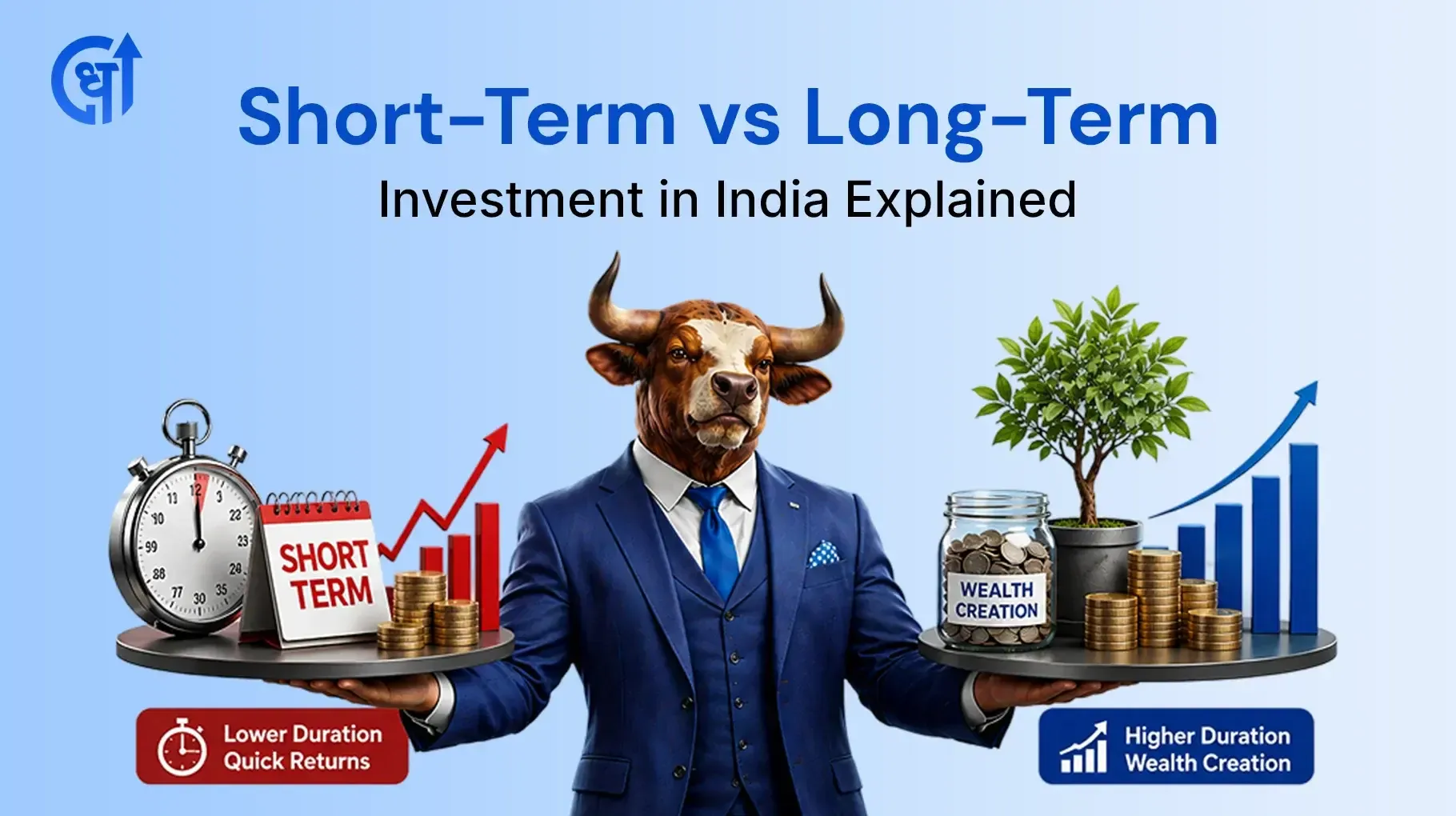
The difference between short-term and long-term investment in India directly affects how much tax you pay, how much risk you take on, and how much wealth you actually build. A short-term investor selling equity in 9 months pays 20% tax on gains. A long-term investor selling the same stock after 13 months pays 0% on gains up to Rs 1.25 lakh. That difference alone changes the math on every investment decision. This article explains both approaches, compares their tax treatment under current rules, shows real return data, and gives you a clear framework for deciding which one fits your financial goals. If you are also choosing between SIP vs lumpsum investing, the investment horizon decision covered here applies directly.
Short-term investment means holding a financial asset for a limited period, typically up to 12 months for listed equity shares and equity mutual funds, or up to 24 to 36 months for other assets like real estate and debt funds. The goal is liquidity and quick access to capital. Long-term investment means holding an asset beyond these thresholds, with the goal of growing wealth through compounding and riding out market cycles. In India, the holding period determines the tax category, not just the investment label.
India's Income Tax Act defines short-term and long-term differently for each asset class. The table below shows the current thresholds applicable in FY 2026-27.
| Asset Class | Short-Term Threshold | Long-Term Threshold |
|---|---|---|
| Listed Equity Shares | Up to 12 months | More than 12 months |
| Equity Mutual Funds | Up to 12 months | More than 12 months |
| Debt Mutual Funds (post April 2023) | All holding periods | No LTCG distinction; taxed at slab rates |
| Real Estate | Up to 24 months | More than 24 months |
| Gold ETFs | Up to 12 months | More than 12 months |
| Unlisted Shares | Up to 24 months | More than 24 months |
Data sourced from Income Tax Act 1961 and Ministry of Finance Budget documents. Last updated: May 2026.
The single most important row in this table is listed equity. Holding a stock or equity fund for 12 months and 1 day moves your gain from a 20% tax bracket to a 12.5% bracket with a Rs 1.25 lakh annual exemption. No other single action in personal finance produces a similar tax benefit this quickly.
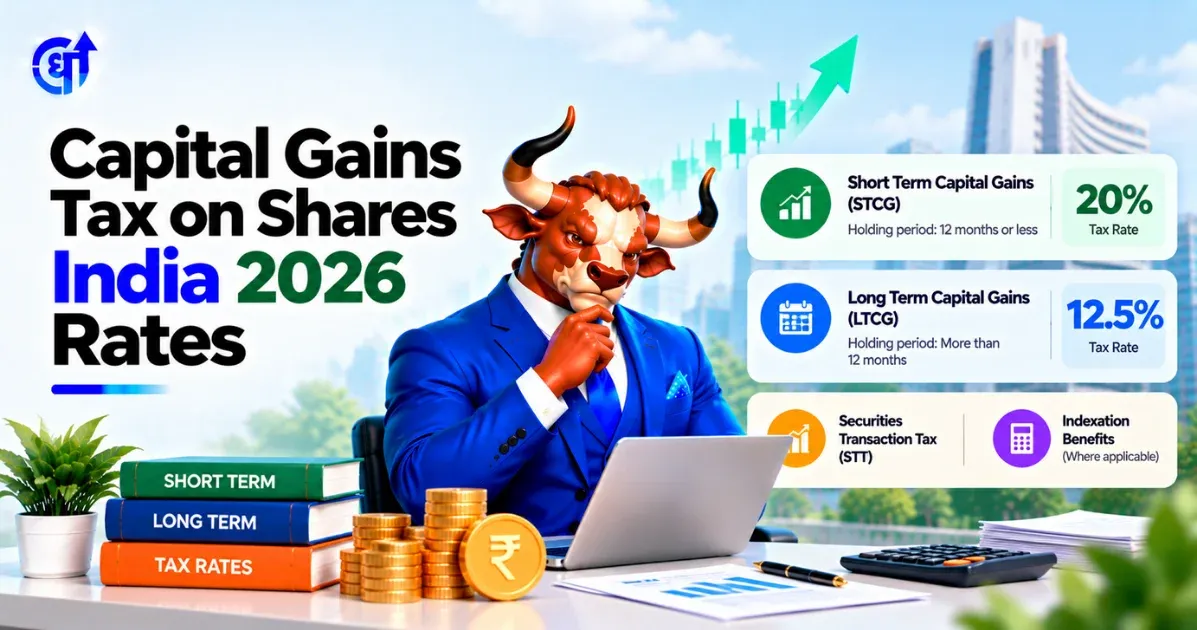
Short-term capital gains (STCG) and long-term capital gains (LTCG) are taxed at different rates. The table below reflects rates applicable for FY 2026-27, confirmed unchanged in Budget 2026.
| Asset | STCG Rate | LTCG Rate | LTCG Exemption |
|---|---|---|---|
| Listed Equity Shares | 20% | 12.5% | Rs 1.25 lakh per year |
| Equity Mutual Funds | 20% | 12.5% | Rs 1.25 lakh per year |
| Debt Mutual Funds (post Apr 2023) | Slab rate | Slab rate | No separate exemption |
| Real Estate | Slab rate | 12.5% (no indexation) | None |
| Gold ETFs | 20% | 12.5% | Rs 1.25 lakh per year |
Data sourced from Income Tax Act 1961 (Section 111A and 112A) and Ministry of Finance Budget 2026 documents. Last updated: May 2026.
Consider two investors who each make a profit of Rs 1,00,000 on an equity stock.
Investor A sells after 9 months. The gain is classified as STCG. Tax payable = Rs 1,00,000 x 20% = Rs 20,000 (plus 4% cess = Rs 20,800 total).
Investor B sells after 13 months. The gain is classified as LTCG. Since Rs 1,00,000 falls within the Rs 1.25 lakh annual exemption, tax payable = Rs 0.
Investor B keeps Rs 20,800 more than Investor A on the exact same profit, simply by waiting 4 more months. This is not a minor difference. Over a portfolio of Rs 10 lakh in gains, the gap becomes Rs 2.08 lakh in a single year.
The Nifty 50 index delivered a 10-year CAGR of approximately 10.2% from January 2016 to January 2026 (Source: NSE Indices historical data). This figure includes reinvested dividends and represents wealth compounded steadily over a decade.
Short-term equity returns tell a very different story. Nifty 50 annual returns have ranged from -51.79% in calendar year 2008 to +75.76% in calendar year 2009 (Source: NSE Indices data). A short-term investor entering in early 2008 and exiting in 12 months would have lost more than half their capital. A long-term investor who stayed through both years recovered and went on to compound at double-digit rates.
For short-term instruments, SBI Fixed Deposits currently offer up to 6.45% per annum for regular citizens on the 444-day Amrit Vrishti scheme (Source: SBI, effective December 2026). This is a safe, predictable return but does not outpace inflation over the long run. India's CPI inflation has averaged approximately 5% to 6% annually in recent years, which means an FD return of 6.45% delivers very limited real return after tax.
For investors comparing equity to other options, reviewing how large-cap vs mid-cap vs small-cap stocks behave across different time horizons helps set realistic expectations for each category.
The data makes a clear case: short-term instruments offer stability and liquidity, not wealth creation. Long-term equity investing has historically been the primary driver of real wealth growth for Indian retail investors.
Every investment carries risk, but the type of risk differs significantly based on the time horizon.
Short-term investing risks: Short-term equity investing carries high timing risk. Getting in and out of the market at the right moment is extremely difficult even for professionals. Transaction costs and Securities Transaction Tax (STT) on every buy and sell reduce gains further. SEBI's study on retail equity derivatives trading, updated in July 2026, found that 91% of individual traders in the equity derivatives segment incurred net losses in FY25, with aggregate losses across all retail traders exceeding Rs 1.05 lakh crore in that single year (Source: SEBI study on retail F&O trading, July 2026). While this data covers derivatives rather than direct equity, it reflects the broader challenge that short-term trading at scale consistently produces losses for retail participants.
Long-term investing risks: Long-term investing is not risk-free. Market downturns like the 38% Nifty fall in calendar year 2008 test even disciplined investors. The key difference is that long-term investors do not need to time the exit. History shows that every major Nifty correction has been followed by a full recovery and new highs, given a 5 to 7 year horizon. Inflation risk is also present for long-term investors: if equity returns in a given decade lag inflation, real wealth can erode.
The risk comparison ultimately comes down to one practical question: can you afford to wait? If yes, the long-term approach reduces timing risk and tax burden simultaneously.
The table below compares common instruments used by Indian retail investors across both time horizons.
| Instrument | Horizon | Typical Returns (p.a.) | Liquidity | Tax Treatment |
|---|---|---|---|---|
| Savings Account | Short-term | 2.70% to 3.50% | Instant | Taxed at slab rate |
| Liquid Mutual Fund | Short-term | 6.50% to 7.00% | T+1 day | Taxed at slab rate |
| SBI Fixed Deposit (1 year) | Short-term | 6.80% | Low (penalty on early exit) | Taxed at slab rate |
| ELSS Mutual Fund | Long-term | 12% to 15% (10-yr avg) | 3-year lock-in | LTCG at 12.5% above Rs 1.25 lakh |
| Nifty 50 Index Fund | Long-term | 10% to 13% (10-yr CAGR) | T+2 to T+3 days | LTCG at 12.5% above Rs 1.25 lakh |
| Direct Equity (Blue-Chip) | Long-term | 10% to 18% (varies) | Real-time on exchange | LTCG at 12.5% above Rs 1.25 lakh |
Data sourced from AMFI, SBI, and NSE Indices. Typical returns are historical averages and are not guaranteed. Last updated: May 2026.
ELSS mutual funds offer an additional advantage: investments up to Rs 1.5 lakh per year qualify for a deduction under Section 80C of the Income Tax Act, making them one of the most tax-efficient long-term instruments available to salaried investors.
There is no single correct answer. The right choice depends on four specific factors.
1. Goal Timeline If you need the money within 3 years, short-term instruments are appropriate. Emergency funds, vacation savings, a car down payment, or a short-term commitment all call for liquid, low-risk options. If your goal is 5 years or more away, such as buying a home, funding a child's education, or building a retirement corpus, long-term equity investing gives you time to compound returns and recover from market dips.
2. Liquidity Requirement Short-term instruments like liquid funds, savings accounts, and FDs allow quick access to funds. Long-term instruments like ELSS (3-year lock-in) or direct equity require you to tolerate the possibility of selling at an unfavorable price if you need cash urgently. A simple rule: never put money you may need within 2 years into equity instruments of any kind.
3. Your Tax Bracket Investors in the 30% income tax slab pay the most on STCG because short-term equity gains are taxed at a flat 20% plus cess, and short-term debt or FD returns are added to income and taxed at the full 30% rate. For these investors, long-term equity becomes significantly more efficient because the 12.5% LTCG rate is less than half their income tax rate. Investors in the 5% or 10% income slabs will find the difference less dramatic, but the LTCG exemption of Rs 1.25 lakh per year still provides a meaningful advantage.
4. Time Commitment and Market Knowledge Active short-term investing in equity requires daily monitoring, chart reading, and fast decision-making. Most retail investors who try this route significantly underperform even a basic index fund, as the SEBI data cited above confirms. If you cannot dedicate meaningful time to tracking positions, a long-term approach with passive index funds or diversified equity mutual funds via SIP removes the skill requirement and replaces it with patience. To understand which stocks and funds deserve long-term allocation, the guide on how to analyse a stock before investing provides a practical starting framework.
For most Indian retail investors building wealth toward retirement, a child's education, or a home purchase, long-term equity investing with regular SIPs has historically delivered superior risk-adjusted returns compared to any short-term strategy.
Mistake 1: Exiting long-term positions early to book profit, triggering unnecessary STCG Many investors sell after 9 or 10 months when a position shows strong gains, not realising they are 2 to 3 months away from shifting to LTCG treatment. Waiting for the 12-month threshold before booking equity profits is one of the simplest tax-saving moves available to retail investors.
Mistake 2: Assuming all short-term instruments are safe Liquid funds and ultra-short debt funds carry credit risk. During the Franklin Templeton debt fund crisis of 2020, six debt funds were wound up, and investors could not access their money for over a year. "Short-term" does not automatically mean zero risk.
Mistake 3: Ignoring transaction costs in short-term equity trading Each buy and sell in equity incurs STT, brokerage, exchange charges, and GST. A short-term trader turning over a Rs 5 lakh portfolio 10 times in a year can easily pay Rs 5,000 to Rs 8,000 in transaction costs before taxes, which directly reduces returns.
Mistake 4: Locking emergency funds into long-term instruments Putting an emergency fund into ELSS, PPF, or long-term equity to earn higher returns is a common error. Emergency funds must remain liquid. A market downturn at the moment you need cash forces a distress sale at the worst possible time.
Before deciding which stocks or funds deserve short-term versus long-term allocation, filtering them by fundamental strength saves significant time and avoids emotional decisions. The Dhanarthi stock screener lets you filter stocks by P/E ratio, dividend yield, revenue growth, and other fundamental metrics, helping you identify which companies have the financial foundation to hold for the long term rather than trade in and out of.
The Difference between short-term and long-term investment in India is not just a matter of time. It is a difference in tax liability, risk exposure, and return potential. Under current rules in FY 2026-27, short-term equity gains are taxed at 20% and long-term equity gains above Rs 1.25 lakh at 12.5%. This gap, combined with the compounding advantage of staying invested through market cycles, makes long-term investing the more efficient strategy for most retail investors with goals 5 years or more away. Use short-term instruments for liquidity and capital safety. Use long-term equity for wealth creation. The two approaches serve different purposes and can work together in a well-planned portfolio.
Disclaimer: This article is for educational purposes only. It does not constitute investment advice. Please consult a SEBI-registered financial advisor before making investment decisions.
1. What is the difference between short-term and long-term investment?
Short-term investments are held for a limited period, typically up to 12 months for listed equity, and focus on liquidity. Long-term investments are held beyond these thresholds, typically 5 years or more, and focus on compounding wealth. The holding period also determines the capital gains tax category in India.
2. Which is better for beginners in India: short-term or long-term investment?
Long-term investing is better suited for most beginners. It requires less daily monitoring, benefits from compounding, and carries a lower tax rate on equity gains. Short-term trading requires technical skills, constant attention, and tolerance for high volatility, which most beginners underestimate.
3. What is the STCG tax rate on equity in India for FY 2026-27?
Short-term capital gains on listed equity shares and equity mutual funds are taxed at a flat rate of 20% under Section 111A of the Income Tax Act. This rate applies to gains from assets held for 12 months or less.
4. What is the LTCG tax rate on equity in India for FY 2026-27?
Long-term capital gains on listed equity shares and equity mutual funds are taxed at 12.5% under Section 112A. Gains up to Rs 1.25 lakh per financial year are completely exempt from this tax. No indexation benefit is available for equity.
5. What are examples of short-term investments in India?
Common short-term investments in India include savings accounts (2.70% to 3.50% p.a.), liquid mutual funds (6.50% to 7.00% p.a.), treasury bills, short-term fixed deposits, and ultra-short-duration debt funds. These prioritize liquidity and capital safety over high returns.
6. What are examples of long-term investments in India?
Common long-term investments include Nifty 50 index funds (historical 10-year CAGR of approximately 10% to 13%), ELSS mutual funds, direct equity in blue-chip companies, PPF, and NPS. These instruments are designed to compound wealth over 5 to 10 or more years.
7. What is the holding period for long-term capital gains on equity in India?
For listed equity shares and equity-oriented mutual funds, the minimum holding period to qualify for long-term capital gains treatment is more than 12 months. For real estate and unlisted shares, the threshold is more than 24 months.
8. How does compounding benefit long-term investors?
Compounding means your returns generate further returns over time. A Rs 1 lakh investment compounding at 12% annually becomes approximately Rs 3.1 lakh in 10 years and Rs 9.6 lakh in 20 years. Short-term investing interrupts this cycle by locking in gains early and restarting from a smaller base after taxes.
9. Can I do both short-term and long-term investing at the same time?
Yes. A balanced portfolio approach works well for many investors: keep 6 to 12 months of expenses in short-term liquid instruments for emergencies, and invest remaining savings in long-term equity instruments for wealth creation. The two serve entirely different purposes and are not in competition.
10. Is a fixed deposit a short-term or long-term investment?
Fixed deposits can serve either purpose depending on tenure. An FD for 6 months to 1 year is a short-term instrument. An FD for 5 years can serve a long-term goal, though SBI currently offers a maximum of 6.45% p.a. (Source: SBI, May 2026), which may not outpace inflation after tax for investors in higher tax brackets.
Share Market
IPO
Artificial Intelligence
Semi Conductor