



Solvency Ratios: Definition, Different Types, & Examples
June 26, 2026



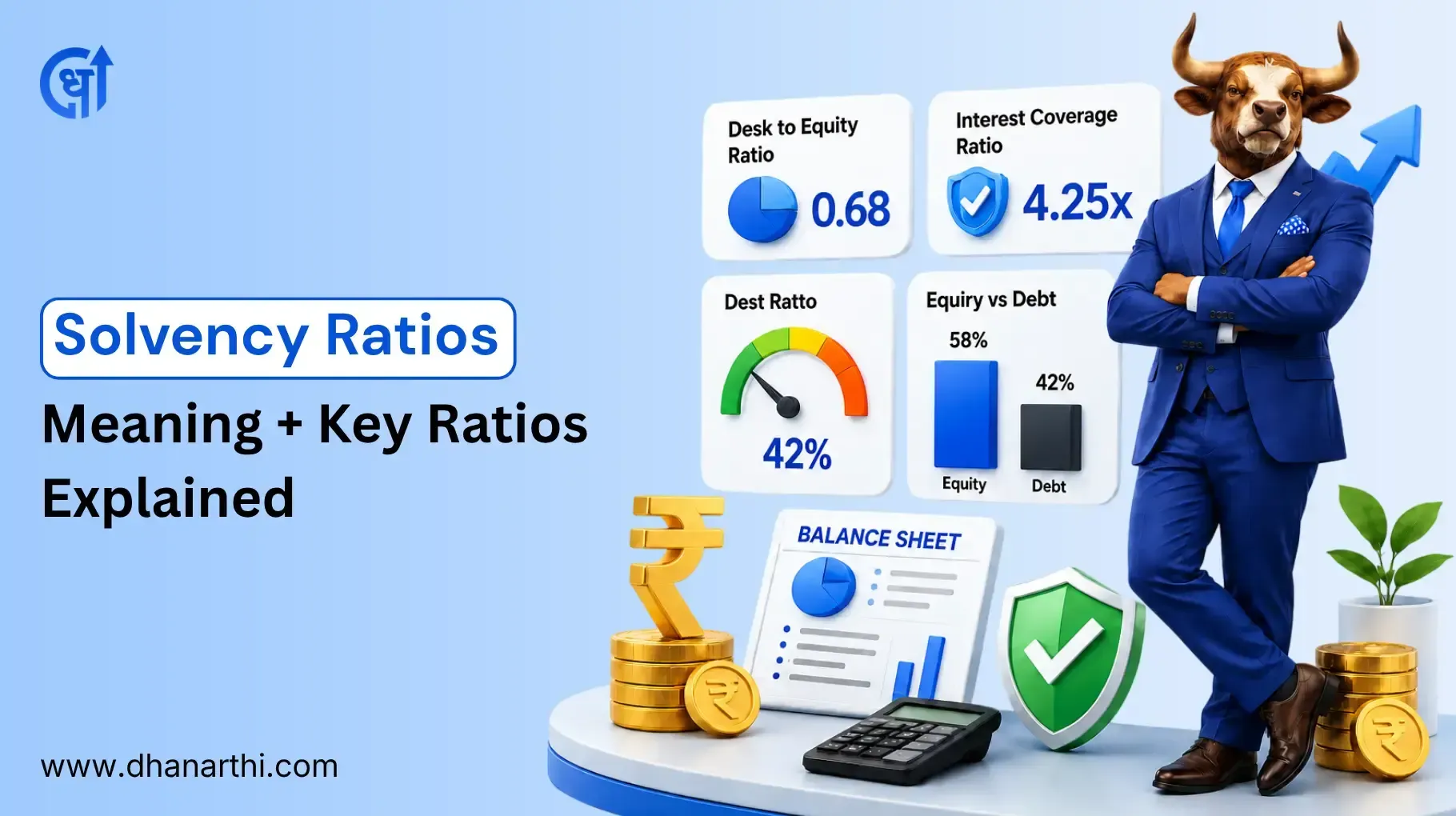
TABLE OF CONTENTS
Get an AI Summary of This Post Using The Tools Below.





When you look at a company’s share prices, profitability is only part of it. A firm can post pretty solid quarterly earnings and still end up collapsing because of long-term debt, and that’s exactly where solvency ratios start to matter.
If you want to get serious about financial ratio analysis, this is the base layer, and solvency ratios are one of the ratios investors should know before buying shares on NSE or BSE, not after.
Think about this example: Tata Steel had a consolidated net debt of around Rs 75,000 crore in FY24. Infosys, on the other hand, has almost zero long-term debt. Both can be called profitable, sure, but the risk profile is not even close. Solvency ratios are what make that contrast visible, pretty cleanly.
(Source: Tata Steel Annual Report, BSE)
Solvency kind of means the company’s ability to deal with its long-term money obligations, mainly debt payments, using what it owns overall, or what it brings in. A solvent business tends to have more assets than liabilities, and it can keep running for the long haul without tumbling into default on loans or even bonds.
Solvency is not really about whether there is cash in hand right now. It’s more about whether the financial setup is stable enough to survive several years of paying back debt.
Firms with weak solvency might look like they’re doing well in the short run, like profitable even, but they often hide a deeper financial frailty, a sort of structural risk, that may show up later during a recession or when interest rates start climbing.
This is one of the most common areas of confusion for new investors. Solvency and liquidity are related but measure very different things.
| Factor | Solvency | Liquidity |
|---|---|---|
| Time Horizon | Long-term (years) | Short-term (days to months) |
| What it Measures | Ability to repay long-term debt | Ability to meet immediate obligations |
| Key Ratios | Debt-to-Equity, Interest Coverage | Current Ratio, Quick Ratio |
| Risk Indicated | Structural financial risk | Operational cash flow risk |
| Example | Can the company repay a 10-year loan? | Can the company pay salaries next month? |
Data sourced from SEBI and NSE financial education resources. Last updated: June 2025.
A company can be liquid but insolvent; it may have enough cash for now, but carry so much long-term debt that its future is compromised. Investors need to check both.
A solvency ratio is a financial measure that basically shows how well a company can cover its long-term liabilities using its net income or total assets. It is kind of meant to say whether the business is durable, not just “right now.”
Unlike liquidity ratios, which are usually about short-term obligations, solvency ratios take the bigger view, like financial endurance and long-term stability. In practice, it helps investors and lenders judge if the company can keep going through heavier commitments, or if it might wobble later, even if it looks fine today.
The general solvency ratio formula is:
Solvency Ratio = (Net Income + Depreciation) / Total Liabilities
This formula basically shows what percentage of total liabilities the company can handle by using its yearly cash-producing power or so. In general, a ratio that sits above 20% is often treated as acceptable, yet of course, it can shift depending on the sector and the way the business model runs.
Each solvency ratio, however, has its own particular calculation method, described later in the next section in more detail.
Yeah, so basically there are four main solvency ratios, the thing is used in fundamental analysis. They kind of each measure a different dimension of long-term financial stability, but in practice, it comes down to the overall durability of the business over time.
Formula: Total Debt / Shareholders' Equity
This ratio tells you how much debt a company carries for every rupee of shareholder equity. A D/E ratio of 1.0 means the company has equal debt and equity. Above 2.0 is generally considered high-risk for most sectors.
Real Example: Tata Steel FY25:
Tata Steel's standalone D/E ratio stood at approximately 0.72 as of March 2025. This means for every Rs 1 of equity, the company carries Rs 0.72 in debt, manageable for a capital-intensive steel business, but still worth monitoring.
(Source: Tata Steel Q4 FY25 results, BSE filing)
| D/E Ratio | Interpretation |
|---|---|
| Below 0.5 | Low debt, financially conservative |
| 0.5 to 1.0 | Moderate acceptable for most sectors |
| 1.0 to 2.0 | High requires sector context |
| Above 2.0 | Very high financial risk |
Data sourced from BSE. Last updated: June 2025.
Formula: EBIT / Interest Expense
The interest coverage ratio basically tells you how many times a company can cover its interest obligations using operating profit (EBIT). If that ratio drops under 1.5x, it kind of signals the firm is having a hard time paying the interest… like, struggling, plain and simple, which is a pretty serious red flag.
Real Example: Infosys FY25:
Infosys reported EBIT of Rs 26,248 crore for FY25 with negligible interest expense, giving an interest coverage ratio well above 100x. This reflects a near-debt-free balance sheet a hallmark of most large Indian IT companies.
(Source: Infosys Annual Report FY25, NSE)
| Interest Coverage | Interpretation |
|---|---|
| Below 1.5x | The danger zone may struggle to service debt |
| 1.5x to 3.0x | Acceptable, but monitor closely |
| 3.0x to 5.0x | Comfortable, healthy financial position |
| Above 5.0x | Strong low debt risk |
Data sourced from NSE filings. Last updated: June 2025.
Formula: Total Debt / Total Assets
This ratio shows what proportion of a company’s assets are financed by borrowing, basically. If the ratio goes above 0.5, then more than half of the company’s assets are debt-funded, which usually means higher financial risk, yes.
Real Example: Maruti Suzuki FY25:
Maruti Suzuki's debt-to-assets ratio was approximately 0.08 as of March 2025. This extremely low figure reflects Maruti's conservative financial structure and its ability to fund operations largely through internal cash flows.
(Source: Maruti Suzuki Annual Report FY25, BSE)
Formula: Shareholders' Equity / Total Assets
The equity ratio is kinda like the mirror of the debt-to-assets ratio, at least in meaning, not in a magic way. It tells you what portion, or percentage, of the assets is financed by equity rather than debt. When this ratio is higher, it often signals lower financial risk, more stable ground in a way.
Say a company has total equity of Rs 10,000 crore and total assets of Rs 15,000 crore, then the equity ratio comes out to 0.67, so that means about 67% of its asset base is equity-funded. Many people see this as a solid financial setup across most sectors.
Let us walk through a full solvency ratio calculation using Tata Steel FY25 data.
Given (Source: Tata Steel FY25 Standalone Results, BSE):
Net Profit (PAT): Rs 8,960 crore
Depreciation: Rs 4,200 crore (approximate)
Total Liabilities: Rs 1,04,000 crore (approximate
Step 1: Add Net Income and Depreciation
Rs 8,960 crore + Rs 4,200 crore = Rs 13,160 crore
Step 2: Divide by Total Liabilities
Rs 13,160 crore / Rs 1,04,000 crore = 0.127 or 12.7%
Interpretation: Tata Steel’s solvency ratio sits around 12.7%, so it falls under the 20% benchmark, and that basically points to how capital-intensive and debt-heavy the steel industry can get.
Now that doesn’t mean it is automatically a bad investment, but it does suggest that the company’s earnings cover only a slice of its overall liabilities each year, which is pretty common for this sector too.
For a deeper look at how the debt-to-equity ratio works as a standalone metric, the linked article covers interpretation, red flags, and sector comparisons in detail.
There really isn’t any one “good” solvency ratio that works for every company, not in a straight line. What counts as healthy can shift a lot, because the industry matters more than people like to admit. For example, capital-intensive businesses like steel and infrastructure often end up with more debt by default, while asset-light sectors such as IT or FMCG tend to run with less.
| Sector | Typical D/E Range | Solvency Ratio Benchmark | Notes |
|---|---|---|---|
| IT (Infosys, TCS, Wipro) | 0.0 to 0.2 | Above 30% | Near-zero debt, high cash generation |
| FMCG (HUL, Nestle) | 0.1 to 0.5 | Above 25% | Conservative, strong cash flows |
| Auto (Maruti, M&M) | 0.1 to 0.6 | 20% to 30% | Moderate debt, strong operating cash flow |
| Steel (Tata Steel, JSW) | 0.5 to 2.0 | 10% to 20% | High capex, sector-normal debt levels |
| Infrastructure / Infra | 1.0 to 3.0 | 8% to 15% | Project-based, long debt cycles |
| Banking / NBFC | Not applicable | Separate capital adequacy norms | Regulated by RBI/SEBI |
Data sourced from NSE/BSE company filings and SEBI sector reports. Last updated: June 2025.
Key rule: Always compare solvency ratios within the same sector. A D/E of 1.5 for a steel company is normal. The same ratio for an IT company would be alarming.
Knowing the formulas is step one. Applying them correctly while researching stocks is what separates informed investors from the rest. Here is a practical framework:
Compare within the sector, not across sectors. A D/E of 2.0 for NTPC (power sector) is not the same risk as a D/E of 2.0 for an IT mid-cap.
Track the trend, not just the current number. A company with D/E improving from 1.8 to 1.2 over three years is deleveraging that is a positive signal. A company going from 0.5 to 1.5 in two years deserves scrutiny.
Check interest coverage alongside D/E. High debt is less dangerous if the company generates strong EBIT. An interest coverage of 5x with high D/E is far safer than a coverage of 1.2x with moderate D/E.
Red flag: interest coverage below 1.5x for two consecutive quarters. This suggests the company is borrowing to pay interest a structural warning sign.
Use the balance sheet + P&L together. Solvency ratios pull data from both statements. Checking them in isolation misses context.
Common investor mistake: Many beginners just look at the D/E ratio and kind of ignore interest coverage, like ok whatever. During the 2018 IL&FS crisis, some infrastructure companies showed “acceptable” D/E on paper, but interest coverage was lower than 1.0x, so it was basically that they could not pay the debt from day-to-day operating cash flow. So both measures need to be checked together, not separately.
Learning how to analyse a stock before investing requires looking at solvency ratios as part of a broader fundamental checklist, not in isolation.
Solvency ratios give you a kind of clear picture of how well a company can last financially, over the long run, basically. Stuff like the Debt-to-Equity ratio, the Interest Coverage ratio, the Debt-to-Assets ratio, and also the Equity ratio each look at a different layer of risk, not the same one.
When you put them together, you can sort out which companies have more robust balance sheets versus the ones that have this deeper structural debt concern.
For Indian retail investors, the practical angle is pretty simple: review the D/E ratio and the interest coverage ratio for every company you actually research, then compare those numbers with sector benchmarks, and keep watching how they move over time.
If a firm is steadily improving its solvency standing year after year, it usually signals a more fundamentally solid operation, even if the latest quarterly profit figure seems to say something else.
Disclaimer: This article is for educational purposes only. It does not constitute investment advice. Please consult a SEBI-registered financial advisor before making investment decisions.
1. What is a solvency ratio in simple terms?
A solvency ratio measures whether a company can meet its long-term debt obligations using its income or assets. Think of it as a financial health check for the company's ability to survive and repay debt over years, not just weeks or months.
2. What is the formula for the solvency ratio?
The general formula is: (Net Income + Depreciation) / Total Liabilities. The result is expressed as a percentage. A ratio above 20% is broadly considered acceptable, though the benchmark varies by sector. Specific ratios like D/E or Interest Coverage use their own formulas.
3. What are the main types of solvency ratios?
The four main types are: Debt-to-Equity Ratio (Total Debt / Shareholders' Equity), Interest Coverage Ratio (EBIT / Interest Expense), Debt-to-Assets Ratio (Total Debt / Total Assets), and Equity Ratio (Shareholders' Equity / Total Assets). Each measures a different dimension of long-term financial stability.
4. What is a good solvency ratio for an Indian company?
It depends on the sector. IT companies like Infosys and TCS typically have solvency ratios above 30% with near-zero debt. Steel companies like Tata Steel may have ratios of 10-15% due to high capital requirements. Always compare within the same industry, not across sectors.
5. What is the difference between solvency and liquidity?
Liquidity measures a company's ability to meet short-term obligations, like paying suppliers or salaries this month. Solvency measures its ability to repay long-term debt over years. A company can be liquid (enough cash now) but insolvent (too much long-term debt to survive long-term).
6. How is the debt-to-equity ratio calculated?
Divide total debt by shareholders' equity. For example, if a company has Rs 5,000 crore in total debt and Rs 8,000 crore in equity, the D/E ratio is 0.625. This means Rs 0.63 of debt for every Rs 1 of equity, a moderate and generally acceptable level for most non-financial sectors.
7. What does an interest coverage ratio below 1.5 mean?
It means the company's operating profit (EBIT) is less than 1.5 times its annual interest payments. This is a warning signal, the company may struggle to service debt from operations. Below 1.0x is critical, meaning the company cannot even cover interest from earnings without additional borrowing.
8. Why are solvency ratios important for stock investors?
Solvency ratios reveal financial risk that profit numbers hide. A company can show strong quarterly earnings but carry debt levels that are unsustainable. Checking solvency ratios before investing helps you avoid companies that look profitable today but may face financial distress during economic downturns or rising interest rate environments.
9. Can a company with high profit still have poor solvency?
Yes. If a company has borrowed heavily to fund growth, its total liabilities can far exceed what its annual profits can cover. The IL&FS crisis of 2018 is a clear example, several subsidiaries were operationally active but had interest coverage ratios below 1.0x, making debt repayment structurally impossible without asset sales.
10. How do I check the solvency ratio of an Indian company?
You can calculate it using data from the company's balance sheet and P&L statement, available on BSE (bseindia.com), NSE (nseindia.com), or the company's annual report. Look for total debt, shareholders' equity, EBIT, interest expense, and net profit, then apply the formulas for each solvency ratio type.
Share Market
IPO
Artificial Intelligence
Semi Conductor