

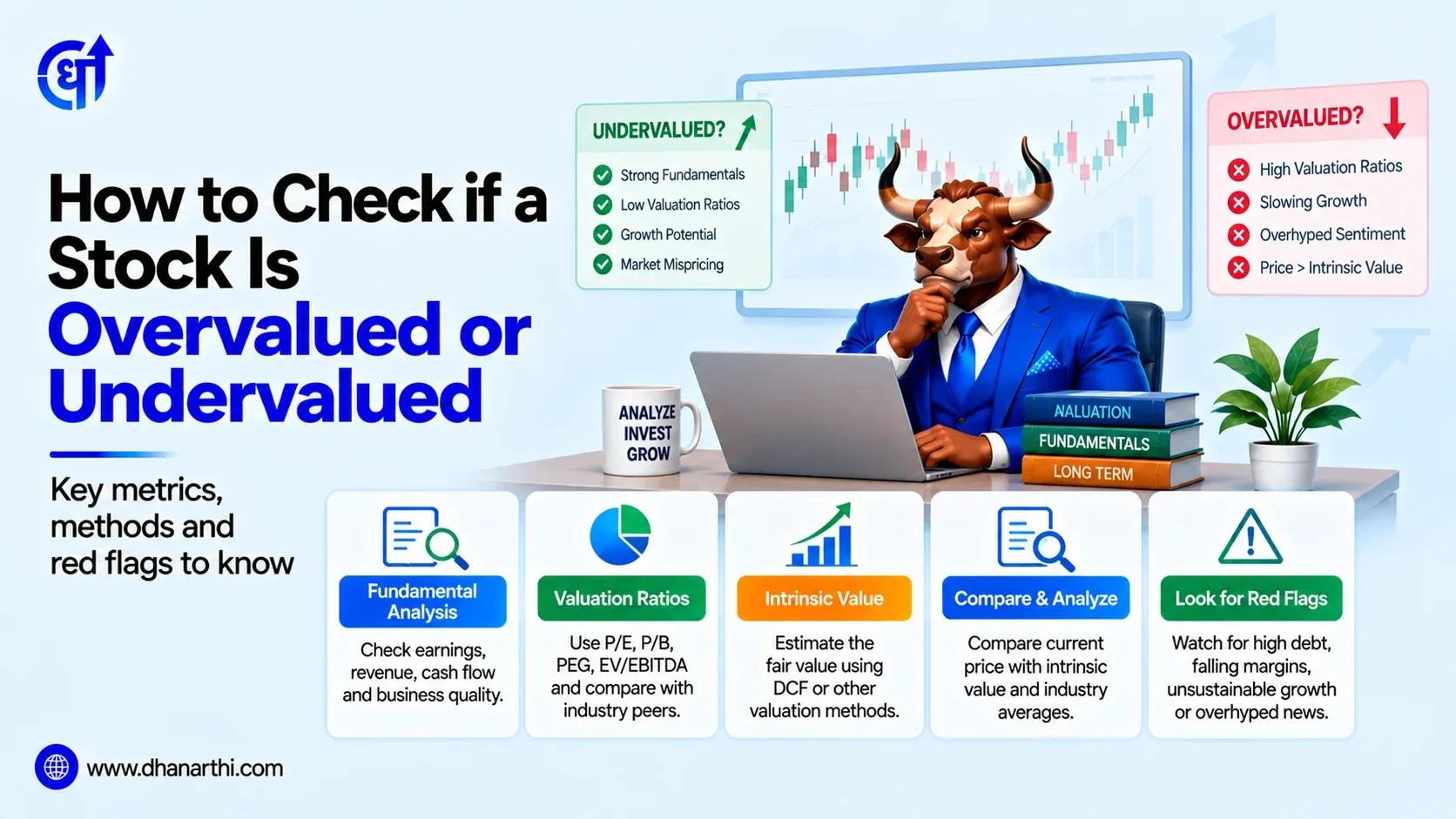



How to Check if a Stock Is Overvalued or Undervalued
September 23, 2026



TABLE OF CONTENTS
Get AI Summary






You are researching a stock and suddenly notice: 45% of promoter shares are pledged. Should you worry? Most investors skip this detail, and that is exactly where costly mistakes happen.
Pledge in stock market refers to using shares as collateral to raise funds without selling them. Pledge means keeping your shares as security against a loan.
In this article, you will learn the pledged shares meaning, how the process works, what margin pledge means, and how to read promoter pledge data to make smarter investment decisions. For a solid foundation, start with how to analyse a stock before investing.
Pledge in the stock market can be used for shares as collateral to borrow money from a lender, which can be either a bank or an NBFC. You do not sell the shares. You keep the shares, but the lender has the authority to sell them if you do not repay the loan.
Think of it like using a gold ornament as security for a bank loan. You keep the gold until you complete your repayment. The bank will sell the gold to recover its losses if you do not pay back your loan. Shares operate in the same manner.
The pledge meaning in the stock market is governed by SEBI (Securities and Exchange Board of India) and processed through depositories CDSL and NSDL, ensuring transparency and investor protection at every step.
Pledge in Hindi Meaning : गिरवी क्या होता है? --> Pledge (गिरवी) का अर्थ है अपने शेयरों को लोन लेने के लिए बैंक या NBFC के पास गिरवी रखना। शेयर आपके ही रहते हैं, लेकिन लोन न चुकाने पर लेंडर उन्हें बेच सकता है।
Here is exactly how the pledge in the share market works:
An investor holds shares in a demat account (with CDSL or NSDL).
Investor submits a pledge request through their broker's platform.
The broker forwards the request to the depository.
The investor receives a confirmation alert via email or SMS and approves via OTP.
The lender provides a loan or trading margin against the pledged shares, minus a haircut.
Investor repays the loan, and the pledge is released. Shares return to normal status.
If the investor fails to repay, the lender sells the pledged shares in the open market to recover the loan.
A Haircut is the Percentage that could share value the lender will NOT lend against.
Example: Your shares are worth Rs. 1,00,000. The lender applies a 30% haircut. You receive only Rs. 70,000 as a loan. The 30% buffer protects the lender in case the share price drops. The higher the stock's volatility, the higher the haircut.
An investor uses a margin pledge to provide their current assets as collateral, which allows them to access additional funds for trading in Futures and Options (F&O) markets. The process differs from a promoter who pledges their shares to obtain funding for business operations or personal expenses.
Key difference:
Promoter pledge = raising personal or business funds
Margin pledge = getting additional trading margin from a broker
The Securities and Exchange Board of India introduced a new pledge-repledge system in 2020 to safeguard retail investors. Under this system, shares remain in the investor's own demat account. The broker is prohibited from using the shares because only a pledge mark exists. This reform established a major new protection system that helps to safeguard investors.
If you trade in F&O and want to understand how margin works in practice, the article on options vs stocks is a useful read.
Promoters pledge their shares for several reasons:
To raise funds for business expansion without diluting their equity stake
To meet short-term working capital needs in capital-intensive sectors like infrastructure or real estate
To fund personal financial requirements
To finance strategic acquisitions quickly when time is limited
The investors go in with a contract that lets them leave with expanded compensation.
Promoter pledge The quarterly shareholding pattern, which companies submit to NSE and BSE, contains their complete shareholding information. The company promotes its track record through its main management team, who control all aspects of business operations. A business experiences financial distress when its promoter shareholder base increases its pledged shares to extreme levels.
Non-promoter pledge: The ownership rights that institutional and public shareholders hold in a company bring unique consequences that differ from each other. The situation seems less serious because independent investors handle their own investment portfolios, while they lack the power to control company activities.
The quarterly shareholding pattern data, which is accessible through NSE and BSE, shows the pledge percentage. IndusInd Bank promoters pledged 50.9% of their holdings as of December 2024, while Apollo Hospitals pledged 13.5% of their holdings, according to the report from Kotak Institutional Equities.
To check pledge share meaning in real data for any company, use a best stock screener like Dhanarthi's stock screener to instantly filter companies by promoter pledge percentage.
Not all pledging is bad. But a high pledge percentage can signal financial stress. Here is when to be cautious:
Pledge percentage above 50% of promoter holding is widely considered a red flag
Pledge percentage rising quarter-on-quarter without a clear explanation is a warning sign
If the stock price falls sharply, lenders may trigger a margin call, forcing promoters to sell pledged shares, crashing the price further
This is called a pledge-triggered sell-off, and it can be brutal for retail investors.
Simple example: Company X has 70% promoter pledge. Stock falls 20%. The lender sells pledged shares to recover the loan. This creates additional selling pressure. Price falls further. Retail investors suffer losses.
The Securities and Exchange Board of India requires companies to disclose all pledge creation and invocation activities, which they must report to stock exchanges. The data achieves credibility because you access checked information that meets regulatory standards.
For a deeper understanding of how SEBI protects market participants, read what is SEBI.
NSE and BSE shareholding pattern filings (quarterly)
Annual reports of companies
Percentage of promoter holding pledged
Trend is it increasing or decreasing quarter-on-quarter?
Comparison with peers in the same sector
Do not panic if the pledge percentage is low and declining
Be cautious if the pledge percentage is above 50% and rising
Always investigate the reason some promoters pledge temporarily for business expansion, not financial distress
Pledge in stock market is not automatically a negative signal, but it demands careful monitoring. Pledge margin requirements must be understood by retail investors who study company ownership structure and by F&O traders who want to learn about the margin pledge and their brokers' margin requirements.
Promoters' pledge information should be verified before making an investment decision. The combination of rising pledge percentages and declining stock prices serves as a strong early warning indicator for all investors to observe.
The Dhanarthi stock screener enables instant access to pledged shares information for all Indian companies, which helps users identify potential dangers that could damage their investment portfolios.
1. Is share pledging good or bad?
Share pledging is not automatically good or bad. It depends on the pledge percentage and the reason behind it. Low and declining pledge is usually fine. High pledge above 50%, especially when rising quarter-on-quarter, can indicate financial stress and is considered a risk signal for investors.
2. How does stock pledge work?
A shareholder submits a pledge request through their broker. The depository (CDSL or NSDL) marks the shares as pledged. The lender provides a loan or margin minus a haircut. If the loan is repaid, the pledge is released. If not, the lender sells the shares to recover the amount.
3. Can I sell pledged shares?
No. You cannot sell pledged shares until the pledge is released. The lender holds a lien on those shares. Once you repay the loan fully and the pledge is removed by the depository, the shares become free and available for selling or any other transaction.
4. Is pledge good or bad for a company's stock?
Moderate and temporary pledging for business expansion is generally acceptable. However, very high promoter pledge especially above 50% raises concerns about financial health. If lenders sell pledged shares due to default, it creates heavy selling pressure and can significantly damage the stock price.
5. Can we withdraw pledged money?
Yes. Once you pledge shares and the lender approves the loan or margin, the funds are credited to your account and you can use them. However, the shares remain under pledge until you repay the full loan along with applicable interest charges.
6. What happens if the pledged stock price falls?
If the stock price falls sharply, the loan value exceeds the collateral value. The lender issues a margin call, asking you to add more collateral or repay part of the loan. If you cannot, the lender has the right to sell the pledged shares immediately without further notice to recover the outstanding amount.
7. What is the difference between pledge and margin pledge?
A regular pledge is when a promoter or investor pledges shares to raise a personal or business loan from a bank or NBFC. A margin pledge is when a trader pledges existing holdings with their broker to get additional trading margin, usually for F&O trading. The purpose and mechanism differ significantly.
8. What percentage of promoter pledge is safe?
There is no fixed rule, but a promoter pledge below 20% is generally considered low risk. Between 20% and 50% warrants monitoring. Above 50% is widely treated as a red flag, especially if it is rising over successive quarters without a clear business justification.
9. Who regulates the pledge process in India?
SEBI (Securities and Exchange Board of India) regulates the pledging framework in India. The actual process is executed through depositories CDSL and NSDL. In 2020, SEBI introduced a new pledge-repledge mechanism to ensure shares stay in the investor's demat account and cannot be misused by brokers.
10. How do I check pledged shares data for any stock?
You can find pledge data in the quarterly shareholding pattern filings on NSE and BSE websites. You can also use a best stock screener like the Dhanarthi screener at dhanarthi.com/screener to filter and check promoter pledge percentages for any listed Indian company instantly.
Share Market
IPO
Artificial Intelligence
Semi Conductor