





Stock Market Basics for Beginners in India
October 24, 2026



TABLE OF CONTENTS
Get AI Summary






Best fintech stocks in India for 2026 span five sub-sectors: lending (Bajaj Finance), insurtech (PB Fintech), digital payments (Paytm, MobiKwik), and market infrastructure (CDSL, CAMS, HDFC AMC). UPI processed 22.6 billion transactions in a single month in 2026, and several fintechs posted their first profitable quarters in 2025-26, marking a real shift from growth story to profitability story.
Fintech stocks represent ownership in businesses that use technology to deliver financial services across five sub-sectors: digital payments, lending and credit, insurtech, wealthtech and market infrastructure, and emerging small-cap platforms. These companies sit at the intersection of financial services and technology, generally achieving faster growth than traditional banks through lower operating costs.
India's digital public infrastructure gives fintechs here a structural advantage few other markets have. Aadhaar provides instant identity verification, UPI enables near-free instant payments, and the Account Aggregator framework lets users share financial data securely with lenders. Together, these systems have cut customer acquisition costs by roughly 90-95% compared to traditional banking channels.
The most significant shift in investor sentiment through 2024-26 has been profitability. PB Fintech turned profitable in FY25, and One MobiKwik Systems posted three consecutive profitable quarters through 2026, including a swing from a ₹56 crore loss to a ₹4.4 crore profit in Q4 FY26 alone (Source: Tickertape, 2026). This transition from growth story to profitability story is drawing renewed institutional interest into the sector. For a broader framework before investing in any stock, see Dhanarthi's guide to how to analyse a stock before investing.
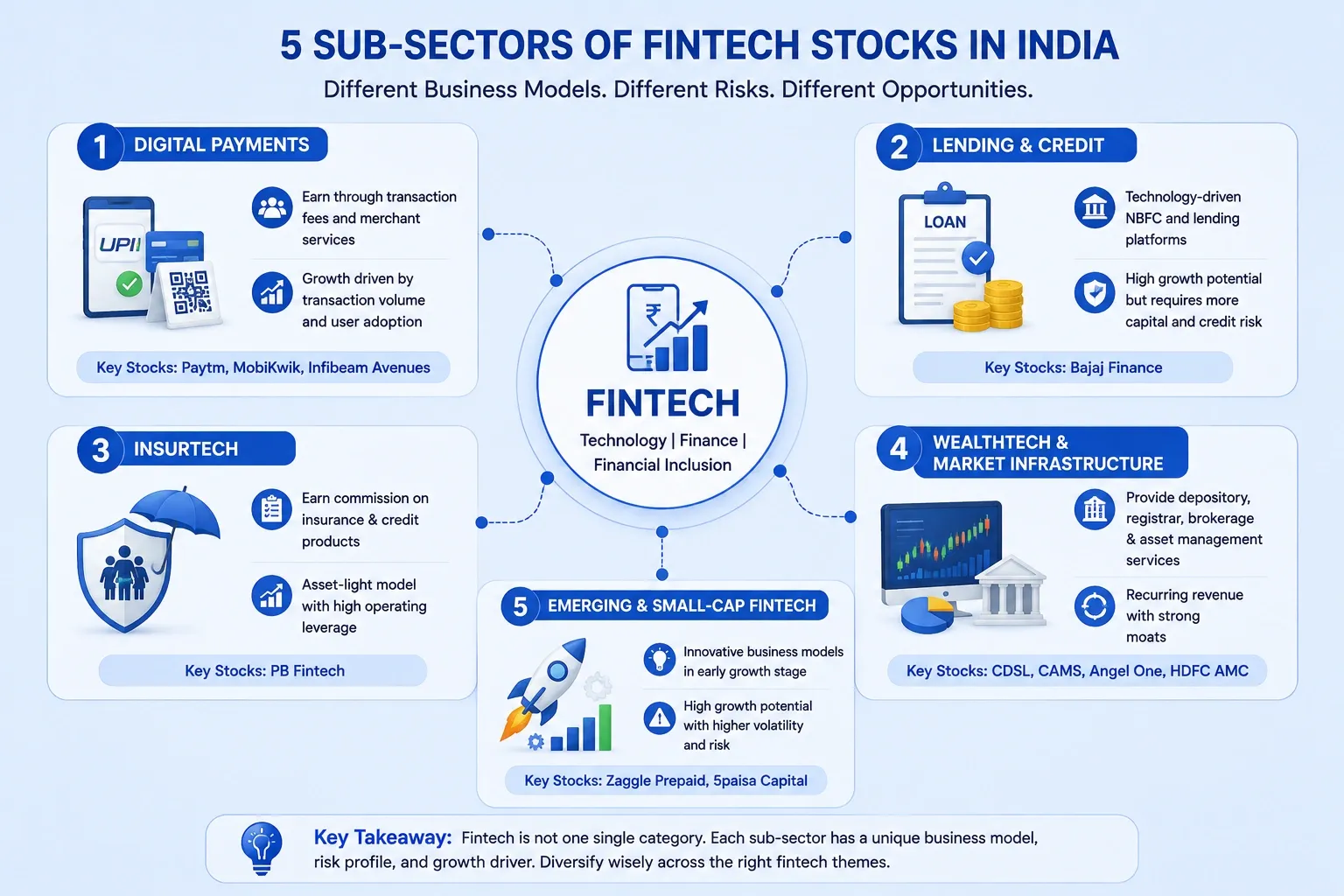
Digital Payments: Paytm (One97 Communications), MobiKwik, and Infibeam Avenues earn revenue through transaction fees, payment gateway charges, and merchant services. Growth comes from transaction volume, but margins face ongoing regulatory and competitive pressure.
Lending and Credit: Bajaj Finance runs a technology-driven NBFC model, using data-based underwriting and distribution. This sub-sector requires the most capital, since companies carry direct credit risk on their balance sheets.
Insurtech: PB Fintech, through PolicyBazaar and Paisabazaar, earns commission on insurance policies and lead generation for credit products, using an asset-light model with high operating leverage.
Wealthtech and Market Infrastructure: CDSL, CAMS, Angel One, and HDFC AMC provide depository services, mutual fund registrar functions, brokerage, and asset management. These businesses behave like regulated infrastructure, generating steady, recurring revenue.
Emerging and Small-Cap Fintech: Zaggle Prepaid and 5paisa Capital represent smaller, higher-growth, higher-volatility names, suited only to investors who can tolerate sharp price swings.
| Company | Sub-Sector | Market Cap (Cr) | P/E Ratio | ROE |
|---|---|---|---|---|
| Bajaj Finance | Lending/NBFC | ₹6,81,306 | ~35 | Strong |
| HDFC AMC | Wealthtech | ₹1,07,681 | 36.34 | 31.8% (3-yr) |
| Paytm (One97 Communications) | Digital Payments | ₹1,01,767 | Negative | -4.48% (3-yr) |
| PB Fintech | Insurtech | ₹74,057 | 110.54 | Improving |
| CDSL | Market Infra | ₹28,019 | Premium | 29.2% (3-yr) |
| Angel One | Wealthtech | ₹26,612 | Cyclical | Strong in bull markets |
| CAMS | Market Infra | ₹19,001 | Premium | 39.9% (3-yr) |
| Zaggle Prepaid | Emerging Fintech | ₹2,200-2,500 (volatile) | ~17-40 | 10.4% (3-yr) |
| 5paisa Capital | Wealthtech | ₹1,800 | ~41 | Volatile |
| MobiKwik | Digital Payments | ₹1,455-1,580 | Negative to breakeven | Improving |
| Infibeam Avenues | Digital Payments | ~₹5,174-6,700 | ~24 | ~4.9% |
| Suvidhaa Infoserve | Digital Payments | Small-cap, below-average growth | NA | Weak |
Data sourced from NSE, BSE, and Screener.in. Figures change daily with trading activity and quarterly results; verify current prices before investing.
Bajaj Finance is India's most established technology-driven NBFC, using data-based underwriting across consumer, SME, and rural lending. Assets under management grew 24% year-on-year to roughly ₹5,46,900 crore as of June 30, 2026, with customer franchise reaching 12.44 crore (Source: Tickertape, 2026). Its P/E of roughly 35 reflects the market's pricing of superior asset quality and consistent double-digit AUM growth. Why it belongs here: the closest thing to a safe anchor in the fintech list, combining large-cap stability with technology-led growth.
HDFC AMC manages India's largest mutual fund business, HDFC Mutual Fund, with total AUM of ₹8.44 lakh crore as of March 2026 (Source: Screener.in, 2026). It carries a strong 3-year ROE of 31.8% and a near-debt-free balance sheet, with HDFC Bank holding a 52.4% stake. Why it belongs here: the most reliable, indirect way to gain exposure to India's structural shift from physical savings to financial assets.
Paytm holds the largest fintech brand recognition in India, with a market cap of ₹1,01,767 crore and profit growth of 19.5% CAGR over the last five years, though 3-year ROE remains negative at -4.48% (Source: Screener.in, 2026). Investors should note that SEBI issued a fresh show-cause notice to the company on August 11, 2026, concerning disclosure timing around a December 2023 event, adding to the regulatory scrutiny that has followed the stock since the 2024 Paytm Payments Bank action. Why it belongs here: high brand recognition justifies tracking, but regulatory and profitability risk must be priced in explicitly.
PB Fintech runs India's leading insurance comparison platform and carries a market cap of ₹74,057 crore with a P/E of 110.54, reflecting the market's confidence in its post-FY25 profitability inflection (Source: Angel One, 2026). Why it belongs here: an asset-light model with improving profitability, though the high P/E leaves little room for disappointment.
CDSL operates as one of only two securities depositories in India, with a market cap of ₹28,019 crore, a 3-year ROE of 29.2%, and a near-debt-free balance sheet (Source: Screener.in, 2026). Why it belongs here: the lowest-risk name in the fintech space, with a genuine regulatory moat producing highly predictable recurring revenue.
Angel One is one of India's leading discount brokerages, with a market cap of ₹26,612 crore, revenue of ₹5,426 crore, and profit of ₹1,032 crore, though promoter holding has declined to 28.6% over the past three years (Source: Screener.in, 2026). Why it belongs here: a high-growth play on India's retail trading boom, with clear cyclical risk tied to F&O volumes.
CAMS services roughly 70% of India's mutual fund assets as registrar and transfer agent, with a market cap of ₹19,001 crore and an exceptional 3-year ROE of 39.9% (Source: Screener.in, 2026). Why it belongs here: conservative fintech exposure with infrastructure-level moats and direct leverage to India's SIP growth story.
Zaggle provides corporate prepaid card and expense management solutions, with a market cap that has fallen to the ₹2,200-2,500 crore range after a sharp correction. The stock hit a 20% lower circuit and a 52-week low in August 2026 following weak Q1 FY27 results, with net profit plunging 56.82% year-on-year to ₹17.53 crore (Source: HDFC Securities, August 2026). Why it belongs here: a differentiated B2B fintech model, but recent results underline the earnings volatility typical of small-cap fintech names.
5paisa Capital is a small-cap discount brokerage with a market cap near ₹1,800 crore. Full-year FY26 net profit declined 35% to ₹44.19 crore on an 11% sales decline, though the company returned to sequential growth in Q1 FY27 (Source: Tickertape, 2026). Why it belongs here: a small-cap fintech play for investors comfortable with sharper volatility than Angel One in exchange for potentially higher upside.
MobiKwik operates a digital wallet, UPI, and lending platform serving over 189 million registered users. The company swung from a ₹56 crore loss to a ₹4.4 crore profit in Q4 FY26, its third consecutive profitable quarter, though full-year FY26 still showed a net loss of ₹62.1 crore (Source: Tickertape, 2026). Why it belongs here: a genuine turnaround story in digital payments, though profitability remains recent and unproven over a longer stretch.
Infibeam Avenues operates CC Avenue, one of India's largest payment gateways, processing transactions for over 600,000 merchants. The company maintains a debt-to-equity ratio of just 0.02 and trades at a reasonable P/E near 24 (Source: SAMCO, 2026). Why it belongs here: an under-the-radar value pick in digital payments with the cleanest balance sheet among small-cap fintech names.
Suvidhaa Infoserve provides payment collection and financial services distribution but shows below-average growth and a weaker capital structure relative to fintech peers (Source: sector peer comparison, 2026). This name suits only investors specifically researching micro-cap payment enablers, given its comparatively weak fundamentals against the rest of this list.
Path to profitability: Track quarter-on-quarter EBITDA margin trends. The timeline a loss-making fintech needs to reach breakeven determines whether its current valuation is reasonable.
ROCE and ROE: CDSL and CAMS demonstrate what strong unit economics look like, with 3-year ROE above 29% and 39% respectively, sustained over multiple years.
Revenue model clarity: Recurring models like CAMS's trail income or CDSL's annual charges are structurally more valuable than one-time transaction fees.
Regulatory compliance track record: RBI and SEBI hold significant authority over fintech operations. The 2024 Paytm Payments Bank action, and Paytm's fresh August 2026 SEBI show-cause notice, show how quickly regulatory action can move a stock. Learn more about what is SEBI to understand this oversight.
User growth versus monetisation: Revenue per user and retention matter more than headline user counts. A fintech with fewer, more engaged, higher-paying users is worth more than one with a larger but shallow user base.
Debt-to-equity ratio: Lending fintechs like Bajaj Finance carry credit risk directly on their balance sheet. Review the debt-to-equity ratio alongside NPA trends before investing in any lending-focused name.
AI-driven credit underwriting now evaluates new-to-credit customers using mobile data, transaction history, and GST filings within seconds, expanding the addressable market for lending fintechs.
Embedded finance via OCEN and Account Aggregator is spreading across e-commerce, travel, and retail apps, with pre-approved loans and bundled insurance becoming standard checkout features.
UPI credit and BNPL adoption is accelerating as pre-approved credit lines become accessible directly through the existing UPI payment flow, benefiting both payment and lending fintechs.
Bank-fintech partnerships have replaced disruption as the sector's dominant theme, with co-branded cards, co-lending arrangements, and white-label insurance products reducing fintechs' regulatory compliance burden while expanding distribution.
Regulatory risk remains the sector's defining feature. The 2024 Paytm Payments Bank episode and Paytm's fresh August 2026 SEBI show-cause notice both demonstrate how quickly a single regulatory action can reshape a company's outlook.
Profitability uncertainty is real for several names. Many fintech stocks trade at P/E ratios of 50-100x or higher on future earnings expectations; PB Fintech's 110.54 P/E leaves little room for a profitability delay before a sharp re-rating.
Competitive intensity stays high in payments and brokerage, where switching costs are low. Zaggle's 20% lower-circuit fall in August 2026 after a single weak quarter shows how quickly sentiment can turn on smaller names.
High P/E premium risk means fintech stocks trading on future growth expectations can fall 30-50% if a single earnings report disappoints, since current valuations offer little downside protection.
India's fintech sector reached a genuine inflection point in 2025-26, with multiple companies posting their first sustained profitable quarters. Build exposure across sub-sectors rather than concentrating in one: CDSL, CAMS, and HDFC AMC offer infrastructure-level stability, Bajaj Finance and PB Fintech offer established growth with different risk profiles, and Zaggle, 5paisa, and MobiKwik offer higher-risk, higher-potential exposure to earlier-stage names.
Verify current prices, quarterly results, and regulatory disclosures directly before committing capital, since this sector's valuations and risk profiles shift quickly on both earnings and policy news.
Disclaimer This article is for educational purposes only. It does not constitute investment advice. Please consult a SEBI-registered financial advisor before making investment decisions.
1. What are the top five fintech stocks in India?
Based on market position and fundamentals, the top five are Bajaj Finance, HDFC AMC, Paytm, PB Fintech, and CDSL, spanning lending, wealthtech, digital payments, insurtech, and market infrastructure.
2. Which fintech share is best to buy in India?
CDSL suits conservative investors due to its regulatory moat and 29.2% 3-year ROE. PB Fintech suits growth investors following its FY25 profitability turn. Infibeam Avenues offers value with a 0.02 debt-to-equity ratio. The right choice depends on your risk tolerance.
3. What are the top 10 fintech companies in India?
The top 10 by market presence are Bajaj Finance, HDFC AMC, Paytm, PB Fintech, CDSL, Angel One, CAMS, Zaggle Prepaid, 5paisa Capital, and MobiKwik, spanning the full fintech value chain.
4. Is Bajaj Finance a fintech stock?
Yes. While technically an NBFC, Bajaj Finance uses technology extensively for underwriting, digital onboarding, and distribution, placing it firmly at the intersection of NBFC and fintech classifications.
5. What are the best small-cap fintech stocks in India?
Commonly tracked small-cap names include 5paisa Capital, Infibeam Avenues, MobiKwik, and Zaggle Prepaid. All carry higher volatility than large-cap fintechs; Infibeam offers the cleanest balance sheet among them.
6. How do I evaluate fintech stocks before investing?
Focus on path to profitability via EBITDA margin trends, ROCE and ROE for capital efficiency, revenue model clarity, regulatory compliance track record, revenue per user over raw user counts, and debt-to-equity ratio for lending-focused names.
7. What risks should I know before buying fintech stocks in India?
Key risks include RBI and SEBI regulatory actions that can reshape a business model overnight, profitability uncertainty at high valuations, low switching costs driving customer churn, and premium valuations that leave little margin for earnings disappointment.
8. Is Paytm a good fintech stock to invest in?
Paytm carries negative 3-year ROE and an active SEBI show-cause notice from August 2026, alongside a longer regulatory history following the 2024 Paytm Payments Bank action. It suits investors specifically comfortable with regulatory and profitability risk, not conservative portfolios.
9. Which fintech stocks turned profitable recently?
PB Fintech turned profitable in FY25. MobiKwik posted three consecutive profitable quarters through 2026, though its full FY26 result remained a net loss. Track each company's quarterly trend rather than a single profitable quarter in isolation.
10. What is the fastest-growing fintech in India?
PB Fintech shows some of the fastest growth among established listed fintechs through insurance premium and Paisabazaar credit volumes. Among newer listings, MobiKwik's recent profitability turnaround stands out, though both carry different risk profiles.
Share Market
IPO
Artificial Intelligence
Semi Conductor