



Capital Gains Tax on Shares India 2026 Rates
October 23, 2026



TABLE OF CONTENTS
Get AI Summary





The trading community received an unexpected shock from the Union Budget 2026 announcement made yesterday. Finance Minister Nirmala Sitharaman announced an unexpected STT increase, which became the major surprise of the budget. The securities transaction tax rate on futures increased by 150%, and options trading was also affected.
The new rules will directly impact your trading costs if you participate in F&O trading or maintain equity investments. The following explanation will clarify STT to you through an example that demonstrates how the new rates will affect your trading expenses starting on April 1, 2026.
What are STT changes? The first question that comes to my mind is whether you're ever known to the stock market. Let me explain more clearly:
Security transaction Tax is a direct tax that the government of India collects every time you buy or sell securities on recognised stock exchanges. Just think of it as a small fee you pay on each transaction, whether you're trading stocks, derivatives, or investing in equity mutual funds.
Our government introduced STT on October 1, 2024, with a clear purpose: to bring transparency to securities trading. Before STT existed, many traders would hide their profits to avoid paying capital gain tax. With STT, the government automatically collects tax at any source the moment your trade happens.
Here are some of the reasons that make STT different from others:
In my experience, most beginners don't realize that STT charges are separate from brokerage fees. While brokers like Zerodha and Groww charge minimal or zero brokerage on delivery trades, STT is always here, a mandatory government that nobody can escape.
This section is critical because the Budget 2026 announcement has completely changed the game for F&O traders. I will demonstrate the exact sequence of events that occurred.
Here's the comparison table that every trader needs to see:
| Transaction Type | Rate till March 31, 2026 | Rate from April 1, 2026 | % Increase |
|---|---|---|---|
| Futures | 0.02% | 0.05% | 150% |
| Options Premium | 0.10% | 0.15% | 50% |
| Options Exercise | 0.125% | 0.15% | 20% |
Let me put this in perspective.
The STT increase in Budget 2026 is the second major hike in just two years. The previous budget raised STT to a higher level.
The new percentage for futures increased from 0.0125% to 0.02%. The new percentage for options increased from 0.0625% to 0.1%.
Budget 2026 introduces new major increases because futures contracts now have a 150% rise. This is more than double the previous rate.
Good news here – STT charges on delivery remain unchanged at 0.1% on both buy and sell sides. The Budget directly impacts long-term investors who purchase delivery stocks because it does not affect their investment strategy.
The STT charges that apply to intraday equity trading maintain a rate of 0.025% for sell-side transactions only. The actual effects impact traders who work with derivatives.
All these new rates start from the beginning of the upcoming financial year. Current rates remain in effect until March 31, 2026. You should evaluate this schedule when you plan your F&O positions for your upcoming projects.
The stock market responded to the news with an instant reaction. The Sensex index dropped more than 1,000 points, and the Nifty index decreased by 1.45% during the Finance Minister's Budget speech on Budget Day. The market showed its disapproval of this action.
I have monitored market activities throughout several years, and I have observed that government authorities now show greater concern about excessive derivative speculation. The Budget 2026 STT hike is directly aimed at curbing this problem.
Here's the reality behind this decision:
SEBI data reveals a shocking fact – 93% of individual F&O traders incur losses. Yes, you read that right. Nine out of ten retail traders who venture into futures and options end up losing money. Yet despite these losses, 75% of them continue trading, hoping to recover their money.
The scale of speculation is mind-boggling. F&O trading volume in India is approximately 500 times the country's GDP. The F&O trading volume reaches ₹1.5 lakh crore while the GDP stands at only ₹300 lakh crore. The extent of speculative activities shows complete control over our markets.
The government's objectives are clear:
The statement about your trading losses shows that a higher securities transaction tax will help you avoid greater financial damage because it will make you consider your next trading decision more carefully.
The situation presents a deceptive contradiction because the actual collection amount for government STT revenue, which was projected to reach ₹78,000 crore in FY 2025-26 according to government estimates, had only reached ₹45,000 crore by January.
The organization projects its revenue for March to reach only ₹57,000 crore, which represents a 25 percent decline from its original revenue target. The implementation of higher STT rates from Budget 2024 has led to a decrease in trading volumes, which resulted in a smaller tax base instead of an expanded one.
I'm going to describe exactly how the STT is determined by using some real examples, helping you to get an idea of the levies' actual impact on your trading costs.
When you trade, STT is automatically deducted from your account. The payment does not require your calculation because it is included in your trading charges. Your stockbroker manages the entire process, and you will find the information in your contract note under charges.
Assume that you are trading Bank Nifty futures, which have a contract value of ₹1,00,000.
Old STT (till March 31, 2026): ₹1,00,000 × 0.02% = ₹20
New STT (from April 1, 2026): ₹1,00,000 × 0.05% = ₹50
Your STT cost just increased by ₹30 per contract. If you trade 10 contracts daily, that results in an additional cost of ₹300 per day, which totals to ₹6,000 per month based on 20 trading days.
The statement requires you to purchase Nifty call options and pay a premium of ₹10,000.
Old STT (till March 31, 2026): ₹10,000 × 0.10% = ₹10
New STT (from April 1, 2026): ₹10,000 × 0.15% = ₹15
The increase seems minimal for each trade, yet options trading requires traders to execute multiple trades throughout their trading day.
The small ₹5 increase results in active options traders who complete 20 trades daily to spend ₹100 every day, which totals to ₹2,000 each month.
For a ₹1,00,000 equity delivery trade:
The current rate remains unchanged since Budget 2026. STT appears as a minor percentage, yet active traders find that it accumulates rapidly.
Your total transaction expenses will consume your profits when added to brokerage fees and exchange costs, GST, and stamp duty.
The Budget 2026 STT increase will affect different people in different ways. I will explain which groups experience the greatest financial burden from this situation and which groups face minimal impact from it.
Day traders and F&O traders are the biggest casualties. Multiple intraday positions combined with daily scalp trading activities now result in increased operating costs for you.
High-frequency traders who employ algorithmic trading systems will experience decreased profit margins. Daily traders who conduct hundreds of trades will find that even minor STT rate increases create high trading expenses.
Arbitrageurs who profit from price differences between cash and futures markets will also suffer. Their already-thin margins will compress further.
Long-term equity investors can experience peace because nothing has changed. Your situation remains unchanged because you purchase quality stocks, which you will hold for multiple years. The STT charges for equity delivery transactions continue to exist at their previous 0.1% rate.
Delivery-based traders who swing trade stocks (holding positions for days or weeks) are also relatively safe. Your costs remain the same.
SIP investors and mutual fund investors won't notice any difference. STT charges for mutual fund redemptions maintain their current rate of 0.001%, which applies to equity-oriented funds. The STT charge for redeeming mutual funds worth ₹1 lakh amounts to only ₹1.
The stock market reacted to the news with extreme volatility. The Finance Minister delivered his speech on Budget day, which occurred on February 1, 2026, and during this time, the Sensex index lost 1021 points while Nifty experienced a 1.45% decline.
The fundamental stock analysis platforms found at Dhanarthi.com will gain advantages from this transition. Investors will adopt fundamental research and long-term value investing strategies because speculative trading costs now become more expensive.
The charges for STT and capital gains tax are constantly being mixed, and it can be very confusing if one has to stay involved in all such conditions. Well, now that at least this idea of separating the separate goals of your taxes is etched in your mind, I am gonna hope that you enter the trap of any of those sales.
Securities Transaction Tax is paid at the time of the transaction, regardless of profit or loss. The STT obligation persists even when you incur a loss. The system deducts the amount automatically, which you will find displayed in your brokerage statement.
Capital Gains Tax, on the other hand, is paid only when you make a profit. If you bought shares at ₹100 and sold at ₹120, you pay tax on the ₹20 profit. Your capital gains tax obligation disappears when you sell at ₹90 because you experience a capital loss that can be carried forward.
The STT deduction from your capital gains calculation, which you want to claim, does not exist. Your income tax calculation for both intraday trading and capital gains purposes must exclude STT from your acquisition costs. Your taxable profit decreases when you include brokerage charges, exchange fees, stamp duty, and all other charges in your cost.
The income from share trading, which you declare under "Profits/Gains from Business and Profession," enables you to deduct STT as a business expense according to Section 36 of the Income Tax Act.
Regular investors and occasional traders must accept STT as an expense that they must pay because it does not affect their tax obligations. Financial statement analysis serves as a crucial tool for this purpose.
The platform Dhanarthi.com provides financial report analysis tools, which enable you to monitor all your trading expenses, including STT, brokerage, and taxes, thus showing you the complete view of your actual returns.
Let me share some important characteristics of STT charges that every trader and investor should know.
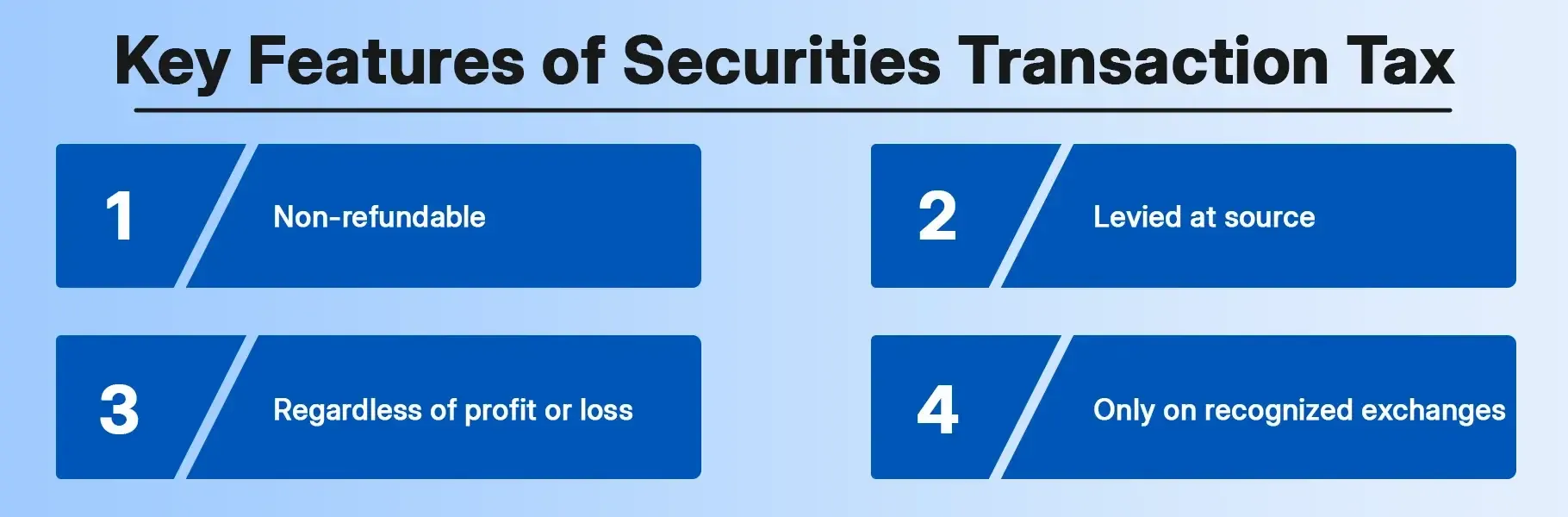
The STT payment becomes permanent because it cannot be retrieved after the payment. The STT payment functions as a final expense, while taxpayers can recover TDS through their return filings when they fall into a lower tax bracket. The process does not provide any options for refunding fees.
The system handles your STT payments through automatic deductions, which begin when your order reaches the exchange. The exchange automatically deducts STT from your account after your order executes. The broker handles collection and makes government payments by the 7th day of the following month.
This point demonstrates that STT charges function as a transaction tax instead of a profit-based tax. The STT payment remains constant because it depends on the transaction value, regardless of whether you earned a profit of ₹10,000 or incurred a loss of ₹10,000.
Many beginner traders are surprised when they discover that STT applies to their trades, which result in losses. The system operates according to this method.
The features of the system let you understand how to improve your trading choices. Investors who want to build wealth through equities should prioritize fundamental analysis because it will help them avoid STT expenses, which accumulate through their trading activities.
The trading community's reaction to STT, which is expected to increase in 2026, has been mixed, with various industry experts sharing interesting perspectives.
Several brokers have expressed some concerns about the potential impact which comes on trading volumes.
With various market experts who could see a positive step. They argue that some of the excessive speculation has created artificial volatility and harmed retail investors.
Financial analysts have discovered an interesting fact. The government projected ₹78,000 crore from STT in FY 2025-26, but actual collections are running 25% below target. The total amount collected until January 2026 reached ₹45,000 crore.
The trading volumes already decreased because the STT rate increased from the Budget 2024. The government will increase tax rates, which creates the possibility that total tax revenue will decrease instead of rising. This situation represents a real-world demonstration of the Laffer Curve economic principle.
Budget day brought negative stock performance for broking companies, which saw their stock prices drop between 5% and 8% for major brokerage firms. Investors expect that the increased transaction expenses will result in traders choosing less risky investment vehicles over their current derivatives trading habits.
The Budget 2026 STT increase establishes a new policy framework that India will follow to manage its derivatives market operations. F&O traders will definitely feel the pinch from April 1, 2026, because of the 150% STT increase for futures and 50% STT increase for options.
The new regulations only affect you if you invest through equity delivery or mutual funds as your primary investment method. The STT charges for delivery and mutual fund investments maintain their current rate.
The best approach for you is to evaluate your current trading procedures during this time. Day traders who make small profits must include these new expenses in their trading evaluations. Understanding stock market timings and using backtesting strategies can help optimize your trades. Fundamental investing might provide you with better results throughout your entire investment journey.
Disclaimer: This article is for educational purposes only and should not be considered as financial or tax advice. Tax laws are subject to change, and individual circumstances vary. Please consult with a qualified chartered accountant or tax advisor for personalized guidance based on your specific situation.
1. What is STT and how is it calculated?
STT (Securities Transaction Tax) is a direct tax charged on buying and selling securities on stock exchanges. It's calculated as a percentage of the transaction value – for example, a ₹1 lakh futures trade at 0.05% rate attracts ₹50 STT, automatically deducted by your broker.
2. What do you mean by STT?
STT stands for Securities Transaction Tax. It's a government levy you pay every time you trade stocks, futures, or options on recognized exchanges like NSE or BSE. Think of it as a small mandatory fee collected automatically, whether you make profit or loss.
3. What is the current STT rate in 2026?
From April 1, 2026, futures STT is 0.05%, options premium is 0.15%, and options exercise is 0.15%. For equity delivery, it remains 0.1% on both buy and sell sides. Intraday equity trading continues at 0.025% on the sell side only.
4. Can I claim STT in ITR?
Regular investors cannot claim STT as a deduction from capital gains. However, if trading is your primary profession and you file income under "Business and Profession," you can claim STT as a business expense under Section 36 of the Income Tax Act.
5. What is STT charges in stock market?
STT charges are mandatory government taxes on stock market transactions. The rate varies by security type – equity delivery (0.1%), intraday (0.025%), futures (0.05% from April 2026), and options (0.15% from April 2026). Your broker automatically collects and deposits it to the government.
6. Is STT automatically deducted?
Yes, STT is automatically deducted the moment your trade is executed on the exchange. You don't need to calculate or pay it manually. Your broker handles everything, and you'll see the STT amount clearly mentioned in your contract note under transaction charges.
7. Can STT be claimed back?
No, STT is non-refundable. Unlike TDS which you can claim back while filing returns, STT is a final payment that cannot be recovered. Once paid, it goes directly to the government and there's no mechanism to get it back under any circumstances.
8. What are STT charges on delivery?
STT charges on delivery trades are 0.1% on both buy and sell sides. For example, if you buy ₹1 lakh worth of shares, you pay ₹100 STT while buying and another ₹100 while selling, totaling ₹200 STT for the complete transaction.
9. What are STT charges in Zerodha?
STT charges in Zerodha are the same as any other broker because the government sets these rates, not brokers. For delivery, it's 0.1% on buy and sell. For futures, it's 0.05% (from April 2026). Zerodha only collects STT and deposits it to the government.
10. What are STT charges in Groww?
STT charges in Groww follow government-mandated rates identical across all brokers. Whether you use Groww, Zerodha, or any platform, STT remains the same: 0.1% for delivery equity, 0.025% for intraday, 0.05% for futures, and 0.15% for options (rates effective April 2026).
11. What are STT charges on intraday trading?
STT charges on intraday equity trading are 0.025% on the sell side only. For example, if you buy and sell ₹1 lakh worth of shares on the same day, you pay ₹25 STT. Intraday rates haven't changed in Budget 2026 and remain the same.
12. What is the STT hike in Budget 2026?
Budget 2026 introduced a massive STT hike: futures increased 150% from 0.02% to 0.05%, options premium rose 50% from 0.10% to 0.15%, and options exercise jumped 20% from 0.125% to 0.15%. These new rates take effect from April 1, 2026.
13. What are STT charges in mutual fund investments?
STT charges in mutual funds are minimal – just 0.001% on redemption of equity-oriented fund units. For a ₹1 lakh redemption, you pay only ₹1 as STT. Debt mutual funds and non-equity funds don't attract any STT at all, making them STT-free investments.
14. How does income tax on intraday trading relate to STT?
STT and income tax on intraday trading are separate charges. STT is paid at transaction time regardless of profit or loss, while income tax is paid only on profits earned. Unfortunately, STT paid cannot be deducted from your taxable intraday profits for regular traders.
15. What are the benefits of using STT?
STT brings transparency to stock market trading and prevents tax evasion. It's collected automatically at source, making tax compliance simple and reducing instances of non-payment. STT also helps the government track securities transactions and generate revenue for public welfare and infrastructure development.
Share Market
IPO
Artificial Intelligence
Semi Conductor