




Don’t Trade in the Dark—Get Your Pre-Market Report Every Day.Join Now
Dhanarthi

Best Tobacco Stocks in India 2026 | Top 10 Companies List

Best Tobacco Stocks in India 2026 | Top 10 Companies List

TABLE OF CONTENTS

    The tobacco stocks in the India market have always been unique, debated, yet highly profitable. Investors who focus on generating income still show interest in Indian tobacco company stocks because these stocks provide consistent dividends and act as safe investments despite health issues that affect the industry.

    In my experience, understanding this sector requires balancing financial potential with regulatory risks. The guide provides information about India's leading tobacco stocks, which include their characteristics, potential hazards, and their suitability for different investment objectives. We will proceed with practical and straightforward solutions. For newcomers to investing, check out our stock market trading tips for beginners to build a solid foundation.

    What are Tobacco Stocks?

    My memory shows that I spent eight hours editing a 10-minute video, which was only 10 minutes long. I found the work to be exhausting because I had to remove silent parts of the video, synchronise different camera views, and create subtitles. The introduction of AI video editing tools revolutionised my work process because all my tasks became simpler to manage.

    The tools provide more than just better performance because they enable users to use their footage for intelligent edits while executing complex tasks that would require multiple hours in just several minutes.

    Here's what makes them stand out:

    • People who smoke tobacco maintain their smoking habits despite price increases.
    • Established brands generate reliable income because they maintain strong cash flow.
    • The government examines tobacco products through its system of imposing high taxes and enforcing advertising limits.
    • When you consider all these facts combined, cigs alone constitute over 90% of tobacco use in India, meaning that it is a concentrated yet highly potent market.

    Tobacco Industry in India – A Brief Overview

    The Indian tobacco industry operates on a large scale. The industry will generate $14 billion in revenue during 2025, and it will continue to expand at a consistent rate of 4.2% CAGR until 2030.

    Let me share some real numbers that show the scale:

    • The tobacco industry currently has more than 275 million adult tobacco users who use its products.
    • The total workforce in the United States agricultural, manufacturing, and export sectors reaches 45.7 million workers.
    • Tobacco farming requires 0.45 million hectares of land for its operations.

    The tobacco production industry in India operates as its second most productive sector worldwide. The main tobacco-production states include Gujarat, which produces 45% of total output, Andhra Pradesh, which produces 20%, Uttar Pradesh, which produces 15%, and Karnataka, which produces 8% of total output.

    The concentrated market structure operates through existing companies, which maintain control over the market. The established companies possess both high entry barriers and controlled pricing authority. The tobacco production map of India should be displayed through an infographic.

    Best Tobacco Stocks in India 2026

    No. Company Name Market Cap (₹ Cr) Price Range (₹) P/E Ratio 1-Year Return Dividend Yield Segment / Key Focus
    1 ITC Ltd 5,50,000+ 450 – 470 25 – 28 5 – 8% 3.5 – 4.0% Cigarettes, FMCG, Hotels, Paperboards
    2 Godfrey Phillips India 38,000+ 6,500 – 6,800 45 – 50 140 – 150% 0.8 – 1.0% Premium Cigarettes (Marlboro, Red & White)
    3 VST Industries 5,000+ 3,500 – 3,700 18 – 22 -10 to -15% 5.0 – 6.0% Cigarettes (South India focus)
    4 Golden Tobacco 500+ 220 – 240 12 – 15 15 – 20% 2.5 – 3.0% Regional Cigarette Brands
    5 Indian Wood Products 150+ 280 – 300 8 – 10 10 – 15% 1.5 – 2.0% Niche Tobacco Products
    6 NTC Industries 80+ 180 – 200 15 – 18 5 – 10% 1.0 – 1.5% Tobacco, Textiles, Paper
    7 Radhika Jeweltech 40+ 60 – 70 NA 20 – 25% 0.5 – 1.0% Penny Tobacco Stock
    8 Dharamsi Morarji Chemical 35+ 45 – 50 NA 8 – 12% 1.0 – 1.2% Specialty Tobacco Inputs
    9 Kothari Products NA NA NA NA NA Regional Tobacco Products
    10 Ausom Enterprise 15+ 35 – 40 NA 3 – 5% 0.5 – 0.8% Micro-cap Cigarette Manufacturer

    Top 10 Tobacco Stocks in India 2026

    The top 10 tobacco stocks in India need to be known because their market capitalisation, performance, and fundamental analysis establish them as the best investments of the industry. Understanding large cap vs mid cap vs small cap helps you categorize these companies better.

    1. ITC Ltd

    ITC Ltd holds the top position in India's tobacco industry because it controls more than 80 per cent of the cigarette market. The company stands out because it operates multiple business areas, which include FMCG, hotels, paperboards and agri-business.

    Market Cap: ₹5,50,000+ crore
    Current Price: ₹450-470
    P/E Ratio: 25-28
    1-Year Return: 5-8%
    Dividend Yield: 3.5-4.0%

    Key Strengths: The ITC company achieves its non-reliance on tobacco income through its diverse business operations. The cigarette market is mainly controlled by the brands Gold Flake, Classic, and Navy Cut. The company attracts income investors through its robust distribution network and its track record of regular dividend payments. For comparison, explore best FMCG stocks in India to understand ITC's FMCG segment.

    2. Godfrey Phillips India

    Godfrey Phillips India has delivered exceptional returns with 140-150% gains, which occurred during the last year. The company operates as a dedicated tobacco business which produces well-known brands such as Marlboro, Four Square and Red & White.

    Market Cap: ₹38,000+ crore
    Current Price: ₹6,500-6,800
    P/E Ratio: 45-50
    1-Year Return: 140-150%
    Dividend Yield: 0.8-1.0%

    Key Strengths: The company maintains a strong brand portfolio, which enables its growth into premium markets through its active pursuit of premiumization. The company operates successfully despite facing challenges from GST 2.0.

    3. VST Industries

    VST Industries operates cigarette manufacturing operations throughout southern India. The company provides substantial dividend payments, which attract investors who seek income.

    Market Cap: ₹5,000+ crore
    Current Price: ₹3,500-3,700
    P/E Ratio: 18-22
    1-Year Return: -10 to -15%
    Dividend Yield: 5.0-6.0%

    Key Strengths: The company maintains its market leadership throughout South India while generating stable income streams and providing its investors with one of the highest dividend distributions in the industry.

    4. Golden Tobacco

    Golden Tobacco operates as one of the few mid-cap tobacco stocks with a high regional thrust and a strong competitive price platform.

    Market Cap: ₹500+ crore
    Current Price: ₹220-240
    P/E Ratio: 12-15
    1-Year Return: 15-20%
    Dividend Yield: 2.5-3.0%

    5. Indian Wood Products

    They are active in the type of company that is serving the small-cap segment while exposing niche tobacco product exposure.

    Market Cap: ₹150+ crore
    Current Price: ₹280-300
    P/E Ratio: 8-10
    1-Year Return: 10-15%
    Dividend Yield: 1.5-2.0%

    6. NTC Industries

    NTC Industries operates in different segments, including tobacco, textiles, and paper.

    Market Cap: ₹80+ crore
    Current Price: ₹180-200
    P/E Ratio: 15-18
    1-Year Return: 5-10%
    Dividend Yield: 1.0-1.5%

    7. Radhika Jeweltech

    Radhika Jeweltech operates as a penny stock which belongs to the tobacco industry and trades on Indian stock exchanges. The stock presents investors with an opportunity to achieve substantial returns through its high-risk nature.

    Market Cap: ₹40+ crore
    Current Price: ₹60-70
    1-Year Return: 20-25%
    Dividend Yield: 0.5-1.0%

    For more high-risk opportunities, explore best penny stocks in India.

    8. Dharamsi Morarji Chemical

    In a different and smaller capacity, this company engages in particular tobacco segments.

    Market Cap: ₹35+ crore
    Current Price: ₹45-50
    1-Year Return: 8-12%
    Dividend Yield: 1.0-1.2%

    9. Kothari Products

    Kothari Products is concentrated on the regional tobacco markets, while the national presence is quite limited.

    10. Ausom Enterprise

    Ausom Enterprises sits on the extreme low end of the hypothetical scale of microcaps, which also includes cigarette manufacturers.

    Market Cap: ₹15+ crore
    Current Price: ₹35-40
    1-Year Return: 3-5%
    Dividend Yield: 0.5-0.8%

    Latest GST 2.0 Impact on the Tobacco Industry

    Historic Budget Presentation: Budget 2026-27 is historic for procedural reasons as well. The Union Budget becomes a historical first for India because it will be presented on February 1 2026 which falls on a Sunday.

    Finance Minister Nirmala Sitharaman delivered her ninth consecutive budget speech, which lasted 1 hour and 25 minutes, making it the third shortest budget speech on record.

    The 40% GST Slab

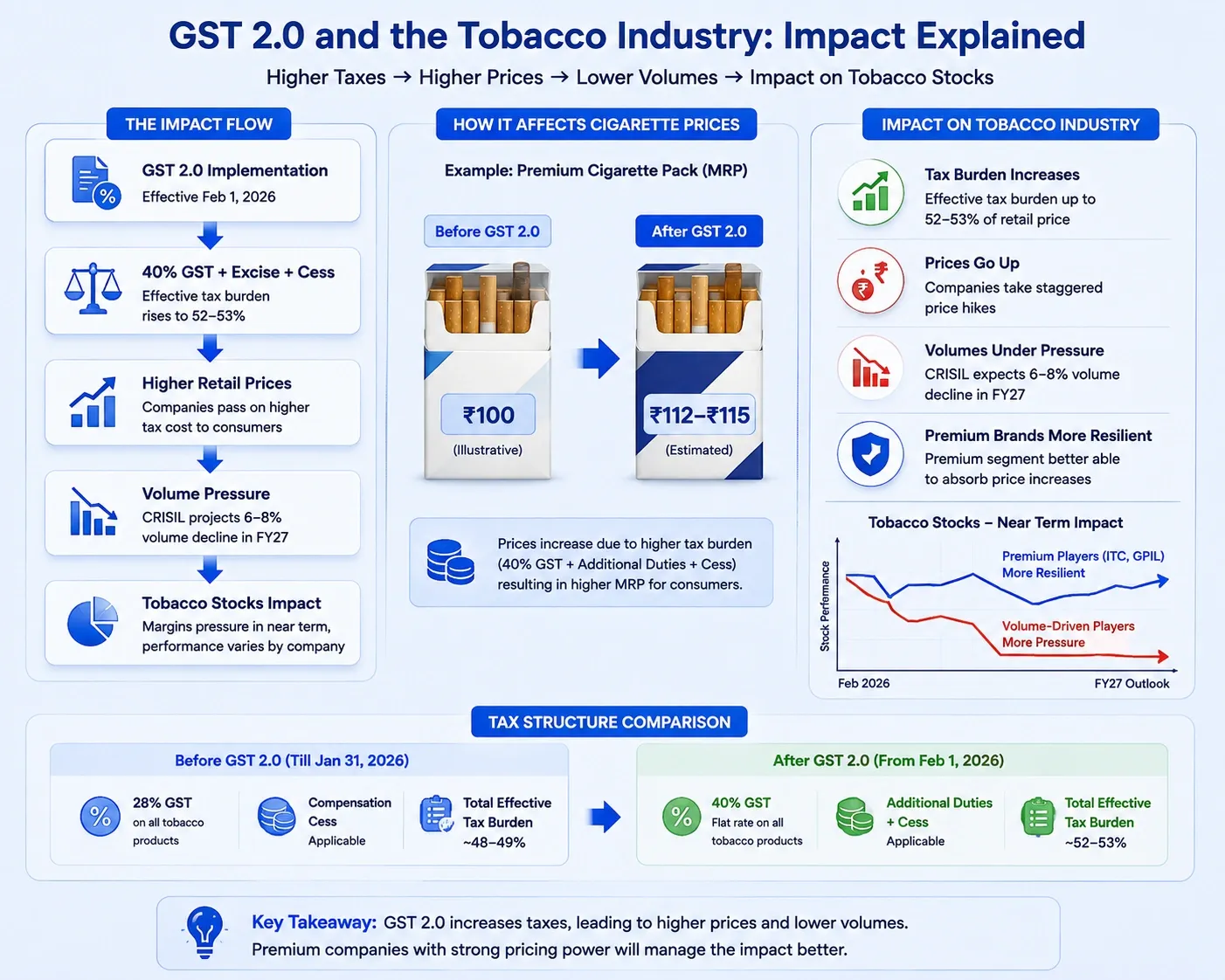
    The government introduced a historic shift from the earlier 28% GST plus compensation cess to a flat 40% GST slab under Notification No. 19/2025-Central Tax (Rate) dated December 31, 2025. The Union Budget 2026-27 confirmed that this change would begin on February 1 2026.

    This affects all tobacco products:

    • Cigarettes and cigars
    • Gutka and chewing tobacco
    • Pan masala with tobacco
    • Bidis

    Multi-Layered Taxation Architecture

    In my experience analysing this sector, the new tax structure is the most complex we've seen. Let me break it down simply:

    Layer 1 – Central Excise Duty: Reintroduced under the Finance Act 2025 and confirmed in the Budget 2026-27, the rates experienced a significant increase because length-based excise duties are now charged between ₹2,050 and ₹8,500 for every 1,000 cigarettes, which equals approximately ₹2.05 to ₹8.50 per stick. The tax rates for chewing tobacco increased from 25% to 82% and Jarda Scented Tobacco now costs 82% while Gutkha requires a tax rate of 91%.

    Layer 2 – Health Security & National Security Cess (HSNS Cess): A new levy, which Budget 2026-27 introduced, will be used to fund healthcare infrastructure and national security operations. The cess which applies to pan masala manufacturers is calculated through their factories according to machine operating speeds and packaging weights.

    Layer 3 – GST at 40%: Calculated on Retail Sale Price (RSP) basis under Rule 31D.

    Layer 4 – National Calamity Contingent Duty (NCCD): NCCD Amendment in Budget 2026-27: The Budget 2026-27 Announcement includes two important updates which will change the National Calamity Contingent Duty (NCCD) rates through an amendment to the Seventh Schedule of the Finance Act 2001, which will start on May 1 2026. The tobacco industry will receive two implementation plans through this program.

    Total Tax Burden Impact

    The total current tax burden equals 52-53% of retail selling prices. The least expensive cigarette pack, which currently costs ₹18, will increase to a price range between ₹70-72, which represents a 280-400% price increase.

    The CRISIL analysis of Budget 2026-27 shows that cigarette volumes will decrease between 6-8% during FY27 because manufacturers will pass 80-90% of their increased costs to customers.

    Premium brands experience lower percentage growth because their products start from higher price points, yet the actual business impact from this change remains unknown.

    The majority of people find it difficult to comprehend the impact of this situation on businesses, so I will provide a straightforward explanation. The actual assessment of a company's ability to control pricing lies in its capacity to transfer tax costs to customers while maintaining its sales levels.

    Compensation Cess Transition

    The previous tax structure, which included 28% GST and compensation cess, will remain in effect until all COVID-related compensation loans have been repaid. The government borrowed ₹2.69 lakh crore during the pandemic, and Budget 2025-26 targets ₹1.67 lakh crore compensation cess collection with ₹67,500 crore earmarked for loan repayment.

    The transition to the 40% slab became effective from February 1, 2026, as announced in the Union Budget 2026-27. Compensation cess has been completely abolished from this date onwards.

    How to Invest in Tobacco Stocks in India?

    I have seen that many beginners consider the stock markets quite intimidating, but they can be quite simple once you understand the process.

    Step-by-Step Investment Process

    Step 1: A few good options to start with are Zerodha, Upstox, Groww, or Angel One. Learn more about what is stockbroker to understand their role.

    Step 2: Complete your KYC verification using your Aadhaar, PAN, and bank details.

    Step 3: The screening tools enable researchers to study tobacco stocks through their research work. The platforms Tickertape and Screener, in addition to Dhanarthi stock screener, enable users to search for stocks by selecting specific criteria, which include market capitalisation, dividend yield and ROE.

    For a tobacco stocks screener, filter by:

    • Sub-sector: FMCG – Tobacco
    • Market cap: Size requires assessment of investor risk capacity for three categories of large, medium, and small companies
    • Dividend yield: Higher yields attract income investors
    • ROE: Above 15% indicates efficient capital use of the company's resources through its operations

    Step 4: Evaluate all financial metrics through complete analysis. The assessment needs to examine two aspects: revenue growth trends, GST 2.0 impact on margins, debt-to-equity ratio and cash flow generation patterns.

    Financial statement analysis tools help beginners study company financials because they provide simplified analysis solutions. Your stock analysis skills will improve when you understand the essential concepts which enable you to make better investment choices than following market trends. Understanding debt-to-equity ratio helps evaluate financial health.

    Step 5: Place buy orders in line with your investment thesis. Decide on whether you want to do a lump sum investment or a systematic approach. Understanding stock market timings in India helps you time your trades better.

    Step 6: You need to monitor both regulatory changes and quarterly results. The tobacco industry requires continuous policy monitoring because it experiences ongoing changes in regulations.

    Investment Options

    You can select one of three available methods.

    Direct Stock Purchase: Buy individual top tobacco stocks in India, like ITC or Godfrey Phillips, based on your research.

    Diversified Approach: Mix the stable performance of ITC with the rising potential of Godfrey Phillips and VST to create a balanced investment strategy.

    SIP Strategy: Invest systematically every month to average out market volatility and build wealth over 5-10 years. Explore best mutual funds investment SIP plans for systematic investing.

    Key Features of Tobacco Stocks

    Key Features of Tobacco Stocks

    The NSE tobacco stocks market has distinct characteristics that separate it from all other market sectors. The addictive nature of tobacco products leads to fixed consumer demand, which remains constant through time.

    Price increases don't significantly reduce demand in the short term because consumers continue to buy products while they shift their spending to other areas.

    High Profit Margins: Brand loyalty and pricing power translate to attractive margins. The business maintains its profits because competitors face challenges in entering the market due to existing regulatory restrictions.

    Strong Cash Flows: Established tobacco companies generate stable cash flows through their existing businesses, which require minimal capital outlay after their initial establishment. Understanding cash flow analysis is crucial for tobacco investors.

    Oligopolistic Market Structure: The Indian cigarette industry has ten major companies, which are controlled by three major firms. ITC, Godfrey Phillips, and VST command significant market share, which enables them to achieve cost advantages through their distribution networks.

    Dividend Aristocrats: Many tobacco companies offer consistent, high dividend yields. ITC yields 3.5-4.0%, while VST delivers 5.0-6.0%, which represents a substantial increase over the yield rates found in most sectors.

    Defensive Nature: The economy experiences downturns, yet performance maintains its consistency. People will reduce their spending on non-essential items, yet they will still spend money on tobacco products. Learn about bullish and bearish market cycles to understand these patterns.

    Benefits of Investing in Tobacco Stocks

    Benefits of Investing in Tobacco Stocks

    In my experience, the best tobacco stocks to buy offer several advantages:

    Steady Cash Flow: Predictable earnings due to inelastic demand create financial stability.

    High Dividend Yields: 2-6% annual yields attract income-focused investors seeking passive income.

    Pricing Power: Companies can pass on tax increases to consumers without major volume loss, protecting margins.

    Market Dominance: Established players like ITC have strong brand equity that's difficult for new entrants to challenge.

    Low Volatility: Defensive nature means less susceptibility to market swings compared to cyclical sectors. Understanding India VIX helps you gauge market volatility.

    Global Demand: Emerging markets, including India and China, offer long-term growth potential as consumption patterns evolve.

    Diversification Benefit: Low correlation with IT, pharma, and banking sectors helps balance portfolio risk.

    Inflation Hedge: Companies adjust prices to match inflation, protecting real returns.

    Economic Resilience: Demand remains stable regardless of GDP growth, recession, or expansion phases.

    Think about it this way – during the 2008 financial crisis, tobacco stocks outperformed most sectors because people continued consuming despite economic hardship.

    Risks of Investing in Tobacco Stocks

    Tobacco stocks in India present major dangers which most investors do not see. The tax system created by GST 2.0, which begins on February 1 2026, will establish tax requirements which have never existed before, according to current regulations.

    The rising public understanding of tobacco's dangerous effects creates anti-smoking movements, which lead to increasing health awareness that reduces tobacco use. The younger generations now prefer to stay away from tobacco products, which will lead to declining smoking rates that scientists expect to continue.

    Illegal trade operations result in revenue loss for lawful companies because they sell smuggled cigarettes and unlicensed goods, which makes their legitimate products more expensive through taxation. According to traders, the upcoming Budget 2026-27 will create a situation where they need to increase their stockpiling because of the extreme price hikes, which will begin on February 1 2026.

    The introduction of GST 2.0 will lead to a decrease in demand because price increases will exceed what customers show they can handle according to their needs.

    Factors to Consider Before Investing in Tobacco Stocks

    Factors to Consider Before Investing in Tobacco Stocks

    Carefully analyse these factors before investing in the best tobacco stocks in India:

    Financial Metrics

    Revenue Growth: The business needs to examine quarterly sales data and annual sales data to track its sales performance. The company experiences problems when its revenues stop growing or start decreasing because this situation shows it has lost product demand.

    Profit Margins: The organisation needs to observe three types of margins, which include operating margin, EBITDA margins and PAT margins. The business experiences reduced margin performance because it lacks the ability to set prices according to its needs.

    Return on Equity (ROE): The capital allocation process achieves maximum efficiency when it reaches results above 15 per cent. The best-performing tobacco companies in India can be identified by comparing their ROE results across different stock markets.

    Debt-to-Equity Ratio: The organisation maintains financial stability through its management of lower debt-to-equity ratios. Organisations that hold excessive debt face increased threats when they encounter periods of regulatory scrutiny.

    Dividend History: The company demonstrates its confidence in dividend payments through its practice of maintaining regular dividend payments, which have shown growth over time.

    Cash Flow Generation: The organisation maintains its capacity to pay dividends and fund expansion projects through its ability to generate free cash flow, which shows positive development.

    Tools which enable financial report analysis help users to compare multiple companies through their ability to analyse financial metrics across different companies at once.

    Regulatory Environment

    The effects of GST 2.0 will show through the observation of corporate pricing modifications, which will begin following February 1 2026. The ability to maintain customer service will determine which companies succeed and which companies fail.

    Excise Duty Changes: The research needs to monitor all central and state tax announcements which will directly impact business income. Understanding what is SEBI helps you understand regulatory oversight.

    Packaging Regulations: The financial burden of plain packaging requirements, together with graphic warnings, creates a more severe impact on smaller businesses compared to larger ones.

    Advertising Restrictions: Tobacco advertising bans prevent companies from establishing their brands, which stops them from entering new markets.

    Company-Specific Factors

    The brand portfolio: The brand portfolio protects against regulatory shocks through its distribution across various price segments.

    Market Share: The market share of a company depends on its cigarette business and smokeless tobacco business, which determine its ability to handle different government regulations.

    Distribution Network: The distribution network achieves stable volume performance because it penetrates both urban and rural areas throughout different regions.

    Diversification: The company achieves a defensive market position through its presence in three industries, which include FMCG, hotels, and paperboards.

    Management Quality: The management team demonstrates future ability to handle regulatory challenges through its successful track record of past regulatory challenges. Reading what is an annual report helps you understand company disclosures.

    Market Dynamics

    Illicit Trade: The combination of high taxes with unbranded products creates an environment which encourages smuggling activities while decreasing legitimate product sales.

    Premiumization: Higher-priced products become more attractive to consumers who prefer expensive brands, which helps companies develop stronger market positions.

    Next-Gen Products: The company demonstrates its readiness for upcoming developments through its funding of both heat-not-burn technology and e-cigarette development projects.

    Rural vs Urban Consumption: The NFHS 2019-21 report shows that 39.1% of men and 4.1% of women use tobacco products, which creates different growth opportunities between rural and urban areas.

    Valuation Metrics

    The PE ratio shows a comparison with the sector average, which ranges between 20 and 30 times. A company needs to prove its high P/E Ratio by demonstrating either growth or exceptional quality.

    The price-to-book ratio shows that comparing the book value of assets enables investors to discover potential undervalued assets.

    The company offers dividend yields between 3 and 6 percent which create safe investment returns for its investors.

    The PEG Ratio shows that growth valuation determines future earnings value assessment. Understanding fundamental analysis vs technical analysis helps you evaluate companies better.

    Who Should Explore Tobacco Sector Stocks?

    In my experience with hardcore investors, botanical stocks are for very narrow-minded and very focused investors:

    Ideal Investor Profiles

    Income-focused investors: They want to achieve their income goals through investments that provide consistent dividend payments between 3% and 6%.

    Defensive portfolio builders: They search for stocks that maintain their value during economic downturns and show stability during market declines.

    Value investors: They find value in stocks which have P/E ratios between 18 and 50 because these stocks generate significant cash flow and maintain their position as market leaders.

    Long-term investors: 5-10 year horizon to ride out regulatory volatility and benefit from compounding dividends.

    Risk-tolerant investors: They accept the possibility of regulatory changes, ethical issues and mainstream media coverage risks.

    Who Should Avoid?

    ESG-conscious investors: The tobacco industry violates environmental, social and governance ESG principles, which govern responsible investment practices.

    Health-focused investors: They refuse to earn profits from products which create cancer and lung diseases and lead to untimely deaths.

    Short-term traders: They find unpredictable market swings, which result from new regulation announcements, to be unworkable for their rapid profit strategies.

    Growth-seeking investors: The tobacco industry operates as a mature industry which grows at 4 to 5 per cent annually, while fast-moving consumer goods and technology sectors reach 12 to 15 per cent annual growth.

    Let me show you a comparison that makes this clearer:

    Metric Tobacco Stocks FMCG Stocks Pharma Stocks
    Dividend Yield 2-6% 1-2.5% 0.5-2%
    P/E Ratio 18-50 50-70 30-60
    Growth Rate 4-5% CAGR 12-15% CAGR 10-12% CAGR
    Regulatory Risk Very High Moderate High
    Ethical Concerns Very High Low Low
    Market Volatility Low Low Moderate

    The analysis shows that tobacco provides greater yield returns for investors who take on higher regulatory risks and experience slower business growth than other defensive industry sectors.

    Current Trends in the Tobacco Industry 2026

    The tobacco stocks in the NSE landscape are undergoing rapid transformations.

    GST 2.0 Transition: The 40% GST transition, which will start on February 1 2026, represents the most significant market change. Companies are assessing their pricing capabilities while studying how customers respond to price increases that reach 280% to 400% for their least expensive products.

    Premiumization Strategy: Companies develop premium cigarette products, which enable them to achieve greater profit margins. The higher-priced brands experience smaller percentage price increases, which makes them more appealing to customers.

    Next-Gen Products: The global market for heat-not-burn devices, e-cigarettes and oral nicotine pouches continues to expand. Indian companies are monitoring regulatory changes which will influence their future investment decisions.

    Digital Transformation: Companies develop digital marketing solutions which comply with legal requirements because e-commerce restrictions remain in effect.

    Sustainability Focus: The use of eco-friendly packaging together with responsible sourcing practices meets ESG requirements, while people remain doubtful about the sustainable claims made by tobacco products.

    Reduced Risk Products (RRPs): The tobacco industry shifts away from traditional cigarettes as major tobacco companies invest in alternative products.

    Consolidation: The smaller companies in the industry are pursuing M&A activities because they need to achieve compliance with regulations and handle rising tax expenses, which require them to grow larger.

    Government Revenue Dependency: State governments depend on tobacco taxes to maintain their financial stability, which creates conflicts between public health goals and the need for revenue generation.

    The study of these trends enables us to determine which of the top 10 tobacco stocks in India will deliver superior performance as the industry changes.

    Conclusion

    The tobacco stocks in the India market offer investors stable cash flows, high dividends, and defensive properties which protect against severe regulatory challenges and ethical problems.

    The sector undergoes its most challenging period in decades when GST 2.0 implementation starts on February 1 2026. The leading tobacco companies in India, such as ITC, Godfrey Phillips, and VST, need to show their ability to set prices while maintaining their current sales.

    The best investment strategy requires you to choose financial assets which match your personal beliefs and risk tolerance. You should track the quarterly results after GST 2.0 goes live because it will help you understand how volume stays strong and how margin development works before you invest major resources.

    Disclaimer: This article is for educational purposes only and should not be considered as financial or tax advice. Tax laws are subject to change, and individual circumstances vary. Please consult with a qualified chartered accountant or tax advisor for personalized guidance based on your specific situation.

    FAQs

    1. Which tobacco share is best?

    ITC Ltd is widely considered the best tobacco stock in India due to its market dominance with 80%+ share in cigarettes, diversified business model across FMCG and hotels, consistent dividend yield of 3.5-4.0%, and strong financial fundamentals with low debt and high cash generation.

    2. What are the top 5 tobacco companies?

    The top 5 tobacco companies in India are ITC Ltd (market leader), Godfrey Phillips India (premium segment), VST Industries (South India specialist), Golden Tobacco (regional player), and Indian Wood Products. ITC dominates with brands like Gold Flake and Classic commanding over 80% market share.

    3. Are tobacco stocks a good investment?

    Tobacco stocks can be good investments for income-focused investors seeking 3-6% dividend yields and defensive positioning. However, they carry high regulatory risks with GST 2.0 imposing 52-53% tax burden effective February 1, 2026, ethical concerns, and declining consumption trends. Suitable only for long-term investors comfortable with these risks.

    4. What stock is Marlboro?

    Marlboro cigarettes in India are owned by Godfrey Phillips India, which operates under license from Philip Morris International. Godfrey Phillips stock (NSE: GODFRYPHLP) has delivered 140-150% returns in the past year, making it one of the top tobacco stocks in India for growth-oriented investors.

    5. Which top 5 shares to buy today?

    The top 5 shares in tobacco sector are ITC Ltd for stability and dividends, Godfrey Phillips India for growth potential, VST Industries for high yield (5-6%), Golden Tobacco for mid-cap exposure, and Indian Wood Products for small-cap opportunities. Evaluate fundamentals before investing.

    6. Which cigarette is owned by ITC?

    ITC owns popular cigarette brands including Gold Flake, Classic, Navy Cut, Silk Cut, India Kings, Benson & Hedges, and Bristol. Gold Flake and Classic dominate the mass market segment, while premium brands like Benson & Hedges target affluent consumers across India.

    7. What is GST 2.0 for tobacco products?

    GST 2.0 introduces a flat 40% GST slab for tobacco products effective February 1, 2026, under Notification No. 19/2025-Central Tax (Rate) dated December 31, 2025, replacing the earlier 28% GST plus compensation cess. Combined with length-based excise duty (₹2,050-₹8,500 per 1,000 cigarette sticks), HSNS Cess, and NCCD, total tax burden reaches 52-53% of retail price, potentially increasing cheapest cigarette prices by 280-400%. The compensation cess has been completely abolished from February 1, 2026.

    8. How do I screen tobacco stocks?

    Use a tobacco stocks screener like Tickertape, Screener.in, or Dhanarthi stock screener to filter by FMCG-Tobacco sub-sector, market cap (large/mid/small), dividend yield above 3%, ROE above 15%, and low debt-to-equity ratio. Compare fundamentals of stock analysis including revenue growth and profit margins.

    9. What is the tax on cigarettes in India 2026?

    Cigarettes in India face multi-layered taxation post Budget 2026-27: Central Excise Duty (₹2,050-₹8,500 per 1,000 cigarette sticks based on length), Health Security & National Security Cess (HSNS Cess) computed factory-wise, 40% GST on MRP under Rule 31D, and 25% NCCD after abatement. Total tax burden is 52-53% of retail sale price. Additionally, capacity-based assessment applies to pouch-packed tobacco products with mandatory CCTV retention and advance monthly payments. NCCD rates will be revised effective May 1, 2026.

    10. Are tobacco penny stocks risky?

    Tobacco penny stocks in India like Radhika Jeweltech, Dharamsi Morarji Chemical, and Kothari Products carry extremely high risk due to small market caps (₹15-40 crore), low liquidity, volatile price movements, and vulnerability to regulatory changes including GST 2.0 implementation from February 1, 2026. Suitable only for aggressive investors with high risk tolerance.

    11. What is the dividend yield of VST Industries?

    VST Industries offers one of the highest dividend yields in the tobacco sector at 5.0-6.0%, significantly above ITC's 3.5-4.0% and Godfrey Phillips' 0.8-1.0%. This makes VST attractive for income-focused investors despite recent negative returns of -10 to -15% over one year.

    12. How does GST 2.0 affect tobacco stocks?

    GST 2.0 effective February 1, 2026 increases tax burden from 28% plus cess to 40% GST, testing pricing power of tobacco stocks. According to CRISIL analysis post Budget 2026-27, cigarette volumes could decline 6-8% in FY27 as manufacturers pass on 80-90% of higher costs to consumers. Companies must either absorb margin compression or pass costs to consumers risking volume decline. Premium brands face smaller percentage impacts than economy segments, favoring companies with diversified portfolios. The market reaction on Budget day was severe - Sensex plummeted 1,546.84 points (1.88%) and Nifty crashed 495.20 points (1.96%), with over ₹9 trillion in market capitalization wiped out.

    13. Which state produces most tobacco in India?

    Gujarat is the largest tobacco-producing state in India, contributing 45% of national production, followed by Andhra Pradesh at 20%, Uttar Pradesh at 15%, and Karnataka at 8%. India dedicates 0.45 million hectares to tobacco cultivation, representing 10% of global tobacco farming area.

    14. What are the risks of tobacco stocks?

    Tobacco stocks face regulatory uncertainty with GST 2.0 implementation from February 1, 2026 and excise hikes, declining consumption due to health awareness, ethical concerns limiting ESG investor participation, litigation risks, illicit trade competition exacerbated by sharp price increases, advertising restrictions, and potential volume decline of 6-8% as per CRISIL forecast. Additionally, capacity-based assessment and MRP-based valuation under Rule 31D increase compliance complexity. Traders warn of increased stockpiling and black-market risks due to the sharp price increases.

    15. How to analyze tobacco company financials?

    Analyze tobacco company stocks using financial statement analysis focusing on revenue growth trends, impact of GST 2.0 on operating margins (assess pricing power and volume retention post-February 1, 2026), ROE above 15%, low debt-to-equity ratio, consistent free cash flow generation, and dividend payout history. Use stock analysis fundamental tools for peer comparison and valuation metrics. Monitor quarterly results post-GST 2.0 implementation to assess volume resilience and margin trends before making significant commitments.

    Bhargav Dhameliya

    Bhargav Dhameliya - Content creator & copywriter at @Dhanarthi

    I help businesses to transform ideas into powerful words & convert readers into customers.