



Tax on Intraday Trading in India: Rules, Rates and Filing
September 15, 2026



TABLE OF CONTENTS
Get AI Summary






An index fund is a passively managed mutual fund that replicates a market index like the Nifty 50 or Sensex by holding the same stocks in the same weight, with no fund manager picking stocks.
For most beginners, a Nifty 50 index fund (UTI, ICICI Prudential, SBI, HDFC) is the safest starting point, not a smallcap or sectoral fund.
Direct plans charge 0.1% to 0.3%, against 1% to 2% for active funds.
Match the index to your risk profile: Nifty 50 for stability, midcap/smallcap for growth, sectoral for high risk.
Picking individual stocks is genuinely hard. Most first-time investors research companies for weeks, then freeze and take no action. An index fund removes that decision entirely. According to AMFI data, passive index funds now account for over 17% of India's mutual fund AUM, and that share keeps climbing every year. If you are still weighing passive against active management, this comparison of mutual funds vs index funds breaks down the difference in plain language.
This guide covers two things most "best index fund" lists split apart: the Nifty 50 large-cap options that most beginners actually search for, and the higher-return midcap, smallcap, and sectoral funds that suit investors who already have a core portfolio in place.
An index fund is a passively managed mutual fund that mirrors a market index, like the Nifty 50, Sensex, or Nifty Midcap 150, by holding the exact same stocks in the exact same proportion. There is no manager trying to predict which stock will outperform. The fund simply tracks the index.
The Nifty 50 TRI has delivered approximately 12-13% CAGR over the last 10 years (Source: NSE Indices factsheet, 2026), a consistent, unspectacular return backed by real data. Index funds do not try to beat the market. They are the market.
Once your core large-cap allocation is in place, midcap, smallcap, and sectoral index funds add growth potential at the cost of higher volatility. The following list ranks funds by 3-year annualised returns, expense ratio, and tracking error. I have personally gone through each of these to give you a clear, honest picture.
| Fund Name | Benchmark | 3-Yr Returns | Expense Ratio | Tracking Error | Best For |
|---|---|---|---|---|---|
| Motilal Oswal BSE Enhanced Value | BSE Enhanced Value | ~28-30% | 0.29% | Low | Value investors |
| ICICI Pru Nifty Auto Index | Nifty Auto | ~22-25% | 0.42% | Low | Sectoral/aggressive |
| Axis Nifty Smallcap 50 | Nifty Smallcap 50 | ~24-26% | 0.30% | Low | High-risk/growth |
| Aditya Birla SL Nifty Smallcap 50 | Nifty Smallcap 50 | ~24-26% | 0.30% | Low | High-risk/growth |
| Kotak Nifty Smallcap 50 | Nifty Smallcap 50 | ~24-25% | 0.29% | Very Low | SIP investors |
| Axis Nifty Midcap 50 | Nifty Midcap 50 | ~22-24% | 0.30% | Low | Balanced growth |
| Edelweiss Nifty Midcap150 Momentum 50 | Nifty Midcap150 Momentum 50 | ~30-34% | 0.30% | Low | Momentum/growth |
| Navi Nifty India Manufacturing | Nifty India Manufacturing | ~18-22% | 0.12% | Very Low | Thematic/sector |
| Motilal Oswal Nifty Midcap 150 | Nifty Midcap 150 | ~22-25% | 0.31% | Low | Long-term SIP |
| Tata Nifty Midcap 150 Momentum 50 | Nifty Midcap150 Momentum 50 | ~30-33% | 0.28% | Low | Aggressive SIP |
Data sourced from AMFI and fund factsheets.
Tracks the BSE Enhanced Value Index, identifying established companies trading below fair value. Suits investors who believe in value investing and can hold for five-plus years.
Tracks the Nifty Auto Index, giving concentrated exposure to India's auto sector. Higher concentration risk since it is sector-specific. For broader context, see the best auto sector stocks in India.
Tracks the Nifty Smallcap 50 Index. Small-caps are volatile short-term but have historically rewarded patience over 7-10 year holding periods.
Another Nifty Smallcap 50 tracker from a large, trusted AMC, with a competitive expense ratio and low tracking error.
Demonstrates strong tracking accuracy against its benchmark, making it a dependable smallcap option for SIP investors.
Tracks the Nifty Midcap 50 Index, offering higher growth potential than large-caps with lower volatility than small-caps. A middle-ground choice.
Uses a momentum strategy, tracking the top 50 momentum stocks from the Nifty Midcap 150 universe. Momentum funds can post strong 3-year returns but swing hard in corrections.
Tracks the Nifty India Manufacturing Index, riding India's "Make in India" and PLI scheme tailwinds. Its 0.12% expense ratio is among the lowest in this table.
Tracks the Nifty Midcap 150 Index for diversified exposure to India's expanding mid-sized businesses. Suits SIP investors with a seven-year-plus horizon.
Uses momentum-based stock selection within the Nifty Midcap 150, giving a passive wrapper around an active-feeling strategy.
Want to dig deeper into the underlying stocks of any of these funds? Use Dhanarthi's best stock screener to analyse the exact holdings before you invest.
Active funds charge 1% to 2% as an expense ratio every year, and most fail to beat their benchmark index over a 10-year horizon. Low-cost index funds charge just 0.1% to 0.5% and consistently match market returns. That cost gap compounds into a significant difference over two decades, which is the single biggest reason low-cost index funds outperform active funds over long periods.
If you search "best index fund in India," you are almost always looking for a Nifty 50 fund first. It is the default, beginner-safe entry point into Indian equities: 50 of the largest, most liquid companies on the NSE, in one fund. Yet most "best index fund" lists jump straight to smallcap and sectoral funds sorted by 3-year returns. That skips the fund type most readers actually came for.
Here are the four largest, most tracked Nifty 50 index funds in India, compared on cost and tracking accuracy rather than short-term returns.
| Fund Name | Benchmark | Expense Ratio (Direct) | Tracking Error | AUM | Best For |
|---|---|---|---|---|---|
| UTI Nifty 50 Index Fund | Nifty 50 | 0.18% | Low | ~₹28,685 Cr | Largest, most liquid Nifty 50 fund |
| ICICI Prudential Nifty 50 Index Fund | Nifty 50 | 0.15% | Very Low (~0.06%) | ~₹9,500 Cr | Lowest cost among the big four |
| SBI Nifty Index Fund | Nifty 50 | ~0.18% | Very Low (~0.02%) | ~₹13,368 Cr | Tightest benchmark tracking |
| HDFC Index Fund - Nifty 50 Plan | Nifty 50 | ~0.20% | Low | Large, established | Investors already in the HDFC ecosystem |
Data sourced from fund factsheets, Value Research, and AMFI.
UTI Nifty 50 Index Fund carries the largest AUM among pure Nifty 50 funds in India, which typically means tighter bid-ask spreads and more stable tracking during volatile sessions. Its 5-year CAGR sits close to 9.9% (Source: Value Research, 2026).
ICICI Prudential Nifty 50 Index Fund is the cheapest of the big four on expense ratio while still posting a very low tracking error, making it the pick if cost matters more to you than sheer fund size.
SBI Nifty Index Fund consistently posts one of the lowest tracking errors in the category, meaning its returns rarely drift from the actual Nifty 50 index, which matters more than a slightly lower expense ratio for a long-term SIP.
HDFC Index Fund - Nifty 50 Plan raised its direct-plan expense ratio from 0.10% to 0.20% in recent years (Source: Business Standard), still competitive, and suits investors who prefer consolidating investments within one AMC.
Both track India's largest companies, so the practical difference is smaller than it sounds.
| Factor | Nifty 50 Index Fund | Sensex Index Fund |
|---|---|---|
| Number of stocks | 50 | 30 |
| Exchange | NSE | BSE |
| Diversification | Slightly broader | Slightly more concentrated |
| Popular options | UTI, ICICI Pru, SBI Nifty 50 | ICICI Pru BSE Sensex Index Fund |
| Typical expense ratio | 0.15% - 0.20% | 0.15% - 0.20% |
Neither is inherently better. A Nifty 50 fund gives marginally wider diversification across 50 large-caps instead of 30, but the two indices move almost in lockstep since they share most of their largest constituents. Pick whichever fund from a large AMC has the lower tracking error and expense ratio; the index choice itself matters less than fund selection within it.
Picking a fund requires more than chasing the highest return. Six factors decide whether that choice actually works for you.
Match the index to your goal. Nifty 50 protects wealth with stability. Midcap indices target growth. Sectoral indices carry the highest risk and reward.
Small-cap and sectoral index funds show more volatility than large-cap funds. Beginners should start with a Nifty 50 or Sensex index fund before adding midcap or small-cap exposure.
Look for direct plans charging 0.1% to 0.2%. That gap looks small today but costs lakhs over two decades of compounding.
Aim for tracking error below 0.5%, ideally under 0.1% for Nifty 50 funds. A higher tracking error means the fund drifts further from the benchmark you are paying to track. Check this figure in the fund's factsheet before investing.
One good year can mislead. Judge performance across 3-year and 5-year CAGR, especially when comparing two funds tracking the same index. This guide on analysing a stock before investing offers a framework that applies to fund evaluation too.
An AUM under ₹500 crore for a Nifty 50 fund can affect liquidity and index-tracking quality. Larger AUM signals investor trust and gives the fund house more room to manage redemptions smoothly.
Investing in an index fund today needs no broker or advisor. Here is the process, step by step.
SIP works better for most retail investors. Rupee cost averaging buys more units when markets fall and fewer when they rise, removing the need to time the market. Read this SIP vs lump sum comparison for a deeper breakdown.
Lump sum works during sharp market corrections, when you can buy at a clear discount. For regular salaried investors, SIP remains the lower-stress default.
Step 1: Complete KYC online with PAN and Aadhaar. Under 10 minutes.
Step 2: Choose the direct plan to skip distributor commissions.
Step 3: Select your fund using the criteria above.
Step 4: Set a monthly SIP. Minimum is Rs 500 in most funds.
Step 5: Stay invested for at least 5 years, ideally 10 or more.
Even Rs 2,000 a month in a Nifty 50 SIP over 15 years can grow into a substantial corpus purely through compounding. Stay the course.
An honest, balanced view so you can make an informed call.
Low cost: expense ratios as low as 0.15% to 0.2% in direct plans
Broad diversification: one Nifty 50 fund covers 50 of India's largest companies
No fund manager bias: no active stock-picking errors or emotional decisions
Transparent portfolio: you always know exactly what you own
Historically, over 80% of active funds underperform index funds over 10 years
Cannot outperform the market, only match it
No downside protection during a crash; the fund falls with the index
Sectoral index funds carry concentration risk in a single industry
Tracking error means returns may drift slightly from the benchmark
For most long-term investors, the advantages outweigh the limitations. To understand what actually drives the stocks inside your fund, see fundamental analysis vs technical analysis.
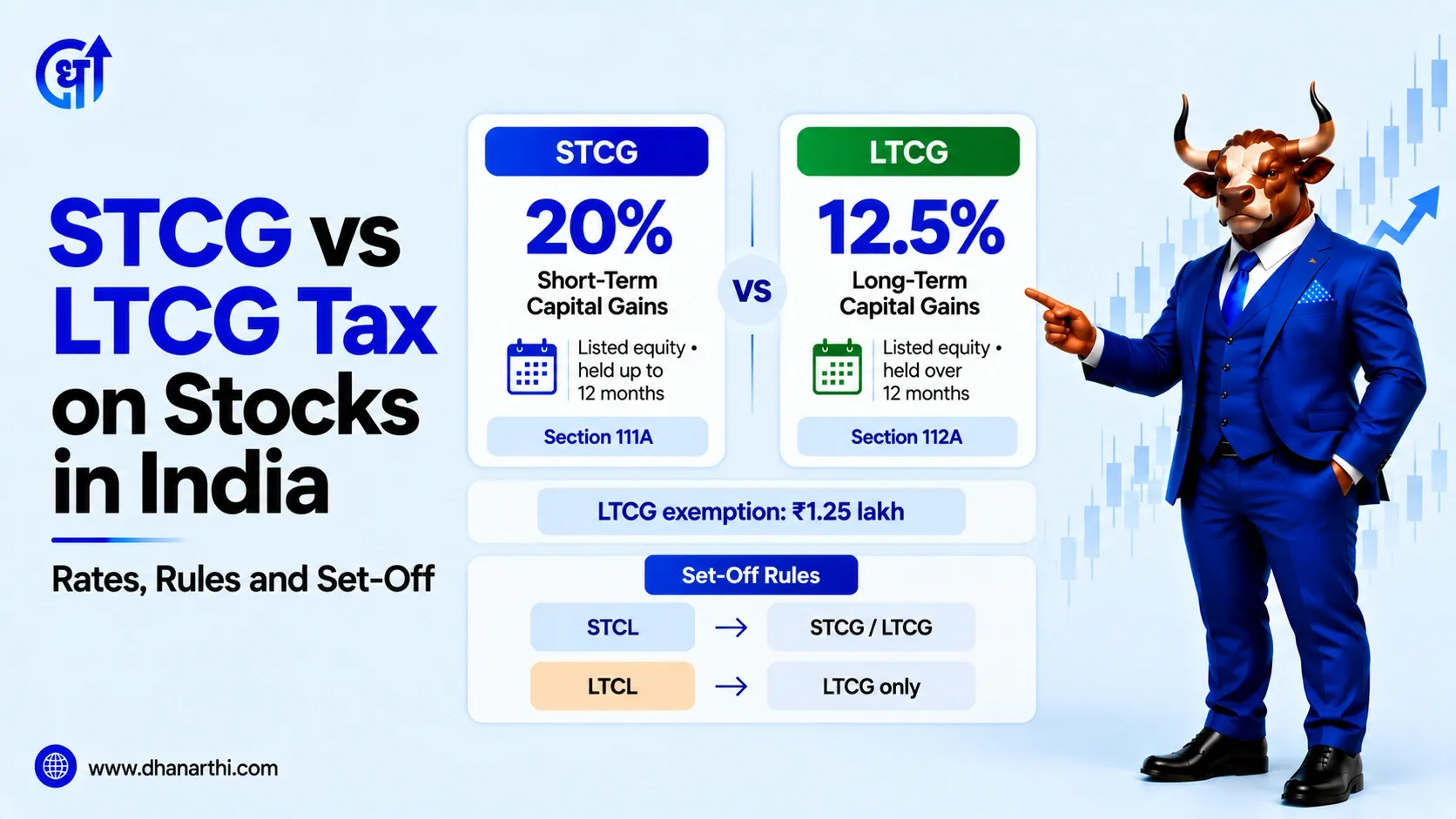
Short-Term Capital Gains (STCG): Units sold within 12 months are taxed at 20%.
Long-Term Capital Gains (LTCG): Units held over 12 months are taxed at 12.5% on gains above Rs 1.25 lakh per financial year, as per post-Budget 2024 rules.
Every SIP installment counts as a separate investment for tax purposes, so you need to track the acquisition date of each installment when you redeem. Most fund houses provide a capital gains statement to simplify this.
The best index funds in India give retail investors a simple, low-cost, disciplined path to long-term wealth. Start with a Nifty 50 fund as your core holding, then layer in midcap or smallcap index funds once that foundation is in place.
Judge funds on expense ratio and tracking error together with your investment horizon, not last year's return chart. Keep the SIP running and let compounding do the rest.
Ready to take the next step? Use Dhanarthi's AI Financial Research Assistant to analyse fund holdings before you invest, or explore Dhanarthi Deep Scan for fund-level and stock-level research in one place.
Disclaimer: This article is for educational purposes only. It does not constitute investment advice. Please consult a SEBI-registered financial advisor before making investment decisions.
1. Which is the best index fund in India for beginners in 2026?
For beginners, a Nifty 50 index fund is the safest starting point. UTI Nifty 50, ICICI Prudential Nifty 50, and SBI Nifty Index Fund are all low-cost, well-tracked, beginner-friendly choices with no sector concentration risk.
2. Is a Nifty 50 index fund better than a Sensex index fund?
Neither is inherently better. Nifty 50 tracks 50 large-cap stocks on the NSE, Sensex tracks 30 on the BSE. Both move almost in lockstep. Pick based on expense ratio and tracking error rather than the index name.
3. What is the difference between an index fund and an active mutual fund?
An index fund copies a market index without a fund manager making calls. Active funds try to beat the market but charge 1% to 2% in fees, and most fail to beat their index over 10 years.
4. How much should I invest monthly in an index fund SIP?
You can start with as little as Rs 500 a month. Even Rs 2,000 monthly in a Nifty 50 SIP over 15 years can build a strong corpus through compounding. Start early and stay consistent.
5. What is tracking error, and why does it matter?
Tracking error shows how closely a fund follows its benchmark. Lower is better. For Nifty 50 funds, look for tracking error under 0.1%; a high tracking error means your actual returns may not match what the index delivered.
6. Are direct plans better than regular plans for index funds?
Yes, always choose direct plans. Regular plans carry distributor commissions that quietly reduce your returns. Direct index funds charge as low as 0.15% to 0.2%, saving lakhs over 20 years.
7. What are the top index funds in India based on 3-year returns?
Among diversified index funds, Edelweiss Nifty Midcap150 Momentum 50 and Tata Nifty Midcap 150 Momentum 50 have posted the strongest recent 3-year returns of around 30% to 34%. For stability, Nifty 50-based funds remain the more reliable long-term core holding.
8. Is SIP or lump sum better for index fund investing?
SIP suits most regular investors through rupee cost averaging. Lump sum works during sharp market corrections. For salaried individuals or beginners, SIP reduces stress and removes the need to time the market.
9. How are index fund returns taxed in India?
Units sold within 12 months are taxed at 20% as short-term capital gains. Units held over 12 months are taxed at 12.5% on gains above Rs 1.25 lakh per year as long-term capital gains. Each SIP installment is a separate investment for tax purposes.
10. How do I compare index funds before investing?
Compare expense ratio, tracking error, 3-year and 5-year CAGR, and AUM. Avoid picking a fund based only on last year's return. Two funds tracking the same index can differ based on cost and replication accuracy.
11. What is the minimum AUM I should look for in a Nifty 50 index fund?
Look for at least Rs 500 crore in AUM for a Nifty 50 fund. Below that, liquidity and tracking quality can suffer, especially during high-redemption periods.
12. Can I build a full portfolio using only index funds?
Yes. Many investors build a complete portfolio mixing large-cap (Nifty 50), midcap, and small-cap index funds for wide market coverage at low cost. A simple 2-fund or 3-fund setup, anchored by a Nifty 50 fund, works well for most people.
Share Market
IPO
Artificial Intelligence
Semi Conductor