





Stock Market Basics for Beginners in India
October 24, 2026



TABLE OF CONTENTS
Get AI Summary






A Candlestick Chart Patterns PDF is a free downloadable guide that teaches you to read Japanese candlestick formations like Hammer, Engulfing, and Doji to predict price direction. This guide covers 15+ patterns, a step by step reading method, indicator combinations, and an intraday strategy PDF section, all with real NSE and BSE examples.
Reading a candlestick chart patterns PDF is often the fastest way for a new trader to stop guessing and start reading price with intent. Candlestick charts began with Japanese rice traders nearly 300 years ago, and today they remain the default chart type on almost every Indian broker terminal. This guide breaks down every major bullish and bearish formation, shows you how to combine them with indicators, and includes a free downloadable candlestick and chart patterns book pdf you can save for daily practice. If you are new to markets, start with our fundamentals of stock analysis before moving into pattern reading.
Candlestick Chart Patterns PDF Download Free
A Gujarati version of this candlestick pattern pdf is also in progress for readers who prefer to learn in their own language. Join our Telegram channel to get notified the moment the candlestick pattern gujarati pdf goes live.
Candlestick chart patterns are visual formations on a price chart that show the fight between buyers and sellers over a fixed time period.
Line charts only connect closing prices. Candlestick charts show four data points at once, which is why traders prefer them for decision making.
Every candlestick carries four price points:
Open: Price at the start of the period
High: Highest price reached
Low: Lowest price reached
Close: Price at the end of the period
A green or white candle means buyers controlled the session and price closed higher. A red or black candle means sellers were in control and price closed lower. The thin lines above and below the body are called wicks or shadows, and they show how far price moved before being pushed back.
Many beginners search for a candlestick and chart patterns book pdf without knowing the two are different tools.
| Feature | Candlestick Patterns | Chart Patterns |
|---|---|---|
| Formed by | 1 to 3 candles | Dozens of candles over weeks |
| Time to form | Minutes to days | Weeks to months |
| Example | Hammer, Engulfing, Doji | Head and Shoulders, Triangle, Cup and Handle |
| Best use | Entry and exit timing | Trend direction and targets |
Source data compiled from NSE and BSE public chart data. Last updated: July 2026.
A technical analysis chart patterns pdf usually studies the second column, while this guide focuses on the first. Traders get the strongest signals when both are combined, which we cover later in this guide.
There are three structural categories of candlestick patterns.
Single candle patterns: formed by one candle, such as Hammer, Doji, or Shooting Star. They show a sudden shift in sentiment.
Double candle patterns: formed by two candles together, such as Bullish or Bearish Engulfing and Harami. These are considered more reliable than single patterns.
Triple candle patterns: formed by three candles, such as Morning Star and Evening Star.
Some patterns signal a reversal. Others signal that the current trend will continue. Knowing which is which matters more than memorising shapes. Understanding bullish and bearish market conditions first will help you apply every pattern in this stock market beginner guide pdf correctly.
This quick reference table covers the 15 most traded patterns across single, double, and triple categories, a common addition traders expect in any candlestick chart pattern book pdf.
| Pattern | Type | Candles | Signal |
|---|---|---|---|
| Hammer | Bullish reversal | 1 | Buyers stepping in after a fall |
| Doji | Neutral / Indecision | 1 | Buyers and sellers in balance |
| Spinning Top | Neutral | 1 | Weak momentum, possible pause |
| Marubozu | Trend continuation | 1 | Strong one-sided control |
| Shooting Star | Bearish reversal | 1 | Sellers rejecting higher prices |
| Bullish Engulfing | Bullish reversal | 2 | Buyers overpowering sellers |
| Bearish Engulfing | Bearish reversal | 2 | Sellers overpowering buyers |
| Bullish Harami | Bullish reversal | 2 | Selling pressure fading |
| Bearish Harami | Bearish reversal | 2 | Buying pressure fading |
| Piercing Line | Bullish reversal | 2 | Buyers reclaiming control |
| Dark Cloud Cover | Bearish reversal | 2 | Sellers reclaiming control |
| Tweezer Bottom | Bullish reversal | 2 | Support level holding twice |
| Morning Star | Bullish reversal | 3 | Sellers exhausted, buyers taking over |
| Evening Star | Bearish reversal | 3 | Buyers exhausted, sellers taking over |
| Three White Soldiers | Bullish continuation | 3 | Sustained buying strength |
Data sourced from NSE and BSE historical chart patterns. Last updated: July 2026.
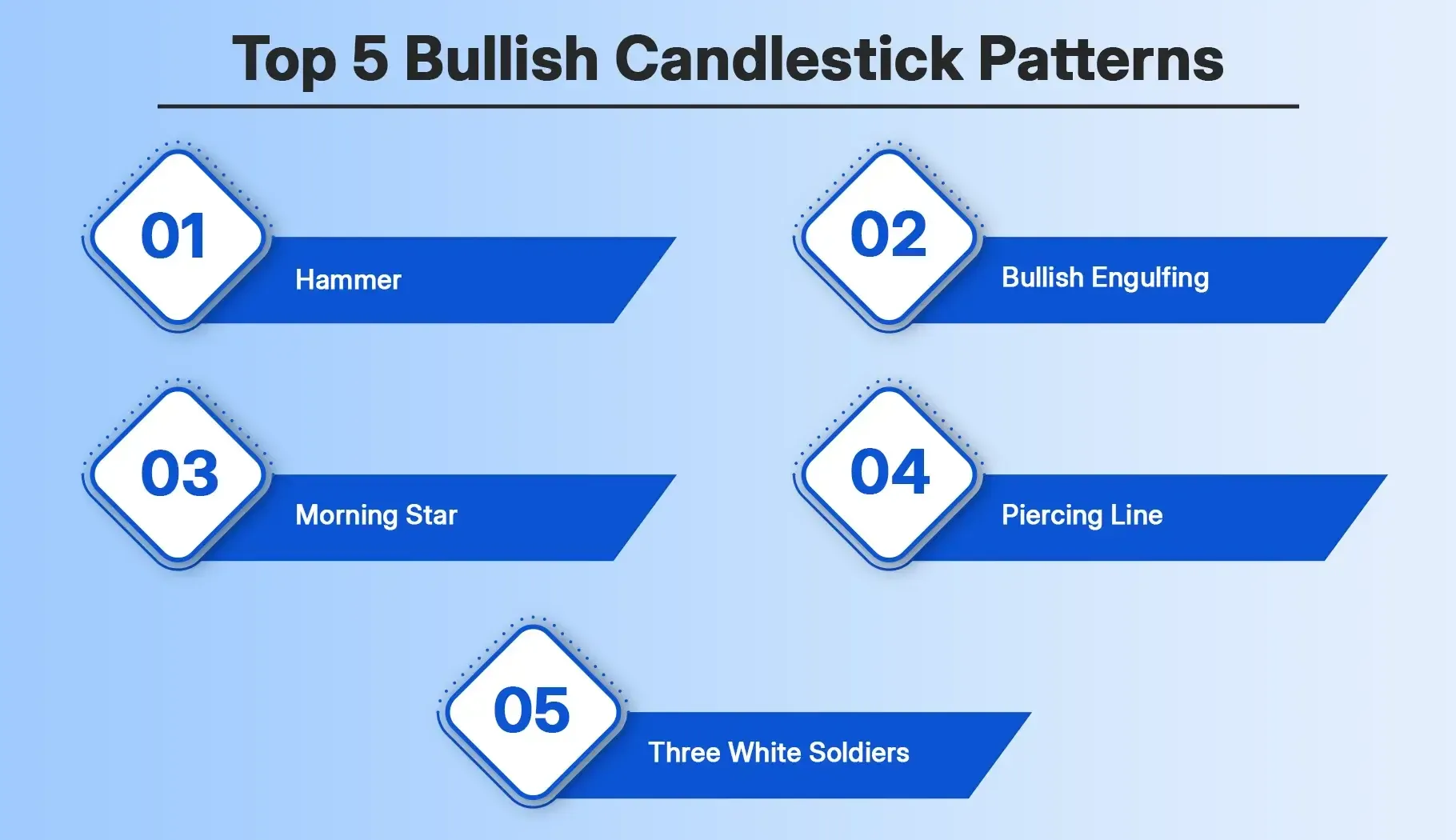
1. Hammer: A small body sits at the top with a long lower wick. It forms at the bottom of a downtrend and signals buyers are stepping in.
2. Bullish Engulfing: A large green candle fully covers the prior red candle. This is one of the most reliable two-candle reversal signals.
3. Morning Star: A three-candle sequence: a red candle, a small indecisive candle, then a large green candle. Sellers have lost control.
4. Piercing Line: A red candle followed by a green candle that closes above the midpoint of the red candle. Combine this with support and resistance in trading levels for stronger entries.
5. Three White Soldiers: Three consecutive green candles with small wicks. Buying pressure is strong and sustained.
Wait for the candle to close fully before acting on any of these five patterns.
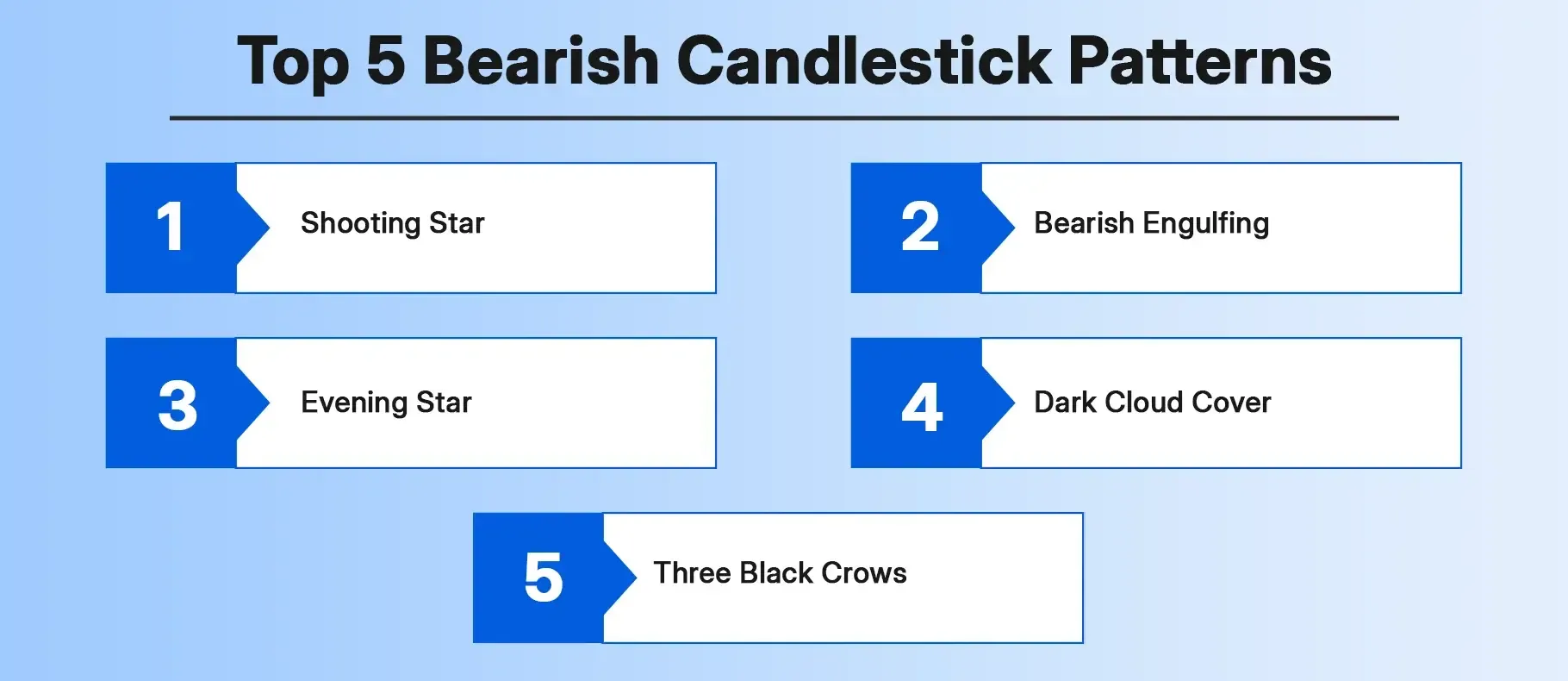
1. Shooting Star: A small body with a long upper wick that forms at the top of an uptrend. Sellers are pushing price back down.
2. Bearish Engulfing: A large red candle fully covers the prior green candle, signalling strong selling pressure.
3. Evening Star: The mirror image of the Morning Star. Green, then small, then a large red candle. Buyers are exhausted.
4. Dark Cloud Cover: A green candle followed by a red candle that opens high but closes below the midpoint of the green candle.
5. Three Black Crows: Three consecutive red candles with small wicks. This is an aggressive bearish signal and existing long positions should be reviewed immediately.
Always confirm these five patterns with a rise in volume before trading them.
Check the trend direction first. Bullish patterns work better inside an existing uptrend, and bearish patterns work better inside a downtrend.
Volume confirms the pattern. A pattern that forms on high volume is far more reliable than one that forms on low volume.
Check support and resistance zones. A pattern that forms exactly at these levels carries more weight than one that forms in open space.
Check the higher timeframe. If your 15-minute chart says buy but the daily chart says sell, treat the signal with caution. This becomes especially important around stock market timings in India when volatility spikes near the open.
Never act before the candle closes. An unfinished candle can still change shape completely.
A breakout patterns pdf usually explains price moving beyond a defined support or resistance zone with strength.
The problem with a plain breakout is that many of them fail and reverse quickly, a move traders call a false breakout or fakeout.
Candlestick confirmation solves this. If price breaks a resistance zone and the breakout candle is a Bullish Marubozu or Bullish Engulfing candle with high volume, the probability of the breakout holding increases sharply. A breakout on a small-bodied, low-volume candle is weaker and should be treated with more caution.
Rule of thumb: never buy the first candle of a breakout. Wait for it to close, then look for a second confirming candle before entering.
Candlestick patterns become stronger when layered with chart patterns. A triangle breaking out alongside a Bullish Engulfing candle is a far stronger signal than either pattern alone.
A technical analysis chart patterns pdf usually teaches this same layering concept for triangles, wedges, and breakouts. Adding candlestick confirmation to any of these raises the accuracy of the setup considerably.
The reason layering works is that each tool observes the market from a different angle: one measures structure, the other measures sentiment. If you are building your fundamentals alongside patterns, resources like technical analysis principles charts indicators uses will strengthen your overall approach.
Stick to 2-3 indicators. Adding more creates confusion, not clarity.
Moving Averages (20 and 50 period): Show the direction of the trend. A buy signal above these lines carries more weight.
RSI: Shows whether a stock is oversold, below 30, or overbought, above 70. A bullish pattern combined with RSI below 30 is a strong buy setup.
MACD: Two lines that track momentum. A crossover alongside a strong candlestick pattern adds confirmation.
Volume: Higher volume behind a pattern means a stronger signal. This single rule filters out most weak setups.
Many traders also pair this with fundamental analysis vs technical analysis before finalising a trade.
For day trading, fast-forming patterns such as Engulfing, Hammer, and Shooting Star work best because they complete quickly.
Recommended timeframes for an intraday strategy pdf approach:
5-minute chart for scalping and quick entries
15-minute chart for standard intraday trades
Simple entry rules:
Enter only after the pattern candle has fully closed
Place stop loss below the pattern low for a buy, or above the pattern high for a sell
Target at least 1.5 to 2 times your risk
A practical morning approach: skip the first 15 minutes of trade, then look for a breakout candle with strong volume. Read our full guide on what is intraday trading if you are just getting started.
Use Dhanarthi stock screener to shortlist liquid stocks before applying any of these setups intraday.
If candlestick patterns are your first exposure to trading, follow this order instead of jumping straight into live trades.
1. Learn the four price points: open, high, low, close.
2. Master 5 to 10 single candle patterns before moving to two or three candle patterns.
3. Practice spotting patterns daily on a real chart without placing any trade.
4. Move to a demo account and apply the entry and stop loss rules from this guide.
5. Only move to real capital once your demo results are consistent over several weeks.
This sequence mirrors what most step by step stock trading pdf resources recommend, and it exists to protect your capital while your skill is still developing. As of May 2026, large-cap stocks such as Tata Steel (NSE: TATASTEEL) have traded near their 52-week highs, a reminder that even well-tracked, liquid stocks move fast and reward patience over guesswork.
Never risk more than 2% of your capital on a single trade. This one rule protects you from most large losses.
Always place a stop loss just below the pattern. If the pattern fails, your loss stays small and controlled.
Example: Capital is Rs 10,000. Risk at 2% equals Rs 200. If your stop loss is Rs 2 per share, you can buy 100 shares.
Always target at least 2 times your risk on the reward side. This way, even if half your trades fail, you can still end up profitable overall. Before you start, understand what is stockbroker and the role they play in executing your trades.
Protecting your capital always comes before growing it.
Trading against the trend: A bullish pattern in a strong downtrend usually fails.
Ignoring volume: Patterns formed on low volume rarely hold.
Overtrading: Trade only the clearest setups. Not every candle forms a valid pattern.
Skipping the stop loss: Without one, you are gambling, not trading.
Trading on emotion: Stick to your plan regardless of fear or greed.
Acting too early: Wait for the candle to close before making any decision.
Learning candlestick chart patterns from a PDF becomes simple once you practice daily. Start with the basic single-candle patterns, confirm every signal with volume, and protect your capital with a stop loss on every trade.
Keep these four rules in mind: move slowly, confirm every signal, always use a stop loss, and paper trade before risking real money.
You can save this candlestick chart pattern book pdf and revisit it during daily practice. Pairing it with backtesting trading strategy helps validate your approach before you commit real capital.
For deeper financial statement analysis alongside your technical setups, see how Dhanarthi helps you analyze financial reports.
Start on a demo account, build consistency, and only then move to live capital.
Disclaimer: This article is for educational purposes only. It does not constitute investment advice. Please consult a SEBI-registered financial advisor before making investment decisions.
1. What is a candlestick chart patterns PDF, and why do I need it?
A candlestick chart patterns PDF is a downloadable guide that teaches you to read price movement on trading charts. You need it because these patterns often signal market direction before it becomes obvious, which makes your entries and exits sharper.
2. Where can I download the candlestick patterns PDF for free?
You can download it directly from this page or from trusted trading education platforms like Dhanarthi. Confirm the guide includes both bullish and bearish patterns along with real chart examples, not just definitions.
3. Which candlestick chart pattern book PDF is best for beginners?
A beginner-friendly candlestick chart pattern book PDF explains patterns like Hammer, Doji, Engulfing, and Morning Star in plain language with live chart illustrations. Practice on a demo account before applying any pattern with real capital.
4. Is a candlestick pattern PDF available in Gujarati?
A Gujarati version of this candlestick pattern pdf is currently being prepared. Until then, this English guide uses simple language and real chart examples that are easy to follow even for first-time Gujarati-speaking traders. Join our Telegram channel to get notified when the candlestick pattern gujarati pdf is released.
5. What are the most powerful candlestick patterns traders use?
Bullish Engulfing, Hammer, and Morning Star are widely used for long entries, while Bearish Engulfing, Shooting Star, and Evening Star are used for short entries. All six work best when confirmed with rising volume near a support or resistance zone.
6. Can I get the price action candlestick patterns PDF free download?
Yes, this guide is built around price action, meaning it relies on the shape and position of candles rather than lagging indicators to signal a trading decision.
7. Is there a step by step stock trading PDF that includes candlestick patterns?
Yes, this guide follows a step by step stock trading pdf structure. It starts with the basics of candlesticks, moves into pattern recognition, and ends with position sizing and stop loss placement so you can apply everything in order.
8. How do I use a technical analysis chart patterns PDF alongside candlestick patterns?
Combine candlestick patterns with chart patterns such as triangles or breakouts for stronger confirmation. A bullish engulfing candle appearing at a triangle breakout is a much stronger signal than either pattern used alone.
9. What is the best intraday strategy PDF using candlestick patterns?
A strong intraday strategy pdf approach uses 5-minute or 15-minute charts with fast patterns like Hammer and Engulfing. Skip the first 15 minutes after market open, then look for a volume-backed breakout candle before entering.
10. Are breakout patterns PDF guides useful alongside candlestick analysis?
Yes. A breakout patterns pdf shows you where price is likely to move beyond support or resistance, and pairing that with candlestick confirmation, such as a Marubozu on the breakout candle, improves your risk to reward significantly.
Share Market
IPO
Artificial Intelligence
Semi Conductor