

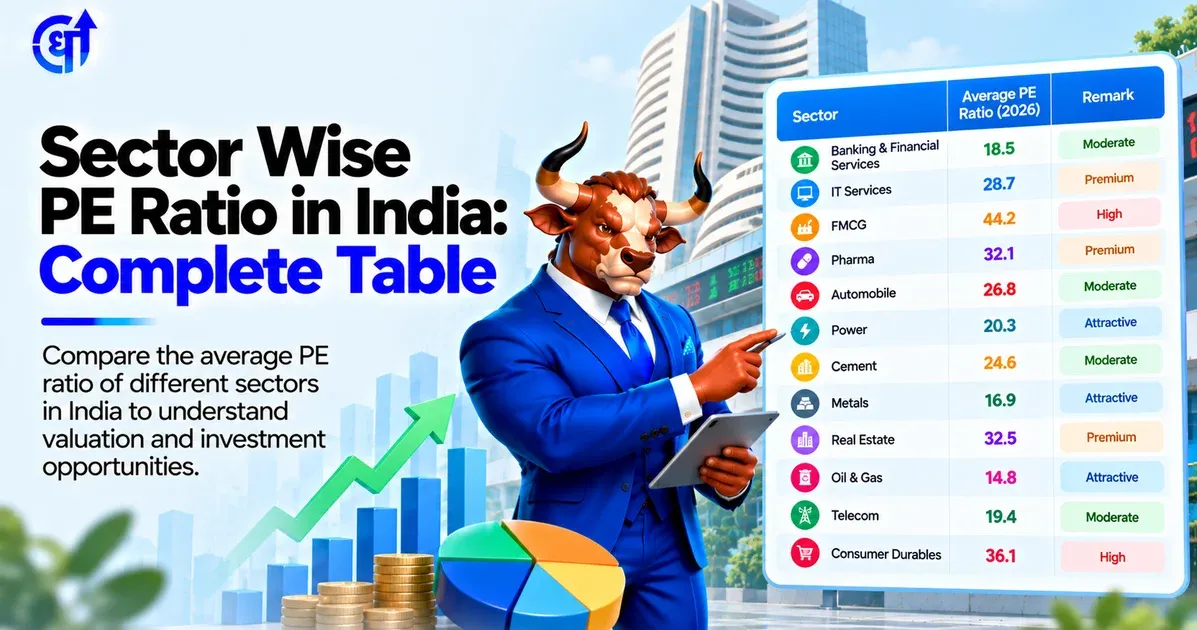



Sector Wise PE Ratio in India: Complete Table
October 15, 2026



TABLE OF CONTENTS
Get AI Summary






Best debt free stocks india include large IT and FMCG names such as Tata Consultancy Services, Infosys, Hindustan Unilever and Maruti Suzuki that report zero or near-zero debt to equity on their latest balance sheets. These companies generate strong cash flows, post ROE above 30 percent in several cases, and avoid interest costs that pressure profits during rate cycles. Investors use them for lower balance-sheet risk while still seeking growth from core operations. Data is drawn from NSE and BSE filings as of mid-October 2026.
Indian investors look for companies that fund growth from internal cash rather than borrowings. Debt free stocks india offer that profile. They sit across IT services, consumer staples, auto and select engineering firms. You can compare them with broader sector performance on the sectors page to see how zero-debt names perform against peers that carry leverage.
A debt free stock shows total borrowings of zero or a debt to equity ratio below 0.1 on the consolidated balance sheet. Companies report this figure in their annual reports filed with BSE and NSE. Many large IT firms keep only short-term working capital facilities that reverse each year, so screeners treat them as zero-debt.
Tata Consultancy Services reported a debt to equity ratio of 0.00 on its latest balance sheet (Source: Equitymaster Stock Screener, 13 October 2026). Infosys showed the same zero reading. These numbers come from company filings, not estimates. The ratio equals total debt divided by shareholders' equity. A figure of zero means the company has no interest-bearing borrowings outstanding at the reporting date.
Some companies show a small residual amount from lease liabilities under accounting standards. Screeners often round these to zero when they fall below 0.05. Always open the notes to the balance sheet to confirm the exact composition of borrowings.
Research Stocks Smarter with Dhanarthi AI Screener
Analyze 5,000+ NSE & BSE stocks with 150+ custom filters, real-time volume breakout scans, and transparent fundamental data.
Use Dhanarthi Screener
Zero debt removes interest expense from the profit and loss account. During periods of high interest rates, leveraged companies see margins compress. Debt free names keep operating cash free for dividends, buybacks or capacity expansion.
Hindustan Unilever has maintained near-zero long-term debt for years while generating consistent free cash flow. This allows the company to return capital to shareholders without refinancing risk. Investors who also track income stocks can review the best dividend paying stocks in India for overlap with high-yield debt free names.
When the RBI raises the repo rate, interest costs for a company with Rs 10,000 crore of debt can rise by several hundred crore rupees within a year. A debt free firm faces no such drag. Its net profit moves more closely with operating performance.
The following table lists selected large companies that screen as debt free or near debt free. Figures reflect prices and ratios around 13 October 2026.
| Company | Market Cap (Rs Cr) | Debt to Equity | ROE (%) | PE Ratio | Sector |
|---|---|---|---|---|---|
| Tata Consultancy Services | 8,21,053 | 0.00 | 49.0 | 15.9 | IT |
| Infosys | 4,31,030 | 0.00 | 31.9 | 13.8 | IT |
| Hindustan Unilever | 4,28,095 | 0.00 | ~28 | 28.6 | FMCG |
| Maruti Suzuki India | 3,55,995 | 0.00 | ~20 | 24.8 | Auto |
| Bharat Electronics | 2,74,263 | 0.00 | ~27 | 44.9 | Defence |
| Divi's Laboratories | 2,44,708 | 0.00 | ~25 | 83.7 | Pharma |
| Cummins India | 1,32,363 | 0.00 | ~30 | 63.7 | Engineering |
| Bosch | 1,30,782 | 0.00 | ~25 | 55.4 | Auto Ancillary |
Data sourced from Equitymaster and Ventura screeners using BSE/NSE filings. Last updated: October 2026.
Tata Consultancy Services leads the list with a market capitalisation above Rs 8 lakh crore and ROE near 49 percent. Its net cash position exceeds Rs 39,000 crore on recent balance sheets. The company funds all growth and dividend payouts from internal accruals.
Infosys follows with ROE of 31.9 percent and a PE of 13.8, lower than many peers. Free cash flow conversion stays above 100 percent of net profit in most years. Hindustan Unilever trades at a higher PE of 28.6 reflecting its stable consumer franchise and zero debt. The company has returned significant cash to shareholders through dividends while keeping borrowings at nil.
Maruti Suzuki India carries a PE near 25 and maintains zero long-term debt despite large capacity expansion plans. Bharat Electronics benefits from defence order visibility and reports debt to equity of zero. Divi's Laboratories operates with high margins and no borrowings, supporting its elevated PE of 83.7.
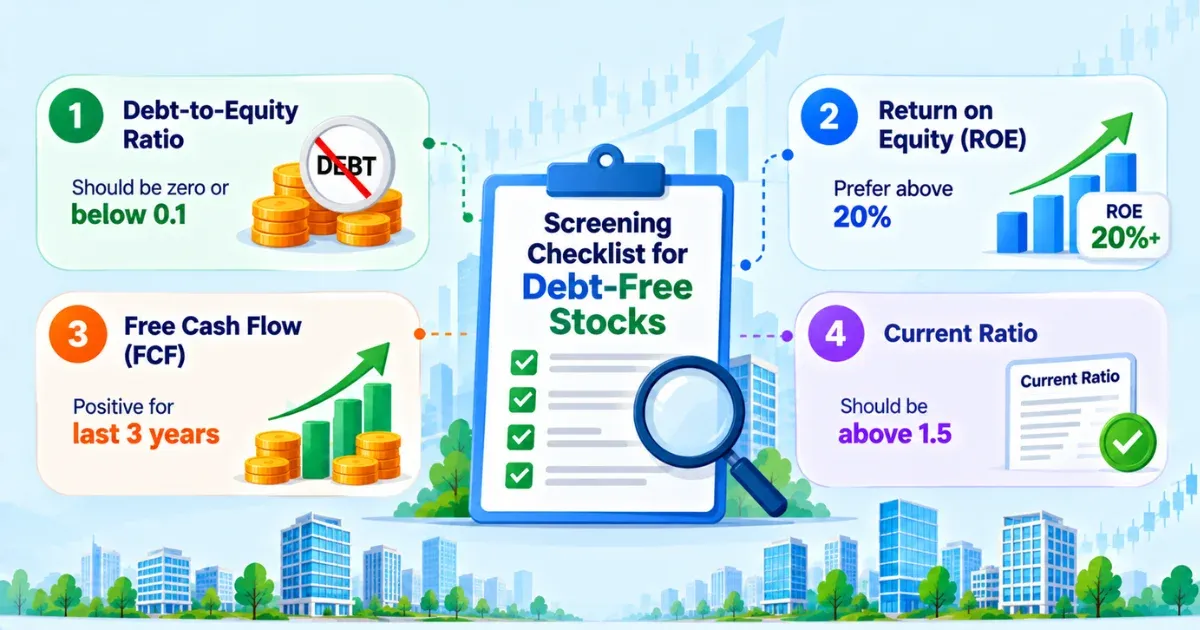
Start with debt to equity equal to zero or below 0.1. Add ROE above 20 percent and positive free cash flow for the last three years. Market capitalisation above Rs 10,000 crore reduces liquidity risk for most retail portfolios.
Screener.in and Equitymaster both offer ready filters for this. On Dhanarthi the stock screener lets you set debt to equity below 0.1 and sort by ROE. Cross-check the latest annual report on BSE for any off-balance-sheet guarantees or contingent liabilities that may not appear in the headline ratio.
Combine the debt filter with a current ratio above 1.5 to ensure short-term liquidity remains comfortable. Companies that pass both tests rarely need emergency funding during ordinary business cycles.
IT services companies dominate because their business model needs little fixed capital. Client contracts generate cash before large outlays. Employee costs form the main expense, and receivables turn over quickly. FMCG firms such as Hindustan Unilever and select pharma names like Divi's Laboratories also appear because brand and process know-how create high returns on modest assets.
Defence and engineering names such as Bharat Electronics and Cummins India enter the list when government orders provide visibility without heavy working-capital debt. Auto names like Maruti Suzuki keep debt low by funding capacity from retained earnings. These patterns hold across multiple years of filings on BSE.
Pharma contract manufacturers often stay debt free because clients pay advances or on milestone completion. This reduces the need for external capital even during capacity additions.
A clean balance sheet does not protect against demand slowdowns. IT companies can face client spending cuts that reduce revenue growth even when interest costs stay at zero. Valuation multiples expand when interest rates fall, so entry price still matters.
Promoter pledging, if any, or high related-party transactions can create risks that the debt ratio misses. Always read the notes to accounts in the annual report. Investors seeking lower valuations among quality names can also check the best undervalued stocks in India for names that combine low debt with reasonable PE.
Currency fluctuations affect exporters among debt free stocks. A sharp rupee appreciation can compress margins for IT services firms even though their balance sheets carry no debt. Commodity price spikes can raise input costs for auto and engineering companies.
Governance issues such as auditor qualifications or frequent related-party deals still appear in some zero-debt companies. The absence of bank debt does not remove the need to examine the annual report in full.
In 2022-23 when the RBI raised the repo rate, companies with high debt saw interest coverage ratios fall. Debt free IT and FMCG stocks held margins better. Historical data from BSE filings shows TCS and Infosys maintained ROE above 30 percent through that period while some leveraged mid-caps cut dividends.
This pattern repeats when global funding costs rise. Zero debt acts as a buffer, not a guarantee of returns. During the 2020 pandemic, many debt free names continued dividend payments because cash generation remained intact while leveraged firms sought moratoriums.
Share price volatility still occurs. TCS and Infosys both corrected more than 20 percent in certain calendar years despite zero debt. The balance sheet strength limited the downside relative to high-debt peers in the same sectors.
Allocate 20-30 percent of an equity portfolio to zero-debt large caps if the goal is capital preservation with growth. Pair them with select dividend payers from the same list. Rebalance annually after the March quarter results when fresh balance sheets appear.
Monitor free cash flow conversion. A company that reports high profit but low cash from operations may still face future funding needs even if current debt is zero. Aim for free cash flow at least equal to 70 percent of reported net profit over a three-year average.
Diversify across two or three sectors. Holding only IT names concentrates exposure to global technology spending. Adding one FMCG and one auto or defence name spreads the risk without sacrificing the zero-debt characteristic.
Investors sometimes buy any name that shows zero debt without checking return ratios. A company can report zero borrowings yet post ROE below 10 percent if its assets earn little. Such stocks rarely compound wealth over long periods.
Another error is ignoring valuation. A debt free stock trading at 80 times earnings may still deliver poor returns if growth slows. Compare the current PE with the company's own five-year average and with sector peers.
Relying only on headline screeners without opening the annual report is a third frequent mistake. Contingent liabilities or guarantees can convert into actual debt later. The notes section usually discloses these items.
Some investors accept debt to equity up to 0.3 as low debt. These companies still carry interest costs but retain flexibility. Pure zero debt names eliminate that cost entirely. The trade-off is that zero debt companies sometimes grow more slowly if they refuse all external capital.
In practice, the largest Indian IT firms sit at or very near zero. FMCG leaders follow the same pattern. Mid-cap names that recently repaid debt may show temporary zero readings before taking fresh loans for expansion.
Debt free companies that generate surplus cash often declare regular dividends. The tax on dividends is paid by the investor at slab rates. Buybacks, when announced, can offer a different tax outcome. Check the latest company announcements on BSE for any buyback or special dividend.
Capital gains on sale of these shares follow standard equity tax rules. Long-term gains above Rs 1.25 lakh attract 12.5 percent tax. Short-term gains attract 20 percent. The zero debt status does not change these rates.

Confused about chart patterns & stock analysis?
Use
Dhanarthi Stock Guru
to chat, analyze price patterns, and ask questions directly.
Debt free stocks india give investors lower financial risk and cleaner profit statements. Large names such as Tata Consultancy Services, Infosys, Hindustan Unilever and Maruti Suzuki lead the category with market caps above Rs 3 lakh crore and ROE that often exceeds 25 percent. Screen for zero debt, strong cash flows and reasonable valuation, then verify the latest BSE or NSE filing before buying.
This article is for educational purposes only. It does not constitute investment advice. Please consult a SEBI-registered financial advisor before making investment decisions.
1. Which are the top debt free stocks in India right now?
Tata Consultancy Services, Infosys, Hindustan Unilever and Maruti Suzuki top most screeners with zero or near-zero debt to equity and market caps above Rs 3 lakh crore as of October 2026. Bharat Electronics and Divi's Laboratories also appear regularly.
2. Do debt free stocks always give higher returns?
No. Zero debt removes interest cost but does not guarantee revenue growth. IT names can still lag if client budgets shrink. Check ROE and free cash flow along with the debt ratio.
3. How often should I check if a stock is still debt free?
Review the latest annual report and quarterly balance sheet on BSE. Debt levels can change after large acquisitions or expansion projects. Annual check after March results is usually enough for long-term holdings.
4. Are all IT stocks debt free?
Most large IT services companies such as TCS and Infosys show zero or very low debt. Product or hardware firms may carry more borrowings. Always verify the consolidated debt to equity figure.
5. Can small cap stocks be debt free and safe?
Some small caps report zero debt, but liquidity and governance risks remain higher. Prefer names with market cap above Rs 5,000 crore and positive free cash flow for three years if you add them.
Share Market
IPO
Artificial Intelligence
Semi Conductor